It’s been 20 years since Rabbi Deborah Schuldenfrei was ordained, and
during that time she has instructed nearly every kind of Jew, from children and seekers to adult scholars and elders. A year from now, she will become the senior rabbi of her first congregation, Kol Tikvah, Woodland Hills, succeeding the retiring Rabbi Jon Hanish.
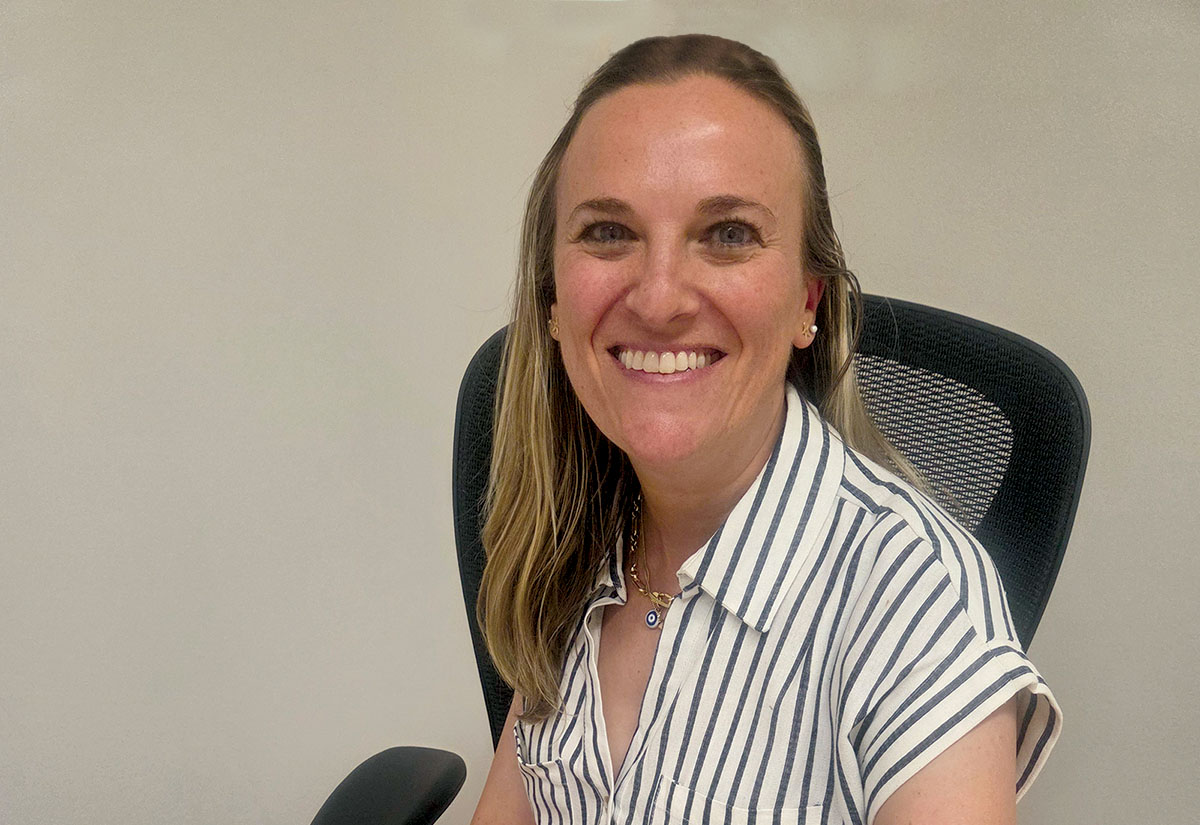
Personable, accessible and outgoing, Rabbi Schuldenfrei, sitting behind her Kol Tikvah desk, explained how she arrived here: “My parents modeled for me what it means to be part of a community.” That was just the first inspiration. Raised in a Conservative/Conservadox home in Milwaukee, she went to day school, to camp, and was very involved in BBYO (B’nai B’rith Youth Organization). “That was big,” she said. “I spent a lot of time in Israel, my summers there as a teenager.”
But none of this explained why this curious teenager was drawn to the rabbinate, where women were flatly barred until the 1970s. To start, she said “I had to be able to imagine what a rabbi looked like.” But there were no female mentors in the Midwest. And members of her congregation didn’t support it. “Women were not allowed to count in a minyan. That didn’t happen until after I was ordained [in 2006].”But importantly, her parents supported her ambitions.
In the summer of 2000, after graduating from Washington University in St. Louis, she came to Southern California to study at the Brandeis Collegiate Institute (BCI) in the Simi Valley. “At BCI, I met a woman who was a rabbi, Shawn Fields-Meyer, and I met a rabbinic student. Those experiences just expanded my capacity to understand what [the rabbinate]could look like. This experience led me in the direction of Jewish education and Jewish leadership.” BCI, she said “truly was trans-denominational and pluralistic… It has a special place in my heart.”
BCI was not going to be the last stop for the determined young woman; she wanted to attend graduate school for Jewish Educational Leadership. Surveying the landscape, it became clear to her that Hebrew Union College “had the strongest program for educational leadership. At the time, it was the only program that required a year in Israel for Jewish educators.” She was determined to be “an educational leader, not only a teacher.”
Schuldenfrei wanted a rounded education, something which she said was reinforced by her “very pluralistic” upbringing. “I didn’t know you couldn’t be pluralist,” she said. “I didn’t know why you would ever think of yourself as so segmented in your movement.”
Aliyah, of course, is on the minds of many Jews once in Israel. Schuldenfrei went in June of 2000. In October, there was the Second Intifada. “It was a formative time for me and for the Jewish people’s understanding and relationship with Israel,” said Rabbi Schuldenfrei. “I always considered Aliyah.”
This is not her first go-round with the Kol Tikvah community. Three years ago, before the High Holy Days, the congregation’s rabbi, Jon Hanish, suddenly became ill. “They hired me as the interim because it was six weeks before the High Holidays,” Rabbi Schuldenfrei said. “I jumped right in and spent six months. The good news is Jon got better.”
Looking back at the path that led her here, Rabbi Schuldenfrei said, “I have had very diverse Jewish educational and Jewish leadership positions in my career.” She has served as Head of School at a day school (Valley Beth Shalom), taught adult and children’s education, children, been part of nonprofits, was a founding education leader at IKAR when she still was a student and led the Graduate School at HUC preparing day school teachers for their work and their California credential.
“Those are all very different jobs. But at the core of it for me it’s the same, and I am passionate about all facets of it.” She took some years to raise a family, she said, “three incredible sons, 18, 16, 14.” All the while she raised them, she worked here and there. “Yes, it has been a singular path with facets, with roads to alternative rabbinic jobs.”
Which isn’t to say it was an easy ride. “When I was working in education,” she said, “people would say ‘When are you going to be a real rabbi?’ They would really say that.”
To some Jews, the only “real” rabbi is on the pulpit. “That is most peoples’ vision of a real rabbi,” she said, “even though rabbis serve in so many important and diverse roles in the Jewish community. I never have felt particularly tied to one or another. All of these roles have been enriching – both educationally and spiritually. I always have felt nourished and interested.”
Fast Takes with Rabbi Schuldenfrei
Jewish Journal:What is your favorite memory?
Rabbi Schuldenfrei: Family vacations to Florida in winter.
J.J.: Your favorite off-time activity?
R.S.: The beach.
J.J. Your favorite Shabbos moment?
R.S.: The aroma of the match after it’s struck lighting the candles.