There is an old debate taking place in America: Is Israel more of an asset or a liability to U.S. foreign policy? Sometimes, the voices of those who say “asset” prevail. Sometimes, it’s the voices of those who warn of a “liability.” The debate runs along a spectrum. No one thinks the U.S. cannot survive without Israel. Almost no one thinks Israel has not brought the U.S. any benefit. The history of both nations moves them along this axis, sometimes a little this way, sometimes a little that way and sometimes a bit more than a little – these are the moments of crisis, where suddenly the future of the relationship becomes uncertain.
In the 1950s, when Israel was still young and occasionally aggravating (the 1956 Sinai Campaign), the Americans preferred to keep their distance. In the 1960s, they realized that distance wasn’t serving them, and drew closer. By the 1970s, they already relied on Israel for important missions (Black September in Jordan). Then they shook it off (the “reassessment” of relations). Then they drew closer and pulled away again, as events dictated new policies and sometimes – though not always – depending on whether the sitting president at the time thought Israel was an asset or a liability.
There is an old debate taking place in Israel, too. It is slightly less public and a bit less explicit, but it is always in the background: just how much does Israel need the United States? It managed almost entirely without it during the crucial decade of the state’s founding. It needed it urgently during the Yom Kippur War. It accepted American leadership in signing the peace treaty with Egypt; it defied it during the First Lebanon War. Israel has grown accustomed to thinking of the U.S. as its great friend, and also its useful friend. The U.S. has a consistent policy on several issues Israel can rely on (Qualitative Military Edge). It has a consistent policy on several other issues that are a constant source of friction (the two-state solution).
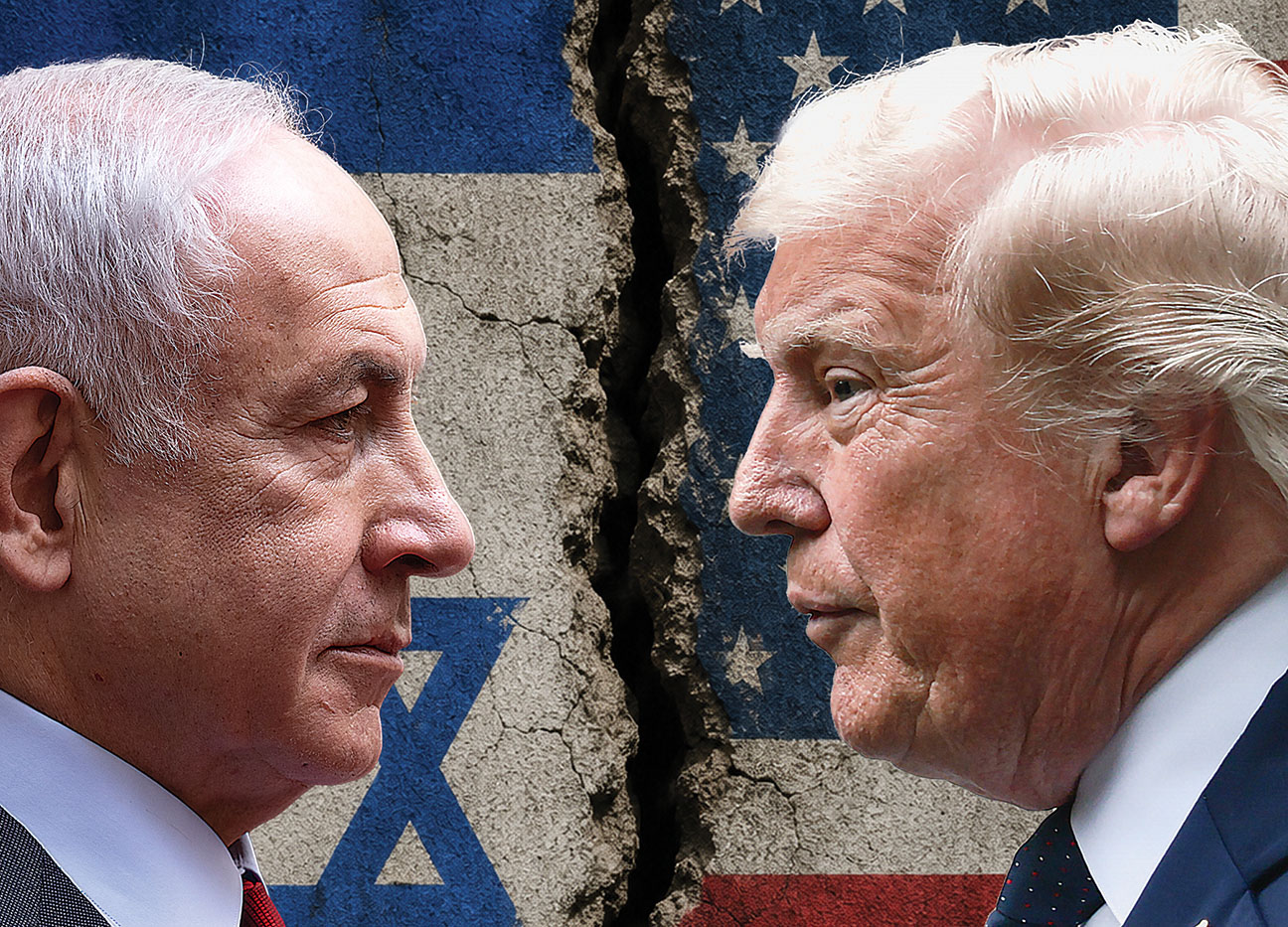
In recent months – and this week, as PM Netanyahu was slated to visit the White House (this article is written before the actual visit takes place) – we have been dealing with the first American debate, asking whether and to what extent the political elite and the broader public have lost interest in Israel as an ally. Israel’s image has eroded significantly in recent years, precisely when Israelis felt it should have been improving. Its ability to maneuver vis-à-vis Washington has been constrained in the era of President Trump, who does not take kindly to countries trying to outsmart him. Senior figures, like Vice President JD Vance, are making tough-to-swallow statements about Israeli influence operations that contradict American interests. Naturally, Israel must ask itself where this relationship is heading, whether and how what needs fixing can be fixed, or whether and how it should adapt to a cooling-off period between the two nations.
While shifting social and geopolitical tides play a role in the fraying U.S.-Israel alliance, Netanyahu’s specific approach to handling Washington has distinctly shaped the current crisis. To be fair to the prime minister, Netanyahu was not elected to befriend American presidents; he was elected to safeguard Israeli interests, and safeguarding those interests sometimes inevitably requires cunning. However, his management of the relationship often falls prey to what can be described as an illusion of symmetry – a profound misunderstanding among Israelis who assume the alliance operates on a level playing field.
When Israeli officials argue that Washington’s own history of wartime civilian casualties strips it of the moral high ground to dictate how the IDF operates, they are entirely right in principle, but entirely wrong in practice. America can still lecture Israel simply because it is the superpower. When Israelis begin to believe that their small country can reshape a whole region, change regimes and install new leaders, they forget an essential fact: the giant they see in the mirror is not Israel, it is the U.S., with Israel on its shoulder (or in its pocket). It is reasonable to wonder whether Israel is in trouble because Netanyahu started thinking about himself in Churchillian terms to the extent that he occasionally fails – just like Churchill – to remember his real place at the table of world leaders.
The point is that Netanyahu might be guilty of overplaying his hand in two seemingly contradicting ways: rebuffing attempts by the Biden administration and its Democratic supporters to moderate Israel’s conduct of war, or, for other reasons, rejecting their parallel attempts to reveal its plan for a day after in Gaza (it still doesn’t have one), and in becoming totally submissive to Trump – tying his country’s fate, as well as his personal fate, to the whims of an erratic leader whose ideas about what needs to be done on grave matters are often hard to decipher.
So, Netanyahu bears responsibility for the fact that Israel’s hands are currently tied on a variety of fronts, from Gaza (Israel just OK’d the plan to have foreign forces deployed in Gaza), to Lebanon (Israeli Lebanese talks are managed by Washington), to Iran (where Trump runs the show as a soloist). But to be honest, it is far from certain that Israel’s hands would be entirely free had the PM chosen differently. More than most other countries, Israel must manage a highly transactional American president who dictates foreign policy aggressively and leaves little room for opposition.
We mentioned the frequent debate about Israel’s value to the U.S., but we rarely engage in a second debate – about America’s necessity to Israel. At least implicitly, it seems Israelis have a changing opinion on this matter. Two recent polling questions reveal that just as Americans feel a bit less close to us, we feel the same toward them. Of course, one thing feeds another; opinion feeds opinion. But the result is worth noting: Israelis, at least psychologically speaking, trust America less than in the past, and value its judgment less than before.
You might ask: Why does this matter? After all, the U.S. is the superpower, and Israel is the mosquito. They call the shots, and we are dragged along. That’s not entirely true. The history of relations between the countries proves that Israel’s level of confidence in the American security umbrella carries great significance. In fact, if you read the very long piece in The New Yorker, where former senior officials from the Joe Biden administration tried to explain why they struggled to restrain Israel during the war in Gaza (it’s a bit annoying that this is what they wanted to do – but that is what they wanted to do), you will discover that some Americans understand this formula, as well. They understand that an Israel that trusts the Americans is a calmer Israel, and therefore less aggressive, less belligerent, less adversarial. When Israel does not trust the Americans, it becomes more suspicious, more aggressive, more dangerous. Henry Kissinger understood this when he supported airlifting aid to Israel during the Yom Kippur War so it wouldn’t resort to acts of desperation and bring the world to the brink of a global conflict. Bill Clinton understood it when he built a relationship of friendship and trust with Yitzhak Rabin, thereby allowing Israel to advance the Oslo Accords (which most Israelis today believe are bad agreements, but that is beside the point).
During the Biden administration, as we learn from recent reporting on its internal dynamics, two approaches competed. The first was held by those who believed in “tough love” – a style prevalent during the Barack Obama era, whose results were unimpressive. The second was held by those who believed in providing as much backing as possible – assuming this would allow the administration to gradually calm Israel down and bring the war to an end. Secretary of State Antony Blinken leaned toward the first position. Brett McGurk, a senior National Security Council official, leaned toward the second.
Today’s Israel, at least regarding its citizens – though it seems this is also the case among much of its leadership – has lost a great deal of trust in the U.S. This is, of course, a paradoxical situation, considering what has happened here in recent years. Seemingly, the friendliest administration ever, the friendliest president ever (as the prime minister has called Trump more than once), is in power. Israel and the U.S. fought a major war together in perfect coordination. And this coordination continues, even now, across various working levels. The Americans are fighting in Iran and do not pass up Israeli-made advice or intelligence. Is Israel an asset? Ask the squadron commanders heading out on bombing runs over the skies of Iran, and you will get an answer that doesn’t always align with the answers of the diplomats at Foggy Bottom.
So there is coordination, there is joint action, and for a while, there was a feeling of great rapprochement between the governments. Yet, on the other hand, there is disappointment, disillusionment and bitterness on both sides. The Americans are having second thoughts about how Israel is selling the Iran narrative. Israelis are having second thoughts about the great friendship of Trump and his team.
We asked (in a JPPI poll): To what extent do you think the U.S. is a true friend of Israel?
Only a quarter of Israelis (27%) said it is “a true friend more than in the past.” Half a year ago, they probably would have given a different answer. Another fifth say the U.S. is a friend “similarly to recent years,” meaning altogether, less than half believe there hasn’t been a turn for the worse in relations. Half of Israelis (50%), which is slightly more than half of those who expressed an opinion, believe there has been a downward turn. Either the U.S. is less friendly than before, or not friendly at all. Not a “true friend.”
It’s easy to rely on a true friend; it’s much harder to rely on someone who is becoming less of one. And it’s even harder to rely on someone whose judgment you don’t respect – and Israelis do not trust the judgment of the American superpower.
We asked (in a Channel 13 News poll): Which of these statements better represents what you think about the situation in Iran? Then we presented two options.
President Trump knows what he wants, and he will do what it takes to win the war.
President Trump is improvising and has no clear goals for the war or a plan on how to win.
Two out of three Israelis chose the second option. In other words, not only do a significant portion of them think the U.S. is no longer the true friend it once was, they also don’t think it’s a country with a serious leadership. In the face of the most dramatic action a state can initiate – war – they identify an American president who they believe is acting without clear goals, without a clear plan, improvising and perhaps even winging it (a word that didn’t explicitly appear in the question). And what is particularly interesting is that the answer is not colored by politics. This is not a “right” or “left” response; this is the response of the Israeli majority across almost all its factions.
There is a certain difference between the two questions we posed. American friendship is perceived as weaker the further you move from the right toward the left. In fact, among those who identify as being on the right, there is still a large majority who believe the U.S. is more of a friend than in the past, or the same as before. On the center-right, the split is almost 50/50. In the center and to the left, there is a majority who think the U.S. is less of a friend. Conversely, on the question of the war – whether or not Trump knows what he is doing in Iran – there is something much closer to a broad consensus. Even on the right, even among coalition supporters, a larger group believes that “President Trump is improvising and has no clear goals.” Only a third of coalition supporters think that “President Trump knows what he wants” and trust him to “do what it takes” to win the war.
What do we learn from all this?
Israeli public opinion is fickle: Israelis change their minds quickly. At the start of Operation Lion’s Roar, there was euphoria – including euphoria regarding relations with the U.S. It dissipated rapidly. It may well return just as rapidly. And yet, it seems Israelis have internalized the fact that Trump does not work for them, is not as committed to them as they thought, and that they are dealing with a president who changes his mind even faster than they (that is, than we) do. That could be an opening for upturn: If opinions change fast, there’s an opportunity in Israel’s coming election. If – and that’s no more than an if – Israel gets a new PM, someone like Gadi Eizenkot. If – and this seems to be the case – this someone doesn’t have grandiose dreams about himself being Churchill. If – and that’s for the future – our next PM speaks English with more accent and hence feels less at home on the American political playground. Maybe – if all these happens – Israel’s image as a less annoying partner could be restored in an expedite way.
A failure of deterrence: The U.S. failed to stabilize our sense of security during the Biden administration because it was not assertive enough. Its former senior officials complain that they weren’t assertive enough toward us, but the real problem is that they weren’t assertive enough toward our enemies. Biden said “Don’t,” and Israel’s enemies did not take him very seriously. Hezbollah fired. Iran fired. The American superpower assisted in our defense, but it did not deter the attackers. The U.S. has also failed to stabilize our sense of security during the Trump administration, despite it being an assertive administration. This is because assertiveness is not enough if there isn’t a good plan that leverages it for long-term achievements.
What does all this mean? That Israelis are still in that same suspicious, apprehensive, combative mood. We are a nation that feels a bit alone, and not under normal circumstances. We are a nation that needs to remind its friends why its friendship is beneficial to them as well, and to remind itself that friendship between nations always comes with a price and always has a limit.
Shmuel Rosner is senior political editor. For more analysis of Israeli and international politics, visit Rosner’s Domain at jewishjournal.com/rosnersdomain.