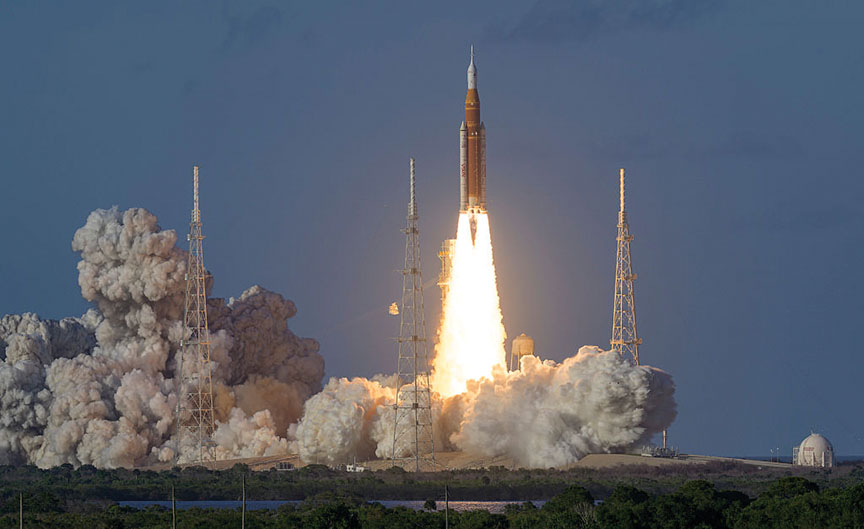
As the crew of Artemis II looped around the far side of the moon on April 6, the astronauts on board broke a human distance record set more than half a century ago.
The four astronauts aboard NASA’s Orion spacecraft — Reid Wiseman, Victor Glover, Christina Koch and Jeremy Hansen — traveled roughly 252,756 miles from Earth, surpassing the record set by the crew of Apollo 13 in April 1970.
At one point during the flyby, Orion passed within about 4,000 miles of the moon’s surface. As it moved behind the moon, the crew entered a planned 40-minute communications blackout before reestablishing contact.
“It is so great to hear Earth again,” Koch said after the signal returned.
The mission also produced an image seen by only a small number of people in history: Earth rising over the lunar horizon.
Jared Isaacman, a Jewish entrepreneur appointed by President Donald Trump to serve as NASA administrator, called the occasion “a milestone.” For the first time in more than half a century, he said, “humans are laying eyes on this side of the Moon again. Artemis II’s trajectory will also reveal parts of the Moon no human has ever seen before. This is how we push the frontier forward.”
At the mission’s furthest point, Isaacman pointed to the distance achieved by the crew. “Reid, Victor, Christina and Jeremy have traveled farther from Earth than any humans in history and now begin their journey home,” he said.
Isaacman is a billionaire entrepreneur, pilot and commercial astronaut who commanded the first all-civilian orbital mission in 2021 and later became the first private citizen to perform a spacewalk. Trump nominated him to lead NASA as part of an effort to expand partnerships with private space companies and accelerate human spaceflight.
Astronaut Jessica Meir, who participated in the first all-female spacewalk in 2019, shared an image on social media of the moon during the historic flyby. “Turns out my four NASA Artemis friends are somewhere in that frame, too,” Meir wrote on X. “As are the rest of you, as the blue glow of Earth’s atmosphere draws the Moon in.”
Jeffrey Hoffman, who in 1996 became the first Jewish astronaut to read from a Torah in space, talked about how confined it was when he first went to space — even on the Space Shuttle. “Those quarters, it’s funny, if they had to do that on the surface of the Earth, in gravity, it would be almost intolerable,” he said on TikTok. “But there’s something about when you’re in zero gravity and you’re floating around, somehow you don’t get claustrophobic in the way that you do normally in a similar volume on Earth.”
Between 1985 and 1996, Hoffman spent over 50 days in space, including 25 hours of extravehicular activity (EVA) outside of the orbiter. He flew on five space shuttle missions. The crew capsule, Integrity, has 60% more space for the crew than the last missions to the moon in 1972.
“So they’re going to be doing just fine,” Hoffmann said about the Artemis II astronauts. “Even back on Gemini, when two people spent 14 days in a tiny little Gemini capsule, they couldn’t have done it on the Earth, but in space, they said it was okay.”
Hoffman also compared the Artemis II flyby to Apollo 8. “Apollo 8 took place at the end of 1968, when there were tremendous disturbances in our country. There were riots in the street, and here we are now going around the moon again while the country is at war,” Hoffman said. When Apollo 8 orbited the moon in 1968, commander Frank Borman, Command Module pilot James A. Lovell Jr. and Lunar Module pilot William A. Anders became the first humans to go beyond low-earth orbit.
“Apollo 8 was often referred to as the one good thing that happened in 1968. And I wonder if maybe this Artemis mission, despite all the problems that our country is having and that we’re having in the world, this at least is something good that humanity is doing, and that we can look at with pleasure and say at least something is going right at the moment.”
As the crew approached the moon, they also heard from one of the last generation of astronauts to make the same journey. Lovell, who was also the commander of Apollo 13, died in August 2025 at age 97. Before he passed away though, he recorded a message that Mission Control transmitted to Artemis II during the flyby.
“Hello, Artemis 2, this is Apollo astronaut Jim Lovell. Welcome to my old neighborhood,” Lovell said in the recorded message. “When Frank Borman and Bill Anders and I orbited the moon on Apollo 8, we got humanity’s first up-close look at the moon, and got a view of the whole planet that inspired and united people around the world. I’m proud to pass that torch on to you as you swing around the moon and lay the groundwork for missions to Mars for the benefit of all. It’s a historic day, and I know how busy you’ll be, but don’t forget to enjoy the view. So, Reid, Victor and Christina and Jeremy, and all the great teams supporting you, good luck and Godspeed from all of us here on the good Earth.”
The first Jew in space was Boris Volynov, a Soviet cosmonaut, in 1969. The first Jewish astronaut in space was Judith Resnik, who flew aboard STS-41-D in 1984 on the first flight of Space Shuttle Discovery. She later died in the Space Shuttle Challenger disaster. The first Israeli astronaut was Ilan Ramon, who flew on STS-107. He died in the Space Shuttle Columbia disaster in 2003. Ramon had brought a Holocaust-era Torah and a drawing of the moon made by a teenager murdered in Auschwitz. Both were lost in the disaster.
By some measures, 16 Jews have been to space. Some do not count space tourists such as actor William Shatner, who flew aboard the Blue Origin capsule in 2021. Since the Blue Origin vehicle is autonomous, some do not count that as going to space even though it climbed over 100 km (62 miles) above earth. Though there is no identifiable boundary of where earth’s atmosphere ends and space begins, for the sake of determining who has been to space, scientists have accepted the Kármán Line, 100 km (62 miles) above earth as the boundary.
Reid Wiseman, the Artemis II commander, is not Jewish. But during the flyby, a tribute was made to his late wife. Jeremy Hansen proposed naming a lunar crater in honor of Wiseman’s late wife, Carroll, who died of cancer in 2020. “It’s a bright spot on the moon, and we would like to call that Carroll,” Hansen said.
The Orion spacecraft is now on its way back to Earth, with splashdown expected in the Pacific Ocean on April 10.