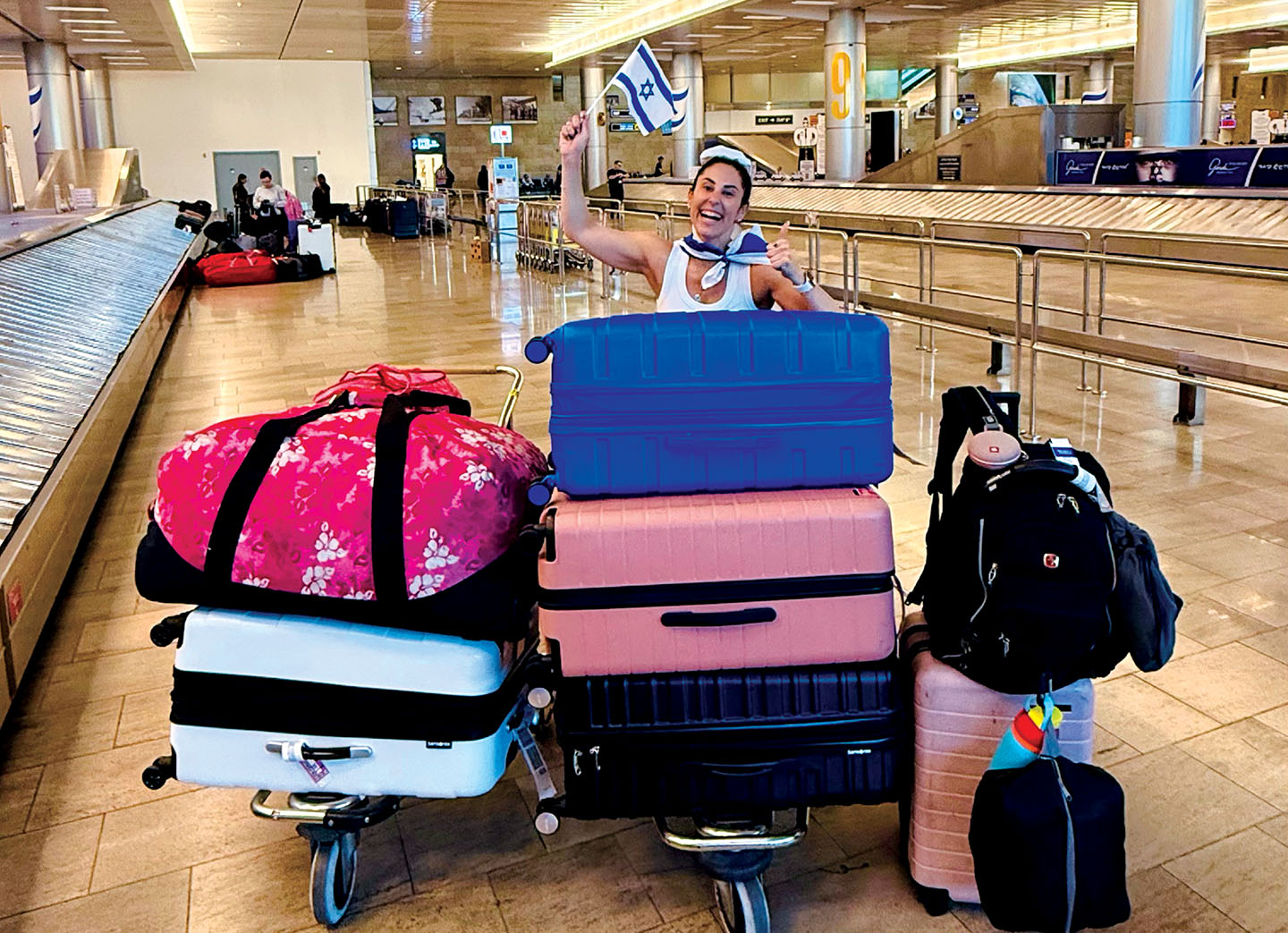
On June 12, Eve Karlin made Aliyah to Israel with the assistance of Nefesh B’Nefesh, in partnership with Israel’s Ministry of Aliyah and Integration, The Jewish Agency for Israel, Keren Kayemeth LeIsrael, and JNF-USA. Twelve hours later, at 3:30 a.m., she woke up to the sounds of loud sirens. The war with Iran had begun — only Karlin didn’t know it at the time. She jumped out of bed and ran outside, looking for someone to tell her where to go — maybe a neighbor — but there was no one out there.
“I didn’t have a mamad [reinforced security room] in my apartment,” she said, “and I knew that if there isn’t one, you’re supposed to go under the stairs. When the sirens stopped, I went back to my apartment.”
The following day, Karlin understood that she had arrived in Israel just in time for the war with Iran. Not the best time to make Aliyah, but she was already there, and she had no plans to leave. Besides, even if she did, there were no flights going in or out of Israel.
“Before I got to Israel, I was planning to give myself a break during the first week,” recalled Karlin. “I was like, I’ll go to the beach, see friends, and relax a little. Instead, I hardly slept during the first six days and I was running to the shelter and back to my room. But honestly, it empowered me. I always said Israelis come together, and they have this resilience and strength and spirit. To be there, in the middle of a war, and see it firsthand — it’s something I’ll always remember. It validated that these are the people I want to create my life with.”
While Karlin’s family and friends were watching the news and worrying about her safety, the new Ola — a term for someone who recently made Aliyah to Israel — was making new friends in bomb shelters. The experience was so special, she said she’ll never forget it. “The next day when there was an alert to be near a protected area, my neighbors knocked on my door and said, ‘We are going for Shabbat and you are coming with us,’” Karlin said.
Only when they got to Shabbat dinner, the sirens started again, and the group rushed into the mamad. “It was actually comforting, because there were so many people, maybe 12–15 of us. All were Olim who made Aliyah at some point. We went in a circle and said what we are grateful for. It was a really beautiful Shabbat.”
At the end of the evening, when it was safe to leave the bomb shelter, Karlin and her neighbors got in a taxi and headed back home. Sure enough, on the way there, the sirens started again, forcing them to run out of the taxi and into the nearest bomb shelter.
In Israel there are public bomb shelters in many neighborhoods and in most apartment buildings. In addition, apartments in Israel have been required by law to include a mamad since 1992. This requirement was introduced after the Gulf War in 1991, during which Iraq launched Scud missiles at Israel. At that time, many Israeli homes lacked adequate shelter, and residents had to improvise with sealed rooms or rely on shared bomb shelters. In response, Israel updated its building code to require that all new residential buildings — including private homes and apartment complexes — include a mamad.
“It was 1:30 a.m., and it was my first time in a real public bomb shelter. It was wild to see everyone there, kids, dogs, elderly, just a lot of people,” said Karlin. “For the next five days, every two hours, nonstop, I was running back and forth from my Airbnb to the bomb shelter.”
The Israelis she met during those days were shocked to learn that Karlin had decided to leave Los Angeles to live in Israel.
“They were very surprised by it, but at the same time they respected it a lot. All of the Israelis I’ve met have been so incredible toward me during this journey,” said Karlin. “They offered me their homes, food, rides. You name it. They have shown an incredible giving soul. They were beyond welcoming, like nothing I’ve experienced before.”
Karlin, a personal trainer, had moved to Los Angeles nine years ago from just outside Boston, Massachusetts. Since her first visit to Israel when she was 17, she had visited Israel seven times, mainly as a madricha — trip leader — with Birthright. The desire to live in Israel was always there, nagging at her for two decades since that first visit.
“Finally I stopped giving myself excuses, and decided to follow my heart and give it a try,” she said in a phone interview with The Journal. “I said to my mom and dad that I wouldn’t move here unless they give me their blessing, and they did. They have always supported me to fulfill my dreams. Their support made it a lot easier — it was a beautiful gift.”
When she told her friends she was moving to Israel, they weren’t surprised — she had been talking about wanting to live there nonstop.
It might be difficult for people to comprehend why someone would choose to make Aliyah during these times — especially to a country still reeling from Oct. 7, the deadliest attack on Israeli soil, and after the war with Iran, in which 28 people were killed, nearly all of them civilians. But Karlin is not alone. In fact, many have made Aliyah with her and after her, once Ben Gurion Airport reopened. They arrived from all around the world to make their home in Israel. Karlin met some of them in bomb shelters.
On a few occasions, when rockets fell near her Airbnb, she found herself in a shelter with a mix of new Olim and Israelis. “There was such a sense of resilience,” she said. “One guy played guitar, someone else brought pastries each time. We started talking and sharing our stories—it felt like a community.”
She recalled another moment when the sirens sounded while she was walking down the street. “Someone rushed me into the mamad in his home — it turned out to be his bathroom. It was incredible to see how people came together.”
For now, Karlin is studying Hebrew at an ulpan and continues to work remotely as a personal trainer for her clients in Los Angeles. She hopes to grow her career in Israel as well — but she has other aspirations, too.
“I really want to be a voice for Olim, to show what it’s like to make Aliyah,” she said. “I want to build a community of Olim Chadashim, [a term for new immigrants to Israel] where we feel physically and mentally healthy — and in return, I want to give back to Israel: helping soldiers, supporting hospitals, working with children, whatever the need may be. I’m 38 years old, and even though I had a good job, great salary and a nice apartment, I left everything behind. I want to show that it’s never too late to follow your dream.”
Follow Karlin and her journey on Instagram at @Eve_in_tlv.