fbpx

July 9, 2025

‘Fagin the Thief’ — A More Nuanced Portrait of Dickens’ Jewish Villain

Reading Charles Dickens is usually an unalloyed pleasure; there is probably not another writer in English as entertaining. But reading “Oliver Twist,” you’re forced to contend with Fagin, the leader of a band of young petty thieves, who Dickens repeatedly refers to as the “Jew.” (Three-hundred-twenty-six times, if you’re keeping count.) To make matters worse, in the illustrations George Cruikshank drew for the original edition, Fagin is a stereotypical Jew: prominent nose, hooded eyes, bearded and dressed in black; he would look right at home among the racist caricatures in Der Stürmer.

For Allison Epstein, author of the recently published “Fagin the Thief,” Fagin was the first Jewish character she encountered in fiction, in a production of the musical “Oliver!,” one of her grandmother’s favorite musicals. “There was something just electric and alive about that character in a way that I hadn’t seen and in a way that really fascinated me,” she said. She fell in love with the character, and when she was old enough, she decided to read the novel. She found the experience of “meeting Dickens’ Fagin is very different” than the musical. “There’s still something in there that I love and that’s important to me, but man, Dickens, you did him so dirty. And I’ve just kind of been mad about it ever since.”

The desire to set things right animates “Fagin the Thief.” Epstein’s Fagin, while by no means an admirable character, is a fuller, more nuanced — and more Jewish — portrayal. For one thing, she gave him a first name, Jacob, and a mother, Leah, who makes her living sewing and mending clothes. They live in a tenement apartment downstairs from the local rabbi, in Stepney, Victorian London’s Jewish ghetto, home to some 400 Jews who have, Epstein writes, “to all intents and purposes built their own country, half a mile square in which they need not be outsiders.” But to Fagin, Stepney is “a claustrophobic nightmare where everyone knows everything about everyone.”

He escapes, even if only a short walk away, where he is befriended by Leftwich, a dandyish pickpocket who takes him under his wing. Fagin is an adept thief, which becomes a source of pride; it’s better to be called a thief, he thinks, than to be called a Jew. Tiring of splitting his take, Fagin breaks up the partnership and goes into business for himself.

Fagin, who today would probably be accused of “grooming” children to be thieves, actually likes children. In the sections of the book that take place in the early 19th century, Fagin takes delight in children, and it ends up that he’s a very good teacher, even though he’s “a man who teaches children how to steal,” she said. But Fagin, Epstein writes, “adapts his approach without thinking about it, molding himself into the instructor each of them needs,”

Epstein tells the story on two timelines; each of the novel’s four sections begins in 1838, the year “Oliver Twist” was published. The reader first encounters Epstein’s Fagin as they do Dickens’: frying sausages over an open fire, the Artful Dodger introducing him to Oliver, newly arrived in London after escaping from the from the undertaker he was apprenticed to. The other timeline is Fagin’s bildungsroman, moving chronologically from 1793 until, at the start of part four, the two timelines meet.

The heart of that story is the relationship between Fagin and Bill Sikes. In “Oliver Twist,” Sikes, a “housebreaker,” no longer needs Fagin’s lessons, but still needs Fagin, as both a scratching post and a father figure.  A violent force of nature, (“just antagonism. There’s nothing beyond that,” was Epstein’s description) Sikes was the hardest character for Epstein get a handle on. She didn’t want to write a book about him, but it was necessary, she said, because “there had to be something that kept them together like that.” She wanted to figure out why they are “still working together after all this time.” When we meet them in “Oliver Twist,” she said, “they hate each other.”

And Fagin is used to being hated. So used to it, you get the sense he’s inured himself to it. When he’s bullied by a gang, Epstein writes that “he’s faced confrontations like this more often than he could count,” calling it “the natural consequence of being visibly Jewish.” And when Bill comes to help Fagin break out of jail, he tells Fagin, “I’m not going to the gallows for your Christ-killing hide,” a sentiment that Fagin thinks  is, oddly, “the most touching thing Bill Sikes has ever said to him.”

While Dickens often depicts Fagin in the most unflattering light — in a few scenes, he’s described in such vampiric terms that Epstein compared it to F.W. Murnau’s 1922 horror classic “Nosferatu” (making Fagin a Nosferat-Jew) — Epstein doesn’t think Dickens would have considered himself antisemitic. “It’s tough to put a modern definition of something like that on a person from the past.” Antisemitism was pervasive in Victorian England, “it was just the air he was swimming in at the time.”(In her research, Epstein discovered that when Lionel de Rothschild was elected to the House of Commons, whether an oath taken on the Old Testament was legally binding. She was excited to find it, since it “captured exactly the feeling that I wanted Fagin to have all the way through this book, which is the antisemitism that he’s facing is not like Eastern European state. It was just such a perfect example of that tolerance rather than acceptance.”)  And, she is quick to add, that to Dickens’ credit, he “did see his portrayal of Fagin as problematic, to use modern language … and learned from it.” In later editions of the book, Dickens removed almost every reference to “Jew,” an edit which frustrates Epstein, “because then you’re just, okay, now he’s not Jewish at all.” And in “Our Mutual Friend,” his last novel, the virtuous Jew, Mr. Riah,  was seen as Dickens apologizing for Fagin. Epstein doesn’t see it that way. In her author’s note she calls Riah a “harmless, dull, self-sacrificing pushover of a Jew.”

Epstein doesn’t follow “Oliver Twist” to the letter — for one thing, she has a more merciful fate for Fagin. In her research, she discovered that thieves in mid-19th century London did not hang; while Bill and Nancy’s deaths closely follow Dickens, she saved Bill’s dog, Bullseye, from the peremptory and unnecessary death he suffers in Dickens — she has a rule that “I will never kill an animal in one of my books. I don’t want to do it. It’s a cheap way to get an emotional reaction. It makes me mad every time.”

As for her human characters, she doesn’t expect “readers to come away thinking, oh, ‘Fagin is a hero, ‘or ‘I can fix Bill Sykes.’ That’s not what I’m going for. But I’d like them to finish the book and think, ‘okay, that’s how a human being might end up in a situation like that where that feels like the best path forward.’”

“I don’t expect readers to come away thinking, oh, ‘Fagin is a hero, ‘or ‘I can fix Bill Sykes.’ That’s not what I’m going for. But I’d like them to finish the book and think, ‘okay, that’s how a human being might end up in a situation like that where that feels like the best path forward.’”

Like Percival Everett’s “James,” which tells the story of Mark Twain’s “Huckleberry Finn,” from the perspective the slave, Jim, “Fagin The Thief” recenters the narrative around a marginalized character. “It feels exciting in a way to be able to tap into that and say, here’s a story that’s in the story you won’t know that has not shared before. And it feels a little bit daring to look at the classics and say, I actually think there’s another story in here that you didn’t think you’re getting in Dickens.”

‘Fagin the Thief’ — A More Nuanced Portrait of Dickens’ Jewish Villain Read More »
‘Bad Shabbos’: You’ll Laugh, You’ll Cringe, You’ll Hide the Body

A lawyer friend of mine who occasionally represents accused murderers once told me a secret of the trade: the first question a jury silently asks is, “Did the victim deserve it?” If you can convince them the deceased had it coming, you’re halfway to an acquittal. In the semi-dark comedy “Bad Shabbos,” director Daniel Robbins puts this theory to the test with an entire audience, and the verdict is unanimous: we’re all rooting for the co-conspirators to get away with it, scot-free.

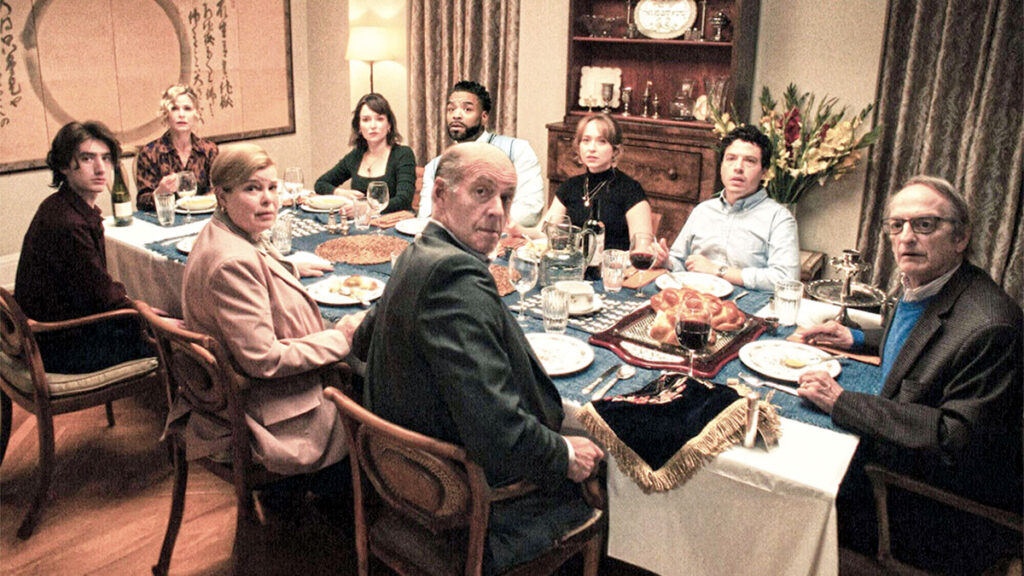
The film, built on a witty and well-paced script by Robbins and co-writer Zack Weiner, invites us to what is well set to be a disastrous Shabbat dinner. At the head of the table, or at least trying to be, are Ellen and Richard (played by the always versatile Kyra Sedgwick and David Paymer). Their son, David (a flustered Jon Bass), is about to marry the lovely Meg (Meghan Leathers). This should be a joyous occasion for a little l’chaim, but … Meg is converting to Judaism, a decision that has managed to unite her future mother-in-law and her own WASP-y parents in shared disapproval.

You sense the classic meet the parentstension simmering. It’s the kind of polite, teeth-grinding agony familiar to anyone who has endured a forced family gathering. But “Bad Shabbos” promptly cranks the heat to inferno level by adding a dead body to the mix right before the doorbell rings. Suddenly, the biggest problem isn’t the seating chart; it’s the corpse in the bathroom.

What follows is a chamber orchestra in suppressed panic. Sedgwick and Paymer may not entirely sell you on decades of marital bliss, but their individual performances are comedic gold. Sedgwick’s Ellen vibrates with the frenetic energy of a woman whose meticulously planned evening and future she has in mind for her son, has been torpedoed first by him wanting to marry someone not already traditionally Jewish but then more pressingly by an inconvenient death.

Sedgwick’s every micro-expression is a masterclass in barely suppressed hysteria. Paymer, a veteran of playing put-upon everymen, embodies the exasperated patriarch whose only wish was a quiet evening and some brisket. You can almost hear his soul sighing over 2000 years of Jewish suffering.

The entire ensemble demonstrates good comic timing, but the film truly ignites whenever Cliff Method ManSmith is on screen. As an unexpected entrant to this domestic catastrophe, he doesn’t just steal scenes — he commits grand larceny, as he pivots from bewildered outsider to the unlikely, take-charge fixer of the hellish situation. His reactions mirror our own disbelief as he attempts to manage a family spiraling into criminal chaos with the calm authority of a seasoned pro, surprising everyone, including himself.

The film aspires to be a Jewish “My Big Fat Greek Wedding” with a dark twist. It captures that same loving, yet claustrophobic, family dynamic but marinates it in gallows humor. Imagine the Portokalos family, but instead of arguing over Windex, they’re arguing over the best way to dispose of a corpse before the challah gets cold.

In a world that often feels too heavy, there’s something energizing about a film that lets us indulge our darker impulses while reminding us that even the worst of days can be survived, especially if you have a good sense of humor and an angel in the form of a doorman.

Those of us from New York appreciate exactly how indispensable a good doorman can be. “Bad Shabbos” is that rare accomplishment: a movie that leaves you in a significantly better mood than when you arrived, wondering just what you would have done.


Scott A. Shay is the author of  “In Good Faith:Questioning Religion and Atheism” (Post Hill Press, 2017) and of “Conspiracy U: A Case Study” (Wicked Son, 2021).  His essays have appeared in publications including The Wall Street Journal, Newsweek, Bloomberg, American Banker and The Jewish Journal.

‘Bad Shabbos’: You’ll Laugh, You’ll Cringe, You’ll Hide the Body Read More »

LA Federation to Award $500,000 in Security Grants

In response to increasing antisemitic threats and attacks, Jewish Federation Los Angeles (JFEDLA), in partnership with several groups, has announced $500,000 in security grants to be distributed to 52 Jewish nonprofits across Los Angeles. 

The grants, ranging from $7,500 to $10,000, are being awarded through a unique collaboration between JFEDLA, Jewish Community Foundation of Los Angeles and Jewish Federations of North America (JFNA), in partnership with the Tepper Foundation, a New Jersey-based philanthropic organization founded by Jewish hedge fund manager David Tepper.

The funds, according to JFEDLA, will provide for vital security personnel for organizations, institutions and groups primarily serving children. The grant recipients are 31 synagogues, 12 schools, four camps, five community centers and other nonprofits in Los Angeles.

“As we have seen time and again recently — from Boulder, Colorado to the streets of our nation’s capital to right here in Los Angeles — Jews in America are under attack. The situation is dire and urgent, and we must do everything in our power to keep our community safe,” JFEDLA CEO Rabbi Noah Farkas said in a June 30 statement. “We are grateful to The Tepper Foundation, the Jewish Community Foundation of Los Angeles, and everyone involved who helped make this vital grant and partnership happen.”

The announcement marks the second time in the past year that these groups — JFEDLA, Jewish Community Foundation of Los Angeles and JFNA in partnership with the Tepper Foundation — have awarded security grants in collaboration with each other. Combined with last year’s grants to 55 Jewish nonprofits, their relationship has yielded nearly $2 million through more than 100 grants to help better protect the Los Angeles Jewish community. 

Protecting the community has long been a JFEDLA priority. Its Community Security Initiative (CSI), launched in 2012, helps the LA Jewish community more effectively stay in dialogue with local, state and federal emergency services, while serving as a single point of contact for critical incident coordination, information sharing, safety and security training.

And with the Jewish Community Foundation of Los Angeles’ expertise in strategic grantmaking, a partnership focused on community security grants was a natural one, according to Jewish Community Foundation of Los Angeles President Rabbi Aaron Lerner.

“Los Angeles has a diverse and active Jewish community. These security grants, based on the Jewish value of pikuach nefesh [saving a life], aim to ensure that we can continue our activities safely,” Lerner said. “Our collaboration with JFEDLA enables us to quickly distribute these security grants, addressing safety concerns for Jewish Angelenos who want to congregate, pray, study, celebrate and express their values peacefully.”

Among the recipients of the just-announced grants are Beth Jacob Congregation in Beverly Hills, IKAR, Sephardic Temple, Sinai Temple, de Toledo High School, Shalhevet High School, Valley Torah High School, Camp Ramah in California, Habonim Dror Camp Gilboa and Jewish Big Brothers Big Sisters of Los Angeles. 

A full list of grant recipients is available at jewishla.org/2025-security-grants-for-the-jewish-community/

LA Federation to Award $500,000 in Security Grants Read More »

Mother, Daughter and OC Synagogue Lead ‘Mitzvah Missions’ to Cuba

Roe Gruber and her adult daughter, Daniella, congregants of Congregation B’nai Israel, a Conservative community in Tustin, CA, run a boutique travel agency, Escapes Unlimited, which specializes in exotic, hard-to-reach destinations, from Bhutan to Belize, Nicaragua to Namibia. But the two have a longstanding connection with Cuba, including a period in the early 2000s when they lived there.

Recently, with the support of their synagogue, they started hosting “Mitzvah Missions” to Cuba. Their most recent mission to Cuba, taking place in February, delivered more than $15,000 worth of food, medicine and medical equipment to the small and struggling Jewish community there. It was enough to pay for food to last four to five months, they said in a recent phone interview.

“Plans are underway to make this an ongoing program,” Congregation B’nai Israel Rabbi Adam Greenwald told The Journal.

Participants of the eight-day trip to Cuba, which took place late February to early March, included the synagogue’s Rabbi Emeritus Eli Spitz, and Spitz’s wife. In total, 23 people participated in the trip, escorted by Daniella Gruber. 

About two years ago, a separate fundraising effort raised approximately $13,000 for the Jews living in Cuba.

The cost of the trip per person is approximately $4,000, which includes airfare from Miami to Cuba as well as double occupancy at the hotels in Cuba. Trip admission includes a $500 tax-deductible donation to Jewish Cuba Connection, which buys food packages for Jewish families and seniors in need in Cuba.

“It’s a lot easier to raise the money for food by doing the trips and just charging people $500 that goes to a nonprofit, because they can write it off on their taxes, and it’s how Jewish Cuba Connection gets money to buy food, so everybody wins,” Roe Gruber said. “And that’s what we’ve been trying to do.”

Currently, the need for assistance in Cuba is great. According to Roe, there’s a lack of food on supermarket shelves, and food prices are too high for anyone in Cuba to afford much anyway. Pharmacies lack basic medicines, and the shortage of fuel means the only cars on the road are tourist vehicles. 

“You can buy food if you have relatives in the U.S. sending you money, but the items that are available are based on U.S. prices, which obviously the Cuban people cannot afford,” Roe said. “Something that would cost us $5 would be impossible for them to purchase. So, it’s very important; the food shipments are what is keeping them going.”

Stan Falkenstein, founder of Jewish Cuba Connection, a Los Angeles-based nonprofit that has supported the Jewish community in Cuba for years, has made several trips to Cuba, including on Roe Gruber’s first mission there in 2000. In a phone interview, he said that Cuba’s current leadership is largely focused on enriching itself, much at the expense of basic quality-of-life needs of the Cuban population.

“The country under the Castros was not an easy place. It was Communist, but there was some concern about having a minimal social safety net,” Falkenstein said, referring to Fidel and Raul Castro. “The current leadership is about whatever they can put in their pockets.”

Roe echoed this assessment.

“You have to look at the history,” she said. “Fidel, as bad he supposedly was, he did provide free education, medicine and housing — things that have deteriorated since then, since he’s no longer in power. His brother is not in power. The Cuban people told us that the guy who is running the show [current Cuban President Miguel Diaz-Canel] is more interested in getting tourist dollars than taking care of his people.”

Cuba continues to be a Communist country, and the Trump administration recently clamped down on U.S. travel there. Trump’s order, however, makes exceptions for certain kinds of visits; because these “Mitzvah Missions” are classified as “religious activities,” they are permitted.

Currently, there are an estimated 600-800 Jews living in Cuba, most of whom are based in Havana, though there are small Jewish communities in Cuban cities Santa Clara and Cienfuegos.

The Jewish population used to be larger—before the Cuban Revolution, an estimated 15,000 Jews lived in Cuba—but a significant number of young people have made aliyah to Israel or left for the States in search of better opportunities. 

Additionally, past prohibitions against practicing religion led to a very high intermarriage rate, Falkenstein said. The remaining Cuban Jewish population is predominately elderly.

Still, signs of Jewish life in Cuba remain. There are three synagogues in Havana, including a Sephardic synagogue known as Centro Sefaradi that functions as a senior center. Beth Shalom in Havana, affiliated with the Conservative movement, operates like a Jewish community center. It hosts folk dances and offers Friday night services. And Adath Israel, a tiny Orthodox congregation, is home to the island-country’s only mikvah and holds daily services.

Havana is home to several synagogues, including this one pictured here. Courtesy of Roe Gruber

The Orthodox synagogue, said Falkenstein, a retired CPA, operates with the support of the Panamanian Jewish community. It’s home to a small pharmacy offering basic medications to those in need, both Jewish and non-Jewish. 

Raising money for food shipments is essential to the “Mitzvah Missions.”The work is facilitated through Miami-based third parties that specialize in food shipments to the island. Additionally, participants of the Grubers’ trips bring along medicine, including insulin, antibiotics and aspirin, as well as medical supplies, such as centrifuges, that are needed by the Jewish and non-Jewish residents of Cuba.

On the trip in February, the group came across a Cuban doctor who had recently had hip replacement surgery and was recovering without any painkillers. 

“I just took whatever Tylenol I had with me and said, ‘Here, please give this to this doctor,’ because, you know, to be working with no painkillers right after a hip replacement surgery, that’s intense,” Daniella Gruber said.

Already, the missions have proven to be a place where people who knew each other in their past lives have reconnected. When Daniella, a former student at the Orange County Jewish day school Tarbut v’Torah, led the latest trip, she was surprised that one of the participants was a former teacher of hers at the day school. 

Lunch at Havana’s Sephardic center. Courtesy of Roe Gruber

“It was funny because he hadn’t seen Daniella for 20-plus years, so he was pretty excited that she was going to be handling the group and was one of his former students,” Roe said. “He’s gotten so excited about working on this and helping with this.”

Ultimately, the Grubers are hoping more people show interest in participating in future missions, whether coming along in person or providing donations for food shipments. 

“We want to do these missions again because the need is so great,” Roe said, “and I think that people feel really good about helping this way.”

Upcoming missions to Cuba are scheduled for Dec 4-12, 2025, Jan. 22-29, 2026, and Feb. 19-26, 2026.  Anyone interested in joining a future ‘Mitzvah Mission’ or donating to support food shipments, contact Roe Gruber at (714) 508-0170 or (800) 243-7227.

Mother, Daughter and OC Synagogue Lead ‘Mitzvah Missions’ to Cuba Read More »

From LA to Israel Under Fire: Why One Woman Still Chose to Make Aliyah

On June 12, Eve Karlin made Aliyah to Israel with the assistance of Nefesh B’Nefesh, in partnership with Israel’s Ministry of Aliyah and Integration, The Jewish Agency for Israel, Keren Kayemeth LeIsrael, and JNF-USA. Twelve hours later, at 3:30 a.m., she woke up to the sounds of loud sirens. The war with Iran had begun — only Karlin didn’t know it at the time. She jumped out of bed and ran outside, looking for someone to tell her where to go — maybe a neighbor — but there was no one out there. 

“I didn’t have a mamad [reinforced security room] in my apartment,” she said, “and I knew that if there isn’t one, you’re supposed to go under the stairs. When the sirens stopped, I went back to my apartment.”

The following day, Karlin understood that she had arrived in Israel just in time for the war with Iran. Not the best time to make Aliyah, but she was already there, and she had no plans to leave. Besides, even if she did, there were no flights going in or out of Israel.

 “Before I got to Israel, I was planning to give myself a break during the first week,” recalled Karlin. “I was like, I’ll go to the beach, see friends, and relax a little. Instead, I hardly slept during the first six days and I was running to the shelter and back to my room. But honestly, it empowered me. I always said Israelis come together, and they have this resilience and strength and spirit. To be there, in the middle of a war, and see it firsthand — it’s something I’ll always remember. It validated that these are the people I want to create my life with.”

While Karlin’s family and friends were watching the news and worrying about her safety, the new Ola — a term for someone who recently made Aliyah to Israel — was making new friends in bomb shelters. The experience was so special, she said she’ll never forget it. “The next day when there was an alert to be near a protected area, my neighbors knocked on my door and said, ‘We are going for Shabbat and you are coming with us,’” Karlin said.

Only when they got to Shabbat dinner, the sirens started again, and the group rushed into the mamad. “It was actually comforting, because there were so many people, maybe 12–15 of us. All were Olim who made Aliyah at some point. We went in a circle and said what we are grateful for. It was a really beautiful Shabbat.”

At the end of the evening, when it was safe to leave the bomb shelter, Karlin and her neighbors got in a taxi and headed back home. Sure enough, on the way there, the sirens started again, forcing them to run out of the taxi and into the nearest bomb shelter.

In Israel there are public bomb shelters in many neighborhoods and in most apartment buildings. In addition, apartments in Israel have been required by law to include a mamad since 1992. This requirement was introduced after the Gulf War in 1991, during which Iraq launched Scud missiles at Israel. At that time, many Israeli homes lacked adequate shelter, and residents had to improvise with sealed rooms or rely on shared bomb shelters. In response, Israel updated its building code to require that all new residential buildings — including private homes and apartment complexes — include a mamad.

“It was 1:30 a.m., and it was my first time in a real public bomb shelter. It was wild to see everyone there, kids, dogs, elderly, just a lot of people,” said Karlin. “For the next five days, every two hours, nonstop, I was running back and forth from my Airbnb to the bomb shelter.”

The Israelis she met during those days were shocked to learn that Karlin had decided to leave Los Angeles to live in Israel. 

“They were very surprised by it, but at the same time they respected it a lot. All of the Israelis I’ve met have been so incredible toward me during this journey,” said Karlin. “They offered me their homes, food, rides. You name it. They have shown an incredible giving soul. They were beyond welcoming, like nothing I’ve experienced before.”

Karlin, a personal trainer, had moved to Los Angeles nine years ago from just outside Boston, Massachusetts. Since her first visit to Israel when she was 17, she had visited Israel seven times, mainly as a madricha — trip leader — with Birthright. The desire to live in Israel was always there, nagging at her for two decades since that first visit.

“Finally I stopped giving myself excuses, and decided to follow my heart and give it a try,” she said in a phone interview with The Journal. “I said to my mom and dad that I wouldn’t move here unless they give me their blessing, and they did. They have always supported me to fulfill my dreams. Their support made it a lot easier — it was a beautiful gift.” 

When she told her friends she was moving to Israel, they weren’t surprised — she had been talking about wanting to live there nonstop.

It might be difficult for people to comprehend why someone would choose to make Aliyah during these times — especially to a country still reeling from Oct. 7, the deadliest attack on Israeli soil, and after the war with Iran, in which 28 people were killed, nearly all of them civilians. But Karlin is not alone. In fact, many have made Aliyah with her and after her, once Ben Gurion Airport reopened. They arrived from all around the world to make their home in Israel. Karlin met some of them in bomb shelters.

On a few occasions, when rockets fell near her Airbnb, she found herself in a shelter with a mix of new Olim and Israelis. “There was such a sense of resilience,” she said. “One guy played guitar, someone else brought pastries each time. We started talking and sharing our stories—it felt like a community.”

She recalled another moment when the sirens sounded while she was walking down the street. “Someone rushed me into the mamad in his home — it turned out to be his bathroom. It was incredible to see how people came together.”

For now, Karlin is studying Hebrew at an ulpan and continues to work remotely as a personal trainer for her clients in Los Angeles. She hopes to grow her career in Israel as well — but she has other aspirations, too.

“I really want to be a voice for Olim, to show what it’s like to make Aliyah,” she said. “I want to build a community of Olim Chadashim, [a term for new immigrants to Israel] where we feel physically and mentally healthy — and in return, I want to give back to Israel: helping soldiers, supporting hospitals, working with children, whatever the need may be. I’m 38 years old, and even though I had a good job, great salary and a nice apartment, I left everything behind. I want to show that it’s never too late to follow your dream.” 

Follow Karlin and her journey on Instagram at @Eve_in_tlv.

From LA to Israel Under Fire: Why One Woman Still Chose to Make Aliyah Read More »

A Snapshot of Love and Herby Fish Brochettes

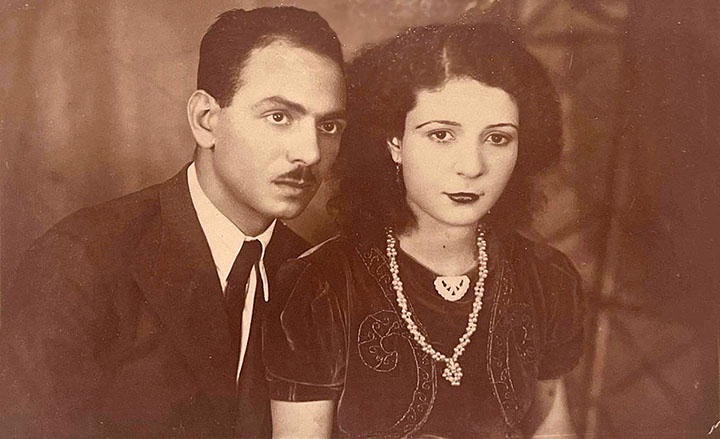
The sepia engagement portrait of my beloved Nana Aziza and Aba Naji is legendary. He sits leaning in to her, looking off into the distance, dashingly handsome in his well-tailored suit and tie. She gazes into the camera, looking like a silent movie star with her soft curls, dark eyes and bow lips. 

This treasured photo captures the beginning of their union and represents our family origin story. It is also a bittersweet reminder of the life that once was. My young grandparents belonged to a Babylonian Jewish community that had thrived for 2,600 years, since the first Exile from the land of Israel. Only eight years after that photo was taken, they, my mother and her four younger brothers were living in the harsh conditions of the ma’abarah, one of the hastily erected tent cities in Israel. 

Two months before my Nana Aziza passed away, I asked her if she remembered when the photo was taken. In telling me the story, she seemed to relive the happiness of that day. They had traveled to Basra from Al-Azair, where for centuries her family had been the keepers of the shrine of Ezra the Scribe. The photographer was a dear friend of my grandfather and the photo was shot in his studio. (I always imagined that her dress was burgundy, but she told me that it was navy. Her beautiful jewels were confiscated by the Iraqi government when they made Aliyah in May 1951.) 

The Shatt Al Arab River, which is formed by the confluence of the Tigris and Euphrates Rivers, flows through the city of Basra. The river was a source of many prized varieties of freshwater fish and Arab fishermen ensured that the many street vendors and restaurants had a steady supply of fresh fish. My grandmother told me that after the photo session, they and a small group of friends feasted on freshly grilled fish kebabs. 

As a little girl growing up in Sydney, Australia, I loved all the food that my grandmother cooked. Except fish. And my grandmother loved to cook fish — grilled, fried or stewed in a sweet and sour tomato broth. 

For me, the only fish that was acceptable was the fish and chips sold at the corner shop — deep fried, crispy, beer-battered cod, served with hot chips, malt vinegar and tartar sauce, all wrapped up in butcher paper. Of course, with age my tastes matured and I learned to love fish. I still love cod for its mild, delicate flavor and its moist, flaky texture.

These roasted cod brochettes with crispy roasted potatoes and purple cabbage slaw were the perfect summer meal.

Nana Aziza would approve. 

—Sharon

This week, Sharon and I dreamed up this delicious recipe for cod skewers in an herby green sauce. The first step is to salt the fish and let it sit for a bit, then pat it dry. Then we made a marinade with olive oil, sweet paprika, chili oil, minced garlic and finely chopped dill and we let the fish absorb the flavors before threading it onto skewers. We popped it in the oven at a high heat and cooked it to golden perfection. 

Then we made my favorite green sauce. There’s something about the combination of garlic, fresh herbs, and lemon that instantly transports me to summer and the blue shores of the Mediterranean. This sauce is so simple and so flavorful. Fresh cilantro and dill give it a bright, almost grassy freshness. Minced garlic adds depth. Good quality extra virgin olive oil brings everything together. A squeeze of lemon lifts it all, making it the perfect companion for grilled fish — or really, anything off the grill.

There’s something about the combination of garlic, fresh herbs, and lemon that instantly transports me to summer and the blue shores of the Mediterranean. This sauce is so simple and so flavorful.

Pairing the tender fish brochettes with the vibrant herb sauce and crispy potatoes reminded us of eating by the sea with the scent of saltwater in the air. Blue skies, blue water, and that magical summer feeling of being far from everything, with nothing on the agenda but to eat and enjoy.

—Rachel

Cod Brochettes

2 lb fresh cod, cut to 3 cubes

Kosher salt

Marinade

1/4 cup olive oil 

2 tsp chili oil or 1/4 tsp red pepper flakes 

3 garlic cloves, minced 

1 tsp sweet paprika 

Salt and black pepper, to taste

1/2 cup finely chopped fresh dill  

Preheat oven to 400°F.

Place fish on a plate and lightly sprinkle with salt. 

Prepare marinade by combining the olive oil, chili oil, garlic, paprika, salt and pepper. Then add the dill. 

Use paper towels to pat the fish dry, then place the fish in the marinade. Allow to sit for 15 minutes. 

Thread marinated fish onto skewers and place on a parchment lined baking tray. 

Roast in the oven for about 15 minutes, until golden. 

Green Herb Sauce 

1 bunch fresh cilantro,

1/2 bunch fresh dill

2 garlic cloves

1/3 cup extra virgin olive oil

1 lemon, juiced 

Salt and freshly ground black pepper
to taste

1 tsp dried oregano, optional 

Use a food processor to gently pulse the cilantro, dill, and garlic.

Drizzle in olive oil and lemon juice. Season generously with salt and pepper.

Allow the sauce to sit for 15 minutes to let the flavors meld.

Serve alongside fish, chicken or vegetables.


Sharon Gomperts and Rachel Emquies Sheff have been friends since high school. The Sephardic Spice Girls project has grown from their collaboration on events for the Sephardic Educational Center in Jerusalem. Follow them
on Instagram @sephardicspicegirls and on Facebook at Sephardic Spice SEC Food. Website sephardicspicegirls.com/full-recipes.

A Snapshot of Love and Herby Fish Brochettes Read More »

National Ice Cream Month: Delicious Decadence, Along with Some Healthy Recipes

There are plenty of food holidays throughout the year. July —  National Ice Cream Month — has to be up there as one of the favorites! While you don’t need a reason to try some new cool, sweet ice cream — or ice-cream adjacent — recipes, it’s certainly fun to have one.

“Two ice cream brands, known for their combinations of textures and flavors, Häagen-Dazs and Ben & Jerry’s, were started by Jews,” Pam Stein, of In Pam’s Kitchen, told The Journal. 

It is in the spirit of those two brands that Stein shared two of her favorite ice cream recipes; both are bursting with unique — and delicious — texture and flavor combinations. “Sweet corn ice cream with caramel is an unexpected, but not strange, flavor pairing, which relies on the natural earthy sugariness of corn blended into rich cream,” she said. “The buttery notes of the [swirled in] caramel enhance the flavor, creating a layered sweetness.” 

Sweet Corn Caramel Ice Cream

1 1/2 cups sweet corn kernels (If using frozen, thaw before using)  

2 cups heavy whipping cream, divided

1/4 tsp salt

1/4 tsp ground cinnamon

1 14-oz can sweetened condensed milk

1/4 cup caramel sauce (homemade or store bought)

Place corn kernels in a single layer on a paper towel to absorb any excess moisture. Let stand for 30 minutes. 

Add corn kernels and 1/2 cup of whipping cream to a blender and puree.

In a medium saucepan, add the remaining whipping cream and corn puree. Warm over medium heat until bubbles begin to form around the edges of the mixture.

Return to the blender and process until smooth.

Pour the mixture back into the pan and cover. Let rest at room temperature for 1 hour. 

With a fine wire mesh strainer, strain the corn mixture into a medium bowl or glass measuring cup, pushing it through with a rubber spatula or spoon. Discard any remaining solids in the strainer.

Add the salt, cinnamon and sweetened condensed milk. Whisk to combine. Cover and refrigerate the mixture for 2-3 hours.

Pour mixture into an ice cream maker and process according to the manufacturer’s directions until thickened, approximately 45-50 minutes.

Remove the work bowl from the machine and transfer 1/2 the ice cream to an airtight container or metal loaf pan. Drizzle 2 tablespoons of caramel sauce over the ice cream. Spread remaining ice cream over the caramel and top with the remaining caramel sauce. 

For a soft creamy texture, enjoy immediately. For a firmer texture, cover and freeze for 1-2 hours. 

Store in the freezer for up to one week.


Blueberry Gingersnap Ice Cream
(Courtesy Pam Stein)

Stein’s blueberry ice cream with crushed ginger snap cookies offers the perfect bite of taste and texture. “It deliciously balances the berry flavor with warm spice, while the creamy ice cream texture of the blueberry ice cream contrasts with the gingersnap crumbs for a crunch,” she said. “It’s like blueberry pie with a spiced cookie crust.”

Blueberry Ginger Snap Ice Cream

2 cups heavy whipping cream

1 cup whole milk

3/4 cup sugar

1 tsp vanilla

1/4 tsp salt

1 1/2 cups frozen blueberries, not thawed

1/2 cup chopped ginger snap cookies, divided

Add heavy whipping cream, milk, sugar, vanilla, salt and frozen blueberries to a high powered blender. Process until smooth. 

Pour the blueberry mixture through a strainer, removing any unprocessed blueberry pieces. Cover and refrigerate for 2-3 hours. 

Pour into an ice cream maker, fitted with an ice cream paddle, and process according to manufacturer’s directions, approximately 45-50 minutes. 

Remove from the work bowl and transfer half the ice cream to an airtight container or metal loaf pan. Sprinkle 1/2 cup of the cookies over the ice cream. Top with the remaining ice cream and cookies. 

For a soft creamy texture, enjoy immediately. For a firmer texture, cover and freeze for 2-3 hours. 

Store in the freezer for up to one week. 


For those who love ice cream, but want healthier options, Dawn Lerman has two to try.

“My three-ingredient, vegan, strawberry blender ice cream offers a wholesome alternative to the classic Dole Whip, providing a healthier option without compromising on taste or texture,” Lerman, a board-certified nutrition expert and the author of “My Fat Dad: A Memoir of Food, Love and Family, With Recipes,” told The Journal. “This frozen treat is not only sweet and seasonal but also rich in vitamin C and fiber, making it a nutritious indulgence.”

Vegan Strawberry Blender Ice Cream
(Photo by Sofia Vaccaro)

Vegan Strawberry Blender Ice Cream

1 cup of frozen strawberries

3 Medjool dates or 1/2 of a frozen banana

1/2 cup coconut milk or any plant-based milk of choice

Place the fresh strawberries and pitted dates in a blender.

Add milk of choice 

Blend the ingredients until smooth.

Serve and garnish the toppings of choice.


For guilt-free decadence with an extra boost of “happy,” Lerman’s matcha whip has you covered. 

“It is infused with ceremonial Matcha, a standout ingredient renowned for its ability to aid weight loss through its metabolism-boosting properties, as well as promote a serene state of mind,” Lerman said. “The banana not only adds a sweet flavor, but also packs a fiber punch.”

Matcha Whip
(Photo by Sofia Vaccaro)

Raw, Vegan, Gluten-Free, Sugar-Free Matcha Whip

Half a frozen ripe banana

1 cup of almond milk or milk of choice

1 tsp of ceremonial-grade matcha

1/4 tsp of arrowroot powder (optional)

1 tsp of vanilla extract

A pinch of salt

4 drops of liquid Stevia (or preferred sweetener) to taste

Blend the frozen banana, choice of milk, matcha powder, arrowroot powder (if using), vanilla extract, salt and sweetener until a velvety smooth consistency is achieved.

Pour the mixture into a container and allow it to freeze for a minimum of 4 hours until it achieves a creamy texture.

Serve in a bowl or cone, garnished with toppings of chocolate chips, fresh berries and/or coconut flakes.

National Ice Cream Month: Delicious Decadence, Along with Some Healthy Recipes Read More »

Table for Five: Balak

One verse, five voices. Edited by Nina Litvak and Salvador Litvak, the Accidental Talmudist

Balak said to Balaam, “What have you done to me? I took you to curse my enemies, but you have blessed them!“

– Num. 23:11


Rabbi Ilana Grinblat

Ahavat Torah

On June 20, after an Iranian missile landed on a building in Haifa, Yona Yahav, the mayor of Haifa stood in front of a damaged building. He was overseeing the process of checking the building for people who might be trapped inside, help them cleanup, and then rebuild. He was interviewed by CNN International Diplomatic Editor Nic Robertson who told the mayor that he had met a young Arab who lives in Haifa. The young man had told him, “I don’t feel that this is my place, my country.” Nic asked: What’s your message to him? 

In that moment, the mayor was put in the position of Balam, who was given a choice to either bless or curse someone from another group. 

The mayor replied, “I’m very sad that he said that, but I would like to meet him.” 

When trying to persuade Balam to curse the Israelites, Balak urged Balam, “Come with me to another place from which you can see only a portion of them; not all of them — and curse them for me from there.” Like the mayor, Balak understood that keeping distant can lead to cursing. Getting close leads to blessing. When we talk with a person from another group one on one, rather than judging them from afar, we do God’s work in the world. 

Rabbi David Cooper wrote a book, “God is a Verb.” When we get to know each other, we are God-ding in this world. Like Balam and Mayor Yona, may we choose blessing.


Rabbi Pinchas Winston 

Thirtysix.org / Shaarnun Productions

There are basically two types of people in God’s world, “machers” (Yiddish for “makers”), and the rest. The vernacular is, “Movers and Shakers,” people who make things happen. They don’t have to be famous, just capable of impacting history, for good or bad. Ambitious people usually become the machers, and people who accept their world as it is usually become their pawns, willingly or unwillingly. But the truth is, even a macher cannot go against the will of God, as Balak found out in this week’s parsha. “Many are the plans of man, but it is the will of God that prevails” (Mishlei 19:21). If so, do machers really exist? No, and yes. Strong or weak, all of us only do the will of God. But some people get to do the will of God to accomplish great things, and some get chosen to do the opposite. A macher is just someone who has a lot of ambition to accomplish something, which makes them ready to be plugged into God’s plan for Creation, in one capacity or the other. But the part they play will depend upon the role they are used to playing in life. But one of the ironies of history is how the roles we get chosen for can seem to be meant to accomplish one thing but end up accomplishing something different. But only if a person, unlike Balak, is good, will “different” will be better, and the “macher” will be pleased with the result.


Rabbi Ari Averbach

Temple Etz Chaim, Thousand Oaks

I’m spending my summer at Camp Alonim in Simi Valley. (To note: I have spent summers at several Jewish camps.) Every morning, I stand in awe as 400 kids silently watch the flags for Israel and the United States raised up the flag poles. Then they all sing (holler) Modeh Ani. 

Judaism infuses this camp, as it does so many others. The most meaningful part of the week – for me – is Friday night. Campers and staff all wear white, and we walk through a tunnel of CITs (16-year-olds) singing Jewish songs before we start the ancient psalms of Kabbalat Shabbat. I’m a little embarrassed that I cry as I walk through this hallway of holiness. But only a little embarrassed – because it is so moving, especially now. 

These kids come from all over – some internationally – to be their most authentic selves. They make Jewish art, learn Jewish culture, constantly dance to Israeli music and spend precious time with Israeli staff members. As the world has looked to curse us, their words have taken on a different effect. More now than any other time I recall, we are looking to Judaism. To learn its texts, to swim in its Torah, to connect with other Jews. People who had never before felt deeply Jewish are finding comfort in our peoplehood. As has happened before, they look to curse us, and so many of us find the blessing.


Rabbi Tova Leibovic-Douglas 

Founder and Director of The Ritual House, rabbitova.com

This prophetic verse feels as if it were written for us in this moment. We are living in a time shaped by binary thinking, where people are quickly placed into categories. Is this person an enemy? A friend? Across political lines, in our communities and throughout the world, many now believe that those we disagree with or those who support someone we oppose — are no longer worth engaging. But Torah offers another path. In this week’s portion, a prophet sets out to curse the Israelites and instead offers one of our tradition’s most beloved blessings: “Mah tovu ohalecha Ya’akov” — “How good are your tents, O Jacob.” What was meant to be a curse becomes a blessing. It was the blessing our ancestors needed and one that continues to sustain us. Perhaps it was also the blessing the prophet needed. This may be the message for us now. We are called to choose blessing over curse, love over hate. In a time filled with division and pain, this feels challenging. But it is also the only path forward: to look at another person and truly see the Divine spark within them. 

Balaam, who came expecting to see only the worst, was capable of transformation. If he could shift from curse to blessing, so can we. In choosing to see the good, we become part of the blessing ourselves. The time is now.


David Sacks

Happy Minyan of Los Angeles

“Ever have one of those days? 

Balaam did. Big time. 

Didn’t he know that God promised Abraham that whoever curses the Jews is cursed? And whoever blesses us is blessed? 

We don’t have to worry about people like Balaam, because the Jewish people are forever under the wings of God’s protection. 

Which brings us to a bigger question. 

If all blessing comes from God, what can we do to receive the maximum amount of good? The answer is simple: More mitzvahs! 

But let’s go deeper. Everybody knows that there is a category of mitzvot that we cannot understand. The most famous example is the ashes of the Red Heifer. Rashi explains that the Satan and the nations of the world bother us by asking us what the reason for this mitzvah is. 

The Ropshitzer Rebbe, one of the great Hassidic Masters from around 200 years ago, asks a wonderful question — of all the mitzvahs in the Torah, the Red Heifer is the one they want to know the reason for? He explains that the nations of the world do this because they want us to ask God why we have to do things that we can’t understand. Their intention is to distance us from God so that we’ll only do things that we think are logical. But says the Rebbe, tremendous blessing comes to us when we serve God “beyond reason.” Do you know what happens then? God blesses us for no reason at all!

Table for Five: Balak Read More »

Visiting Our Nation’s Capital Yields Two Standout Moments

It was great to finally be back. Why do I say that? Because after countless Washington, D.C. trips over the course of 20-plus years, this was the first visit since 2008.

Our family’s involvement took us to D.C. for a variety of reasons. Both my husband and I are former UJA National Young Leadership Cabinet members (which is how we met in the ’80s) and the attended the iconic Washington Conference many times. During the Bush 43 administration, it was a privilege to attend White House Hanukkah parties. My husband’s years on the Holocaust Memorial Council took us there many times. In addition, both of our children had Congressional internships during their high school years. Ultimately it didn’t require much of a reason to hop on a plane and head to Washington for an always-inspiring visit.

For no particular reason, we had experienced a long gap while traveling extensively both domestically and abroad. But when a wonderful young family friend was nominated and confirmed as the Deputy Secretary of the Labor Department, it was an ideal time to return.

Keith Sonderling, who effectively runs this vast department hand-in-hand with Secretary Lori Chavez-DeRemer, kindly invited us to see his office and arrange for other tours, the most anticipated being an after-hours West Wing visit. His ace scheduler likewise arranged the Eisenhower Executive Office Building, the U.S. Capitol and the Library of Congress. We took in an Orioles game all on our own as the Nationals were away.

Has the nation’s capital changed in the many years between visits? Yes and no. Crossing over the Key Bridge and glimpsing the Jefferson, Lincoln and Washington Memorials truly bring chills every time. But the Museum of African American History did not exist, and the structure is impressive and imposing. The U.S. Capitol was unchanged, but the Visitor Center is new. There are several more 5-star hotels (Waldorf Astoria, Rosewood), but we felt like no time had passed since our last stay at the venerable Hay-Adams with its outstanding view of 1600 Pennsylvania Avenue.

Among all the visits and meals and catching up with new and old friends, two experiences are unique and will remain in our memories for an exceptionally long time.

The first was visiting the Lillian and Albert Small Capital Jewish Museum. Only open since 2023, this beautiful space provides a comprehensive look at the history of Jews in and around the District along with nearby areas in Virginia and Maryland.

 How sad that likely many of us outside D.C. were unfamiliar with the museum until the horrifying events of May 21, 2025. Frankly, I did not know of its existence. Upon hearing that two young souls, both staffers at the Israeli Embassy, were shot dead just a short distance after leaving a museum event was unfathomable.

Thus, it was imperative to pay our respects to Sarah Milgrim and Yaron Lischinsky. We paused in front of the makeshift memorial where many had left notes, stones and candles. My husband made sure to proudly wear his Jewish Lives Matter shirt. It was a profound moment. May their memories be a blessing.

The second instance that won’t soon be forgotten was during our East Wing tour of the White House. This tour is more generally available and includes the first two floors. Photos may be freely taken whereas the West Wing Tour requires phones to be locked up prior to entering. One can look into the China and Vermeil Rooms, as well as walk through the State Dining Room, East Room, other reception rooms and the Entrance Hall. People familiar with the main hall might recall the imposing staircase where the First Family descends from the main residence.

It was in this hall that a different but also memorable moment occurred. A large oil painting is prominently displayed, accurately depicting the moment after President Trump was shot in Butler, Pennsylvania, where he raises his fist in the air. Many people were moved by the memory of this, but clearly not everyone. In particular, a young girl, perhaps 12 or 13, looked at the painting and both stuck her tongue out and gave a thumbs down gesture while posing for a photo.

Our immediate thought: only in this great country can one have that freedom of expression and speech. We’re left wondering if she knows how fortunate she is to live in the United States of America. And if you haven’t been to the capital, make it a priority. It is truly incredible.


Teri Bialosky is a business owner, travel consultant and travel writer via Travel with Teri B. A native Angeleno, she lives in Studio City.

Visiting Our Nation’s Capital Yields Two Standout Moments Read More »

Interfering With Regular Life

By sheer chance, Israel’s 12-day war with Iran fell right in the middle of our 20-day visit to our family in the Boston area.  Sarah and I were engrossed in the news from Israel and especially in the news coming from our children.  As has been the case repeatedly since Oct. 7, our son Elie, a major in the reserves, was called up to command his company; his wife Hadar, along with their three small children, moved in with her parents.  Our daughter Ruthie had a particularly difficult time of it, as she does not have a “safe room” in her apartment; and so every time there was a missile siren (even if in the middle of the night), she and her husband Nofar had to gather their two very small children and go down to the shelter in their building’s basement.  Though kind neighbors made the experience fun for my two-year-old-granddaughter Gili (who says that she likes doing puzzles in the shelter during the “azakot“), Ruthie was pretty much a wreck during this period, especially since all schools were shut, and so after a day with her children Ruthie had to work several hours at night.   

Thankfully on June 24, Israel and Iran agreed to a ceasefire. Beginning at 8:00 that night, Israel emerged from its war-time lockdowns: synagogues, community centers, workplaces, and schools would now all be open as normal. To my bewilderment, though, when I woke up the next morning and looked at our family’s WhatsApp chat, I read the following:

“What a crappy day!” (Ezra, my son)

“Totally” (Nofar, my son-in-law)

“For a second there I had thought that life had returned to normal. Children went onto their school busses this morning as if everything was okay.” (Ezra)

“We returned to not living.” (Rebecca, my daughter)

“I’m shattered. It’s impossible to process.” (Ruthie, my daughter)

What was going on?  Hadn’t the ceasefire gone into effect?  A glance at the day’s headlines clued me in soon enough: “Seven Israeli soldiers were killed in Gaza in a single attack involving an explosive device near Khan Younis.”  For my family and I suspect for just about all Israelis, June 25 was not the first day in almost two weeks that Israelis could congregate, but a day marred by tragedy.

I couldn’t help but contrast my family’s reaction on June 25 to what I had been privy to only a few days before. It was Sunday afternoon June 22, and I was with Sarah and my in-laws at the Rockport (Massachusetts) Chamber Music Festival for a concert by the Galvin Cello Quartet.  As is his custom, Barry Shiffman, the Festival’s artistic director, introduced the musicians.  In a humorous note, he told us that he had tried to convince his daughter to attend but she refused to come in from the beach.  He assured us that we had made a much better decision by being where we were, and without further ado the concert began (the four young cellists did indeed play wonderfully well).  I sat there in shock.  Only the night before, the president of the United States had made an exceptional address to the American people in which he had informed them of the bombings of Iran’s nuclear facilities, and just that morning — a Sunday! — the American Secretary of Defense and the Chairman of the Joint Chiefs of Staff held a follow-up press conference. Was there really to be no mention of this exceptional military action? Forget what people might feel about President Trump or Secretary Hegseth: how about some acknowledgement for the pilots and other servicemen who had carried out their missions and who had returned safely?   

After the concert, when I mentioned these thoughts to a few concertgoers, they were surprised by my surprise; more than this, they said it would have been inappropriate had Mr. Shiffman said anything about the bombings — that would have been to mix music with politics.  Really? Should no exception have been made? The sheer normalcy of that concert coming within a day of exceptional political and military activity was extremely disturbing to me. 

In many siddurim there is a “Prayer for the Safety of the American Military,” and this was recited at the Shabbat service on June 26 that I attended at Shaarei Tefillah in Newton, where my sister-and-brother-in-law are members. The prayer asks God to “bless the soldiers of the American military forces who risk their lives for the sake of peace on earth.” While you need to be religious to call upon God to bless soldiers, there is nothing religious or political in understanding that soldiers risk their lives.  With the United States being so strong militarily, in ordinary times it is understandable and even appropriate for the American way of life to proceed without acknowledging the forces that safeguard it. There are days, however, when military news is so exceptional that life cannot proceed as normal.  There are rare moments when to not take time out from ordinary life and show gratitude seems ungracious.


Teddy Weinberger made aliyah with his family in 1997 from Miami, where he was an assistant professor of religious studies. Teddy and his wife, Sarah Jane Ross, have five children.

Interfering With Regular Life Read More »