In acts that are increasingly ambiguous,
on stages where the settings are far more
important than ourselves, we know we are contiguous
to nothingness, with close to zero as our score.
We start forgetting fantasies that we minutely,
observed before our powers ebbed away and we
could act no longer as we did when resolutely
we followed all our fancies, feeling fresh and free.
When this occurs to us our life becomes more clear,
for while the play goes on we know the curtain fell
before we understood the plot, and wait to hear
the chimes at midnight that will buzz us into hell.
This happened:
art experts failed to recognize
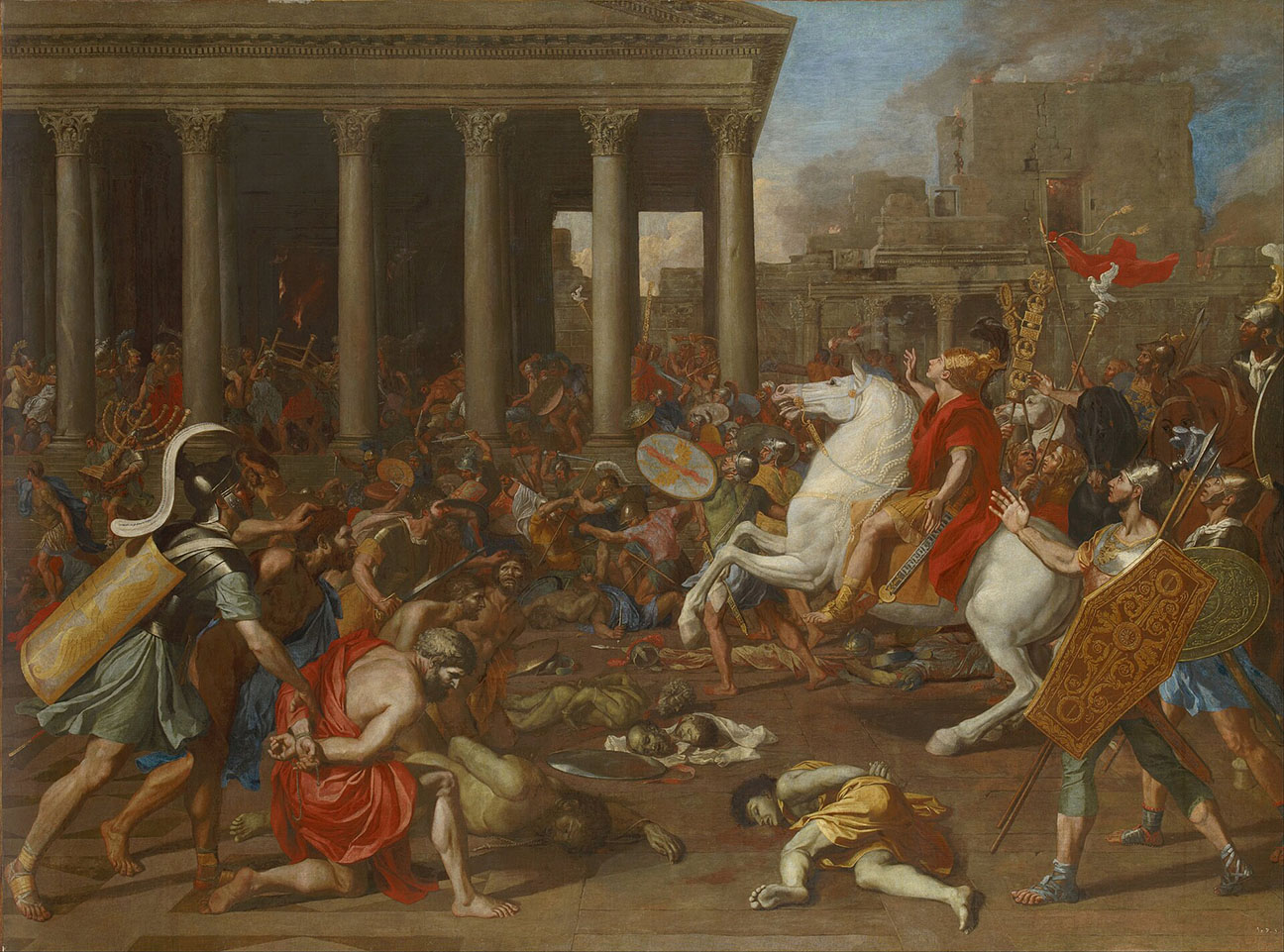
that Poussin painted the theft of the menorah from the temple
for which we condemn
the Romans, who removed its holy vessels as their
stolen prize,
misplacing its location to ancient Carthage instead of
Jerusalem,
failing to recognize
the presence of the menorah —
that the Romans had poached — in Poussin’s painting, echoing
how the bas relief
beneath the arch of Titus, no exiled Jewish adorer
of the menorah depicts. Poussin was of Jewish faces artistically
not theologically a thief.
Their absence echoes how the prehistoric art
upon the walls
of caves depicting prehistoric living beings never
any human face recalls.
Indeed, the absence of Jewish faces in the carving beneath Titus’s arch
has led to a revisionist deduction,
suggesting that no Jews were exiled from Jerusalem to Rome
after the holy Temple’s tragic destruction.
In “A tale of two paintings and one city,” ideas.tikvah.org, 7/12/18, Meir Soloveichik writes:
This is a tale of two paintings by two 17th-century masters. Both depict the same historical event. In every other respect, they present a complete contrast.
The first painting has a fascinating back story. During World War II, an eccentric Englishman by the name of Ernest Onians made a fortune with his invention of Tottenham Pudding, a form of pigswill produced from waste food. Having amassed his millions, Onians became an art collector, purchasing canvases at country fairs and garage sales and accumulating some 500 works in all. On his death in the early 1990s, his heirs consigned the whole lot to Sotheby’s, which rushed out a catalogue on the assumption that none of the paintings was especially valuable.
One image in the catalogue, depicting the destruction of an ancient city and an army bearing loot out of a building in flames, happened to catch the eye of the art historian Denis Mahon. The painting had been identified by Sotheby’s as The Sack of Carthage, a work by the minor artist Pietro Testa, and was listed at the suggested price of ₤15,000.
Looking carefully, however, Sir Denis, an expert in the art of the great French Baroque painter Nicolas Poussin (1594-1665), suspected that Sotheby’s attribution was incorrect. What may have tipped him off was that among the looted objects was a menorah—which meant that the city wasn’t Carthage after all. Or perhaps he noticed the picture’s striking similarity to a 1638 painting by Poussin titled Conquest of Jerusalem by the Emperor Titus.
Mahon’s intuition had clued him in to the greatest art discovery of the 20th century. In 1626, Poussin had created an earlier rendition of the destruction of Jerusalem and the Temple by the Roman general Titus. That work, commissioned by a nephew of the Pope, had been given as a gift to Cardinal Richelieu but then repeatedly changed hands and became lost; the later painting by Poussin was thus a second version. Now, once Sotheby’s canvas was cleaned, Mahon’s hunch was confirmed; he had identified a Poussin, The Destruction and Sack of the Temple of Jerusalem, that, lost for 300 years, was worth millions.
How had Sotheby’s experts missed what Mahon saw? The answer might lie in Poussin’s artistic choices. His Temple looks nothing like the ancient Temple in Jerusalem, but rather like a duplicate of the ancient Greek Parthenon. In addition, the main characters in the painting aren’t the Jews but the Romans. As Rabbi Jonathan Sacks noted at a celebration of the find at the National Gallery, Poussin had managed to “portray a Jewish tragedy almost without Jews.”
In “Balancing Acts: A Response to Shai Secunda,” Jewish Review of Books, Summer 2026, David Kraemer defends his book “Embracing Exile, “ from Secunda’s charge that Kraemer ignores Jewish oppression by gentile foes while dwelling on texts that focus on exiled Jews’ favorable treatment. Kraemer draws to the reader’s attention that many of the legends about the oppression of Jews may be false, pointing out as an example the fact that no Jewish exiles are depicted in the famous illustration of Jews under the Arch of Titus, as Doron Lopez has pointed out.
Gershon Hepner is a poet who has written over 25,000 poems on subjects ranging from music to literature, politics to Torah. He grew up in England and moved to Los Angeles in 1976. Using his varied interests and experiences, he has authored dozens of papers in medical and academic journals, and authored “Legal Friction: Law, Narrative, and Identity Politics in Biblical Israel.” He can be reached at gershonhepner@gmail.com.