fbpx

July 23, 2026

I Can’t Always — A poem for Parsha Va’etchanan

Va’etchanan — I entreated (Deuteronomy 3:23–7:11)

As one who follows the teachings
of Jewish theologian and scholar Mick Jagger
I have learned the Torah of
not always getting what I want.

I’m at the point where it sometimes feels like
not always becomes rarely ever. I have learned,
like Moses, to ask earnestly, but, like to Moses,
the response is uncomfortably firm.

I keep asking though. My vision for
the world as it should be is not wavered by
the holy anger. I’m an unrequited entreater.
(I make up words to suit my needs.

No one is happy about this.)
I keep trying to reach a promised land
but either my entry is denied, or I’m
missing the signs I’m already there.

Grammar check is having a field day
with my choices here, and it too is
learning entreatments are not always
answered the way we want.

You Can’t Always Get What You Want
came out the year after I was born. (Don’t
look up that year, you already know too much.)
Was I already too noisy as a baby?

Oh, Holy One … if you’re anything beyond
my imagination, please give me more than
a little glimpse. Just a single toe on the ground
I want to get what I want, just once.


Rick Lupert, a poet, songleader and graphic designer, is the author of 30 books including “Begin the Beget” and “God Wrestler: A Poem for Every Torah Portion.” Visit him at www.JewishPoetry.net

I Can’t Always — A poem for Parsha Va’etchanan Read More »

A Bisl Torah — Senseless versus Sensible

The Talmudic sages determine the Holy Temples and Jerusalem were destroyed due to sinat chinam, senseless or baseless hatred. If there is a category of senseless hatred, does that mean there is a category of sensible hatred? What might sensible hatred look like?

Rabbi Tzadok HaKohen of Lublin teaches that jealousy is the root cause of senseless hatred. It is difficult to define sensible hatred. Perhaps when we see our people attacked, our children wronged, or a moral injustice, sensible hatred feels like the path to pursue. The only issue is that the lines between senseless and sensible hatred are very blurry. We must relearn the art of speaking out versus shaming another, defending versus defaming, protecting versus attacking.

Instead of engaging in any form of hatred, senseless or sensible, the first step may be inquiring: in which ways will my words or actions heal, strengthen, or offer a road towards peace? Am I creating pathways to bring others together or leading others towards that which our ancestors faced— pools of anger, reservoirs of jealousy and deep sources of enmity?

The 9th of Av is an annual reminder to look inward and ask if any hatred has taken root within our hearts. And then we spend each day forward, planting seeds of righteousness, compassion, and generosity. This kind of planting is hard work, filled with toil and exertion. Yet, it is perhaps the holiest work a human can do. I plan on restarting. Join me.


Rabbi Nicole Guzik is senior rabbi at Sinai Temple. She can be reached at her Facebook page at Rabbi Nicole Guzik or on Instagram @rabbiguzik. For more writings, visit Rabbi Guzik’s blog section from Sinai Temple’s website.

A Bisl Torah — Senseless versus Sensible Read More »

Moment in Time: Tisha B’Av – A Time to Comfort

Dear all,

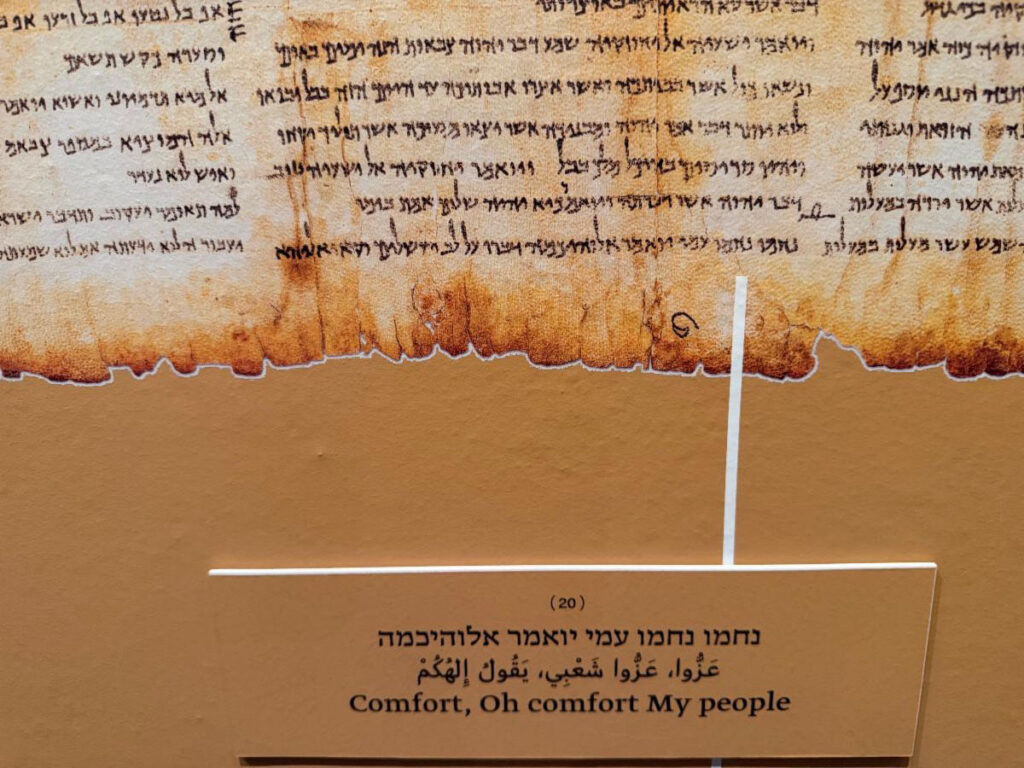
During my recent sabbatical, I stood before fragments of the Dead Sea Scrolls at the Israel Museum in Jerusalem—words written between the 3rd century BCE and the 1st century CE, the oldest surviving manuscripts of our sacred texts.

Discovered in the caves of Qumran in 1946, these fragments form a living bridge between ancient Judaism and the vibrant, unfolding story of our people today.

One fragment, in particular, has stayed with me as we mark Tisha B’Av—the 9th of Av—a day that recalls the destruction of the First and Second Temples, as well as the expulsion of Jews from Spain in 1492. It is a day that holds the weight of our history.

And yet, from within that weight comes a voice that refuses to let despair have the final word. The prophet Isaiah calls out: “Nachamu, nachamu ami—Comfort, oh comfort My people.”

Spoken to a people in exile, these words are not only consolation—they are a quiet act of defiance, a reminder that even in a moment in time of loss, we are never abandoned.

We live in an era when challenges to our people and our story persist. But our tradition has never been defined by fear. It has been shaped by resilience, by memory, and by an enduring capacity to imagine what comes next.

So on this Tisha B’Av, we do more than remember what was broken. We affirm what endures. We turn toward one another in compassion. And we choose, again and again, to carry forward a vision rooted not in fear, but in hope.

With love and Shalom,

Rabbi Zachary R. Shapiro

Moment in Time: Tisha B’Av – A Time to Comfort Read More »

Poussin’s Menorah Chimes Without Jews at Midnight

In acts that are increasingly ambiguous,
on stages where the settings are far more
important than ourselves, we know we are contiguous
to nothingness, with close to zero as our score.

We start forgetting fantasies that we minutely,
observed before our powers ebbed away and we
could act no longer as we did when resolutely
we followed all our fancies, feeling fresh and free.

When this occurs to us our life becomes more clear,
for while the play goes on we know the curtain fell
before we understood the plot, and wait to hear
the chimes at midnight that will buzz us into hell.

This happened:
art experts failed to recognize
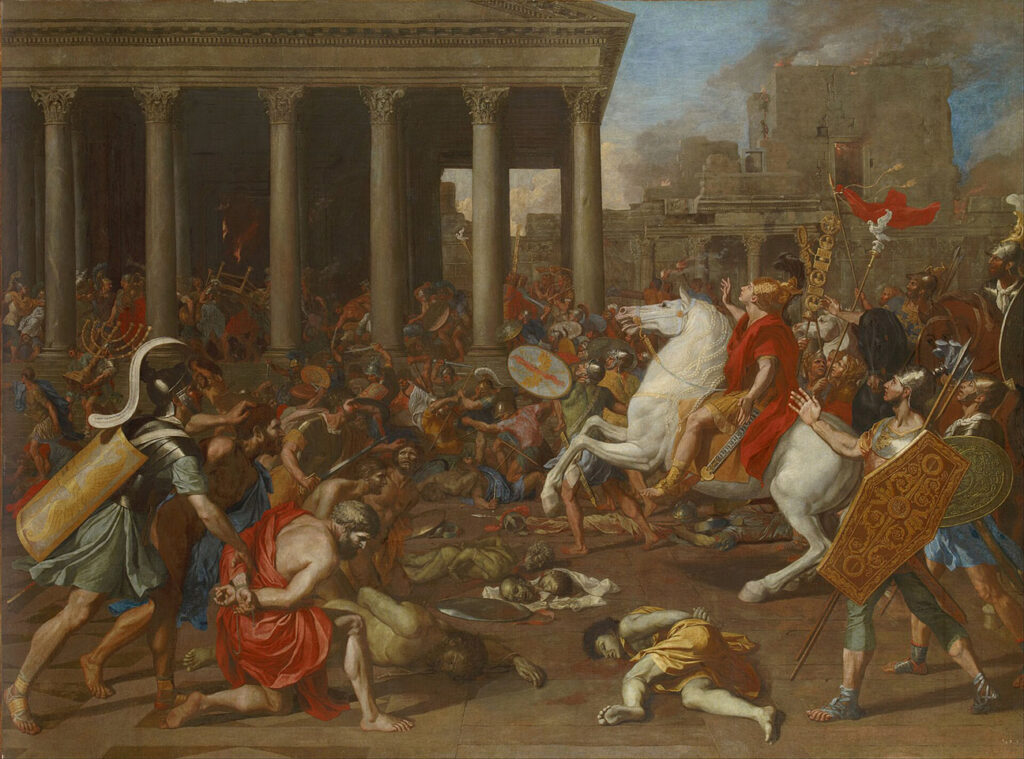
that Poussin painted the theft of the menorah from the temple
for which we condemn
the Romans, who removed its holy vessels as their
stolen prize,
misplacing its location to ancient Carthage instead of
Jerusalem,
failing to recognize
the presence of the menorah —
that the Romans had poached — in Poussin’s painting, echoing
how the bas relief
beneath the arch of Titus, no exiled Jewish adorer
of the menorah depicts.  Poussin was of Jewish faces artistically
not theologically a thief.

Their absence echoes how the prehistoric art
upon the walls
of caves depicting prehistoric living beings never
any human face recalls.

Indeed, the absence of Jewish faces in the carving beneath Titus’s arch
has led to a revisionist deduction,
suggesting that no Jews were exiled from Jerusalem to Rome
after the holy Temple’s tragic destruction.


In “A tale of two paintings and one city,” ideas.tikvah.org, 7/12/18, Meir Soloveichik writes:

This is a tale of two paintings by two 17th-century masters. Both depict the same historical event. In every other respect, they present a complete contrast.

The first painting has a fascinating back story. During World War II, an eccentric Englishman by the name of Ernest Onians made a fortune with his invention of Tottenham Pudding, a form of pigswill produced from waste food. Having amassed his millions, Onians became an art collector, purchasing canvases at country fairs and garage sales and accumulating some 500 works in all. On his death in the early 1990s, his heirs consigned the whole lot to Sotheby’s, which rushed out a catalogue on the assumption that none of the paintings was especially valuable.

One image in the catalogue, depicting the destruction of an ancient city and an army bearing loot out of a building in flames, happened to catch the eye of the art historian Denis Mahon. The painting had been identified by Sotheby’s as The Sack of Carthage, a work by the minor artist Pietro Testa, and was listed at the suggested price of ₤15,000.

Looking carefully, however, Sir Denis, an expert in the art of the great French Baroque painter Nicolas Poussin (1594-1665), suspected that Sotheby’s attribution was incorrect. What may have tipped him off was that among the looted objects was a menorah—which meant that the city wasn’t Carthage after all. Or perhaps he noticed the picture’s striking similarity to a 1638 painting by Poussin titled Conquest of Jerusalem by the Emperor Titus.

Mahon’s intuition had clued him in to the greatest art discovery of the 20th century. In 1626, Poussin had created an earlier rendition of the destruction of Jerusalem and the Temple by the Roman general Titus. That work, commissioned by a nephew of the Pope, had been given as a gift to Cardinal Richelieu but then repeatedly changed hands and became lost; the later painting by Poussin was thus a second version. Now, once Sotheby’s canvas was cleaned, Mahon’s hunch was confirmed; he had identified a Poussin, The Destruction and Sack of the Temple of Jerusalem, that, lost for 300 years, was worth millions.

How had Sotheby’s experts missed what Mahon saw? The answer might lie in Poussin’s artistic choices. His Temple looks nothing like the ancient Temple in Jerusalem, but rather like a duplicate of the ancient Greek Parthenon. In addition, the main characters in the painting aren’t the Jews but the Romans. As Rabbi Jonathan Sacks noted at a celebration of the find at the National Gallery, Poussin had managed to “portray a Jewish tragedy almost without Jews.”

In “Balancing Acts: A Response to Shai Secunda,” Jewish Review of Books, Summer 2026, David Kraemer defends his book “Embracing Exile, “ from Secunda’s charge that Kraemer ignores Jewish oppression by gentile foes while dwelling on texts that focus on exiled Jews’ favorable treatment. Kraemer draws to the reader’s attention that many of the legends about the oppression of Jews may be false, pointing out as an example the fact that no Jewish exiles are depicted in the famous illustration of Jews under the Arch of Titus, as Doron Lopez has pointed out.


Gershon Hepner is a poet who has written over 25,000 poems on subjects ranging from music to literature, politics to Torah. He grew up in England and moved to Los Angeles in 1976. Using his varied interests and experiences, he has authored dozens of papers in medical and academic journals, and authored “Legal Friction: Law, Narrative, and Identity Politics in Biblical Israel.” He can be reached at gershonhepner@gmail.com.

Poussin’s Menorah Chimes Without Jews at Midnight Read More »

Print Issue: Haredim at War | July 24, 2026

CLICK HERE FOR FULLSCREEN VERSION

Print Issue: Haredim at War | July 24, 2026 Read More »

The Inversion of History

“Here Where We Live Is Our Country: The Story of the Jewish Bund” by Molly Crabapple. Random House, NY (2026)

Rummaging through her great-grandfather’s obscure past, Molly Crabapple transports herself back to the tumultuous world of Eastern European Jewry: a world of national awakenings, pogroms, emerging modernity, democratic ferment and revolutionary struggle. It was a whirlwind, whose centrifugal force yanked Jewish communities from their traditional moorings and hurled them into political life. But it was also a maelstrom that culminated in the barbaric destruction of the Warsaw ghetto and Yiddish civilization and the murder of two-thirds of Europe’s Jews.

Crabapple resurrects her love of Yiddishkeit from spectral haze to fully realized embodiment and does so with great verve, wit and pathos. Like a skilled novelist she breathes life into the minutiae of ghetto life — its struggles, victories, tragedies and defeats — time-travelling from her great-grandfather’s days in the old country to her awakening as a link in the chain of Jewish life. It is a work of immense scholarship, beautifully illustrated by the author. She taught herself Yiddish and used her immense linguistic and literary skills to pore over, it would seem, every existent source of Bundism and reanimate its beating heart.

She posits that the Bund’s secular, anti-clerical, anti-Zionist principles remain a living model for the struggle against authoritarianism, and a guide to Jewish survival. And she links the fight against antisemitism to the struggle against Zionism: “For leftist Jews longing for resources within our own past for combating the Zionist death cult, the Bund is a model.”

It is a work of great inversion and of ultimate betrayal.

As the great protest movement against exploitation and oppression, socialism became a natural node of attraction for many young Jewish intellectuals beginning in the late 19th century. But the most prominent socialists had little interest in Jewish emancipation per se. As intellectual heirs of the Enlightenment and the French Revolution, their vision of equal rights for the Jew extended no further than the freedom to assimilate and be accepted into the polity of the nation in which he resided. Of Jews as a collectivity, its dissolution was welcomed, as their survival retained no intrinsic value for the larger commonweal.

Were the Jews a nationality? For most socialists, Jews had a national past, but were ground first by repeated dispersion and then by feudalism into a caste wedged in the interstices of nations. Once emancipated and accorded political liberty under socialism, it was believed, the Jews would surely not reconstitute themselves into a nation, when offered the free choice of assimilation. Assimilation, freely chosen, would be the democratic solution to “the Jewish Question.”

The Bund, too, at its inception at the end of the 19th century, did not address itself to “the Jewish Question.” Its organizers saw themselves as Russian intellectuals who assumed the task of organizing the Jewish section of the Russian working class. They did not necessarily speak Yiddish as their primary language; some were even baptized and may not have initially identified as Jews. They originally wanted an association that would embrace all the Jewish workers within czarist Russia, without overtaxing ideological demands and obligations.

The Bund, however, could not long dodge the issue of the double oppression of the Jewish workers — exploited as all other workers, but also oppressed as an outcast nation. In practice, neutrality in the cause of assimilation meant not the elimination of all national particularities, but Russification. And this prospect singularly lacked appeal for Jewish workers.

Under pressure from below, from competing territorial-nationalist and Zionist sentiments percolating among both Jewish intellectuals and workers, the Bund was reluctantly compelled to seek a solution to the Jewish problem that addressed the issue of (Russian-) Jewish collective survival. It finally adopted a National Program (1903), recognizing Jewry, dispersed among other peoples within the czarist empire, as a national community, and called upon the socialist movement to fight for a social order that would assure the Jewish population of a future, liberated Russia the opportunity to carry on as a distinct community — to regulate its cultural affairs according to its needs. The Bund’s nationalism of “hereness” — doikayt in Yiddish — was an endorsement of a proto-identity politics in the form of Ashkenazi ethnosocialism.

The Bund’s national program met implacable hostility from their socialist opponents. For the Russian social democracy crowd, the Bund was nothing but “Zionists suffering from seasickness.”

This was a baseless slander. For the tendency to grasp the Jewish question locally and culturally, and not globally, also placed the Bund squarely in the anti-Zionist camp, as both Bundists and Zionists fully agreed. Bundism did not address itself to Jewish survival writ large, but to the narrowly defined aspirations, as they perceived it, of Jewish workers within the Russian Empire. It was also diametrically opposed to the thoroughly liberal Zionism of Herzl, who placed his hope for a conventional Jewish state — and his appeal to world powers — on the proposition that Zionism might also dissipate the revolutionary unrest of Jewish workers.

But Zionism also had a socialist wing, Poale Zion, absent except in cartoon form from Crabapple’s account, that also opposed Herzlian nationalism. They insisted that a homeland cannot be granted from on high by world powers: it must be a revolutionary act of Jewish creative ferment and activity from below culminating not in a conventional bourgeois state, but a Jewish socialist one. And it mounted a left-wing attack not only against liberal Zionism, but also against Bundist cultural nationalism. They, like the Bund, organized Jewish workers to defend their communities from pogromists. They, like the Bund, engaged in revolutionary activity, trade union organizing and electoral campaigns within the Russian Empire. And they, like the Bund, were to write a glorious chapter of Jewish pride and resistance against German armies in the ghettos, forests and concentration camps of Eastern Europe. They created what was to become the Israeli working class in the pre-state years and to fashion its key parties, social and cultural institutions, and self-defense organizations.

Whether Crabapple finds Poale Zion’s critique of Bundism meritorious or not, it is a dereliction of responsibility to have simply parodied it.

Like the Bund, Poale Zion demanded political autonomy with broad cultural jurisdiction for those nationalities whose needs could not be met territorially. But this was a stopgap for the Jewish people. The conditions of marginality, and the continued outsized presence of Jews in precarious middle-class and professional fields peripheral to the national economic centers, made Jews a convenient target of hatred by other oppressed people and a scapegoat for vulnerable ruling classes.

For Poale Zion, therefore, Zionism was the minimal program for a normal national, rooted existence — the precondition for the Jewish people’s participation as equals in the global struggle for a democratic and emancipated future. The Jewish people would finally be driven to Palestine, an underdeveloped land well suited for economic development.

Zionism, at least for socialist-Zionists, was not meant as a solution to the “Jewish Question,” if by “Jewish Question” is meant the reoccurring, shape-shifting problem of antisemitism. Then again, neither was the Bund’s proposed cultural autonomy. These were alternative programs for Jewish national survival — the right of any nation, hated or not.

Bundists rejected as utopian the ingathering and reconstitution of the Jewish nation in Palestine. Their own “nonutopian” program of national-cultural autonomy, on the other hand, was fully enacted by the Ukrainian Central Rada (1917-18). The Bund had straddled the idea of full Ukrainian independence, rightly fearing that the drive toward an independent Ukraine would splinter Jewish communities and subject them to outright persecution; that it would strengthen the power of Jew-hating reactionaries.

And that is exactly what occurred. Ultimately the Rada (and the ruling Bolsheviks) proved unable and unwilling to intervene when the autonomists partnered with the White armies during the Russian Civil War to unleash the bloodiest anti-Jewish massacres prior to the Holocaust.

What stronger rebuke could there be to the tragedy of Bundist illusions? “National-cultural autonomy” failed, horribly failed, the judgment of history, in the one grand national laboratory experiment where it was actually tested — a conclusion unpardonably glossed over by Crabapple and her fellow Bundist reenactors.

After the Bolsheviks took power, the social democratic Bund was forced to disband in 1920, and decamp to Poland leaving a small pro-Bolshevik Russian remnant that had capitulated to the increasingly authoritarian Communist Party. It was in Poland that the Bund fought its last heroic, doomed battles, culminating in a belated united front with labor Zionists. To the end, in the face of mounting Nazi bestiality, the Bund stubbornly held to its principles, insisting, all evidence to the contrary, that a workers’ revolution alone could save the Jews, and ruled out, in principle, organizing a mass emergency exodus to Palestine for being an unpardonable affront to the Arabs.

To the end, in the face of mounting Nazi bestiality, the Bund stubbornly held to its principles, insisting, all evidence to the contrary, that a workers’ revolution alone could save the Jews, and ruled out, in principle, organizing a mass emergency exodus to Palestine for being an unpardonable affront to the Arabs.

By the mid-1930s, Stalinism had extinguished what few embers of working-class autonomy the Bolsheviks still tolerated. German social democracy and its militias had ignominiously collapsed in the face of Nazi thuggery without offering any resistance. The downfall of Red Vienna, the citadel of Austrian socialism, followed soon after. The Spanish Republic was destroyed with the active connivance of the GPU (the Soviet secret police), whose Russian masters preferred a fascist victory to democratic socialism.

An ardent labor Zionist of the 1930s, R. E. Ashery, answered the Bund in frustration:

“As to the … crackpot solution that Jews, en masse, should join the revolutionary movement in the lands they reside in that they may be the beacon and light of the revolution, it seems the revolutionary theologians have formed a new incarnation for the hoary concept, Jews as a Chosen People. … The ‘revolutionaries’ preach a gospel of becoming the chosen cannon-fodder for the German, Polish, Romanian and Lithuanian brothers whose revolutionary growth is retarded or stunted. Meantime are the Jews gladly to let themselves be killed in pogroms by these future brothers?”

When principles harden into dogmas and dogmas become blinders, they cease to be a useful guide to action. To leave would have meant letting their tormentors win, and so this “right to stay” ossified into an inviolable principle that the Bund refused to relinquish even when its further insistence became pure folly.

Antek (Yitzhak) Zuckerman, a socialist-Zionist hero of the Jewish Combat Organization in Poland, walked away at the conclusion of the war in utter exasperation at the Bund’s “hereness,” which he damned as a “self-destructive delusion.” “Anyone could see that the Jews had no future without a state.”

Not for Molly Crabapple. For her, evidently, social justice has no future if the Jews do have a state. No sloppy, snidely unexamined antizionist and anti-Israel cliché remains untapped. And why shouldn’t they be invoked? These are the axiomatic beliefs of a modern leftist worldview — increasingly the worldview of a generation — where narrative coherency supplants factual correspondence. Absent this subtext, I suspect that this work, elegantly written as it is, would never have broken out of its academic niche to attain the mass appeal it has garnered. Ms. Crabapple is a creature of this party of the left. And she has paid her dues here in kind.

For Crabapple, evidently, social justice has no future if the Jews do have a state. No sloppy, snidely unexamined anti-Zionist and anti-Israel cliché remains untapped.

Zionism is allegedly criminogenic because it is a settler-colonial enterprise, supercharged by its alignment with American power. And because it is a settler-colonialism enterprise, it has a genocidal aim. The more that the genocidal beast is subsidized, and fattened, the more it, paradoxically, remains unsated.

Israel is the epicenter of a wider American vortex — the torchbearer and repository of all the crimes of Western civilization — a vortex that extracts and strips wealth from the rest of the world, a global imperium and the machine shop of social injustice. As long as the American-Israel nexus remains unbroken, and resources diverted to its defense, the longer fundamental social problem will remain unaddressed and addressable. That is why climate change, and Black Lives Matter, and police brutality, and the housing crisis, and health insurance, and wage stagnation and LGBTQ+ rights are interlocked. That is why AIPAC is the most monstrous of all lobbyists. That is why Gaza is a trade-union issue, a feminist and gay issue, a wealth disparity issue and income inequality issue, and above all, the omnibus social justice issue. That is why all local politics are anti-imperialist politics; why Gaza is the central issue for New York City politics and all the lesser city and municipality and village politics, and, above all, national politics.

This Manichean, apocalyptic worldview, it should be redundant to point out, is unlike any leftist worldview known to history. It hijacks the concerns of the left, the grievances of the left and the language of the left. And inverts them all. It creates a moral permission structure to ostracize and purge all those who stand in the way of social progress by failing to respect the “link” between it and its material dependency on the elimination of Israel. In its twisted but consistent logic, it further calumniates anyone who upholds the Israeli right to self-determination for being white supremacists, upholders of the present global structures of hierarchy and advantage.

Whereas 80 years ago leftists like Carey McWilliams saw antisemitism as a mask for privilege, the modern left considers fear of antisemitism to be the apprehension of a privileged elite. And it creates a ready-made, all-purpose scapegoat for present and future failures by would-be social reformers to implement their programs. “We can’t have Medicare for All because the necessary funds have been diverted to the child killers of the IDF.”

Most important, it elevates the most reactionary, fascist, theocratic, irredentist, misogynist and racist movements and regimes that plague the Middle East and the world to noble heroes of the anti-imperialist struggle, for having thrown a spanner in the machinery of global oppression. Progressive and freedom-loving are any movements that threaten to disrupt the world order, even if they do so with the intent of blocking or hurling backwards any gains of human rights or democracy. Condemned is any war against fascism, religious fanaticism and jihadi imperialism that operates within that order — even if it lays the predicate to future democratic openings — for upholding the status quo.

Toward the end of her book, as the remnants of the Bund and the Polish Socialist Party together survey the horror and destruction of the war, Ms. Crabapple relates a Polish socialist’s plea for reassurance and, if not for forgiveness, then for understanding; asking pleadingly of the Bundist, had we Polish comrades done enough? Had we done all we could do? And she imagines herself now, in the place of the Polish socialist, looking across the chasm of the “Gaza genocide,” and asking similarly for a reassuring absolution for her ineffective opposition to Israeli retaliation presumably from a representative of Hamas, now obscenely cast in the roll of the Bund. This perverse analogy between Gaza and the Warsaw Ghetto, between Hamas and the Jewish resistance fighters — this appropriation of Jewish tragedy and heroism — in service to Islamism is, lamentably, a feature and not a bug of contemporary socialism.

This perverse analogy between Gaza and the Warsaw Ghetto, between Hamas and the Jewish resistance fighters—this appropriation of Jewish tragedy and heroism—in service to Islamism is, lamentably, a feature and not a bug of contemporary socialism.

Here, where we live, is our country. Except if “we” live in Israel. There is much more to be said. Suffice to say, the Bund deserves better. These fearless secularists and democratic socialists, who stood up against religious obscurantism and defied mass authoritarians on both the right and left, who waged a doomed rearguard battle for the dignity of European Jewry, should never had their legacy tarnished and perverted to backhandedly justify Hamas’ atrocities of Oct. 7, 2023.  But here we are.


Barry Finger has also written on the Gaza war for Fathom Journal.

The Inversion of History Read More »

From ‘The Chosen’ to ‘Imaging Torah’: Jeremy Kagan’s Journey to Bring Torah to Life

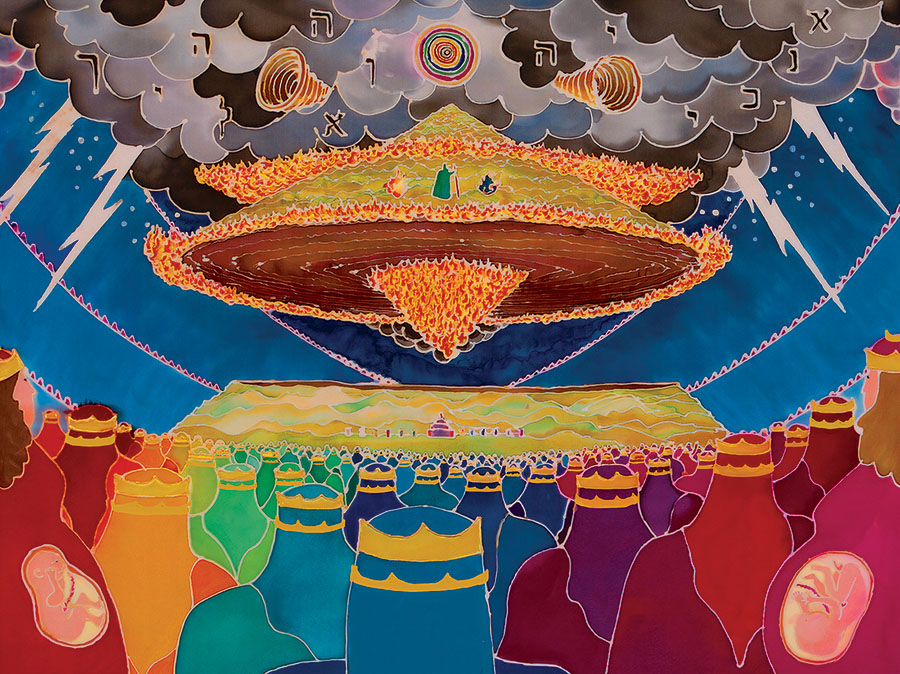
Jeremy Kagan has spent a lifetime bringing stories to the screen, but his latest project is perhaps his most personal. In “Imaging Torah,” a visually striking 25-minute film, the acclaimed director combines his original paintings and drawings with the timeless words of the Hebrew Bible, transforming the weekly Haftorah readings into a rich tapestry of color, symbolism and imagination.

The Torah is divided into 54 weekly portions, known as parashas. Following each parashah, a selection from the books of the Prophets is traditionally read; these passages are known as the Haftorahs. Kagan’s paintings and drawings are visual responses not only to the words of the Torah and Haftorah, but also to centuries of Jewish interpretation, including rabbinic commentaries found in the Talmud and Mishnah, as well as the mystical teachings of the Zohar and other ancient texts. The film offers a deeply personal artistic interpretation of sacred texts, inviting viewers to experience them through both sight and spirit.

The son of a Reform rabbi in Mount Vernon, New York, Kagan grew up immersed in biblical stories, which captivated his imagination from an early age. Encouraged by a father who was himself an amateur painter, Kagan grew up in a home where art and faith existed naturally alongside one another. He was drawing almost constantly as a child, and his talent was evident early on. Family friends suggested that his parents send him to a specialized art school, but they ultimately chose not to pursue that path, a decision Kagan later believed was influenced by their concern that the life of an artist might prove challenging.

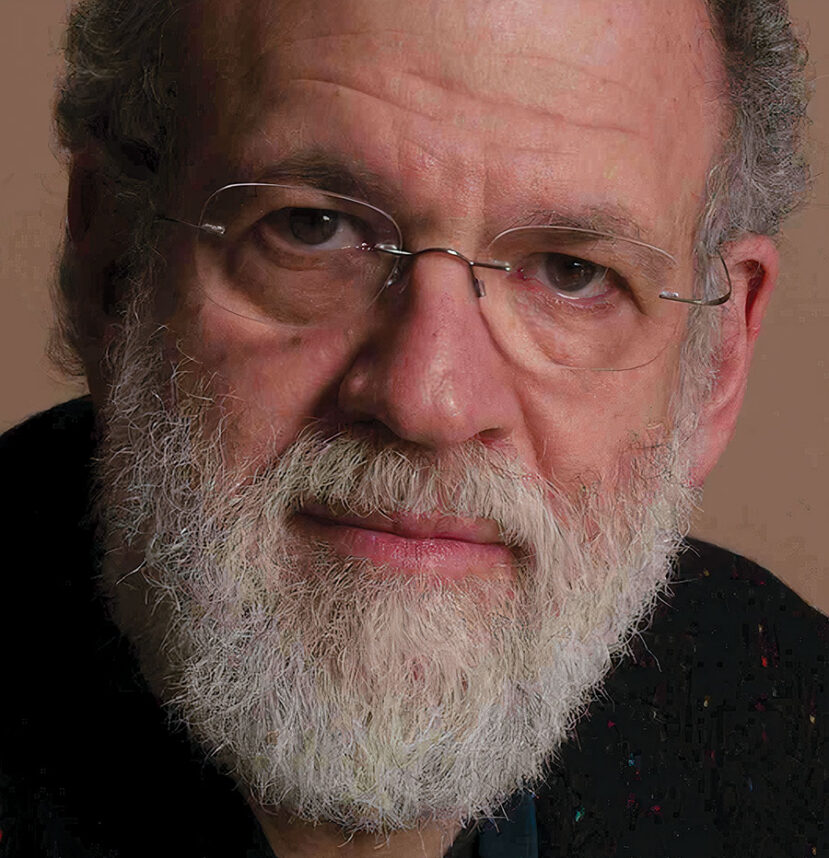
Jeremy Kagan

It was through filmmaking that Kagan’s relationship with Judaism would deepen in unexpected ways. His 1981 adaptation of Chaim Potok’s 1967 novel “The Chosen” became more than a professional milestone — it opened a door to a spiritual exploration that would eventually shape his life and his art.

“When I started making “The Chosen,” I was in New York. I didn’t know how to pronounce or spell Hasidic,” he recalled. “It wasn’t a part of Reform Judaism.”

Kabbalah, the mystical tradition of Judaism, was also outside his experience. He remembers asking his father about it when he was 12 years old. “I said, ‘What is Kabbalah?’” Kagan recalled. “And he said ‘That’s part of old thinking, it’s superstitious. You have to be married and 40 years old to study it, and it has no real relevance today.’”

But while doing research for “The Chosen” Kagan began questioning those assumptions. He started meeting members of Orthodox communities, spending Shabbat with families and learning about a more spiritual dimension of Judaism. “I got exposed to the concept of spiritual Judaism, and I got really interested in it,” he said.

That journey eventually led him to Rabbi Stephen Robbins in Los Angeles, who taught courses on Kabbalah. Kagan would wake up early to attend the 6 a.m. classes before continuing with his work as a filmmaker.

“We would read Aryeh Kaplan’s work, which is the most wonderful way of approaching it because it makes it incredibly accessible,” he said. “Suddenly I realized what the spiritual basis was, and how profound and effective it was. … I practiced it daily,” Kagan said. “It became part of my daily being.”

Today, Kagan attends The Happy Minyan in Pico-Robertson, a congregation influenced by Rabbi Shlomo Carlebach’s teachings and his emphasis on making Judaism accessible and welcoming. Looking back, Kagan sees his path toward a deeper Jewish connection as something that unfolded rather than something he consciously planned.

“I feel like some things in life are chosen for you,” he said. “You think you’re choosing, but you’re really not. These are unintentional events that happen in your life. The story of making ‘The Chosen’ was one of those things.”

At 80, Kagan shows no signs of slowing down. But for him, creating art and illustrating biblical stories is more than another project — it is a calling.

Speaking with The Journal from his home studio in Venice Beach, Kagan reflected on the decades-long journey of creating “The Haftorahs,” which will be screened at The Braid on July 25 and 26 alongside an exhibition of his artwork.

Mishpatim

“I have an obsession to create an image based on the parashah of the week. I’ve been doing it for at least 20 years,” said Kagan. “I assumed that if I drew one set a week, this would take a year. But just doing the first set actually took five years.”

Inspired by a Midrash describing the serpent in the Garden of Eden as a tall, two-legged creature with a long neck, Kagan created his first painting using an ancient Indian technique on stretched silk. His spiritual studies influenced the symbolism and color palette that became a hallmark of the series.

Although he remained busy directing feature films and television projects, Kagan refused to let the artwork sit idle. He brought canvases with him to film locations, using evenings, weekends and any spare moments between shoots to continue painting. Each week’s artwork began with studying the Torah portion and traditional commentaries, followed by pencil sketches that were gradually developed into detailed paintings.

Yet Kagan’s decision to visually interpret biblical stories did not come without questions. The Second Commandment’s prohibition against making graven images has historically shaped Jewish attitudes toward religious art, particularly depictions of God and divine beings. Unlike many other religious traditions, Jewish art developed largely through ornamental, decorative and symbolic forms rather than figurative representations of sacred subjects.

Yet Kagan believes the relationship between Judaism and art has evolved over time. As Jews entered broader society, visual expression became more prominent, with artists such as Camille Pissarro, Marc Chagall, Mark Rothko and Roy Lichtenstein using art to explore identity, spirituality and Jewish experience.

During his travels, Kagan encountered many examples of Jewish communities embracing visual expression. He makes a point of visiting synagogues wherever he spends Shabbat, whether in London, Amsterdam or Casablanca. “I found many that incorporate artistic elements, including stained-glass windows,” Kagan said.

For the director/artist, creating images inspired by Torah is a way of engaging with the stories, ideas and interpretations that have shaped Jewish life for thousands of years.

Over the past several years, he has been compiling his Torah artwork into a book, including a collection devoted to Genesis, with each chapter accompanied by his own commentary and multiple interpretations of the biblical text.

Kagan emphasized that financial gain was never the motivation behind the project. His decades-long filmmaking career has already provided him with professional and financial success. Now, he hopes “The Haftorahs” will serve a different purpose: offering viewers another doorway into Jewish texts and traditions.

“I hope that it would be of value – that it would be another way to see Torah, be inspired by it and that it would become part of people’s lives.”

The film will screen at The Braid, followed by a conversation with filmmaker Jeremy Kagan and composer Yuval Ron, a musical performance by Ron, and an exhibition of Kagan’s artwork. Screenings will take place on July 25 at 7:30 p.m. and July 26 at 2 p.m. 

From ‘The Chosen’ to ‘Imaging Torah’: Jeremy Kagan’s Journey to Bring Torah to Life Read More »

Three Dates to Dataland

I took three different dates, ages 6, 72 and 35, to see Dataland, the unusual digital art experience in downtown Los Angeles.

As we entered and were warmly welcomed by creator Refik Anadol, we were given wrist bands to measure our biological responses to the exhibit and a neck yoke to emit scents in synch with the immersive AI artistry. We read the fervent thanks to the Yawanawá spiritual leader Nixiwaka for the ancestral memories he contributed to creation of the exhibit.

Data.Token—a record of my biological reactions to the exhibit

Free range six-year-old Julie found it all “awesome.” She said she felt like she was playing “inside machines” from the moment we descended on the long escalator into the Data Pavillion. Captivated by the evolving plays of light and color on the floors, walls and ceilings, music emanating from every surface, she frolicked around in it as did other children. Babies set free from transfixed parents’ arms crawled happily, giving chase to dazzling, pulsing patterns.

Seventy-two-year-old Stan noticed the circles of light forming around his feet in one sequence wherever he stepped. “I’m always aware of vision and sound’s effects on me and forget that my biology has an impact back on the world. Here, it’s minor visual evidence — more of a suggestion that the environment feels my presence.” Articles on Anadol mention that the art can “feel you back.” I didn’t see or get the promised taste of that feedback or how mine might be singularly identified among a crowd; but perhaps I was overstimulated by captivating musical and visual aspects and didn’t notice my personal readout on the walls or floors.

Thirty-five-year-old Angie, while loving the Infinity Room “where memory, landscape and storytelling were really immersive,” found the scents from our neck pieces “… synthetic. Instead of adding to the experience, it pulled me out, reminding me of the artificial intelligence element rather than helping me feel connected to the natural world.” I agreed — the L’Oreál Luxe-created fragrance bore no resemblance to the indelible aroma of a real rainforest I was fortunate to sniff firsthand years back.

Angie, wearing Empatica Biosensor wristband and Data.Scent
at neckline, with daughter Julie

As a nice Jewish cynic who was engulfed in nonjudgmental wonderment in a Team Labs Tokyo’s immersive exhibit just two years ago, I was surprised I didn’t surrender to the more spectacular aspects of this one. I found the culminating flight through the simulated Amazon woodlands exhilarating. But when we flew into the eye of the hovering bird, I found myself wondering if we were looking at actual retinal and colorized bird brain matter or just an AI impression of it.

I wondered if the plaintive, unanswered call of the now extinct wild bird, and the reminder of forestry forever lost was a manipulation of our longing and  felt the poignance nonetheless. I pondered how much of the beautiful two-hour show artist Anadol had hand-drawn and story-boarded and how much was a lucky AI improvisation captured and looped. I worried that the accelerating proliferation of AI slop and chronic scams of the last two years has made me far more suspicous than openly susceptible to such new works of fine art, and if they even are fine art.  I wondered if natural talent at the bases of these arts can still be discerned as talent as it evolves and submerges in electronic media effects.

Another element that took me out of the phenomena was the bottlenecked lines that formed as a final chamber only admits 15 people at a time. From the crowds building up throughout the morning, that seems shortsighted. I felt for poor little Julie and another child, forced to look at adults’ butts for over 12 minutes. And, the wrist band that led to a coded souvenir disc for us adults can’t be deciphered by unenhanced human eyes. I’m not sure for whose benefit our biological interactivity was captured or if it even was, but it brought up privacy concerns, as that is the sort of paranoia such measurement produces in me in this era.

Perhaps Dataland and Anadol’s promise to “feel us back” can ease these minor discomforts for all ages in its rosy future.


Melanie Chartoff has acted on Broadway and television. She is the author of “Odd Woman Out.”

Three Dates to Dataland Read More »

Hakol Shalom, All Is Shalom

Imagine the scene over 2,000 years ago. Every night, the Jerusalem Temple has been the site of sacrifices all day long. It’s filthy. Yet a group of young kohanim, young priests, are so eager to do the work of cleansing and purifying and starting again that they don’t even leave the building compound. They sleep in a side room next to the altars. The ones who rise early before the sun is out and who immerse themselves in a mikveh so that they’re ritually pure, they are called upon by that day’s head priest to have the privilege of cleaning off the ashes, setting up the altar, and starting the new daily sacrifice, the Korban Tamid.

I was so struck by the eagerness of these people to serve, even though the tasks are not necessarily elevating work. It’s filthy, smelly, strenuous manual work. Yet they are eager to serve the Temple, their people, God.

Their eagerness and their devotion is inspiring. But there’s more; here’s what I noticed in the Mishnah (Tamid 3:8). When these young kohanim are ritually cleansed and after they are selected, they proceed in two lines down two separate parallel hallways, which come together in a single room at the end of the two corridors. And when they arrive in the room where the work is to be done, they unite once more, see each other and greet each other with the following formula: They say, “shalom, ha-kol shalom. Peace. Everything is peace.”

They can’t be so naive to believe literally that their contemporary reality was “peace, that everything was peace.” Their world, like ours, was falling apart. Their world, like ours, was torn between values of power and ostentation on the one hand, and humanity and compassion on the other. Those conflicting values, represented by the civilizations of Rome and Israel were in conflict then, just as those values are in conflict today. The voice of Rome was overwhelming. By the time this story was composed, that Temple was no more. The Romans had obliterated it with their militarism and their violence and their propensity for pomp and power.

Shalom, Ha-kol Shalom is not a surrender to the current reality, it is meant as a challenge, an affirmation, a goad to resistance.

Their greeting is a mobilization and an insistence: Our love will be more resilient than their hate. The grandeur of our vision will rise above their brittle pettiness, and we will bring about, through our dedication and work, a renewed cleansing, a renewed sacrifice, a renewed offering. Kedushah (holiness) and tzedek (justice) will endure and triumph. There will be shalom. But that shalom will be because of the Holy One, and because of us. Not because we accept the way things have always been or even the way things are, but because we are determined to be heirs to the promise.

Our Scripture records the story of a cosmos created by superfluous love and overflowing grace. Through that love was birthed an presence that continues to bring down pharaohs and marches all creation to freedom. “You shall have one law” the Torah commands; we are not any of us free unless we are all free. The Children of Israel marched out of Mitzrayim not just with the descendants of the patriarchs and matriarchs, but with an eruv rav, a mixed multitude that included everyone who shared the dream. And so their descendants and those who share their vision must continue to build a world through hesed, through lovingkindness and compassion.

With this new position, I intend to help my colleagues at American Jewish University to do precisely that.

That is precisely the promise that first attracted me to AJU. And so my first thank you is to the man who hired me, Rabbi Dr. Robert Wexler, and to the faculty and the staff of the then University of Judaism, now American Jewish University, and most of all to my beloved students, past and present. All the staff, lay leaders, students and faculty, thank you, all of you, for being people of vision, people who shatter boundaries, people who see things that I could not have seen without your hand.

My second thank you is to our president Jay Sanderson and the extraordinary team of the AJU board, the Ziegler advisory board, the lay leaders and donors who make up our community, and the remarkable staff who are now ready to go, ready to build this new reality. This position of Distinguished Scholar has never been at AJU before, but it reflects a refined vision of what our life ought to be. Jay, only you could have thought up this wonderful possibility. You invented and then offered something magnificent and I promise you I will work with you to live up to it for the next ten years.

To my dear Roslyn Goldstine: Roz, you told me when we first met at a women’s league conference, three things I’ve never forgotten. You told me I was very young. Young people never think they’re young, but looking back, I just want to tell you, you were right. You also told me that I was not going to remain in Mission Viejo, which I also did not agree with at the time, but it turns out you were right then, too. You also told me your hilarious definition of an optimist: a woman in a synagogue who when the rabbi says “and in conclusion” begins to put her shoes back on. I have no idea if that’s right or not. But, Roz, you and Abner (z”l) have been like family to me for as long as I have been here. And I could not have become me without you and without Abner and now without my dear friend Ethan, who has proven to be quite the leader, quite the visionary himself.

  It is a thrill to me that I get to be the Goldstine Distinguished Scholar. And I thank you both, and I thank Abner from the bottom of my heart. A rabbi could not have dearer friends and partners than the Goldstines, and it is my privilege to still carry your name. Thank you.

And then because this gala is apparently a combination of my wake and my bar mitzvah, I just have a few more thanks, if you would indulge me for one more moment.

When I first met Elana, I was 19, and she’s still two years younger than me. We waited before we told our families we were getting married, and our parents agreed that we were still too young. Perhaps, but the best decision I ever made was to link my life to Elana’s. I love you.

Because of Elana’s incredible integrity, intelligence, vision and generosity of soul, we have a golden life. We have two beautiful children who lift my heart every day, Jacob and Shira. And Shira managed to find someone extraordinary, Asher, who has become fully a part of my heart and our family.

  And Asher and Shira had the deep wisdom to produce the very best grandson a Zayde could possibly have.

And since they’re here, I also want to salute my beloved mother who is at an age which she uses as a weapon. “I don’t have to do that. I am (fill in the blank) years old.” Here’s one of life’s little jokes: my mother is not at all religious. My mother loves scholarship. She has a big heart and a passion for justice. I would not be the rabbi I am and have always been were it not for my mom. She continues to be my guide in the world.

My dear sister and sister-in-law and brother and niece and nephew and my beloved cousins are here because I am part of the best family on the planet.

I love you all, and you are all my family and community, and I love you too


Rabbi Dr Bradley Shavit Artson is the AJU Goldstine Distinguished Scholar while also serving as Vice President of American Jewish University in Los Angeles. He is also Rabbinic Leader of the Abraham Joshua Heschel Seminary in Potsdam, Germany, ordaining Conservative rabbis for Europe, after founding the first Conservative/Masorti seminary in Europe since the Holocaust. He is currently publishing a new book, “Judaism Beyond Belief: Wisdom for People who Simply Want to Thrive” (Monkfish Book Publishing).

Hakol Shalom, All Is Shalom Read More »

A Slice of Aussie Heaven for the Jewish Day of Love

The summer after I graduated from Yeshiva University, my parents decided to move back to Australia. They rented a beautiful old house in Rose Bay and enrolled my two younger brothers in school.

Life had an idyllic feel. Living a block away from the picturesque southern part of the Sydney Harbor meant that we spent weekday afternoons walking along the water, watching ferries, hydrofoil boats and yachts crisscross the harbor.

Shabbat meals were spent with my grandparents, as well as with the familes of my aunt Rebecca and my uncles David, Ben and Menashe. We had coffee dates in the old-school, European-style coffee shops of Double Bay—the Cosmopolitan, Twenty One, George’s and Vardi’s.

Sundays were spent in the surf at Bondi Beach or at Centennial Park, at the pier in Manly or at Watsons Bay.

While I was deciding what I wanted to do with my life, I got a job as a salesgirl at my very favorite clothing store, Sportsgirl. Hired to work at the flagship store on Pitt Street in the heart of the City (the central business district), I really enjoyed my job.

I enjoyed the train rides to and from work. I loved making friends with my colleagues. I loved merchandising and selling clothes. It was a special thrill to work on wardrobe for TV and movie productions. I even spent a day with Nicole Kidman, putting together a wardrobe for one of her upcoming roles.

On lunch breaks, I would walk to the outdoor food court at St Martin’s Place. I would eat sushi or Greek yogurt with tropical fruits. Other times I would order a salad sandwich. You’ve never tasted anything as good as an Aussie salad sandwich, piled high with lettuce, tomato, cucumber, shredded carrot, avocado and slices of sweet canned beetroot and pineapple.

Tucked away in a corner of the mall was a little bakery. They sold delicate butterfly cupcakes with buttercream frosting and finger buns with pink icing, custard tarts dusted with nutmeg and Lamingtons, a square of sponge cake doused in chocolate sauce and coconut. But my obsession was their chocolate coconut slice. Once a week, I would treat myself to a piece of this irresistible chocolatey goodness.

A classic Australian dessert chocolate coconut slice features a rich, dense, fudgy chocolate base packed with dried coconut, finished with a thick cocoa frosting and generously dusted with even more coconut.

Recently, I found myself dreaming about it and I was determined to bake it in honor of Tu b’Av, the Jewish day of love.

I gathered all the ingredients — butter, brown sugar, cocoa, cinnamon, coconut and flour. My daughter Alexandra patiently mixed and baked and frosted and sprinkled coconut. The slice melted in my mouth and was every bit as good as I remembered. Maybe better for conjuring such sweet memories.

This year Tu b’Av begins at nightfall on Tuesday July 28. We hope you bake this recipe for the people you love.

—Sharon

My mother loved telling the story that when I was very little I loved strawberries. I loved them so much that one day, I ate far too many and I broke out with an allergic reaction. My mother was so frightened that she banned me from eating strawberries.

As a teenager, I cautiously tasted a couple and nothing happened. Thankfully, my love affair with strawberries could continue.

One of the first desserts I learned to make was chocolate-covered strawberries (and one of the first desserts I taught my daughter Rebekah to make as well). I love their simplicity and elegance and that everyone’s eyes light up when they see them on the dessert table.

Whenever I’m serving a simple dessert, like sponge cake or cookies, I love adding a platter of chocolate-covered strawberries alongside it. They instantly elevate the table and make an everyday dessert feel like a celebration.

Keep them classic by dipping them in rich dark or creamy milk chocolate. Or have fun drizzling them with white chocolate like Sharon’s daughter Alexandra did here. You can also roll them in toasted chopped pistachios or almonds, or sprinkle them with colorful sprinkles or toasted coconut or a pinch of flaky sea salt. Always guaranteed to be a crowd pleaser.

Turns out that my granddaughter Raquel inherited the strawberry obsession. On Friday nights, while everyone is enjoying cake and cookies, she’s perfectly content with a big bowl of fresh strawberries. I haven’t introduced her to chocolate-covered strawberries just yet. We’ll save that special treat for a few more years.

This Tu b’Av, celebrate the sweetest holiday of love by sharing a platter of chocolate-covered strawberries with the people you love most.

—Rachel

Chocolate coconut slice

9 Tbsp unsalted butter, melted

3/4 cup brown sugar

1 egg, lightly beaten

1/2 cup all-purpose flour

1 tsp baking powder

2 Tbsp cocoa powder

1 tsp cinnamon

Pinch of kosher salt

1 cup desiccated coconut

1 1/2 cups confectioners sugar

2 tsp unsalted butter, room temperature

1 1/2 Tbsp cocoa powder

3 Tbsp hot water

2 Tbsp desiccated coconut, to decorate

Preheat oven to 350°F.

Line a small baking tray with parchment paper.

In a large bowl, combine the melted butter, brown sugar, and egg. Sift in the flour, baking powder, cocoa, cinnamon and salt and mix well.

Fold in the coconut, then spread the mixture into the baking tray.

Bake in the oven for 20 minutes.

In a small bowl, combine the confectioners sugar, softened butter and cocoa. Gradually pour in the hot water and stir to a smooth consistency.

Pour frosting over the chocolate coconut slice, then sprinkle with coconut flakes.


Sharon Gomperts and Rachel Emquies Sheff have been friends since high school. The Sephardic Spice Girls project has grown from their collaboration on events for the Sephardic Educational Center in Jerusalem. Follow them on Instagram @sephardicspicegirls and on Facebook at Sephardic Spice SEC Food. Website sephardicspicegirls.com/full-recipes.

A Slice of Aussie Heaven for the Jewish Day of Love Read More »