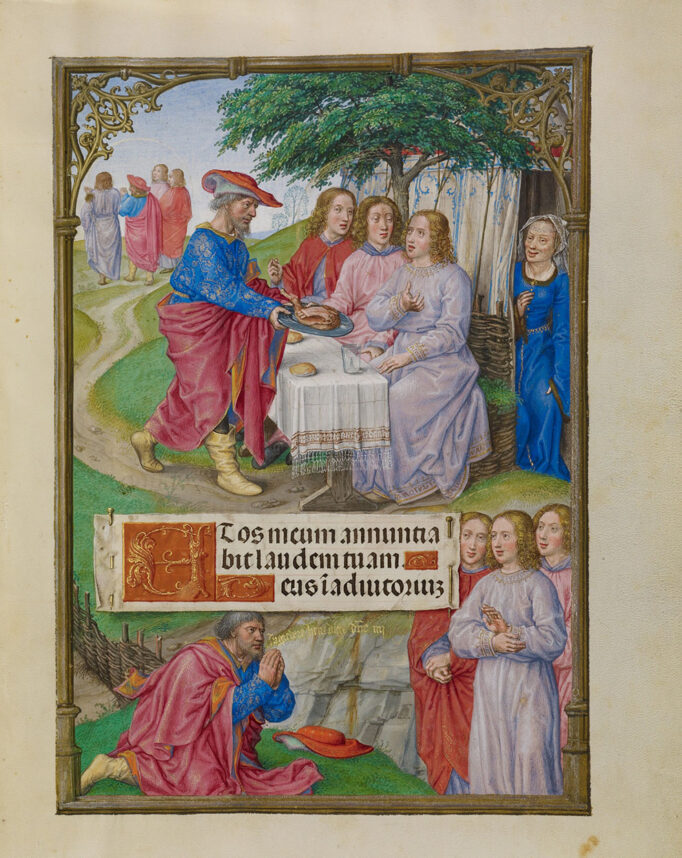

Imagine the scene over 2,000 years ago. Every night, the Jerusalem Temple has been the site of sacrifices all day long. It’s filthy. Yet a group of young kohanim, young priests, are so eager to do the work of cleansing and purifying and starting again that they don’t even leave the building compound. They sleep in a side room next to the altars. The ones who rise early before the sun is out and who immerse themselves in a mikveh so that they’re ritually pure, they are called upon by that day’s head priest to have the privilege of cleaning off the ashes, setting up the altar, and starting the new daily sacrifice, the Korban Tamid.
I was so struck by the eagerness of these people to serve, even though the tasks are not necessarily elevating work. It’s filthy, smelly, strenuous manual work. Yet they are eager to serve the Temple, their people, God.
Their eagerness and their devotion is inspiring. But there’s more; here’s what I noticed in the Mishnah (Tamid 3:8). When these young kohanim are ritually cleansed and after they are selected, they proceed in two lines down two separate parallel hallways, which come together in a single room at the end of the two corridors. And when they arrive in the room where the work is to be done, they unite once more, see each other and greet each other with the following formula: They say, “shalom, ha-kol shalom. Peace. Everything is peace.”
They can’t be so naive to believe literally that their contemporary reality was “peace, that everything was peace.” Their world, like ours, was falling apart. Their world, like ours, was torn between values of power and ostentation on the one hand, and humanity and compassion on the other. Those conflicting values, represented by the civilizations of Rome and Israel were in conflict then, just as those values are in conflict today. The voice of Rome was overwhelming. By the time this story was composed, that Temple was no more. The Romans had obliterated it with their militarism and their violence and their propensity for pomp and power.
Shalom, Ha-kol Shalom is not a surrender to the current reality, it is meant as a challenge, an affirmation, a goad to resistance.
Their greeting is a mobilization and an insistence: Our love will be more resilient than their hate. The grandeur of our vision will rise above their brittle pettiness, and we will bring about, through our dedication and work, a renewed cleansing, a renewed sacrifice, a renewed offering. Kedushah (holiness) and tzedek (justice) will endure and triumph. There will be shalom. But that shalom will be because of the Holy One, and because of us. Not because we accept the way things have always been or even the way things are, but because we are determined to be heirs to the promise.
Our Scripture records the story of a cosmos created by superfluous love and overflowing grace. Through that love was birthed an presence that continues to bring down pharaohs and marches all creation to freedom. “You shall have one law” the Torah commands; we are not any of us free unless we are all free. The Children of Israel marched out of Mitzrayim not just with the descendants of the patriarchs and matriarchs, but with an eruv rav, a mixed multitude that included everyone who shared the dream. And so their descendants and those who share their vision must continue to build a world through hesed, through lovingkindness and compassion.
With this new position, I intend to help my colleagues at American Jewish University to do precisely that.
That is precisely the promise that first attracted me to AJU. And so my first thank you is to the man who hired me, Rabbi Dr. Robert Wexler, and to the faculty and the staff of the then University of Judaism, now American Jewish University, and most of all to my beloved students, past and present. All the staff, lay leaders, students and faculty, thank you, all of you, for being people of vision, people who shatter boundaries, people who see things that I could not have seen without your hand.
My second thank you is to our president Jay Sanderson and the extraordinary team of the AJU board, the Ziegler advisory board, the lay leaders and donors who make up our community, and the remarkable staff who are now ready to go, ready to build this new reality. This position of Distinguished Scholar has never been at AJU before, but it reflects a refined vision of what our life ought to be. Jay, only you could have thought up this wonderful possibility. You invented and then offered something magnificent and I promise you I will work with you to live up to it for the next ten years.
To my dear Roslyn Goldstine: Roz, you told me when we first met at a women’s league conference, three things I’ve never forgotten. You told me I was very young. Young people never think they’re young, but looking back, I just want to tell you, you were right. You also told me that I was not going to remain in Mission Viejo, which I also did not agree with at the time, but it turns out you were right then, too. You also told me your hilarious definition of an optimist: a woman in a synagogue who when the rabbi says “and in conclusion” begins to put her shoes back on. I have no idea if that’s right or not. But, Roz, you and Abner (z”l) have been like family to me for as long as I have been here. And I could not have become me without you and without Abner and now without my dear friend Ethan, who has proven to be quite the leader, quite the visionary himself.
It is a thrill to me that I get to be the Goldstine Distinguished Scholar. And I thank you both, and I thank Abner from the bottom of my heart. A rabbi could not have dearer friends and partners than the Goldstines, and it is my privilege to still carry your name. Thank you.
And then because this gala is apparently a combination of my wake and my bar mitzvah, I just have a few more thanks, if you would indulge me for one more moment.
When I first met Elana, I was 19, and she’s still two years younger than me. We waited before we told our families we were getting married, and our parents agreed that we were still too young. Perhaps, but the best decision I ever made was to link my life to Elana’s. I love you.
Because of Elana’s incredible integrity, intelligence, vision and generosity of soul, we have a golden life. We have two beautiful children who lift my heart every day, Jacob and Shira. And Shira managed to find someone extraordinary, Asher, who has become fully a part of my heart and our family.
And Asher and Shira had the deep wisdom to produce the very best grandson a Zayde could possibly have.
And since they’re here, I also want to salute my beloved mother who is at an age which she uses as a weapon. “I don’t have to do that. I am (fill in the blank) years old.” Here’s one of life’s little jokes: my mother is not at all religious. My mother loves scholarship. She has a big heart and a passion for justice. I would not be the rabbi I am and have always been were it not for my mom. She continues to be my guide in the world.
My dear sister and sister-in-law and brother and niece and nephew and my beloved cousins are here because I am part of the best family on the planet.
I love you all, and you are all my family and community, and I love you too
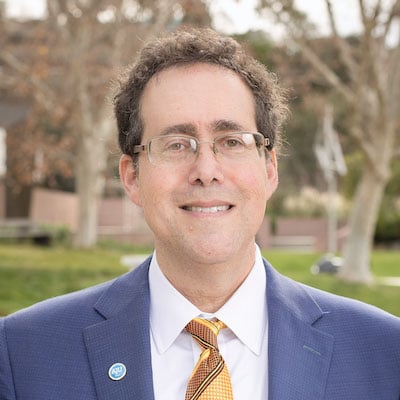
Rabbi Dr Bradley Shavit Artson is the AJU Goldstine Distinguished Scholar while also serving as Vice President of American Jewish University in Los Angeles. He is also Rabbinic Leader of the Abraham Joshua Heschel Seminary in Potsdam, Germany, ordaining Conservative rabbis for Europe, after founding the first Conservative/Masorti seminary in Europe since the Holocaust. He is currently publishing a new book, “Judaism Beyond Belief: Wisdom for People who Simply Want to Thrive” (Monkfish Book Publishing).