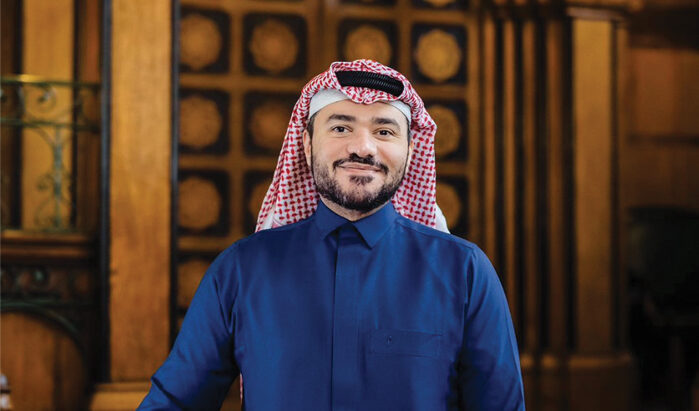
Loay Alshareef grew up a religious Muslim in Saudi Arabia, where he learned that Jews came from pigs and apes, they lived on stolen land in Israel and “The Protocols of the Elders of Zion” was true.
And then, when he was in his 20s, he went to Paris to study French. When he walked into his hosts’ home, he saw a Star of David – and he was horrified. He called up his mother and his school, who urged him to “take his time” and stay. He ended up living in that home for almost a year, where he did Shabbat dinner with his host family and realized his views on Jews were wrong.
Now Alshareef is an outspoken peace activist who welcomes Israelis to the UAE and recently completed a tour of college campuses in the U.S., where he spoke to students about bringing peace to the Middle East.
“I want the American audience on campuses to listen to the critical voices from the regions, from the UAE, Saudi Arabia and the Gulf.”
“I want the American audience on campuses to listen to the critical voices from the regions, from the UAE, Saudi Arabia and the Gulf,” he said. “We believe in peace in the Middle East. “We believe in a reconciliation of the children of Abraham. This is a message not being heard a lot on campuses. I’m doing my part to give people hope.”
Alshareef has a large social media following and has used it to highlight his trips to campuses. He visited USC, speaking to students and posing in pictures with them and Dov Wagner, the Chabad Rabbi. Next to the photos, posted on Instagram, he wrote, “Evil ideologies, like those promoted by the Muslim Brotherhood, seek to keep Muslims and Jews in eternal enmity. We are spreading hope on campuses because we are native Arabs who can effectively debunk this misinformation.”
The pro-peace influencer also met with Tessa Veksler, president of Associated Students at the University of California, Santa Barbara, an Israel on Campus Coalition fellow and a prominent pro-Israel voice on campus. “Peace activists are growing in number, and Loay is an incredible representation of being the unique voice among many standing up for the right thing,” Veksler wrote on Instagram. “As a Muslim and Jewish duo, we are a shining example of coalition-building.”
While touring the campuses, Alshareef met students who he said were “disconnected from what’s really happening.” For instance, at a school in Rhode Island, “people were chanting chants without any idea of what they meant. Did they read the Hamas charter? They have the wrong idea about these people, who they think are freedom fighters. They don’t know Hamas’ ideology.”
What Alshareef believes will change people’s minds – even those who are radicalized – is education. When he visited the Intrepid Museum in New York during his U.S. trip, he read about the Japanese kamikaze pilots during World War II and how they were also radicalized. But with education, they altered their way of thinking.
“It starts with education, whether we like it or not,” he said. “I use social media along with other Arab peace activists to change the narrative on Israel and show great examples of reconciliation between Arabs and Israelis. We are not doing this to serve any political agenda. We are doing this for our children and grandchildren.”
After all, Alshareef can personally attest to the power of education. When he met his Jewish host family and learned about the Torah and other Jewish texts – instead of reading the antisemitic “Protocols of the Elders of Zion” and consuming hateful media – he changed his entire stance.
“I’ve seen the darkness, and I can help overcome it,” he said. “No one will give you the solution for how to change people’s minds and hearts like someone who has been in the darkness, overcame it and went to the light.” Though Alshareef acknowledged he is not in the majority of voices, there are a growing number of pro-peace activists. “People are slowly but surely changing,” he said.
Most of his social media content is in English with Arabic subtitles so that he can reach his Arab audience as well. “It tells them, ‘I haven’t forgotten about you,’” he said. “In my subtitles, I use the right words that touch their hearts because I have been in their shoes. I’ve been there and I know how they think.”
So, where does the Middle East go from here?
Alshareef believes that the Israelis and Saudis will come to an agreement after the war ends and there are some concessions and deals made. “I believe that Saudi Arabia views Israel as part of the region, and peace will take place,” he said. “It’s very close, and of course, peace will benefit everyone.”