fbpx

May 2, 2024

Being Good is Easier to Resist than Sweezy vs New Hampshire

No person can resist what’s evil

try though he may, and should;

but many find that being civil

is harder.  Being good

is something many people find

is easy to resist,

so good is often left behind

as soon as you are kissed,

when being good appears redundant,

the opportunities

for being naughty so abundant

the ones for goodness freeze.


New Hampshire when opposed by Sweezy,

Supreme Court decision

making hateful speech most easy,

gives prejudice permission,

to be as if quite blameless blurred,

mere blarney that’s defended,

and even —-not nem con! — conferred

a right that can’t be ended

for reasons such as anti-sem-

itism, which, though hateful,

woke people often don’t condemn

when anti-Jewish stateful.


Chekhov said: “One cannot resist evil, but one can resist good” (from the “Notebook of Anton Chekhov,” translated from the Russian by S. S. Koteliansky and Leonard Woolf, the concluding volume of the 15 volume “The Tales of Chekhov,” published by The Ecco Press.

In “Colleges Have Gone Off the Deep End. There Is a Way Out,” NYT, 4/28/24, David French writes:

I had my head in a law book when I heard the drums. That was the sound of the first campus protest I’d ever experienced. I’d come to Harvard Law School in the fall of 1991 as a graduate of a small, very conservative Christian college in Nashville. Many of my college classmates had passionate religious and political commitments, but street protest was utterly alien to the Christian culture of the school. We were rule followers, and public protest looked a bit too much like anarchy for our tastes.

But Harvard was different. The law school was every bit as progressive as my college was conservative, and protest was part of the fabric of student life, especially then. This is the era when a writer for GQ magazine, John Sedgwick, called the law school “Beirut on the Charles” because it was torn apart by disputes over race and sex. There were days when campus protests were festive, almost celebratory. There were other days when the campus was seething with rage and fury.

That first protest was in support of faculty diversity, and it was relatively benign. I walked outside and followed the sound of the drums. A group of roughly 100 protesters were marching in front of the law school library, and soon they were joined by an allied group of similar size from Harvard’s John F. Kennedy School of Government. I watched as they danced, sang and listened to speeches by student activists and sympathetic professors. That first protest had an angry edge, but it was also completely peaceful and endlessly fascinating to a kid from a small town in Kentucky who’d never seen a drum circle before.

But things soon got worse, much worse. Protests got more unruly, and student activists got more aggressive. The entire campus was in a state of conflict. In Sedgwick’s words, students were “waging holy war on one another.” Small groups of students occupied administrative offices, and angry activists shouted down their political opponents in class and often attempted to intimidate them outside of class. I was shouted down repeatedly, and twice I received disturbing handwritten notes in my campus mailbox in response to my anti-abortion advocacy. My student peers told me to “go die.”

Watching the protests and experiencing the shout-downs changed the course of my career. I was both enthralled by the power of protest and repulsed by the efforts to silence dissenters. Given the immense cultural influence of American higher education, I agreed with the Supreme Court’s famous words in the 1957 case Sweezy v. New Hampshire: “Teachers and students must always remain free to inquire, to study and to evaluate, to gain new maturity and understanding; otherwise, our civilization will stagnate and die.” Those words, combined with my own negative encounters at Harvard, helped define my legal career. From that point forward, I would defend free speech.


Gershon Hepner is a poet who has written over 25,000 poems on subjects ranging from music to literature, politics to Torah. He grew up in England and moved to Los Angeles in 1976. Using his varied interests and experiences, he has authored dozens of papers in medical and academic journals, and authored “Legal Friction: Law, Narrative, and Identity Politics in Biblical Israel.” He can be reached at gershonhepner@gmail.com.

Being Good is Easier to Resist than Sweezy vs New Hampshire Read More »

A Bisl Torah – Souls Connected

It seems strange to think about Yom Kippur before celebrating Shavuot. However, the Torah reading compels us to think about the Yom Kippur rituals and how they apply to our lives, both during Yom Kippur and every day.

Rabbi Shai Held explains that the verses regarding Yom Kippur are less about the purification of one’s soul and more about the purification of the Mishkan, the traveling sanctuary. He teaches, “A defiled sanctuary is a terrifying proposition because, Leviticus assumes that God will not abide in a place of impurity….The Day of Atonement thus aims to ensure that God’s presence does not depart from the sanctuary, and thus, from the people.” One might assume that because today, there is no physical Temple, these verses would hold less import and significance. However, I find them more relevant than ever before.

The Torah is suggesting that our spiritual impurities leave a stain on the physical building in which we congregate. And in that staining, we stir God’s disappointment and sorrow. How true it is that our personal misgivings have power to negatively impact and transform the greater community. Physical structures aside, we blemish each other when we choose to ignore necessary, daily spiritual introspection. Think about the trail of hurt we forge when we take our grievances from the home to the workplace to synagogue and elsewhere. When we choose to face our mistakes, we choose to elevate ourselves and in return, elevate the communities we touch. Instead of blemishing, we nourish. Instead of defiling, we sustain.

When we regret our mistakes and see their tie to the greater world, God dwells within us. It is God’s presence that demands an ability to see each soul connected to each other. And it is each soul connected to each other that enables the dwelling of God.

Shabbat Shalom


Rabbi Nicole Guzik is senior rabbi at Sinai Temple. She can be reached at her Facebook page at Rabbi Nicole Guzik or on Instagram @rabbiguzik. For more writings, visit Rabbi Guzik’s blog section from Sinai Temple’s website.

A Bisl Torah – Souls Connected Read More »

All the Fish in the Sea – A poem for Parsha Acharei Mot

No man shall come near to any of his close relatives, to uncover [their] nakedness. I am the Lord. ~ Leviticus 18:6

There are plenty of fish in the sea
but not all of them are available to you.
Not your sister or parents or children.
Not anyone with the same last name as you
Or anyone who once had the same last name as you.

This is not how it works in the royal family
but odds are you are not in the royal family.
My mother always suspected she was
in the royal family but no correspondence
ever came confirming it so, I am taking
these prohibitions seriously.

There are plenty of fish in the sea but
you’d be better off with a human anyway.
There are billions of them out there.
The number gets smaller when we
restrict ourselves to the children of
Abraham and Sarah.

Don’t be too concerned about that –
Yes, we are all family, despite distance
and generations of disagreements.
But so much time has gone by
it’s no longer about blood, but
shared interests.

There are plenty of fish in the sea
and birds in the sky, and mammals
in the plains and jungle and
some even dwell in the mountains.

So find the right one to complete you.
Not too similar. Let them complement
what you bring. Let yourself change
as they change until you are definitively
one soul and one flesh whose nakedness
is only available to each other.


Rick Lupert, a poet, songleader and graphic designer, is the author of 27 books including “God Wrestler: A Poem for Every Torah Portion.” Find him online at www.JewishPoetry.net

All the Fish in the Sea – A poem for Parsha Acharei Mot Read More »

State Legislator Demands Federal Probe into UCLA’s Failure to Protect Pupils

In a sternly-worded letter, Assemblymember Rick Chavez Zbur (D-Hollywood)  is urging U.S. Department of Education to do a federal inquiry into the University of California, Los Angeles in the wake of the civil unrest between pro-Palestinian demonstrators and Jewish students on campus this week.

Zbur’s April 30 letter cites “mounting evidence” that demonstrations on campus involved “dangerous, discriminatory practices that flagrantly violate the University’s student conduct policies,” but more specifically “likely violate” Title VI of the Civil Rights Act of 1964. He writes that the Title VI violations include UCLA’s failure to “protect students from discriminatory harassment and from being denied equal access to an education on the basis of race or national origin, which as you know includes ‘shared ancestry or ethnic characteristics’ or ‘citizenship or residency in a country with a dominant religion or distinct religious identity.’”

Zbur’s letter emphasized the imperative of safeguarding students’ First Amendment rights to free expression and peaceful assembly — including speech he “may find offensive, vulgar, or hateful.” Still, he writes there is mounting video evidence of clear violations and little action by the university.

“Video footage published on social media and shared with my office, as well as first-hand accounts from my staff who were present on the campus, show that some students and demonstrators have gone beyond the bounds of protected First Amendment speech,” Zbur wrote.

The letter detailed incidents where pro-Palestinian students were blocking fellow students identifying as Zionists from entering university facilities, including libraries and lecture halls.

Video footage and first-hand accounts “indicate that demonstrators at UCLA are maintaining checkpoints throughout campus with signs such as ‘Zionists not welcome,'” Zbur wrote. One specific incident involved a Jewish student being denied entry to Powell Library, to which Zbur provided the transcript of the concerning behavior that UCLA did not stop.

Jewish Student: “You guys want to prevent Jewish students from entering? Fine.”

Demonstrator: “No, we’ve got a couple Jewish students. Are you a Zionist?”

Jewish Student: “Of course I’m Zionist.”

Demonstrator: “Yeah, we don’t let Zionists in.”

A copy of Zbur’s letter was also sent to UCLA Chancellor Gene Block, California Attorney General Rob Bonta (D) and University of California Board of Regents Chair Richard Leib. Despite claims from Block about increased security measures and the removal of barricades, Zbur’s office found these to be insufficient.

“When my office visited campus hours after the statement was released, they discovered that the library had been closed entirely and the barricades and checkpoints around the entire quad were still in place,” Zbur wrote. “Photos taken by my staff show UCLA-contracted private security present during the assault but failing to intervene to protect the victim. While I appreciate that some attempts have been made by administrators to calm the situation, the alarming reality for Jewish and Israeli-American students has not changed, in spite of the Chancellor’s statement.”

Zbur is calling for Federal authorities to investigate these potential violations and to hold the UCLA administration accountable.

“Not only is UCLA allowing ongoing egregious violations of its own policies in place to prevent such conduct, but it is allowing potential violations of federal civil rights laws as well,” Zbur wrote.

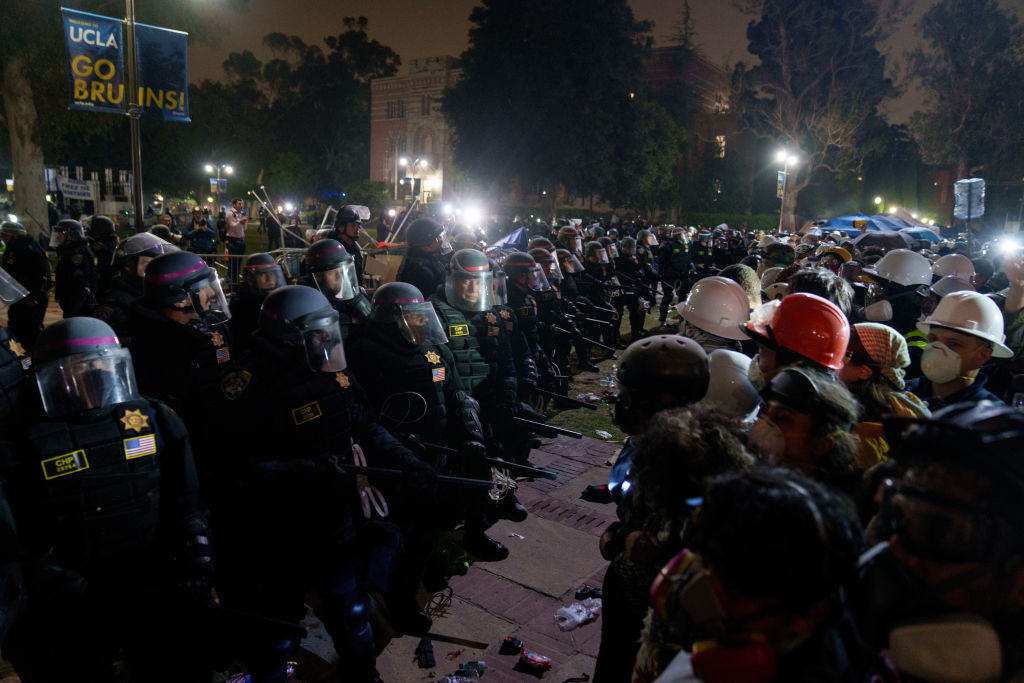
Hours after Zbur sent his letter to Assistant Secretary of Education Catherine E. Lhamon at the Office for Civil Rights in Washington, D.C., the situation at Royce Quad at UCLA devolved into violent clashes between pro-Israel and pro-Palestinian protesters. Video footage of the incidents show private security on site severely outnumbered for several hours leading up to the arrival of law enforcement.

ABC7 reported there were more than “two hours of clashes” with no uniformed campus police or LAPD officers on scene.” According to reports, violence raged from 11:00 p.m. until about 3:00 a.m., when law enforcement began to disperse the crowd.

“Yesterday, my staff witnessed the violent assault of a Jewish student on campus, just one of many antisemitic incidents that have occurred in the last week and in recent months,” Zbur said in a press release on May 1. “Hours later, a violent mob attacked protestors at the encampment with fireworks, pepper spray, and blunt objects, reportedly injuring students and reporters. In both instances, University security failed to prevent the assaults or respond in a timely manner, despite Chancellor Block’s assurances of adequate security on campus.”

Later in the day, Chancellor Block called the previous evening “a dark chapter in our campus’s history.”

Fox 11 Los Angeles confirmed that there were “at least 15 reported injuries” and that “one person required hospitalization.”

Zbur has represented California’s 51st Assembly District since 2022, which includes the entire UCLA campus, Beverly Hills, Hollywood, Santa Monica and Westwood. He currently serves as the Democratic Caucus Chair and a member of the California Legislative Jewish Caucus.

While Zbur waits to hear back about his demand for a Federal inquiry, he remains incensed at UCLA officials.

“While we continue to gather all the facts, one thing is abundantly clear: the UCLA Administration has failed in their most important duty — to protect the safety, wellbeing, and civil rights of all students on campus,” Zbur said.

Below is the text of the letter:

April 30, 2024

Hon. Catherine E. Lhamon Assistant Secretary

Office for Civil Rights

U.S. Department of Education 400 Maryland Avenue, SW Washington, DC 20202

Re: Potential Title VI Violations at UCLA

Dear Assistant Secretary Lhamon,

I am writing to request that your office investigate potential violations of Title VI of the Civil Rights Act of 1964 at the University of California, Los Angeles (UCLA) and take swift action to prevent any further violations of students’ civil rights. Specifically, as demonstrators have created encampments on UCLA’s campus in response to the Israel-Hamas war, mounting evidence indicates that some demonstrators are engaging in dangerous, discriminatory practices that flagrantly violate the University’s student conduct policies and likely violate Title VI’s mandate that universities protect students from discriminatory harassment and from being denied equal access to an education on the basis of race or national origin, which as you know includes “shared ancestry or ethnic characteristics” or “citizenship or residency in a country with a dominant religion or distinct religious identity.”

As the State Assemblymember elected to represent UCLA in the California Legislature and a longtime civil rights leader, I firmly support the First Amendment rights of all students to exercise free speech, to peacefully assemble, and to protest. Free and spirited debate on college campuses is a unique American value that must be protected. All students must have the opportunity to learn how to analyze various viewpoints while developing positions and advocating for them. Indeed, I have advocated strongly for the protection of students’ free speech rights, including protected speech that I may find offensive, vulgar, or hateful.

In 1960, Shelton v. Tucker found “the vigilant protection of constitutional freedoms is nowhere more vital than in the community of American schools.”

Unfortunately, video footage published on social media and shared with my office, as well as first-hand accounts from my staff who were present on the campus, show that some students and demonstrators have gone beyond the bounds of protected First Amendment speech and engaged in unprotected and illegal conduct, including physically intimidating students by blocking their movements, pursuing them aggressively, and even engaging in violence.

Video footage and first-hand accounts from my staff indicate that demonstrators at UCLA are maintaining checkpoints throughout campus with signs such as “Zionists not welcome.” Given that the overwhelming majority of Jews identify as Zionists, and the term is used to describe people of Israeli national origin, this can be very clearly interpreted to mean that Jewish and Israeli-American students may not enter University facilities, including libraries and lecture halls.

In one video posted on Twitter by the account @AGHamilton29, a Jewish student was refused access to the main entrance of Powell Library because he self-identified as a Zionist:

Jewish Student: “You guys want to prevent Jewish students from entering? Fine.”

Demonstrator: “No, we’ve got a couple Jewish students. Are you a Zionist?”

Jewish Student: “Of course I’m Zionist.”

Demonstrator: “Yeah, we don’t let Zionists in.”

I am alarmed and extraordinarily disappointed that the University has allowed the situation to deteriorate with seemingly little regard for Jewish and Israeli-American students’ personal safety and their civil rights as enrolled students. These incidents are well-documented, and UCLA’s administration has acknowledged their awareness of the incidents. Still, they have refused to take sufficient action to protect students’ rights under Title VI.

“I am alarmed and extraordinarily disappointed that the University has allowed the situation to deteriorate with seemingly little regard for Jewish and Israeli-American students’ personal safety and their civil rights as enrolled students.”

Earlier today, UCLA Chancellor Block released a statement claiming that steps had been taken to protect students’ civil rights, including increased security presence and the removal of barricades that protesters had erected to prevent certain students from accessing buildings on campus. When my office visited campus hours after the statement was released, they discovered that the library had been closed entirely and the barricades and checkpoints around the entire quad were still in place. My staff also witnessed a Jewish student being assaulted by more than a dozen demonstrators, as well as demonstrators allowing or denying allowed entry to parts of campus based on the perceived national origin or ethnicity of students. Photos taken by my staff show UCLA-contracted private security present during the assault but failing to intervene to protect the victim. While I appreciate that some attempts have been made by administrators to calm the situation, the alarming reality for Jewish and Israeli-American students has not changed, in spite of the Chancellor’s statement.

Not only is UCLA allowing ongoing egregious violations of its own policies in place to prevent such conduct, but it is allowing potential violations of federal civil rights laws as well. I respectfully urge your office to take action immediately to investigate potential Title VI violations, to hold the University administration accountable, and to protect the civil rights of all students, including Jewish and Israeli-American students.

Sincerely,

RICK CHAVEZ ZBUR

Assemblymember, District Fifty One

Democratic Caucus Chair

State Legislator Demands Federal Probe into UCLA’s Failure to Protect Pupils Read More »

Chancellor Block Addresses Pro-Palestinian Encampment Removal: “It Needed to Come to an End”

UCLA Chancellor Gene Block issued a statement on May 2 addressing the decision to send law enforcement to remove the pro-Palestinian encampment, saying that “it needed to come to an end.”

Acknowledging that the “community is in deep pain” and that the university’s initial response “approached the encampment with the goal of maximizing our community members’ ability to make their voices heard on an urgent global issue,” he admitted the school had allowed it to remain in place “so long as it did not jeopardize Bruins’ safety or harm our ability to carry out our mission. But while many of the protesters at the encampment remained peaceful, ultimately, the site became a focal point for serious violence as well as a huge disruption to our campus.”

Block added that the clashes between protesters and counterprotesters fostered an “unsafe” environment. “Demonstrators directly interfered with instruction by blocking students’ pathways to classrooms,” he said. “Indirectly, violence related to the encampment led to the closure of academic buildings and the cancellation of classes. And frankly, hostilities were only continuing to escalate.”

In the end, he said, “the encampment on Royce Quad was both unlawful and a breach of policy. It led to unsafe conditions on our campus and it damaged our ability to carry out our mission. It needed to come to an end.”

The chancellor claimed that the university sought to negotiate “a peaceful and voluntary disbanding of the encampment” but no agreement was brought to fruition.

“To preserve campus safety and the continuity of our mission, early this morning, we made the decision to direct UCPD[University of California Police Department] and outside law enforcement officers to enter and clear the encampment,” Block said. “Officers followed a plan that had been carefully developed to protect the safety of protesters at the site. Those who remained encamped last night were given several warnings and were offered the opportunity to leave peacefully with their belongings before officers entered the area. Ultimately, about 300 protesters voluntarily left, while more than 200 resisted orders to disperse and were arrested.”

The area is currently being cleaned, and the university has asked people to stay away from the area.

Block said he recognized “the significance of the issues behind the demonstrators’ advocacy.” “The loss of life in Gaza has been truly devastating, and my administration has and will continue to connect with student and faculty leaders advocating for Palestinian rights to engage in discussions that are grounded in listening, learning and mutual respect,” he stated. “Similarly, we will continue to support our Jewish students and employees who are reeling from the trauma of the brutal Oct. 7 attacks and a painful spike in antisemitism worldwide.”

We will continue to support our Jewish students and employees who are reeling from the trauma of the brutal Oct. 7 attacks and a painful spike in antisemitism worldwide.”- Gene Block

The university is investigating the violent incidents that have occurred on campus, he said, as well as the university’s “security processes” the night of April 30 when clashes took place between pro-Israel and pro-Palestinian protesters.

Siamak Kordestani, West Coast Director of the Friends of European Leadership Network, criticized Block’s statement for “not condemning the vandalism of one of, if not the most, iconic UCLA buildings,” referencing Royce Hall. “Shameful.”

Police had announced dispersal orders to the encampment on the evening of May 1, resulting in a several hour-long standoff between protesters and law enforcement before the police broke through the barricades protesters had set up.

The university will be holding classes remotely for the rest of the week.

Chancellor Block Addresses Pro-Palestinian Encampment Removal: “It Needed to Come to an End” Read More »

Police Clear Pro-Palestinian Encampment at UCLA

Following a long standoff, law enforcement dismantled the pro-Palestinian encampment at UCLA on  May 1-2, reportedly arresting more than 200 protesters.

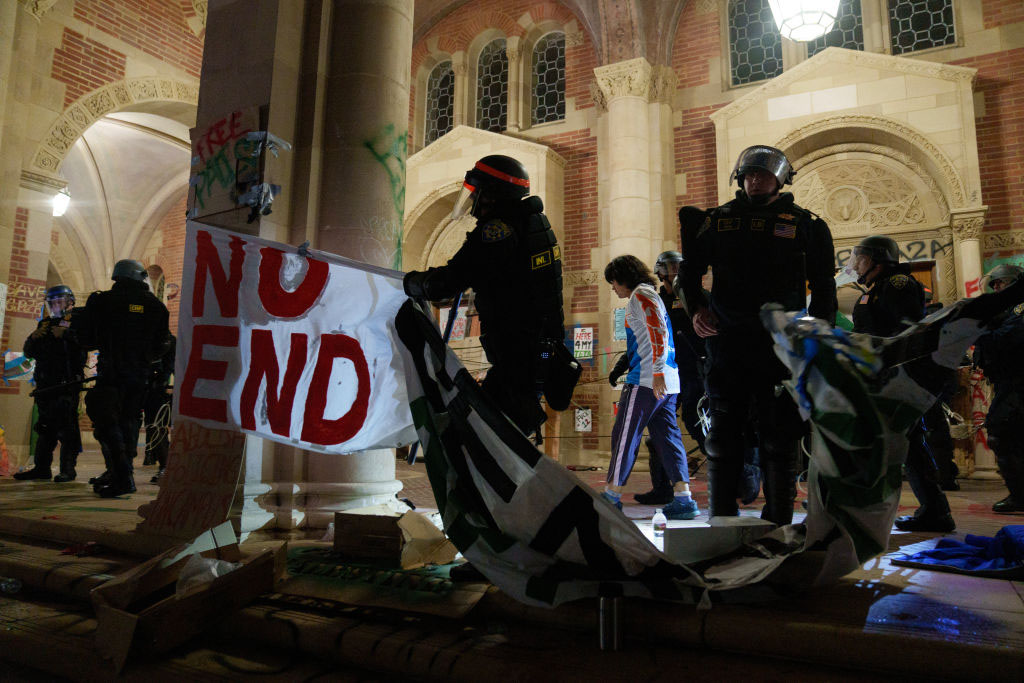
According to reports, police announced a dispersal order to the protesters at 6 pm; setting off a standoff that lasted several hours before police moved in. Some of the protesters formed a human chain and attempted to resist the police, but police in riot gear broke through the barriers and swept through the encampment. While the majority of the protesters reportedly left voluntarily, the protesters who remained in the encampment were arrested. Fox 11 Los Angeles reported those arrested were subsequently released but are being charged with unlawful assembly, which carries a maximum sentence of six months in jail or a $1,000 fine.

Video of the police clearing out the encampment can be seen on social media.

Journalist Cam Higby shared screenshots he claimed were from the encampment’s Telegram chat as the police took action.

Video of the aftermath shows the entire area the protesters occupied — and even some nearby areas — covered in graffiti and littered with garbage.

A clean-up of the area is currently underway.

Fox 11 also reported that some protesters returned to the encampment to take some of their personal belongings and that one protester shouted, “This is not over!”

The university announced on May 2 that classes will be held remotely for the rest of the week and that anyone who remains in the encampment “will be in violation of the law” and could be disciplined.

“It’s a very sad day for UCLA and Bruins everywhere. Last night was devastating and the aftermath is devastating.” – UCLA Hillel Executive Director Dan Gold

“It’s a very sad day for UCLA and Bruins everywhere,” UCLA Hillel Executive Director Dan Gold told the Journal. “Last night was devastating and the aftermath is devastating. Hillel at UCLA, like always, is first and foremost thinking about our Jewish students and all of UCLA’s student and hope that everyone comes together to support the well-being of each and every one of them. We are grateful to the university leadership and the local authorities for taking the difficult steps to enforce their polices and start the process of bringing order back to our campus. We are praying for continued calm. We also know there will be a lot to reflect on in the coming days and weeks ahead about the anti-Jewish and anti-Zionist hate and rhetoric that was part of and in parts of the encampment. Our Hillel will continue to do what’s best for the Jewish students, their pluralistic identities, and the antisemitism they face on campus.”

Police Clear Pro-Palestinian Encampment at UCLA Read More »

The Assault: A Coordinated Attack on America’s Jews and Israel

Many of my readers and former students have expressed frustration in the “depressing” manner in which I have interpreted current Jewish political news. Indeed, my messaging is often framed in a problematic context, sadly reflecting the state of Jewish and public affairs.

In so many ways, two articles have defined my take on the current realities. The themes in these publications speak to the deeper sense of anguish that we are feeling and seek to describe the “unsettled” character of the Jewish condition.

Since releasing these essays, the events, beginning with October 7th and involving the most recent anti-Israel campus mobilization, have so clearly brought into perspective this moment. In this essay, I am moving this troubling scenario forward.

When considering the current crisis, folks often begin with the question of, “So why now?” In some measure, as Simon Montefiore has suggested in his new volume, “The World, A Family History of Humanity,” we as a civilization are reverting to an earlier, more traditional, political timeline of defined and minimized roles, where minorities, such as the Jews, will be returning to their former status as marginalized petitioners. His argument confirms the end of a distinctive but non-normal period of Western and Jewish liberalism and acceptance.

During these past 75 years, and more generally, over these last 150 years, Jews have held a fundamentally different political status and economic place in Western societies than in previous times. Both the collective and personal achievements that have defined the modern Jewish condition were without precedent, and in turn, Western societies have exhibited a more open tolerance, allowing for a Jewish renaissance of power and influence.

The factors now contributing to the undoing of this unique era are at hand. Five elements explain this moment.

First, even as Jews may have contributed to the world of new technologies, the advent of the internet and the presence of social media platforms have been the staging areas for much of the adverse messaging now being directed against Israel and global Jewry. This has been the seedbed for creating the new antisemitism that is today serving to marginalize Jews and undermine the State of Israel.

Second, beginning in the 1970s, political scientists began to note the decline of trust in core Western institutions, and with such a loss of confidence and belief in the infrastructures of our democracies came a corollary pushback directed against the central actors and decision-makers associated with these centers of power. Jews are seen as being a part of an elite class of influencers who helped to shape contemporary culture, the economic marketplace, and the political agenda. This assault on the status quo not only sees Jews as fellow travelers contributing to the “white” dominated political and economic order but also as the architects of many of its core policies that have ensured their positions of power.

Since the onset of this century, accompanying this assault on trust, we have encountered an environment where public discourse and conduct have given way to conspiracy theories, racist messaging, and antisemitic rhetoric and action. This new level of incivility has been fueled by social media and the expanded possibilities of creating “fake” news and alternative outcomes. We are living in a political culture in which public debate is being reduced to a base level of distrust, where alternative viewpoints are often labeled and minimized, and where one’s opponents are marginalized. All these countercultural expressions led to such transformational moments as Charlottesville’s Unite the Right Rally (2017), the antisemitic attack at Pittsburgh’s Tree of Life Synagogue (2018), and the January 6th civil insurrection (2021).

In this period, we are experiencing a changing generational dynamic. In connection with the Gen Z phenomenon, we are being introduced to a cohort whose educational orientation and socialization experience are fundamentally different from prior generations. Minimally exposed to classroom civics and American history, this age group has been far less connected to the rhythm and traditions of the earlier periods of this nation’s social and cultural evolution. In its place, this is the first generation to be raised on the internet, with all its problematic realities. As a result, our newest and largest generation is entering the world with a highly limited but distorted view of history, culture and politics, driven and shaped by the platforms of social media.

As these Gen Zs move forward, they are being exposed to the full imprint of post-modernism, with its critique of Western culture, democracy and the economic order. Intersectionality, Critical Race Theory and Woke Culture are all being layered onto the mindset of this new emerging constituency.

Beyond these individual factors, we are observing how the cultural artifacts of institutions are being debased and, in some instances, minimized. We are observing that younger constituencies are prepared to minimize history, reject culture, and dismiss a group’s storyline.

Today’s language of the street, with its distortions of Zionism, misrepresentations of Judaism, and its outright dismissal of the Jewish people, is both unsettling and troubling, as these players are attempting to rewrite the Jewish narrative concerning who we are and what we represent. As with the Nazis and other enemies of our people, the messages being conveyed by these activists seek to deny both our presence in the land of Israel and our historic connection to this holy space. Our opponents in this moment are calling for our genocide, comfortably aligning themselves with those in prior periods who were committed to seeking our demise.

Our opponents in this moment are calling for our genocide, comfortably aligning themselves with those in prior periods who were committed to seeking our demise.

A new American alliance appears to be emerging that is comprised of an alignment of minority religious, ethnic and racial voices, many of whom we once considered our allies. This new coalition is directing its messaging and organizing itself against Israel and American Jewry, with support from a cadre of academic groups, a coalition of national organizations, and a core of political elites. In turn, this effort is being supported by a collection of foreign interests.

The dismembering of the American Jewish political story is designed to weaken the United States’ support for Israel, question American Jewish policies and behaviors, and seek to undo the influence and status of Jewish Americans. This displacement is well underway.

As we awaken to our new political reality concerning our changing status and position, we will be undergoing a degree of communal shock and a profound sense of political dislocation. In moving forward, we must employ our resources wisely, refine our core objectives, and rethink our messaging to maximize positive outcomes as we enter this new day in America.


Dr. Steven Windmueller is an Emeritus Professor of Jewish Communal Studies at HUC-JIR, Los Angeles. His writings can be found on his website, www.thewindreport.com.

The Assault: A Coordinated Attack on America’s Jews and Israel Read More »

We Need Tactical Training to Combat Campus Antisemitism

In the past few weeks, I have visited numerous college campuses and watched the antisemitic madness grow. I have also spoken to many groups about how the progressive ideologies that have been ascendant in higher education have left campuses and have permeated the mainstream, now heavily influencing the media, corporate culture, and many facets of our nation’s government. Jewish students are now under extreme threat and duress.

In response, various donors, groups, professors, and leaders have spoken out against this Jew hatred. Most recently, major Columbia donor Robert Kraft suspended his giving. And Jewish communal organizations like the American Jewish Committee have been calling on universities and their leaders to keep Jewish students safe on their campuses. As AJC CEO Ted Deutch said: “We will not accept conditions that are so fraught for Jewish students that they rightfully fear attending classes or going to the library on campus.”

But even with all this valuable pushback and more, the critically important localized responses have been remarkably weak, poorly coordinated, and ineffective. What we need now is on-the-ground tactical training for Jewish student activists and leaders. This strategy has been neglected and is something that must be corrected if the Jewish community is going to push back against this madness and protect college students.

I share this idea now because I am regularly asked what can be done to address the dangerous post-October 7 environment on many campuses as many have noticed that the elite level responses and attempts to help put an end of the violence and intimidation are simply not working in the short run, and the dangers are increasing as schools cancel classes, change finals, and cancel graduation ceremonies. Fortunately, there are some concrete and powerful steps that the Jewish community can take on the campus or local levels that can complement the various legal and Title VI claims that are mounting along with varied lobbying attempts.

Immediately, the many Jewish institutions that have established campus outreach initiatives or programs to address antisemitism need to coordinate and collaborate effectively. Jewish students do not need or want numerous online pages and “helpful” literature or guides. There is constant talk of various top-heavy initiatives and education to teach about the history of Jews, as well as Jewish leaders and organizations releasing statements about campus troubles or debating narrow-minded, antisemites on major mass media.

But none of this is effective—not if we want to help students on campus right now.

Students report to me that while they appreciate the various efforts, they remain confused about how the organized community’s actions and statements asking for help and intervention will actually change anything for them. For weeks if not months, Jewish students have been worried about the calls for their extermination and most recently, many feel they can no longer safely set foot on their own campuses.

In reality, Jewish students want and need on-the-ground support, real legal and practical guidance, and the reassuring conviction that they are not alone. Despite not being widely seen in the public, calls for Jewish harm are widespread and known to Jewish students. A now former Columbia student was expelled after a video surfaced showing this student stating, “Zionists don’t deserve to live” and “Be grateful that I’m not just going out and murdering Zionists.” Sadly, students also know that he is far from being the only one harboring such sentiments.

Since October 7, Jewish students have been managing calls for their death and various other threats along with numerous instances of antisemitism from many administrators and professors in dining halls, dorms, and even classrooms. Far too many Jewish students have been assaulted and attacked; they understandably feel unsafe. With good reason, Jewish students at Columbia were told by Rabbi Elie Buechler, Director of the Orthodox Union-Jewish Learning Initiative on campus, to “return home as soon as possible and remain home until the reality in and around campus has dramatically improved.”

But as sound as his advice may have been, the many students who have stayed on campus have too often been left to fend for themselves. It is critical that students and collegiate Jewish communities have the tools and backing to manage this crisis. Unfortunately, off-campus Jewish groups are not focused on supporting the students directly. This needs to change.

It is critical that students and collegiate Jewish communities have the tools and backing to manage this crisis.

They can help students in many ways. As one example, students need legal counsel and professional and practical help to know that their rights and legal protections are intact. They need the proper support and services to hold others who are committing hate crimes against them accountable.

A second critical area of need now involves improving the Jewish community’s media performance and messaging. Tragically, the Jewish community has lost control over the narrative. The false narrative that Israel is committing genocide is being disseminated at too many campuses. These same players also work to delegitimize the Jewish state’s right to exist.  Campus Jewish community leaders would benefit from media training along with preparation on conflict diffusion and crowd management tactics.

Over the years, I have experienced absolutely unhinged student protestors in my face, spitting at me, screaming, and calling me a host of things from a rapist to a genocidal maniac; some even threatened to murder my children. I have learned how to react and not to give them the rise that they seek.

Regrettably, we now need to train our Jewish community leaders and our students to contend with similarly hate-filled crowds. Jewish students need to take control of the narrative and present well in print, online, in public actions, and protests. While one of the most effective ways to push back and change the narrative. The Jewish campus leaders need clear talking points and must know how to respond to lies and misinformation. We need to train the students and leaders to debate in uncomfortable situations and to demonstrate that Israel has the right to exist and that it is not committing genocide. This is a ground game and rather than debating progressive ideologues on podcasts and an TV, the Jewish community must support the students and community organizations that are on the front lines of this tragedy.

A powerful and instructive video at UCLA shows a student handling a purported professor who appears unhinged and maniacal, incapable of reasoned thought and dialogue. The student however is calm, reasonable, and holds the professor accountable for her claims that Israel has been committing genocide. The professor cannot handle the student’s impeccable logic and the video shows her becoming increasingly agitated, angry, and frustrated, eventually screaming for help because she was not able to answer basic questions about what she was protesting.

And then there’s the matter of local support. Our nation’s colleges and universities are not isolated. Schools like Columbia, Northwestern, and the University of Pennsylvania that have seen incredible hate are embedded in areas with large Jewish populations. Local Jewish communities need to come to campus and show support for the Jewish students. This does not mean being aggressive or behaving in ways that are unethical or dangerous. But it does mean making it known to both Jewish students and the campus communities at large that Jews are here to support one another. I know that the experience of solidarity when hundreds of pro-Israel supporters recently showed up outside Columbia’s gates was deeply appreciated and affirming to many students last week.

Without question, the Jewish community has every right to be outraged, scared and anxious since October 7th. But the time for shock and confusion is over. Truths have been revealed and we know just how deep the antisemitic rot is in our institutions of higher education. It is now time to fight this madness on the ground and not only in the halls of Congress, the national mass media, and alumni associations. It is time to change tactics and equip Jews on campus and in the surrounding communities with the requisite tools and training. Certainly, Jewish communal actions and impending federal intervention will help as will the avalanche of litigation coming. But Jewish students need support immediately and with the right help, can be more knowledgeable, mobilized, organized, competent and effective.

Truths have been revealed and we know just how deep the antisemitic rot is in our institutions of higher education.

With so many school terms ending in the next few weeks, Jewish students will have a moment of peace and a second to pause. But the Jewish community should see the summer break as an opportunity to prepare for the long run. The fall term may be quieter than the spring, but there is no reason not to prepare for the worst and help train our younger Jewish community members in how to manage the far too frequent calls for their destruction.

Organizations can and should work on top level change and reform. But they cannot continue to overlook the ground game that students are facing. The time is now for the Jewish community to step up and provide this care. For we as Jews are commanded (Shavuot 39a) to care for our own community as we are all interconnected, share a linked fate, and must be prepared to help each other. Or as Hillel famously commented (in part): “If I am not for myself, who will be for me? And if not now, when?”


Samuel J. Abrams is a professor of politics at Sarah Lawrence College and a senior fellow at the American Enterprise Institute.

We Need Tactical Training to Combat Campus Antisemitism Read More »

Chico Menashe: Asif: Culinary Institute of Israel, Cooking with Chutzpah and The Open Kitchen Project

Chico Menashe is the CEO of Asif: Culinary Institute of Israel, a nonprofit organization and culinary center in Tel Aviv. Founded in 2021, Asif is dedicated to cultivating and nurturing Israel’s diverse and creative food culture.

“It’s an Israeli food culture, not specifically Jewish culture,” Menashe told the Journal. “We have influences from all over the world.”

When asked about the fascination with Israeli food, Menache said it’s the combination of traditions.

“So many societies came into Israel and created this big pot of cultures,” he said. “Everyone came into Israel with its own heritage and gave its part to this cultural asset.”

He believes that it’s not an accident that so many Israeli restaurants are succeeding.

“This Israeli combination of creativity, of innovative thinking, of daring – this Israeli chutzpah – doesn’t happen only in Israeli high tech or in the Israeli military,” Menashe said. “It happens also in the kitchen.”

Israeli food is part of the essence of Israeli culture as a whole.

Having more chutzpah in the kitchen starts with being open to new ideas, recipes and tastes. Find new recipes, whether it’s on Asif.org, another website or a cookbook, buy unfamiliar ingredients and try them out.

“This is part of the Israeli way,” he said. “You might like it, you might not, but dare to try.”

Recipes from Asif are below.

One of Asif’s latest initiatives is the Open Kitchen Project, where Israeli locals open their homes to people who have been displaced by the war and need a place to cook. The first few months of the war, Asif prepared 1500 meals a day for evacuees and others. Feeding people is so important; giving them a place to prepare beloved meals is priceless.

“We are the matchmakers between the cooks that were displaced from their homes on October 7th and the locals that wish to open their kitchens,” Menashe said.

There’s a lot of logistics that go into this; some need strict kosher kitchens, others do not. Sharing food, recipes and traditions have been invaluable to all.

“We found out that we created not only a connection between individuals, we connected families and after that we created a connection between communities,” Menashe said.

In one instance, one of the cooks wanted to bake a few cakes for their community in the Tel Aviv hotel; thousands of people still live in the local hotels.

“She started cooking five or seven cakes,” he said. “It turned out successful and she decided to make 20 cakes in one day, but the lady that hosts her has only two ovens.”

Embracing the chutzpah part of cooking in Israel, she starts knocking on the host neighbor’s doors, asking, ‘Can we use your kitchen for an hour or two?’ Most of the people said, “Yes.” They made more than 20 cakes that evening.

“We have so many of these types of stories,” Menashe said. “There is such a connection in the kitchen … between two ladies [who] met for the first time on that evening.”

He added, “It’s a spark that happens there; a real magic in the kitchen.”

At the Asif test kitchen, they try out some of these dishes, write the recipes professionally and take photos. They also gather the backstories.

“The ones that we recognize that bring special cultural, traditional value we put on our website,” he said. “It’s an online treasure box of families’ unique recipes with their stories, with their traditions, with their heritage.

“It’s something we’re really both inspired by and proud of.”

To learn more about Asif and the Open Kitchen project and get more recipes, go to Asif.org.

For the full conversation, listen to the podcast:

Sylvie Atias’s Stuffed Artichokes

Photo by Dror Einav

18 artichoke bottoms, fresh or frozen

For the sauce:

½ cup olive oil

2 onions, finely chopped

Approx. 3 cups chicken stock or water

½ Tbsp ground turmeric

½ tsp black pepper

1½ tsp salt

For the filling:

500 grams (1.1lb) ground beef

1 large onion, chopped

1 small potato, peeled and grated

½ bunch parsley, chopped

1 egg

4 Tbsp olive oil

½ Tbsp paprika

½ tsp cumin

½ tsp ras el hanout

½ tsp salt

½ tsp black pepper

To serve:

½ lemon, juiced

Prepare the sauce: Heat the olive oil in a wide pan over medium heat. Add the chopped onions and cook until golden brown, 20-30 minutes.

Add stock or water, turmeric, black pepper and salt and bring to a boil. Reduce to a low heat and cook for 15 minutes.

Prepare the filling: Place all the ingredients in a bowl and mix well. Divide the mixture into 18 equal meatballs and press each meatball into an artichoke bottom.

Place the stuffed artichoke bottoms in the sauce so that they are submerged halfway, and bring to a boil. Reduce to a low heat, cover and cook until the artichokes are soft and the meat is cooked, about 30 minutes. Squeeze lemon juice on top and serve.

Lizi Ezra’s Veal Sweetbread Stew

Photo by Dror Einav

1 tomato, diced

1 red bell pepper, thinly sliced

1 green bell pepper, thinly sliced

1 shifka (or other pickled hot) pepper, chopped

6-7 garlic cloves, thinly sliced

1 bunch cilantro, finely chopped

2 Tbsp paprika

½ tsp chili flakes

1 tsp turmeric

1 tsp ground white pepper

1½ cups boiling water

¾ cup vegetable oil

1 tsp salt

500 grams (1.1 lb) veal sweetbreads, cleaned (you can also use frozen sweetbreads)

Line the bottom of a wide pot with the tomato slices.

Add the sliced peppers, garlic, ½ bunch chopped cilantro, paprika, chili flakes, turmeric and ground white pepper.

Pour the boiling water on top and cook for 5-7 minutes over high heat, until the vegetables lightly soften.

Add the oil and mix well. Lightly season with salt (exercise caution with the amount of salt added, as sweetbreads tend to have a natural saltiness) and cook, uncovered, over low-medium heat for 30 minutes.

Add the sweetbreads and cook over medium-low heat for 40 minutes. Using a wooden spoon, gently press the sweetbreads into the sauce, ensuring they are fully submerged.

Sprinkle the remaining chopped cilantro on top, cover and cook for 1½ hours, stirring occasionally. Check the stew every 30 minutes; the sweetbreads should change color and become tender in texture. Serve alongside steamed white rice and roasted vegetables.


Debra Eckerling is a writer for the Jewish Journal and the host of “Taste Buds with Deb.Subscribe on YouTube or your favorite podcast platform. Email Debra: tastebuds@jewishjournal.com.

Chico Menashe: Asif: Culinary Institute of Israel, Cooking with Chutzpah and The Open Kitchen Project Read More »

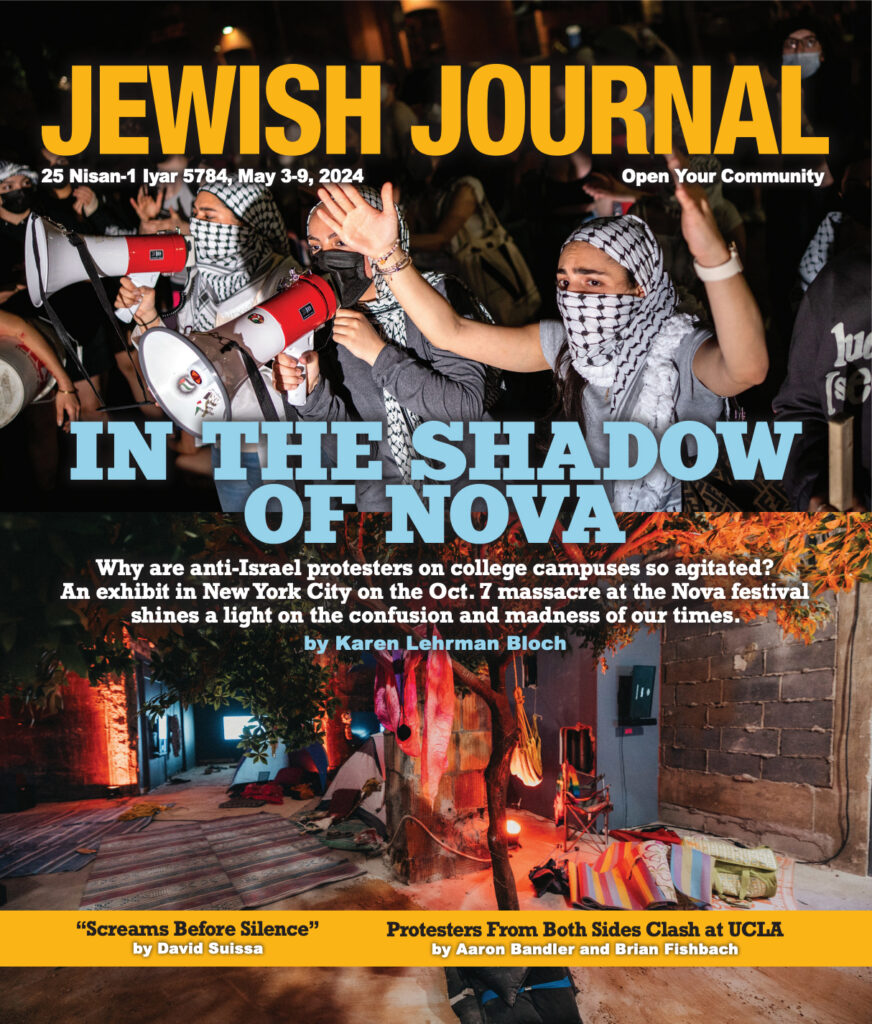
Print Issue: In the Shadow of Nova | May 3, 2024

CLICK HERE FOR FULLSCREEN VERSION

Print Issue: In the Shadow of Nova | May 3, 2024 Read More »