
fbpx

May 2, 2024

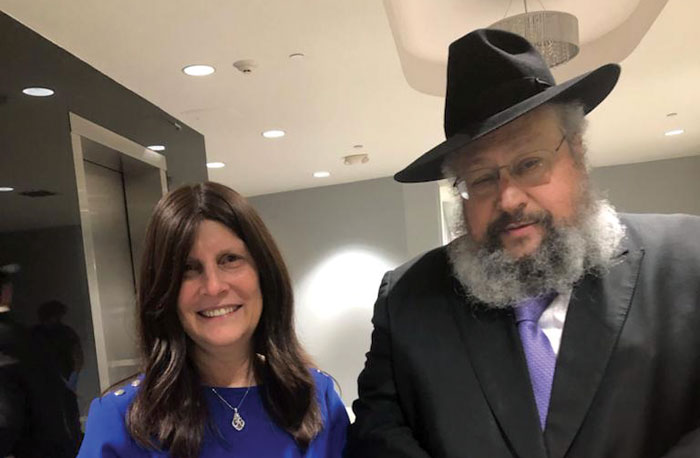
Rabbis of LA | This Year, 44 Is Rabbi Mordy’s Magic Number

When Rosh Hashanah arrives the first week of October, Rabbi Mordechai Einbinder will turn 44 twice: 

His 44th wedding anniversary with Rebbetzin Chave, mother of their 11 children, and the next day his 44th anniversary as leader of the sprawling Chabad of the Valley community based in Tarzana.

As arguably the most outgoing Jew in the entire San Fernando Valley, Rabbi Einbinder, known to all as Rabbi Mordy and in his 60s, was asked if he is slowing. “In some ways,” he said. “But I have become energized and taken on new things in other ways.  

He has his own theory of relativity. “If you’ve two hairs on your head, you are pretty bald. The same two hairs in your chicken soup in a restaurant on Pico Boulevard, it’s a lot. You send it back. You see, it’s relative.” But when “a man reaches 60, three things in his life get worse: First is your memory. The other two I just don’t remember.” But he recalls with precision the day his life was shaped for him. Born into a traditional Chabad family, the youngest of four and the only boy, he grew up in New Haven, Connecticut. Einbinder was 12 and a half years old when his parents drove him to Crown Heights for a revealing visit with the Lubavitcher Rebbe. It was the first of many he would have with the legendary late leader of Chabad. They conversed in Yiddish, which the young boy had learned. After imparting blessings, the Rebbe switched to English. “When you grow older, you will become my personal emissary.” 

More than 50 years after the childhood forecast, Einbinder wears the Rebbe’s emissary designation as a golden badge.  And the Rebbe’s prediction came true. After moving to Southern California in 1976 as a yeshiva bochur to work with the late Rabbi Joshua Gordon, who made the valley bloom for Chabad from his Encino headquarters, he was one of a dozen young men chosen to be the Rebbe’s representative and strengthen Chabad’s Torat Emet yeshiva in Jerusalem. Returning from Israel as educational director of the empire Rabbi Gordon was building, he was asked to partner with Gordon.

The young Einbinder at first demurred. “I did not come out here to raise money,” he said. “But I saw what Rabbi Gordon went through every day, and I had a knack for it. I started bringing in a lot, a lot of money.” He discussed the offer with Rabbi Shlomo Cunin, appointed by the Rebbe as leader of Chabad in California in 1965. Einbinder pledged “I will not elevate myself without the Rebbe’s blessing and guidance.” The Rebbe concurred. Ever since “we have been partnering to build Chabad of the Valley,” today comprising a sprawling 32 institutions.

“We reach out to everybody. We have in our synagogue people who can’t read Hebrew and people who are religious scholars. We have the full potpourri and kaleidoscope, which is the Rebbe’s work.”

As Einbinder pointed out, “since 1980, there has been an explosion of Yiddishkeit. Many different shuls have opened. People have pointed the finger at us. Other than the market Ventura Kosher Meats back then, there wasn’t much in our realm of religiosity.”He takes pride in the variety that identifies his shul, also known as Chabad of Tarzana. “We reach out to everybody,” he said. “We have in our synagogue people who can’t read Hebrew and people who are religious scholars. We have the full potpourri and kaleidoscope, which is the Rebbe’s work.”

Einbinder’s father was a model of a deeply religious parent and a lifelong Torah learner, a pillar of the community. He owned “a decent business,” the younger Einbinder said, as a wholesale paper distributor. The elder Einbinder wanted his only son to eventually take it over.

His father’s vision never had a chance though after the Rebbe’s prophetic words when young Mordy was en route to becoming bar mitzvah. “Those words about being an emissary built me up,” he says. “My father was champion of the community when it came to kindness, sweetness and goodness. Both of my parents were very special – I could talk for hours about them.”

With that, he launched into a childhood scene stamped on his mind with love. One day when he was seven, he walked in the front door and immediately could see the family atmosphere had been disrupted. “When I see it’s not the normal tempo, I say ‘Ma, what’s wrong?’ She said my father had been called in for an audit by the IRS.” Even after his mother explained what IRS meant, it made scant sense to her son. “My father was a very honest person,” Einbinder recalled. “It would make us nervous how honest he was. The elder Einbinder insisted his tax returns squeaked with cleanliness. At first, the government agents did not budge. “We noticed the amount of charity you gave this past year,” they said. “We know you always give a lot, but this year it is off the scale … It’s a major part of your income. We want proof it is real.” Seemingly unshaken, Rabbi Einbinder’s deeply religious father showed the agents every receipt and canceled check. His records were scrupulously itemized. 

“Charity is the most important thing in life,” the elder Einbinder said. He told the IRS agents that his mother had died during the past year, and when a mother passes away, the greatest way to elevate a soul is by giving charity. With that, the rarely stunned IRS agents stood up, walked over and hugged the man they wrongly had suspected. The IRS eventually apologized to him.” 

When the conversation returned to the present day, Einbinder talked about the Gaza war. “Not a week has passed,” he said, “that I haven’t spoken about it between Mincha and Ma’ariv, and on Shabbos. I don’t look for peace. I look for safety and security. Peace will come when Moshiach comes. A two-state solution is a tragedy.” 

Fast Takes with Rabbi Mordy

Jewish Journal: What do you do in your spare time?

Rabbi Mordy: I try to sleep.

J.J.: The most influential book you have read outside of Judaism?

RM:  George Orwell’s “Animal Farm.” Political satire touched me deeply.

J.J. Do you have any unattained goals?

RM: All of my goals are unattained because when persons find completeness and totality in what they are seeking, then they are missing the point. This is what the Rebbe accentuated: You are getting older, slow down. But don’t retire because then you will get old fast.

Rabbis of LA | This Year, 44 Is Rabbi Mordy’s Magic Number Read More »
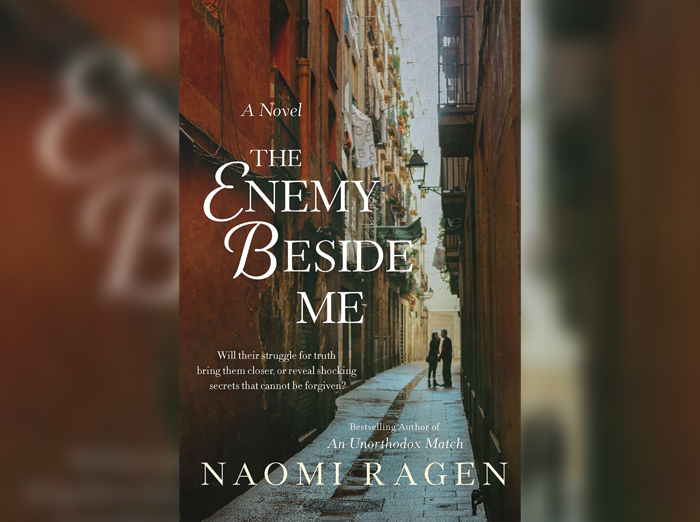
‘The Enemy Beside Me’: Can the Truth of Lithuania Holocaust History Be Told in Lithuania to Lithuanians and By Lithuanians?

Only once in my professional career did I assign a work of fiction to my syllabus for a history course. The story-teller was the incomparable Philip Roth and the book was “The Plot Against America,” Roth’s fictional account of what might have happened had Franklin Delano Roosevelt lost the Presidency to the antisemitic, isolationist aviation hero Charles Lindbergh, who might have allied the US with Hitler and come after the Jews. No book of history that I could have assigned could quite convey the ethos of the 1930s and the turmoil of America. In fact, Roth’s work was so compelling that the first time I read it, I turned to the ending just to make sure that I was remembering history correctly.

While Israeli-American author Naomi Ragen might rightfully be thrilled to be compared to Philip Roth – she is not quite there yet, but few are – she has written a novel that reveals the truth of two historical moments, the Holocaust in Lithuania and the struggles in Lithuania to come to terms with that history. Recall that two out of three Jews murdered in Lithuania during the Holocaust were killed by Lithuanians, not by Germans and several of these Lithuanians murderers are now honored in some quarters as nationalist heroes who helped achieve Lithuanian independence.

There have been multiple books in recent years covering this historical ground. Ruta Vanagaite and Efraim Zuroff’s “Our People: Discovering Lithuania’s Hidden Holocaust” tells the story of the granddaughter of a Lithuanian perpetrator and the nephew and namesake of a Lithuanian Jewish victim, who took a 40-day journey to the sites of destruction to learn of the past and to confront the present. Silvia Foti, an American of ardent ethnic Lithuanian roots, set out to fill in the story of her heroic grandfather only to discover that contrary to the legends she was told, he had murdered Jews and was anything but a hero. Telling the truthful story of this imagined past sent ripples through her family and community, but she could only tell the truth. 

Ragen has read these books and includes them in her novel. She has studied the many writings of Los Angeles’ own Grant Gochin, who has confronted Lithuanian historians and political leaders and insisted on a truthful history of the past. She has created two imaginary heroes, the second-generation Israeli Nazi hunter Milia Gottstein-Lasker, who inherited the mantle from her father and Dr. Darius Vidas, a Lithuanian scholar who has the audacity to invite her, considered public enemy number one in Lithuania, to speak at a conference on the Holocaust in Lithuania.

What follows is an academic political intrigue. Can Gottstein-Lasker give her speech, will it be heard, or will she be scorned? And can Vidas withstand the political and personal pressure to either cancel the event or censor the speech? Gottstein-Lasker’s marriage to a prominent Haifa physician is on the rocks as in his mid-life crisis he had an affair with their close friend and moved in with her. So as she visits Lithuania, she is uncertain of herself and her future both personally and professionally.

And the more Vidas and Gottstein-Lasker explore Lithuanian history the more they are drawn together by the obstacles and dangers they must confront, the more so by the history they share and the passion that drives their respective work. The reader wonders will their romance be acknowledged? Will it be consummated?

In between, Ragen does an admirable job of presenting the history of the Holocaust in Lithuania from the sites they visit, the documents they read, the false histories they correct, and the falsifiers they face.

As an academic, I can attest to the fact that she gets the politics of academia just right both in Lithuania and in Israel: the intrigues, the petty rivalries, the subtle and not-so-subtle pressures.

No need for a spoiler alert in this review—I leave to Ragen to tell and the reader to appreciate that the passion for a common task, respect for maintaining one’s integrity despite the immense costs, joy of self-discovery, and bond of facing mutual danger can overcome the differences between Jew and Lithuanian. The story is riveting. As an academic I can attest to the fact that she gets the politics of academia just right both in Lithuania and in Israel: the intrigues, the petty rivalries, the subtle and no so subtle pressures.

But as we draw close to Yom Hashoah, it is important to detail the important facts of the Holocaust by Bullets in Lithuania. Ragen instructs us so gently that we may not know how much we are learning.

Independent Lithuania was occupied by the Soviet Union and then annexed as a Soviet Socialist Republic precisely as attention was focused on the German invasion of Western Europe in 1940. The Soviet regime demanded collaboration and when the Germans invaded in June 1941, those who collaborated with the Soviets needed to demonstrate their allegiance to their Nazi occupiers. The false promise of independence gave rise to militant nationalists displaying their fidelity to the Germans by murdering the Jews for them and with them, all the while inheriting Jewish property, apartments, businesses and land. During Communist times, this history was suppressed, and the Jewish dimension of the slaughter silenced. When the Iron Curtain fell, for a time, for the first time, a true history could be written. But soon, all too soon, Lithuanian nationalism traced its roots back to the very nationalistic leaders whose hands were soaked in Jewish blood. Only the courageous few could challenge the nationalistic narrative and the honors the nation has bestowed on these leaders. 

And yet, there is a high price to pay for telling an unpleasant truth not only for the Ragen’s fictional heroes but also for Vanagaite and Fiti and even for Zuroff and Gochin, whose work has been done outside of Lithuania. Ragen has captured their integrity and their anguish. Her fictional depiction rings so very true.


Michael Berenbaum is director of the Sigi Ziering Institute and a professor of Jewish Studies at American Jewish University.

‘The Enemy Beside Me’: Can the Truth of Lithuania Holocaust History Be Told in Lithuania to Lithuanians and By Lithuanians? Read More »