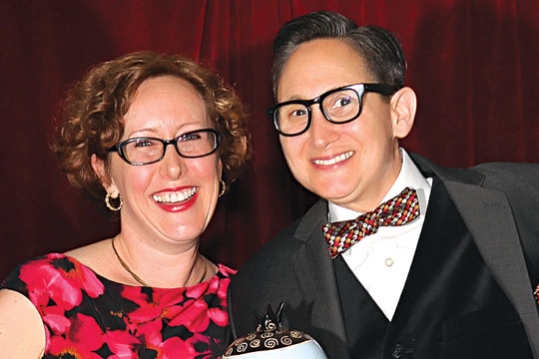
Some years ago, Zsa Zsa Gershick and her wife, Elissa Barrett, went to visit Barrett’s grandparents at their retirement community in Texas.
“This is my granddaughter Elissa, and her lovely wife, Zsa Zsa,” Barrett’s grandmother would proudly tell her friends.
“Oh,” the delighted friends all responded. “Your granddaughter Elissa, and her lovely husband, Joshua!”
Was it the “wife” that threw them off? Mishearing the unusual name, “Zsa Zsa”? Or was it the fashionable male clothing?
Whatever the reason, those prescient octogenarians were onto something: Last November, Gershick began to transition to male, and he decided to go with the name Joshua.
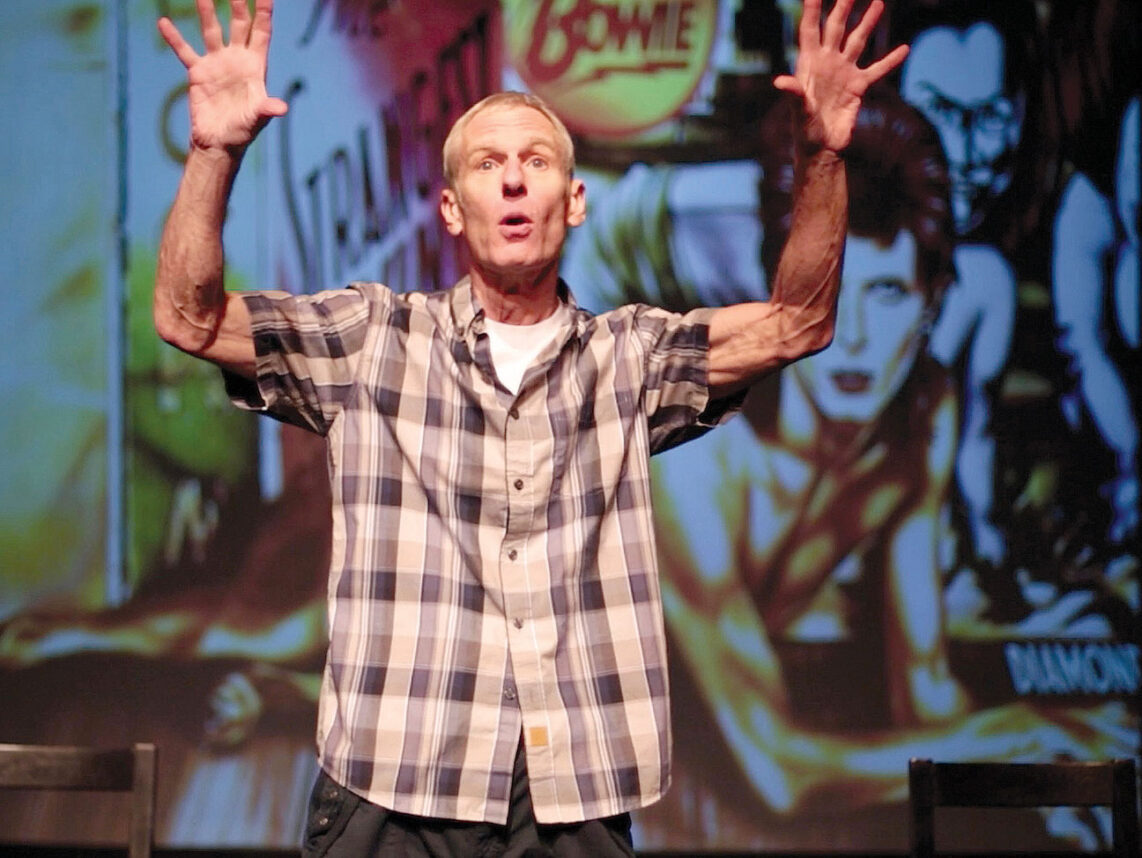
For Gershick, a 55-year-old playwright, author, gay activist and Army veteran, the transition to male hasn’t been all that dramatic — for the past 10 years Gershick has presented as a courtly, well-dressed gentleman who speaks in grammatically correct sentences with a florid vocabulary. He wears velvet vests and bow ties, holds doors open for women and can arrange a bouquet just so.
READ: BEYOND THE RAINBOW–TRANSGENDER JEWS
In fact, his sister-in-law told him his nieces have been secretly calling him “Uncle Zsa Zsa” for years, and Barrett, who’s been with him since 2001, said she’s been waiting for him to come to the realization that he was transgender.
Gershick said that, for years, waiters and clerks would stutter through sirs and ma’ams, but only recently he had begun to bristle whenever someone failed to realize that he wanted to be recognized as male. He knew he needed to make that subtle nudge along the gender spectrum to bring his internal and external beings into harmony.
“For me, being transgender means I am fully embracing all that I am — my female, my male — and being just authentic,” he said.
The first time he introduced himself as Joshua, “It was like a robe of chains fell off of me.”
Growing up in the San Francisco Bay Area, Gershick always felt different and always pictured himself as a boy. His Jewish identity also was confusing: His parents, deeply assimilated Jews wary of anti-Semitism they had seen growing up, didn’t tell him he was Jewish until he was 13. He spent his teens and 20s trying to catch up on his Jewish identity — he went to Israel and said he belonged to a “coven” of Jewish lesbian feminists in San Francisco.
But it wasn’t until he found Rabbi Lisa Edwards at Beth Chayim Chadashim (BCC) 15 years ago that he truly connected as a Jew, and it was at BCC that he came out as transmale by giving a
derash at Edward’s invitation.
Barrett, who is vice president and general counsel at Bet Tzedek Legal Services, said she has witnessed how freeing Gershick’s transition has been for him. For her part, she has had no problem adjusting to his new name or his pronouns and said she will unconditionally support whatever physical transformation he wants to make. Her biggest concern, she said, is that she herself might lose an important part of her own identity as a queer woman. The first time she referred to Joshua as a “he” at the dry cleaners, for instance, she was taken aback when the clerk tried to bond with her with an eye-rolling reference to “those men.”
“Twenty years ago when I came out, it was still a big deal, and I have had to embrace that and to stand up for myself as a queer woman. I treasure that part of my identity, of not being part of the norm. I love the queer community — our culture, our panache, our camp, our courage,” she said.
Gershick worried, too, that he might lose a part of himself if he abandoned Zsa Zsa.
“My principal concern was that if I came out and I told the truth about who I am, then people wouldn’t love me. They loved Zsa Zsa” — he says the name as if it’s on a marquee — “and all that name represented. But would they love Joshua? So far, when I’ve expressed that fear, people have said to me, ‘We love you. We don’t care what we call you. We love your essence, your spirit, your neshamah.’ ”
And he knows from years of living as “a boy in a girl suit in boy clothing” that even strangers can eventually see the true person behind the exterior.
“I find, oftentimes, that if you give people permission to have their feelings, their reaction, usually they come around. I often speak to groups, and if no one in the audience knows me, you can usually feel this sense of, ‘Oh. Who is this?’ Then I begin talking, and usually talking the language of the heart, and you can see a subtle shift. And now they’re not thinking about the necktie, not thinking about what’s under those clothes. They’re thinking about what you’re saying and mapping their own experience. They’re listening and have forgotten all about what, just five minutes before, was an obstacle.