Rabbis of the Mishnah and Gemara, the Jewish oral law that developed from the second to the sixth century C.E., certainly knew nothing of the term transgender. But the rabbis did recognize variations in sexual anatomy and debated the halachic status of those who fell somewhere between clear-cut male and clear-cut female. Below are the categories the rabbis identified.
Zachar: Male Nekevah: Female Androgynos: A person who is intersex, or has aspects of both male and female sexual characteristics. Tumtum: A person whose sexual characteristics are indeterminate or obscured. Ay’lonit: A woman who does not develop secondary sexual characteristics at puberty and is infertile. Saris: A male who does not develop secondary sexual characteristics and is infertile. Saris also refers to someone who has been castrated.
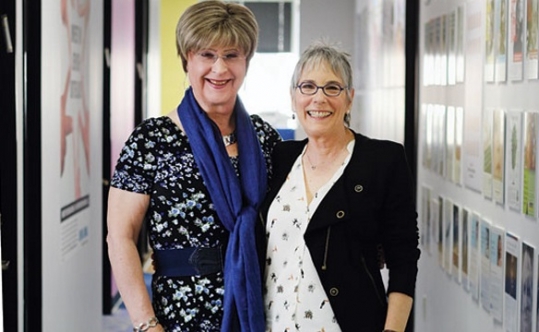
Elissa Barrett and Joshua Gershick. Photo by Marcia Perel Photography
Some years ago, Zsa Zsa Gershick and her wife, Elissa Barrett, went to visit Barrett’s grandparents at their retirement community in Texas.
“This is my granddaughter Elissa, and her lovely wife, Zsa Zsa,” Barrett’s grandmother would proudly tell her friends.
“Oh,” the delighted friends all responded. “Your granddaughter Elissa, and her lovely husband, Joshua!”
Was it the “wife” that threw them off? Mishearing the unusual name, “Zsa Zsa”? Or was it the fashionable male clothing?
Whatever the reason, those prescient octogenarians were onto something: Last November, Gershick began to transition to male, and he decided to go with the name Joshua.
For Gershick, a 55-year-old playwright, author, gay activist and Army veteran, the transition to male hasn’t been all that dramatic — for the past 10 years Gershick has presented as a courtly, well-dressed gentleman who speaks in grammatically correct sentences with a florid vocabulary. He wears velvet vests and bow ties, holds doors open for women and can arrange a bouquet just so.
In fact, his sister-in-law told him his nieces have been secretly calling him “Uncle Zsa Zsa” for years, and Barrett, who’s been with him since 2001, said she’s been waiting for him to come to the realization that he was transgender.
Gershick said that, for years, waiters and clerks would stutter through sirs and ma’ams, but only recently he had begun to bristle whenever someone failed to realize that he wanted to be recognized as male. He knew he needed to make that subtle nudge along the gender spectrum to bring his internal and external beings into harmony.
“For me, being transgender means I am fully embracing all that I am — my female, my male — and being just authentic,” he said.
The first time he introduced himself as Joshua, “It was like a robe of chains fell off of me.”
Growing up in the San Francisco Bay Area, Gershick always felt different and always pictured himself as a boy. His Jewish identity also was confusing: His parents, deeply assimilated Jews wary of anti-Semitism they had seen growing up, didn’t tell him he was Jewish until he was 13. He spent his teens and 20s trying to catch up on his Jewish identity — he went to Israel and said he belonged to a “coven” of Jewish lesbian feminists in San Francisco.
But it wasn’t until he found Rabbi Lisa Edwards at Beth Chayim Chadashim (BCC) 15 years ago that he truly connected as a Jew, and it was at BCC that he came out as transmale by giving a
derash at Edward’s invitation.
Barrett, who is vice president and general counsel at Bet Tzedek Legal Services, said she has witnessed how freeing Gershick’s transition has been for him. For her part, she has had no problem adjusting to his new name or his pronouns and said she will unconditionally support whatever physical transformation he wants to make. Her biggest concern, she said, is that she herself might lose an important part of her own identity as a queer woman. The first time she referred to Joshua as a “he” at the dry cleaners, for instance, she was taken aback when the clerk tried to bond with her with an eye-rolling reference to “those men.”
“Twenty years ago when I came out, it was still a big deal, and I have had to embrace that and to stand up for myself as a queer woman. I treasure that part of my identity, of not being part of the norm. I love the queer community — our culture, our panache, our camp, our courage,” she said.
Gershick worried, too, that he might lose a part of himself if he abandoned Zsa Zsa.
“My principal concern was that if I came out and I told the truth about who I am, then people wouldn’t love me. They loved Zsa Zsa” — he says the name as if it’s on a marquee — “and all that name represented. But would they love Joshua? So far, when I’ve expressed that fear, people have said to me, ‘We love you. We don’t care what we call you. We love your essence, your spirit, your neshamah.’ ”
And he knows from years of living as “a boy in a girl suit in boy clothing” that even strangers can eventually see the true person behind the exterior.
“I find, oftentimes, that if you give people permission to have their feelings, their reaction, usually they come around. I often speak to groups, and if no one in the audience knows me, you can usually feel this sense of, ‘Oh. Who is this?’ Then I begin talking, and usually talking the language of the heart, and you can see a subtle shift. And now they’re not thinking about the necktie, not thinking about what’s under those clothes. They’re thinking about what you’re saying and mapping their own experience. They’re listening and have forgotten all about what, just five minutes before, was an obstacle.
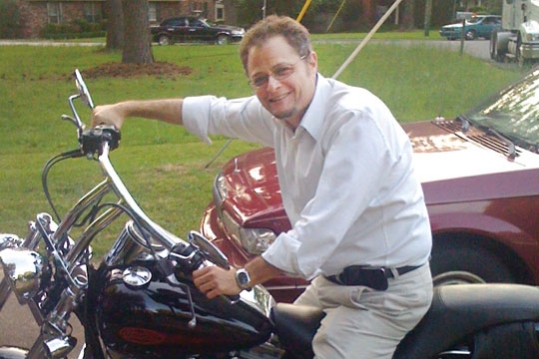
Alan W. is sitting at a table in Starbucks, looking uncomfortable. His shoulders hunch up a bit in his suit and open-collared shirt, and his trim goatee is surrounded by the five o’clock shadow of a long day spent with numbers at his job managing a funding program at the Department of Children and Family Services, where he’s worked for 25 years.
Self-conscious and shy are lifelong defaults for Alan, who is 54. But, he said, he’s not nearly as awkward as he was back when he lived in a woman’s body.
“Everyone grows up not liking something about themselves, but to really be disconnected from who you are … I never looked at myself in the mirror. I didn’t like to look at my breasts and all that stuff,” he said. Since transitioning nine years ago, Alan said he now feels free. “All of a sudden, you can be who you are and not be ashamed. I can look in the mirror and go, “ ‘Wow, I’m really who I am.’ ”
His confidence has been so lifted that he was able to stand up and speak before family friends at his adult bar mitzvah at Congregation Kol Ami four years ago — an unthinkable feat a few years before.
Kol Ami has been an anchor for him and his wife, Yaffa. (Yaffa’s parents don’t know that Alan used to have female parts, so the couple is using only first names for this article.)
Yaffa grew up Southern Methodist, and Alan grew up in Beverly Hills in a marginally Jewish home — his family occasionally attended services at Temple Isaiah on Pico Boulevard, and they also had a Christmas tree. He connected with Israel on a seven-month kibbutz stay while in college, but other than sporadic shul attendance, he was mostly disconnected from Judaism. Yaffa, who converted three years ago, insisted when they got together 10 years ago that they find a spiritual community, and they became regulars at Kol Ami.
One of Alan’s most signficant milestones was a naming ceremony held for him on Kol Ami’s rooftop, where Rabbi Denise Eger bestowed on him his new Hebrew name, Avraham Saul.
“It was really the first step of me getting more in touch with my spirituality, my connection to community,” Alan said. “People we met in temple were there, and I could look out and see my family — they were proud and accepting.”
Alan’s split with his past has been pretty stark. He has changed his name and gender on his birth certificate, and he has a visceral reaction to seeing pictures of himself in his 20s and 30s. While everyone at work knows he transitioned, he doesn’t talk about it, and to new people he’s just another male. He showed up incognito at his Beverly Hills High School 30th reunion.
“I have had a lot of good experiences and good people in my life, but I want to go on with my life — I don’t want to always have to look back,” he said.
Still, he can also laugh about his transition. He jokes that after his mastectomy, he’s had to work out to build up his chest to look more buff. His nephew was 13 when Alan transitioned, and the two would compare facial hair growth and voice changes. He said he had the utter joy of going through puberty and menopause at the same time, and still laments the loss of his curly hair (he’s bald now).
But he knows some people lose everything when they transition, and he considers himself lucky for what he has — a supportive family, employers who stuck with him through transition, the resources to pay for treatments and a loving community.
“I have no regrets. I lived my life a certain way for a reason. If I had transitioned earlier, my life may have been different, or it may not have,” Alan said. “But I have no regrets. I feel a calmness and an acceptance in myself.”
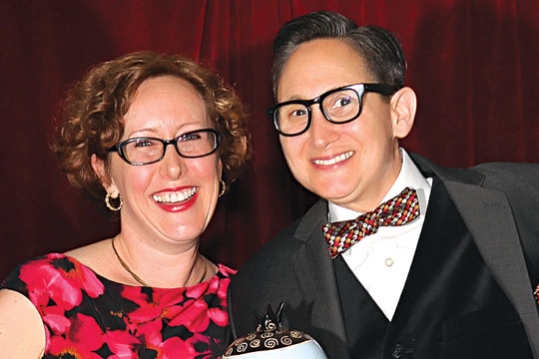
Mike Dennis was a married man for 40 years. He and his wife divorced in 2007, after he decided to stop hiding the fact that he was transgender. So, at 66, she was a heterosexual, transgender woman who now went by the name of Mike/Michelle and sometimes still dressed as a man. She was pretty sure love, for her, was a thing of the past.
Robin Gurse is a bisexual Jewish woman, now 65, who never married and has had some pretty painful relationships, mostly with men.
Robin and Mike/Michelle remember well an evening in 2010, just a few days after they met by chance (or was it beshert, fated?) at a self-empowerment seminar, and realized that their encounter could change their lives.
Mike/Michelle invited Robin to a play. Over dinner, Robin suddenly realized that this elegant woman, whom she by that point knew was also a man, was courting her. At the time, she laughed out loud; today she tears up at the memory of it.
“I said, ‘Oh my God, is this the perfect person for me?’ ” Robin recalls.
As Robin speaks, Mike/Michelle jumps in. They were driving down Olympic Boulevard, Mike/Michelle remembers, and Robin told her she was bisexual.
“I just about drove off the road, because I thought, ‘This is so perfect!’ ” Mike/Michelle says.
Five months later, the two exchanged rings in a commitment ceremony, and within a year they officially married. Mike/Michelle wore a traditional white gown and pearls, and Robin wore a raspberry evening gown.
Rabbi Lisa Edwards of Beth Chayim Chadashim co-officiated with the pastor from Mike/Michelle’s Brentwood Presbyterian Church. The couple remain actively involved in both congregations, as well as in JQ International, a Jewish LGBT organization, where Mike/Michelle organizes the speakers, and Robin handles the newsletter.
The two grew up less than a mile apart, near Centinela Avenue in West L.A., and both attended Venice High School, a few years apart. Robin was confirmed at Temple Adat Shalom and has warm memories of celebrations of Jewish holidays with her family.
The two have very different styles. Robin, a life coach who runs empowerment workshops for teens, sports jeans and a tie-dyed top, no makeup, and her cropped silver hair surely doesn’t need more than a towel dry. She wears a simple wedding band and a small, silver Jewish star around her neck.
Mike/Michelle, by contrast, wears a frosty coif, her nails and makeup done just so, dangling earrings and a thick, silver necklace. On this day, she is also wearing black heels, polka-dotted black stockings and a striped bolero jacket over a short black dress with a thick elastic belt.
Mike/Michelle, who was the director of finance for the City of Santa Monica for 20 years and now teaches finance at UCLA, goes by male and female pronouns. He said he had wanted to be a girl since he was a young child. His then-wife knew, but had little patience for it, and he would secretly cross-dress whenever he could.
“Have you ever tried to keep an inflated beach ball underwater? That is what I did for years. And there was one night, when the kids were already off in college and my wife was asleep, and I knew I couldn’t do it anymore. I got on my knees, and I said, ‘Take my life, or show me something,’ ” Mike/Michelle says.
That was in the 1990s, and it was the fledgling Internet that opened up a new world for Mike/Michelle. Four years after that night, he joined a cross-dressers group. He divorced in 2007 and started dressing as Michelle most of the time.
It wasn’t until they were ready to become sexually intimate that Robin met Mike, sans wig and lipstick.
“Even though I was totally clear that the person I was falling in love with was a person who would sometimes show up as female and sometimes as male, I think that moment was still startling. It still is, every once in a while. God has a great sense of humor — I get both!” Robin says.
Mike/Michelle said she keeps both names because that is who she is, and because the slash opens eyes.
“It always generates a question, and I get to interact with people. My intention is for them to leave with the notion, ‘You’re 72, about 5-7, 160 pounds, transgender and you wear a size 10 shoe.’ What that does is it normalizes the experience and creates a safe space for transgender people. And that is really so important.”
More and more, transgender Jews are introducing themselves to the Jewish world
Mike/Michelle and Robin (Gurse) Dennis were sure love was a thing of the past, until they found each other. Photo by Lynn Pelkey
Deborah attends services at Temple Aliyah nearly every week, but on a Friday night two years ago, she was nervous. Her daughter, Rebecca, then 18 and known all of her life as Jeremy, had chosen the Kabbalat Shabbat service to come out in public dressed as a woman for the first time. Deborah worried Rebecca’s newfound confidence and courage might be shot down by disapproving stares.
Tall and thin, with a head of brown curls that were still short on that day so early in her transition, Rebecca wore a straight, white skirt and a top with large purple paisleys. She doesn’t like to be showy, so she wore flats and no makeup.
When Deborah and Rebecca walked into the family service at the Woodland Hills Conservative synagogue, along with Rebecca’s younger brother, they were greeted with friendly smiles, with Temple Aliyah’s Rabbi Stewart Vogel in the lead.
Although for this article Rebecca asked that her last name not be used so that she can protect her future identity — she wants to be known just as a woman, not a transwoman — the family is very open at its synagogue and grateful for the support it has found there.
Like many other Jewish institutions, Temple Aliyah is increasingly coming face-to-face with a human issue that until just two or three years ago was mostly in the shadows. Transgender people — their stories and their rights — were often not discussed or openly welcomed. Even with the “T” expeditiously tacked onto the LGBT of gay and lesbian equality, transfolk didn’t get much serious attention.
Increasingly, however, transgender acceptance and rights have entered the mainstream conversation. Bruce Jenner’s revealing interview last week with Diane Sawyer gave a huge audience more insight and information than it has ever had about what it means to be transgender. Shows such as Amazon’s award-winning and Jewish-centric “Transparent,” as well as significant storylines on “Glee” and “Orange Is the New Black,” have opened conversations in popular culture, moving the topic from a whisper and a snicker to “The Today Show.”
Likewise, transgender openness is increasingly a part of life at Jewish institutions, as members or children of members come out, or just as often, as shuls, schools and other organizations try to proactively determine how they will accommodate and embrace community members who are transgender.
“The willingness of the Jewish community to have this conversation in a nonpushback way is amazing,” said Asher Gellis, founder and director of JQ International, a Los Angeles-based programming and advocacy group for LGBTQ (lesbian, gay, bisexual, transgender and queer) Jews. “Five years ago, I would send speakers to youth groups to tell their coming-out stories and to talk about bullying, and very often, in a very polite way, those groups were trying to push us away from the transgender conversation. Now, all they want is transgender speakers.”
This month alone, there are at least two significant trans events in the L.A. Jewish community. JQ, along with New York-based Eshel, is sponsoring “TransTorah: A Family Journey,” at The Jewish Federation of Greater Los Angeles on May 3, part of the Jewish Wisdom and Wellness Conference sponsored by Cedars-Sinai and the Kalsman Institute of Hebrew Union College. On May 5, the Sandra Caplan Community Bet Din will hold a daylong conference for rabbis titled “In God’s Image: Transgender Folk in the Conversion Process.”
Rabbi Denise Eger, senior rabbi at Congregation Kol Ami, a West Hollywood congregation founded to serve the LGBT community, said she has witnessed great — though incomplete — progress toward acceptance; she also said she has received a stream of calls from institutions and families looking for guidance.
Although more traditional circles still struggle with reconciling transgender lives with halachic observance, many Jewish communities embrace transgender people as created in the image of God. Equally, they know that their support can be pikuach nefesh — a matter of life and death — because transgender people have disproportionately high rates of suicide and of being victims of violence.
But even in liberal circles, the Jewish notion of a shandah, an embarrassment, lingers.
When Rebecca came to Temple Aliyah that first Friday night, an acquaintance sneered about how awful and embarrassed Deborah must feel.
Rebecca doesn’t let comments like that one bother her because she knows she is being true to herself.
“Every single year for my birthday, for four or five years, I wished that I would turn physically female the day afterward,” Rebecca said in an interview in her home, her voice high and soft. Rebecca is now a student at CSUN, and she wants to become a teacher. “Now I feel a lot better than I used to feel, like I can be myself and express myself. I’m still not completely satisfied, but a lot more satisfied than I used to be — I’m not afraid to look at myself in the mirror.”
Vogel said Temple Aliyah has worked hard through sermons, education and programming to create a culture where everyone understands that everyone has a story — whether it involves sexual identity, disability, mental illness or maybe a difficult past.
“All along, we have talked about synagogue being a place for all Jews to find their spiritual haven, no matter what their story is,” Vogel said, noting Temple Aliyah has at least two other families with transgender members.
As a mother, Deborah said, the adjustment has been a long road. Although her immediate reaction was to offer love and support when she realized her son was serious about transitioning, it took Deborah a good year of talking and therapy and grappling before she fully came to terms with the idea. And she made some choices. For example, Deborah refused Rebecca’s request to take down all the pictures of Jeremy in their house, but she did agree to move them to her bedroom.
Deborah said she still mourns the loss of Jeremy, and she also continues to worry about Rebecca. She worries that she will be assaulted on a bus or at school, or that other students will be unkind. She worries that Rebecca’s internal struggle has only just begun, that it will require so much more bravery. She worries about who Rebecca will find to love, to share her life with.
But even with those worries, Deborah is amazed at the transformation she sees in Rebecca.
“She is much more comfortable and carries herself differently. She used to walk looking at the ground and didn’t talk very much. She was very inward. And she’s really blossomed into a very social person. … And I think because she is more comfortable, she talks about herself in a much more positive way than she used to. If that is what being transgender does for a person, then I am all for it,” Deborah said.
For people who have never thought about whether their gender identity matches the body in which they were born, the idea that gender is not as clear cut as it seems can be hard to conceptualize.
“If you are not transgendered, I imagine that what I am about to say will sound fantastic — fantastic in the sense of strange and beyond comprehension — but for years, I would look in the mirror and be completely shocked at who I saw,” Joshua Gershick, who began transitioning last November, at 55, said over coffee at a North Hollywood cafe. “I would look in GQ magazine, or see guys on the street, and think, ‘I look like that.’ And then I would look in the mirror and I would think, ‘Whoa!’ It was shocking. It’s an interesting experience: You know who you are, you have a body of work, you have a position and a place in society, you love your life — and I do love my life — and you also have this profound disconnection between how people see you and how you internally feel and see yourself.”
For those who experience it, this is not new. The medical world since about 1980 has officially recognized gender dysphoria as a real condition — and the wide consensus among mental health and medical professionals is that it is best treated by some level of transitioning to the desired gender. But going much further back historically, there are some surprising approaches to the question of gender in Jewish legal discourse.
The Mishnah and Gemara recognize four genders that are neither male nor female, where people have various combinations of anatomy from both genders or neither, either by nature or by injury. The rabbis debated their status, but the very fact that they are acknowledged undermines the whole idea that there are only two choices, says Rachel Biale, a San Francisco-based author and activist.
Many Jewish ideas that seem starkly black or white have in-betweens, she pointed out. To meat or dairy, there is pareve. To innocent or guilty, there is an array of levels of culpability. There is holy and profane, and, in between, many levels of sanctity or purity.
“The most obvious binary distinction we have is with the mechitzah [dividing men and women in a synagogue], which doesn’t apply to people who are in between male and female. So does that mean we need a tri-chitzah, a three-sectioned synagogue? Or does it mean what we have to realize that the whole underpinning of the mechitzah is no longer relevant?” she asked.
To be sure, there are still many Jews who consider cross-dressing or surgically altering sexual anatomy a grave violation of Jewish law and values, particularly within traditional Jewish circles. Even among more progressive Jews, acceptance isn’t always forthcoming.
“I think in the larger Jewish community, there is a lack of awareness and a lack of understanding and a lack of compassion,” Kol Ami’s Eger said.
For the traditional Jew, so much of halachah assigns roles by gender, leaving the transgender person as all but an outsider. But the elimination of nearly all halachic and ritual distinctions between men and women in liberal Judaism minimizes the halachic ramifications of transitioning. If men and women count in a minyan, if men and women are obligated in all the mitzvot, what does it matter what gender they are or were, and whether that changes?
In 2006, a halachic treatise in the Conservative movement concluded that reassignment surgery in fact changes one’s halachic status from one gender to the other. Rabbi Len Sharzer, a professor of bioethics at the Jewish Theological Seminary who was a plastic surgeon before he became a rabbi, said he hopes to present a new halachic treatise, or teshuvah, by early 2016 that will expand that recognition to include transgender people who have not had surgery, as many opt not to have the highly invasive and imperfect procedures.
In the Conservative movement, Sharzer said, the only areas of Jewish law where gender makes a difference are in personal-status issues, such as marriage, divorce or conversion. His teshuvah will look, for example, at questions involving whether someone who has transitioned has to offer a get — divorce consent — to a prior spouse if that marriage dissolves. He wants to explore whether a reconstructed penis should or can have some sort of circumcision or drawing of blood traditional in a conversion. Or how to compassionately handle the same question for a transfemale who still has a penis.
The Orthodox world is less willing to take on such considerations or concessions. Rabbi Howard Jachter, an Orthodox bioethicist and a dayan (beit din — Jewish court of law — adjudicator) in New Jersey, said, “I have all the sympathy in the world for them, but it is an enormous tragedy for people to mutilate their bodies and to do this to themselves,” Jachter said. He said reassignment surgery is halachicly forbidden, as is wearing the clothing of the opposite gender, a view shared by much of mainstream Orthodoxy.
Jachter said he has officiated at divorces in which the husband has transitioned, and that a get is still required, because in Orthodox Judaism, halachah does not recognize a person in their new gender.
But even in the Orthodox world, there are some signs of movement: Rabbi Zev Farber, a progressive Orthodox thinker based in Atlanta, has written an as-yet-unpublished article that offers some openings for allowing surgery and recognizing the person in his or her new gender.
He bases his argument on the idea that if halachah is forced to confront this issue for people who have physical, visible gender disorders, the laws should also show compassion for people whose gender dysphoria is internal but still real.
He believes the reaction to transgender people is coming from fear and misunderstanding — much as it did, and still does, for gays — but he said as Orthodox people, like the rest of the world, increasingly start coming out, the community will have to find a way to welcome them.
In fact, a few years ago, a student at the Modern Orthodox Shalhevet high school confided in head of school Rabbi Ari Segal that she was going to transition to male. The student had already decided to leave the school and move away from his halachically observant community. Segal offered concern for the child’s welfare.
“Once you understand what someone is struggling with, I don’t know that there is anything to do but have compassion and love, and to support that person. And I think he felt that,” Segal said. The student eventually did transition, and he and Segal remain in touch occasionally.
Segal said if a transgender student were to ask to stay in the school, he would have to consult with rabbis and do some research before making a decision as to how to respond.
“I would have to work through it the way I work through all issues — trying to have fealty to halachah, while being supersensitive to the person who is struggling,” he said.
But even in circles where openness to transgender Jews is unambiguous, things can get complicated.
Kadin Henningsen, 36, grew up as a Methodist girl in Nebraska but always envisioned himself as a Jewish man as an adult. He converted and transitioned in 2009 in Los Angeles.
“I think, for me, having a deeper relationship with the divine made my work in exploring my gender feel more safe, so I started exploring more and taking more risks and slowly coming out to people,” Henningsen said. “The more Jewish I felt, the more comfortable I became with my gender identity. The two sort of fed each other.”
But when Henningsen applied to rabbinical school at the Reform Hebrew Union College in Los Angeles, he was rejected.
Elliot Kukla and Reuben Zellman were the first openly transgender rabbis ordained by the Reform movement, in 2006 and 2010, respectively, and the Reform movement has led the Jewish community in LGBT equality. Yet in a meeting after Henningsen was rejected, the committee told him, “We can’t figure out if you want to be a transsexual rabbi, or a rabbi who happens to be transsexual,” Henningsen recalled.
In his application, Henningsen had used only the term transgender, so the committee’s use of “transsexual” to him signified a lack of nuanced understanding. But more than that, Henningsen said, the rhetoric of “a rabbi who happens to be” was used concerning women 40 years ago, and gays 20 years ago, and has been discredited as a way of dishonoring the interconnected components of a person’s identity.
When reached for comment, Rabbi Dvora Weisberg, HUC’s rabbinic school director, said she is legally barred from discussing Henningsen’s case, though she points to HUC’s history of openness. But although Henningsen recognizes that HUC is not trans-phobic and has been supportive of trans students in many ways, he believes there may be lingering blind spots.
Henningsen decided instead to enroll in a master’s program in gender studies at the University of Wisconsin, where he is writing a thesis on transgender issues and Jewish law, but he says rabbinic school is still a possible path. He is also a fellow at Svara: A Traditionally Radical Yeshiva in Chicago.
Joel Kushner is director of the Institute for Judaism, Sexual Orientation & Gender Identity (IJSO) at HUC but was not part of Hennigsen’s acceptance decision; he suggested the case reveals how nuanced and complicated such decisions can be. Although gay and lesbian rabbinical school candidates, already familiar to admissions committees, might have the luxury of leaving their sexual orientation in the background, Kushner said, transgender people, like Henningsen, don’t have that privilege, as their visibility in the mainstream community is so new. “Knowing Kadin, he has a fully integrated identity of his Jewishness and his trans-ness, and he lives that out every day in a full way. I think many people are not used to that, and it hits up against assumptions and potential prejudices that people do not realize they have,” Kushner said.
Kushner suggested that even for the most welcoming, it is too soon for complacency when it comes to transgender acceptance in the Jewish community.
“We think we’re further along than we are, and that’s hard to face,” Kushner said. “The majority of the Jewish community is at a tolerant place, not an inclusive place, and who wants to see themselves as just tolerant?”
Still, he points to many areas of progress. While the cross-denominational Sandra Caplan Community Bet Din (a Jewish legal court) in Los Angeles has not yet converted someone who is transgender, more than a year ago it changed its forms to make the pronouns more sensitive, and offered a more neutral option for Hebrew names along with ben or bat, “son of” or “daughter of”: mi’beit, “from the house of.” The beit din now allows the person converting to decide the gender of those who will witness the mikveh ritual.
On another front, Beit T’Shuvah, the rehabilitation community in Culver City, last year moved its first transgender resident from the male to the female residence, after consulting with Gellis at JQ.
Weizmann Day School in Pasadena created a safe environment for learning about the issue a few years ago when a first-grade boy wanted to come to school in a dress. Administrator Lori Snyder helped prep the other students. The kids had some questions: “If we think his dress is cool, can we tell him?” “Can we tell him we think he’s brave?”
The child came to school in a new purple dress and pink-and-silver Skechers for a Friday Shabbat party, Snyder said. He was afraid to get out of the car at morning carpool, but by recess he was sitting with his friends as if nothing was different. The school opted not to send a letter to parents and ended up fielding only a handful of questions.
Camps, religious schools and day schools are encountering similar situations. More than 30 leaders from nine L.A.-area day schools participated in a daylong workshop last November about sexual identity and orientation. The program was organized in part by Conservative Temple Beth Am’s Rabbi Yechiel Hoffman, its director of education and a trained educator for Keshet, a Boston-based Jewish LGBTQ advocacy and educational organization, which sponsored the programing. The workshop launched a yearlong program to foment cultural change.
“The issue tends not to be one of outright homophobia, but of creating environments that are less hetero-normative, and making institutions more welcoming and embracing to students and faculty and families who identify as LGBT,” said Catherine Bell, national program director at Keshet.
Changes might start with something as simple as eliminating “male” or “female” check-off boxes on forms and leaving a blank line for gender. It might mean family trees that are more inclusive or fewer gender-segregated activities.
A year ago, the Los Angeles Jewish Federation, in partnership with JQ and IJSO, sponsored a similar workshop for Jewish communal professionals. Nearly 50 front-line Jewish professionals — executive directors, social workers, rabbis, mental health professionals — attended, focusing both on issues of sexual orientation and sexual identity.
And from the pulpit, at least two rabbis have given sermons about transgender issues this year, inspired by “Transparent.” The Amazon Prime TV show, which has won numerous top TV awards, features the patriarch of a comically dysfunctional Jewish family who, in his 70s, has come out as a woman. The show has also inspired a class at the San Francisco JCC and an active exchange among trans Jews on the show’s message board. Its Los Angeles-based creator, Jill Soloway, based the show on her parent’s transition just a few years ago; she said she is gratified to see “Transparent” opening up conversations in families.
“It’s kind of amazing how the show is affecting so many people,” Soloway said. “I think before, a lot of these people would have been bullied or committed suicide or gone underground. It was so shameful, even five years ago. The fact that this has lifted, the fact that the Internet has offered people the opportunity to say their truth to their families — I think there is exponential possibility for healing around these issues.”
In June, Congregation Beth Chayim Chadashim (BCC), an LGBT synagogue on Pico Boulevard, will honor “Transparent’s” star, Jeffrey Tambor, with its annual Herman Humanitarian Award at a ceremony at the Skirball Cultural Center.
One of the most dramatic examples of transgender acceptance in the Los Angeles area is at the Pasadena Jewish Temple and Center (PJTC), which last summer became the first Conservative congregation to hire a trans rabbi. Rabbi Becky Silverstein beat out 40 other candidates to assume the post of education director.
“The real story is that this congregation is totally embracing him. The story is that it’s a non-story, which is I think the way we want it to go,” said Rabbi Joshua Grater, senior rabbi at PJTC.
“What is so beautiful to see is that people are responding to Becky’s Torah and his teaching and his ability to connect with people as just a person,” Grater said.
In an interview in his office, Silverstein said he recognized himself as gender-queer or gender nonconforming, the first time he heard the terms while at rabbinical school at Boston’s Hebrew College. He made the decision during rabbinical school to use male pronouns and to wear a kippah and tzitzit, in addition to the mostly male clothes he had been wearing for years.
But while he changed his Hebrew name from Rivka to Ezra Natan, he chose to hold on to his given name.
“I’m pretty attached to Becky and he, and creating that dissonance in the world. It both gets across my identity as someone who is outside the gender binary, and also satisfies my need to push people, and to push society,” said Silverstein, who is 33.
PJTC’s search committee debated whether to address the gender issue when introducing Silverstein to the congregation but decided it wasn’t necessary. It simply sent out his bio, using male pronouns. The community — from children to senior citizens — has been surprisingly nonchalant.
Experts agree that wider societal acceptance will come, much as it did for gays, when more people personally know people who are trans. But that sort of critical mass of people coming out that changed things for gays has not yet tipped in the trans community because the numbers are inevitably smaller. According to the website transgenderlaw.org, at most an estimated 2 percent to 5 percent of the population experiences some degree of gender dysphoria, but the number who identify as such is smaller.
“Many people don’t have the privilege of knowing them, and that is where it starts to be more like second nature to think about the diversity of human experience, and to be thoughtful and respectful of someone’s gender identity,” said Bell of Keshet.
Over the last several years, transgender Jews increasingly have found one another, building a base of support both locally and online.
Several books delve into the trans Jewish world, including “Balancing on the Mechitza” by Noach Dzmura and “Through the Door of Life: A Jewish Journey Between Genders,” written by Joy Ladin, who in 2006 became the first tenured professor at the Orthodox Yeshiva University to come out as trans. Yiscah Sara Smith, who lived much of her life as a male Judaic studies teacher at Orthodox institutions in the U.S. and Israel, recently published “Forty Years in the Wilderness: My Journey to Authentic Living.”
Online, rabbinic pioneers Kukla and Zellman have founded TransTorah.org, with educational and ritual resources, including wedding liturgy, and ceremonies to acknowledge the practices of chest-binding, transitioning or changing a name.
In Los Angeles, gay Jewish organizations also have been a natural gathering place for transgender Jews. Gellis said in the first five years of its 10-year existence, JQ didn’t see many transgender people. But over the past five years, JQ has nurtured a group for trans Jews that has hosted Purim parties, a Havdalah service and Shabbat dinners, and has worked to integrate trans people onto its board.
Kol Ami and BCC have been at the forefront of embracing trans people, hosting trans events, creating naming rituals and serving as a resource to anyone with questions.
But even gay shuls are sometimes not as natural as they might seem for trans people, because some gays can feel betrayed by those who transition.
To help educate their community, BCC, which calls itself the “world’s first LGBT synagogue,” hosted a “Trans 101” class and has made some subtle changes in its services: When they read out the names of people who perished in the Holocaust or died of AIDS, they now say “people of all ages” instead of “men, women and children,” as some trans people don’t identify fully as a single gender. Even things such as baby namings or b’nai mitzvah need special accommodations, as both are based on assumptions about gender identity.
Those kinds of changes are just starting to seep into mainstream consciousness as more people are coming out as trans.
Rabbi Ed Feinstein of Conservative Valley Beth Shalom said he has helped several families struggling as their young-adult children transitioned.
“Transgender is not a movement or a culture or a thing,” Feinstein said. “They are individuals who find themselves often in remarkably difficult situations of being in the wrong body, and trying to search for their gender identity. And our job is to respond with love and to support the people that God meant them to be, and to look at them as individuals. It’s amazing how the insults and the jokes and the gazes stop when you realize that it’s someone’s brother or sister, or the person who sits with you in shul and prays with the same kavanah [devotion]. When it stops being an abstraction, the ethics become clear.
My daughter is about to give birth to her first child and my first grandchild any day, any minute, any second. I am so excited that I am just about losing it with anticipation! Yes, I know, being an Almost Grandma is NOT about ME! But I have to admit; I’m having a difficult time keeping my mouth closed. I only want what’s best for everyone. And isn’t it my job to tell them?
Looking at my daughter, I remember how I felt when I was pregnant with her. And boy, some things have really changed, but the worry and stress hasn’t. I think I need Almost Grandma therapy!
So I talked to lots of Now Grandmas and here is what they told me:
1. Almost Grandma is supposed to be calm.
2. Almost Grandma is supposed to have all the answers, but not share them.
3. Almost Grandma is not supposed to be a noodge. (Look it up)
4. Almost Grandma is not supposed to call her daughter four times a day and ask if the baby is moving.
5. When Almost Grandma calls her daughter’s house and no one answers, stop calling every hour and imagining the worst. You told her to take naps and maybe that’s what she’s doing.
6. Almost Grandma is not supposed to tell her daughter she still has her contact lenses and make-up on in case it’s time to go to the hospital. Almost Grandma is not supposed to answer the phone with; “is it time to go to the hospital yet?”
7. Almost Grandma is never supposed to say; “Tonight is the Night. “
Seriously, I think I’ve done at least four of these things already. Okay, maybe all seven of them. But hey, I’m Almost a Grandma.
Oy, it’s tough to be an Almost Grandma. But here is what I am learning; the more nervous I am, the more nervous my daughter becomes. And the extra stress is not good for anyone. And if Almost Grandma asks too many questions, my daughter starts researching on to the Internet. Read ten mommy sites; get ten answers…more nervousness, too many opinions and total confusion.
So, Almost Grandma… Calm the Heck Down! Eat some chocolate! Go shopping, take a nap, just do something and stop driving yourself crazy. And repeat the following four tips at least once an hour until that adorable little miracle is born.
1. Let your daughter ask you the questions.
2. Let your daughter talk about her labor, delivery, her worries, fears and anything else as much as she wants. (And don’t interrupt or share your own thoughts)
3. Let your daughter be silent if she wants and don’t ask her what’s wrong.
4. Let your daughter be grouchy and irritable and don’t ask her what’s wrong.
Let your daughter experience this wonderful miracle of life on her own terms and know your love and support are just what she needs the most! Lips zipped and heart bursting with pride because sometimes, Silence is Golden.
Blythe Lipman is the Founder of Baby and Toddler Instructions based in Scottsdale, Arizona and a nationally recognized baby and toddler expert, parenting consultant, and author of three award-winning parenting books, a teacher, a caregiver, a keynote speaker, a blogger and host of Baby and Toddler Instructions, a weekly Parenting Internet talk radio show which airs live each Wednesday, 11:00am EST on Toginet. Blythe is available to speak at your events. For more information or to schedule a telephone or video consultation contact her at: http://mybestparentingadvice.com/contact/ or Office: 480-510-1453. And please like her pages on FB and follow her on Twitter.
I love Big Sunday Weekend (BSW). It’s like going home for me. Jennie, my deaf mother, raised eight of her 10 kids in New York tenements and then in a low-income housing project. This year, my labor was dedicated to her.
My plans were simple. Drive my wife as she accompanied David Levinson, Big Sunday’s founder, to 10 or 15 of the hundreds of projects scattered throughout Los Angeles County, meet lots of folks and work with them. I planned to photograph each event for the Big Sunday website’s daily updates. I also have become, after 12 years of participating in BSW, an experienced handyman — a great janitor, painter, gardener, digger and friend for the weekend.
Saturday morning, I arrived at the Big Sunday storefront in time to help Ruth load heavy boxes of books into her SUV for her school library building project. Meanwhile, Alice’s pickup was weighed down for her literacy project near USC. The Big Sunday office was packed with piles of clothes, food, sporting equipment, toiletries, books, a couple of bikes and dozens of other things to be given away. Levinson was there greeting volunteers from all over, who were introducing themselves to one another.
We visit A Place Called Home in South L.A., a haven for underserved youth. Volunteers from Big Sunday, A Place Called Home and ADT (the security company) are everywhere, painting floors, gardening, doing industrial cleanup. I end up washing pots in the kitchen. I meet a trumpet-playing kid who had just won a scholarship through the organization to study music. I greet Joel Lipton, a professional photographer, who frequently contributes his great talents doing portraits of Big Sunday volunteers.
At the Tom Bradley Magnet School, BSW volunteers sort through enormous piles of books and arrange them on shelves. I work with Michael, the school’s custodian, digging and shoveling mulch around plants that Alex is planting. Michael is later joined by Jesse. They build forms and I sweep. Nearby, tons of kids paint murals.
At Harbor Interfaith, a homeless residence in San Pedro, I’m glad to see Tony Molina again. Tony is captain of this project and has helmed many others over the years. I’m always surprised at how far he can stretch resources and volunteer crews. I scrape and help paint a fence with a friendly family from Palos Verdes. The mom’s amazing, expertly leading the crew through the work. Ricardo, 16, takes his BSW T-shirt off and returns to being a resident. He’s tired and leans against a wall. Until recently, he was living on the street with his mom and two younger siblings. He wants to graduate high school but knows he needs a job.
On Sunday morning, we arrive at Beverly Hills Carmel, an assisted living center. Lots of BSW volunteers are assembling from synagogues and churches, jumping in as Levinson alternates between shtick and playing the piano. I invite Albert, 95, to join us. He lost his wife last year and misses her. He’s distracted, waiting for a “bad phone call” about his terribly ill daughter in Minneapolis. He’s afraid he may lose her, too. He asks whether I’m clergy, and I ask several volunteers wearing yarmulkes whether any are rabbis. I meet Bob, 86, who lives there with his wife, Henrietta. Bob was an optometrist in Bellflower; his son is now working the practice. Levinson, at the piano, plays “Over the Rainbow.” We all sing. Two ukulele players strum “Hey Good Lookin’.” It’s a big hit. “Edelweiss” is my favorite. The kids prefer “Tomorrow,” dancing as they sing. My darling wife sings into the ear of a hard-of-hearing man named Harold.
Kelso Elementary School in Inglewood surprises me. I worked here on BSW two years ago. I meet Kara Corwin, who’s brought a huge crowd from the Center for Early Education. Together, the two communities have helped transform a once-dismal school into a bright, cheerful and welcoming place where students are happy. One continuing problem: the ugly chain-link fence surrounding the playground. Kara says TreePeople is coming to plant trees along it, and before I know it, I volunteer to provide irrigation-engineering plans and help dig. ABC 7’s Jovana Lara, who also volunteered, interviews Levinson. Several children — some from the Westside, others from Kelso — get to be on TV, too. After painting a mural in a classroom, I greet Mrs. Woods. I remember her from my last BSW visit. She began teaching here more than 20 years ago. She reminds me of a favorite teacher from decades ago in my school in the South Bronx.
At Arlington Heights Elementary in Mid-City, I find hundreds of people from both Arlington Heights and the Curtis School across town. A family of five cuts shrubs and rakes leaves in the front. There’s professional equipment. This gardener and his family live nearby; they’ve come to help on BSW. A stubborn old root system has six men taking turns with a pickaxe. I drift off to take pictures, sweep and dig in a hidden side garden. Kids plant vegetables, which they promise to water. I walk back to the yard. There is a mound of exhausted, thick roots next to a freshly planted king palm.
On Big Sunday Weekend, I drive to places I normally don’t go. I smile a lot; people see my Big Sunday T-shirt and return my smile; everyone knows who we are. Thousands of us smiling and eager to help. L.A. is measurably better and so are we, for the community we built and will continue to build throughout the year. Everyone helps, everyone wins. Especially me.
Thanks, Jennie.
Charles Schwartz lives in Santa Monica and is a 12-year Big Sunday Weekend veteran. His wife, Rachel Schwartz, is Big Sunday’s longtime PR representative. This year’s event took place May 1-3.
Los Angeles Jewish and Muslim leaders gathered April 19 at the gold-domed and blue-mosaic King Fahad Mosque in Culver City for a multifaith harmony program that reflected on the recent holiday of Passover.
Organizer Mohammed A. Khan, the mosque’s director of interfaith outreach, welcomed participants, pointing out that the world we live in makes such gatherings even more important. Invoking the Creator, Khan said, “We are here out of love for you and out of love for Moses.”
The program began with the Pledge of Allegiance, led by youth members of the mosque. Then a succession of Jewish speakers offered their insights into the importance of Passover. The Jewish speakers included Rabbis Yitzchok Adlerstein, Yonah Bookstein, Shlomo Einhorn and Abraham Cooper. Holocaust survivor William Harvey, Los Angeles Police Department (LAPD) officer Bob Rothman, Jewish Journal Editor-in-Chief and Publisher Rob Eshman, Dov Cohen and Isaac Hertz were there as well.
Muslim speakers included Imam Ayman Abdul-Mujeeb, Imam Abu Ishaq Abdul Hafiz, Nida Maqsood and Soraya Deen.
“The message we have in common,” said Einhorn, dean of Yavneh Hebrew Academy, “is that religion is here to bring people light.”
“We have much to learn from our Muslim brothers and sisters,” added Bookstein of Pico Shul.
“The most important lesson,” said Cooper of the Simon Wiesenthal Center, “is to treat the stranger with dignity.”
Khan took time to introduce his host committee of Muslim leaders, as well as eight officers from the Los Angeles County Sheriff’s Department and the LAPD active in interfaith relations.
“Passover is a reminder of the mutualities between our two faiths,” Maqsood, a law student, said.
After short speeches from the participants, the mosque hosted a dinner featuring a halal buffet and a separate kosher buffet.
The Our House Grief Support Center’s sixth annual Run For Hope on April 26 at the West L.A. Civic Center raised more than $370,000 for the California-based nonprofit.
Melissa Rivers, the daughter of late comedian Joan Rivers and a supporter of the organization, presented awards to the largest and most successful teams at the benefit for grief support for adults and children.
“The Run For Hope was even more meaningful for me this year as I participated in memory of my mother,” Rivers said, as quoted in a statement. “Coming together with others in a large group commemorating memories of loved ones is a powerful reminder that you’re not alone and can seek support from others, something Our House does beautifully.”
Nearly 1,600 participants turned out, many of whom wore personalized T-shirts with their loved ones’ photos printed on them. The event featured a 5-K run/walk, an in-memory walk and a family fun run.
Grief specialist Jo-Ann Lautman, who has run support groups at Stephen Wise Temple and worked in Cedars-Sinai Medical Center hospice care, founded the nonsectarian organization in 1993. Rabbi David Eshel of Wilshire Boulevard Temple and Cantor Chayim Frenkel of Kehillat Israel are among its advisory board members.
Local philanthropist Erika Glazer has donated more than $1.6 million in endowment money to a Cal State L.A. resource center that opened last October and that serves students who are undocumented immigrants.
“Cal State L.A. is grateful for the generous support we have received from Erika J. Glazer and her family. They realize that one of our greatest assets is our youth and that investing in them is investing in our future,” Cal State L.A. President William A. Covino said in an April announcement. “Her gift helps keep the promise of higher education alive for dreamer students.”
Glazer’s donation will “underwrite staff costs and maintain a dedicated space to provide academic guidance, referral assistance and other support to undocumented students. The center will be named the Erica J. Glazer Family Dreamers Resource Center,” according to a statement. The name of the center refers to the DREAM Act — the Development, Relief and Education for Alien Minors.
Since 2006, the Glazer family has donated more than $2 million to the university toward assisting undocumented students, $700,000 of which has funded scholarships for such students. Helping illegal immigrants who are enrolled in college is a passion of Glazer’s.
“Fortunately, in recent years, there is less need for private scholarships but definitely a growing need for a center where students can get help working their way through a difficult legal process and assistance in powering through a four-year university on time,” she said in a statement. “My hope is that this resource center will be obsolete in a few years and the funds can go toward other programs at Cal State L.A.”
Richard Siegel, director of the Zelikow School of Jewish Nonprofit Management (ZSJNM) of the Hebrew Union College-Jewish Institute of Religion (HUC-JIR), was honored during a retirement luncheon April 23 at the school’s Los Angeles campus. His retirement takes effect July 1.
Hired as the interim head of school almost eight years ago, Siegel “immediately undertook a strategic plan, with the signature aspect being the name change from the School of Jewish Communal Service to the School of Nonprofit Management,” said Joshua Holo, dean of HUC-JIR’s L.A. campus. “That gave clarity and strength to the school’s mission. The other aspect to it was a stroke of genius: He turned a strategic plan into an educational plan by having the students themselves help develop the plan.”
When the school was slated to close as a cost-cutting measure in 2008, Siegel headed the effort to save it and, afterward, was asked to stay on as permanent director.
“I have a great deal of optimism about the future of the school,” Siegel told the Journal.
With more than 100 people in attendance, luncheon guests included HUC-JIR President Rabbi Aaron Panken; former advisory council chairs for the school Rhea Coskey; Marcie Zelikow (who made a $6 million naming gift with her husband, Howard, to support the school last year); and Siegel’s wife, Rabbi Laura Geller of Temple Emanuel of Beverly Hills. The school’s associate director, Mandi Richardson, organized the luncheon.
Prior to coming to Los Angeles, Siegel was the director of the National Foundation for Jewish Culture in New York for 28 years. A successor at ZSJNM has not yet been determined, however a search committee is active, according to officials.
— Sarah Soroudi, Contributing Writer
Moving and Shaking highlights events, honors and simchas. Got a tip? Email ryant@jewishjournal.com.
Less than a year after her mother’s death, Melissa Rivers has written a biography of their relationship, available just in time for Mother’s Day. The idea for the book originated at Joan’s funeral, Melissa writes: “I was walking down the aisle of Temple Emanu-El, when a strange woman (who I later found out was to become my fabulous editor) pressed her card into my hand and made the international hand sign for ‘Call me!’ ”
Momentarily taken aback, Melissa, 47, asked herself, “What would my mother have done?” The answer: “Sell, baby, sell! This book would be a perfect Mother’s Day gift.”
It is easy to imagine Joan’s raspy laugh as she might have mouthed that joke — maybe early in her career, on “The Tonight Show Starring Johnny Carson,” or perhaps later, palling around with celebrities on the red carpet, alongside her daughter.
For Melissa, writing “The Book of Joan: Tales of Mirth, Mischief, and Manipulation” (released May 5 by Crown Archetype) “was extremely cathartic and gave me permission to laugh again,” she said during a phone interview.
More a collection of vignettes than a traditional biography, “The Book of Joan” is a lighthearted account of a mother-daughter relationship. Steering clear of sentimentality, Melissa offers breezy comedic anecdotes, raunchy one-liners and, of course, her mother’s advice on flying on airplanes, falling in love and gift-giving (see sidebar for Melissa’s “Tips on Mother’s Day Gifts,” influenced by her own attempts to satisfy Joan).
Melissa reveals her mother “was a stickler for manners,” that she used to hide money in empty Milk Duds boxes while traveling, and that she had a lifelong obsession with death. When Melissa was a kid, “[M]y mother would read part of an obituary in the paper, and I’d have to guess facts about the deceased.”
Joan also was a terrible speller but a stickler for grammar. She hated public restrooms. She enjoyed needlepointing slogans onto family pillows. Her first-grade teacher wrote on her report card: “Joan’s voice is still loud, and she tries to gain attention this way.”
Her teachers, it seems, were never able to lower her volume. In fact, Joan only became brassier and more brazen as time went on — a trait her daughter seems to have inherited. Also, Joan was “the only other person that I could look at and know what we were both trying to say or that we saw the same thing,” Melissa said during the interview. “ I miss having that inside-joke moment.”
Throughout the book, the brash sense of humor shared by Joan and Melissa often emerges in jokes about Judaism. Remember, Joan’s birth name was Joan Molinsky, and her longtime husband, Melissa’s father, was Edgar Rosenberg.
Joan raised Melissa in a home that was culturally Jewish, although not religious. Culturally Jewish “in the sense of the tight bonds of family, and the unity of being a part of something,” Melissa recalled during a follow-up interview.
But more than anything, Judaism meant comedy. “Jews are the funniest,” Melissa added.
On the first day of third grade, Melissa writes in the book, all the kids in her class had to share a little about themselves. Joan had trained her on what to say: “I’m Melissa Rosenberg, and I’m single, and I’d like to meet a nice Jewish boy with liquid assets and a good nose.”
In one of the book’s more revealing moments, Melissa notes that the cause of Joan’s “obsession with appearances was that for most of her life she was never happy with how she looked, which fed into her sense of being ‘less than.’ ”
According to Melissa, Joan’s feelings of inferiority stemmed from a childhood of always being second-best in comparison with her sister.
Joan later turned this feeling into an innovative style of self-deprecating humor now known as “over-sharing.” But despite all the jokes Joan made about her own plastic surgery, and all the jokes made at her expense, “I find comfort in knowing that … she did what she needed to do to feel better,” Melissa writes.
Late in her career, Joan starred with Melissa on WE tv’s “Joan & Melissa: Joan knows Best?” for which the two shared the screen during countless red carpet events. Melissa also executive produces “Fashion Police,” which her mother co-hosted.
But nothing brought mother and daughter closer together than Melissa giving birth to her son, Cooper, who is now 14.
“Nothing else will compare to that,” Melissa said during the interview, adding, “He was her favorite accessory.”
Despite the humor — or, at times, the attempt at humor — it was clear throughout the interview and book how deeply Melissa cared for her mother, and that Joan’s unexpected death last year is something with which she is still struggling.
“I’m lost as a performer right now, but I will find my own voice,” she writes. “I was taught by the best.”
Melissa’s ‘Tips on Mother’s Day Gifts’
As both a daughter and a mother, I’ve learned a thing or two about giving good (read: appropriate) Mother’s Day gifts. Here are a few suggestions that I hope will help you in the coming years:
Never, ever, ever — I don’t care what kind of pressure you’re under, even if Dick Cheney’s standing over you with his waterboarding kit — give your mother a vacuum, a Salad Shooter, or any household item that either requires her to work or can be construed as self-serving. For example, you say, “Happy Mother’s Day, Mom! Here’s your new washer-dryer.” What she hears is “I’m thirty-five, not getting married anytime soon, and have no intention of doing my own laundry.” I learned this the hard way. I once bought my mother a steam iron for Mother’s Day. She thanked me by “allowing” me to sleep in the maid’s room for a week.
Buy something. Making a jewelry box out of Popsicle sticks is adorable — if you’re 7. If you’re old enough to be tried as an adult, you’re old enough to put together a couple of bucks and hit a mall.
Buy something that will make your mother feel good — a pair of fun, not-too-cheap earrings; a day of beauty at a local spa; a box of chocolates that says to her, “I Love You More Than My Birth Mom.”
Buy her something she’ll always remember — like a framed photo of the two of you together, or an autographed copy of a book by her favorite author, or a gift certificate for a consultation with the world’s best divorce lawyer.
Don’t buy a gift with an agenda. Last year my mother bought me three beautiful picture frames — complete with the photos of the lovely couples that had come with the frames. And in each photo, she’d cut out the woman’s face and taped my face in its place. Forget thoughtfulness; think of the effort that went into making that gift so special! I’m surprised the card didn’t read, “Happy
Single Mother’s Day!”
One addendum Melissa asked the Journal to include: “It probably doesn’t matter because she’s not going to like it anyway.”
I’ve been motherless for almost 10 years, but I occasionally listen to recordings of my mother, Marcia Goodfriend, just to hear her voice. I especially love Mom telling the story of the organ grinder’s monkey jumping onto her head and clinging to her hair when she was 5. The best part is my mother laughing hysterically while trying to describe this momentous event.
During my 25 years of conducting oral history interviews, I’ve heard about hundreds of mothers — the fabulous, the absent, the affectionate, the adventurous, the nagging, the generous and the inspiring. What follows are excerpts from some of the stories I’ve been privileged to record.
Grandma’s Door Was Always Open
My father, Robert Goldhamer, was born in 1918. His maternal grandparents, Leba and David Klein, and his aunt, Helen Klein, lived with his family from the time he was born, so it was quite a full house.
“During the Depression, there were many homeless, jobless men who were drifting around the country. We referred to them as ‘bums.’ They were unshaven, dirty and unkempt. Often, when I would come home from high school in the afternoon, I’d find my tiny grandmother in our kitchen with two of these men seated at the table. Grandma would be serving them meat, potatoes, vegetables, soup, dessert and a beverage. She did this with absolutely no fear for herself or the house. There was apparently a sign on our gate that meant ‘good food.’ They would come to the back door and knock. Grandma would let them in, serve them, and they would leave. She didn’t speak English, so there was little conversation, but she knew what they wanted and she gave it.
My mother would come home from work and find men sitting at the kitchen table with her mother. Mom was very upset to have these wild-looking strangers in her house when Grandma was alone. When she asked my grandmother how she could let these men in the house, all Grandma would say was that the poor men were hungry.”
A Natural-born Leader
August Maymudes’ mother, Golde Kusher Maymudes, was born in 1903 in Poland. She came to America with her family in her late teens and met her husband, Abraham Maymudes, at a union meeting. They moved west to Boyle Heights, where August, his brother and sister grew up.
“The word that comes to me about my mother is ‘stoic.’ She just did what had to be done without question or hesitation. She was never undecided; she always knew what to do — at home, in her work and in organizations she belonged to.
To make extra money, she worked as a machine operator in the ladies’ garment industry. She was a leader, both in terms of her skills on a sewing machine and her ability to handle conflicts. Everyone else had one chore to do — sew a buttonhole or make a sleeve or a collar — but my mother was a model maker, which meant that she sewed the entire garment. She wasn’t modest; she was totally blind to the fact that she was at a higher skill level than others.
She was a natural union leader for the International Ladies’ Garment Workers Union. She would speak up to the boss to demand toilet breaks or better ventilation or a longer lunchtime. She never progressed in the union because she never campaigned to be an officer — she just did whatever was needed. She was highly respected and very active. I remember, as a child, often helping her send out union mailings. At 60 years old, my mother was suddenly nominated and elected president of the Emma Lazarus Society. She’d been a member for 40 or 50 years and didn’t aspire for office, but this occurred simply because she was so highly respected.
My primary memory of my mother was that, good or bad, she accepted whatever fate put in front of her.”
An Unexpected Seat at the Wedding Banquet
Sophie Hayeem Miller was born in 1934 in the Jewish community of Bombay, India (now Mumbai). Her mother, Emma Sassoon Hayeem, had a tremendous influence on Sophie and her five siblings.
“My mother was a Baghdadi Jew who was brought to India to marry my father, a lawyer in Bombay. Women in general were treated as property. My mother was trained to cook, cater to her husband’s needs, have children, raise them as Jews and oversee the household.
My mother’s native language was Arabic. She didn’t learn English until we children began to teach her. We would tease her about the way she spoke English with her lovely accent. I remember she could not say the word ‘spectacles.’ When my father asked for his spectacles, we would find them for her to give to him. She would hand them to him and say, ‘Here, Hayeem, put on your testicles.’ We always had fun with our multilingual background.
There were six of us children, and while growing up, we never had enough cookies, ice cream and other desserts that are so readily available to children growing up in this country. We considered ourselves ‘deprived,’ and I believe we were correct. If we knew there was a Parsee (Zoroastrian) wedding nearby at Mongini, an Italian confectionery hall that catered weddings on the premises, my mother would take us to gaze at the desserts from the outside. To us, this was sheer ecstasy, and we would stand outside Mongini’s and drool!
One day, my mother told us to dress in our finer clothes, and she took all six children to see an actual wedding at Mongini’s. She said, ‘We’re not going inside the hall. We’re just going to look from outside.’ But, when we were standing there, someone at the door asked her, ‘Are you from the bride’s side or the groom’s side?’ Though surprised, she calmly said, ‘The bride’s side.’ We were motioned in to sit on the left side of the hall with the bride’s party. We were given delicious Indian ice cream and wedding cake! We sat in our seats and displayed our best etiquette. ‘Please’ and ‘thank you’ were on our lips in between every mouthful. My mother was a very ‘proper’ lady. She put on her best British air and, as soon as we finished eating, she said, ‘We have to go now. Thank you.’ She then shook hands with everybody and took us all home. What a party we had!”
Born with Mom’s Funny Bone
Gladys Sturman, co-publisher of Western States Jewish History Journal, laughed a great deal during our interview. As she talked about her mother, Rose Mitzman Freiman, it became clear that her sense of humor was probably genetic.
“My mother was born Rachel Mitzenmacher in 1897 in a village between Poland and Ukraine. They lived in a one-room house with a dirt floor and thatched roof, and the six children slept on the top of the oven. They were dirt poor. My mother had no education in the old country. She could read Yiddish but not write it.
When she was 13, my mother came to America with her father. They lived in separate boarding houses for 10 cents a week and her landlady served sardines every night, which must have been inexpensive then. Once they were here, my mother’s name became Rose Mitzman. She worked in a factory, sewing buttons for 10 cents a day. It was a hard life.
My mother always struggled with English and never learned to read. Since she couldn’t read my report card, I used to joke that I could tell her that F and D stood for ‘fine and dandy.’
She developed colon cancer when she was 50, and she suffered with it for 13 years. When we first learned she had cancer, we were all sitting in the living room crying. She’s looking at us, and she says, ‘Why are you crying? Kings die. Presidents die. What? Did you think I wasn’t going to die?’ She was in a tremendous amount of pain at the end, but she somehow had a sense of humor about it. That’s the kind of unusual woman my mother was.
I know my parents loved each other very much. My father took care of her every minute and never left her side. I remember she would tell him, ‘When I die, I want you to go out with Molly Friedman. She’ll be good for you. But don’t wear that terrible brown jacket! And don’t laugh that loud way you laugh!’
He didn’t listen to her instructions, and he didn’t go out with Molly Friedman. He married my husband’s Aunt Tilly instead.”

 Alan W. is sitting at a table in Starbucks, looking uncomfortable. His shoulders hunch up a bit in his suit and open-collared shirt, and his trim goatee is surrounded by the five o’clock shadow of a long day spent with numbers at his job managing a funding program at the Department of Children and Family Services, where he’s worked for 25 years.
 Mike Dennis was a married man for 40 years. He and his wife divorced in 2007, after he decided to stop hiding the fact that he was transgender. So, at 66, she was a heterosexual, transgender woman who now went by the name of Mike/Michelle and sometimes still dressed as a man. She was pretty sure love, for her, was a thing of the past.