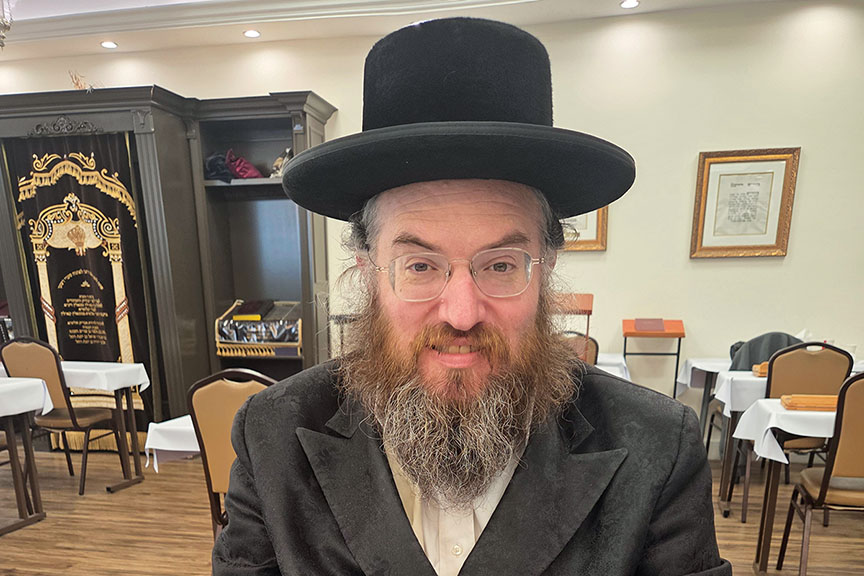
The other day I was speaking to an engaging young Chasidic student who impressed me with his erudition in Jewish and secular studies.
I was engrossed in the conversation, gaining more and more respect for him, when he suddenly said, “Where I grew up, we lived in a tough neighborhood surrounded by shvartzas.” Hearing his words broke my heart, and my impression of him plummeted.
A friend with whom I discussed the incident told me that I judged the young man too harshly, that he might have meant nothing by it, and that it was just an expression to which he had been acclimated.
He asked me that, rather than judge this student, I lend him the benefit of the doubt and attempt instead to educate him as to why the term ought never be used.
About a year ago I wrote a column about how the word “shvartza” must be retired forever. It is an insulting, offensive, and derogatory term that has no place in the mouths of people committed to ethics.
And since we Jews have a faith that demands the highest moral standards, it simply can never be part of our lexicon.
In the wake of that column, I was surprised to find that a number of people — religious and secular alike — wrote that I was exaggerating. “Shvartza,” they said, was an innocent and benign term that simply meant “black person.”
It doesn’t. It’s a pejorative, a term with a distinctly condescending connotation. While I will not go so far as to agree with my esteemed former radio co-host, Peter Noel, one of America’s leading African American journalists, that it is Yiddish for the “N” word, I will say that it has some of the same vibes.
My purpose in addressing this issue again is not to sound holier than thou or be self-righteous. Believe me, I am the worst person I know. But when I hear the term I feel pain. Pain that we Jews who have suffered so much persecution can be so callous as to speak condescendingly, however unintentionally, of other human beings. And pain that we religious Jews in particular can so betray our core values by inadvertently coming across as bigots.
I once found myself in an argument with a fellow Orthodox Jew, who lived in Brooklyn, after I had politely shared with him why the term “shvartza” is offensive: “It’s OK for you to criticize, Shmuley, because you don’t live in a neighborhood where you have to be afraid to walk the streets or where your car gets vandalized every night. We don’t mean anything bad with the term, but we are the victims here.”
But what do the sins of a few have to do with criminalizing an entire population? And isn’t this tactic of blaming an entire community not only racist, but exactly what is used today against Jews by the worst anti-Semites?
How many Jew-haters will harp on a few high-profile white-collar criminals from Wall Street or Enron who are Jewish to reinforce anti-Semitic stereotypes such as “scratch a Jew and find a Shylock?”
Jews are called by the Torah to be a light unto the nations, and it is religious Jews in particular, who live lives openly committed to Jewish ritual and values, upon whom this responsibility first devolves. But what light is it that we impart when we use a term of vulgarity that betrays the Torah’s most sacred value, that there is only one God in heaven who created every human being in His likeness.
And just think how people who are unfamiliar with Jews must react when they hear any of us using an unpleasant expression about a fellow human being.
Bigotry is least appealing among those whose lives should be most dedicated to its opposite. If you can love giant ducks and outsized rodents, then surely you can find a place in your heart for your human brother who goes by the title Jew.
How much more so that we Jews, a righteous and generous people, whose Torah calls us to the mighty ideal of loving our neighbor as ourselves, must never speak of another person contemptuously. How much more so that Orthodox Jews in particular, who are renowned the world over for their charity, humility, and loving-kindness must be extra vigilant never to offer even a hint of discriminatory language.
The speeches of the Rev. Jeremiah Wright have caused considerable consternation to the campaign of Sen. Barack Obama. Obama has eloquently expressed the need for America to transcend red state and blue state divisiveness and come together for shared national purpose. People expect that his pastor should be at least as loving, that men of God should be especially careful with their words.
But Wright has given speeches that have put rifts over reconciliation and generated heat rather than healing. The same is true of Louis Farrakhan, whom Wright has praised, even though he is guilty of hate speech against Jews and Judaism.
Our moral authority to condemn such insensitive and inflammatory rhetoric is dependent upon us being utterly different in thought, speech, and action.
Who better than Jews and blacks know what it is to suffer? And who better than Jews and blacks know that there can be no tolerance for intolerance? And who better than Jews and blacks must come together to battle bigotry, defeat discrimination, and generate good will among all of God’s children?
Blacks and Jews share not only a common history of oppression, but a common legacy of spiritual longing and a love for the eloquence of the Bible. Let us find words that will draw our communities together and a vocabulary that will instill a common faith and a common hope.