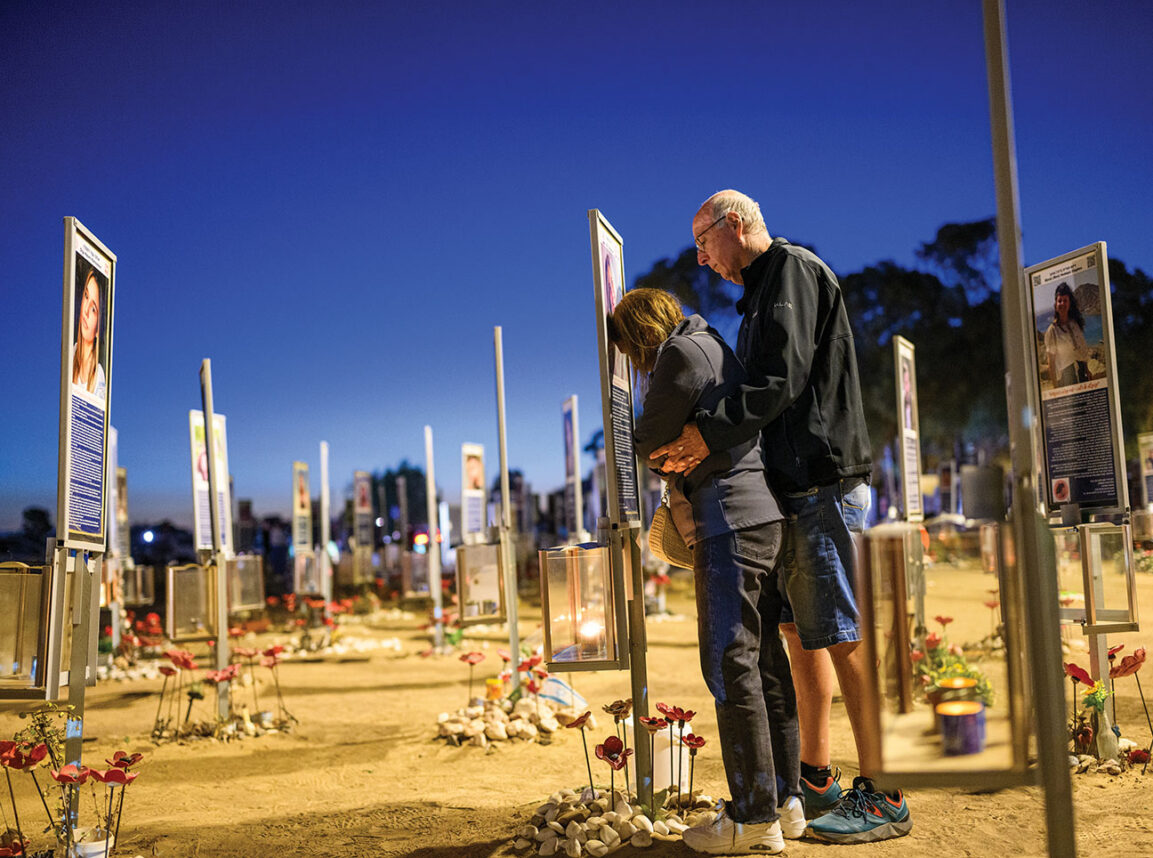

So, they are all back. More than 250. Many alive, many in body bags. Many are breathing, laughing, living human beings. Many are just memories. On Monday, the last of them was returned, after much effort, to his family. He was a policeman, shot and killed on Oct. 7, 2023, his body taken, to serve as a bargaining chip in tough negotiations. On his return, Israelis cleared empty chairs that waited for the last hostage, removed yellow pins, marked an x on a last picture. It’s over. The nightmare of hostages is over.
Fighting to find the body of Ran Gvili was as important for victory as fighting to defeat an enemy. It was a completion of a mission many Israelis considered crucial, sacred even. Is it more important than defeating Hamas? That’s a thorny question. The Israeli government, at the outset of the war, made these two its primary goals. At times, they seemed contradictory. As if Israel must choose between having its hostages and eliminating Hamas. At times, Israelis debated the proper sequence for achieving both. Should we get them back first and deal with Hamas later. Or begin with Hamas and only then turn to the hostages.
Fighting to find the body of Gvili was as important for victory as fighting to defeat an enemy. It was a completion of a mission many Israelis considered crucial, sacred even. Is it more important than defeating Hamas? That’s a thorny question.
Ultimately, decisions were made, some unwise, some possibly cynical, realities changed, because of Israel or because of other players. One deal led to the other, one battle preceded another. Could Israel get all of them back earlier. Could it get more of them alive rather than dead. Could it shorten the torturous path by making better choices, appointing better negotiators, planning in more meticulous way. These debates are endless, and tired, and have no clear answers. One thing is clear now: The hostages are all back, and this saga is over. Hamas is not yet defeated, and that saga had barely began.
Israel’s determination, preoccupation and obsession with returning a hostage was again on display, in the days prior to finding Gvili. In the Gaza mud, soldiers were digging out graves, examining remains, clearing debris. If anyone wonders, the IDF is a military that can put up a fight in more than one way. Searching for Gvili it fought for Israel’s sanity and peace of mind. Occasionally, one is astonished with Israel’s insistence on finding every remain of every lost citizen. It is a weakness we have – one that the enemy uses, time and again, to its advantage.
It is also a strength of immeasurable value. Every person counts, every soul, every member of the community. When 250 Israelis were taken away from us, we all rushed to make these lost people a family. We learned their names, familiarized ourselves with the families, their life stories, treated them as if – as if they were brothers and sisters. The one with the beard, the one with the awkward glasses, the one with the disability, the one who needs treatment, the one with the twin, the one with the soulmate, the one with the very happy end, the one with the heartbreaking tragic end.
Did we learn any lesson from this journey of sorrow and anger? From past experiences we learn that Israel can sit calmly and make all sorts of calculated decisions concerning the next time. It can appoint a committee, it can write rules, it can make policy recommendation and nod with a stern face as a report is submitted to the government. What it cannot do is follow through. What it cannot do it keep the calm when an Israeli is taken away to serve as a bargaining chip. On such occasions, all rules are thrown away, all strict commendations become mere proposals. Rules are for countries, for citizens. Rules do not apply to families, and Israelis – as polarized as they are today, as angry at one another, as disappointed with each other – somehow manage to become more of a family when the fate of hostages is on the line.
Was it different this time? Maybe it was. The debates over the proper policy Israel must implement following the debacle of Oct. 7 were fierce, and sometimes involved angry, ugly rhetoric against the families of hostages, against the activists who worked to keep the cause of releasing the hostages front and center, against government officials who’d been accused that they don’t much care about the hostages. The large number of hostages made the debate more complicated than usual, the high-stakes war against Hamas made it more complicated, the long and intense two years of battle challenged the nerves of all Israelis. And of course, there’s the politics. Our miserable way of practicing politics.
On Monday, Ran Gvili was brought back to Israel, and made his last contribution to a crazed grieving nation. For just a few hours he gave us a reason to forget about our miserable way of practicing politics – and remember that some things we can still do. Remarkable things.
Something I wrote in Hebrew
What complicates all coalitions? Predetermined boycotts on participation of parties:
No one is ready to forgo all boycotts. Not even Gantz, who constantly explains that his rationale for lifting one boycott (on Netanyahu) is to impose another (on Ben-Gvir). He lifts the ban on those he defines as “non-extremists” only to slap a ban on “the extremists.” That is all well and good, of course, but it raises a question: Who is an extremist, and who gets to decide? And that is a question with an answer: Almost everyone considers someone an extremist, and almost everyone is an extremist in the eyes of someone else. Shall we make this clearer? There is hardly a single Israeli to be found who is truly willing to forgo all boycotts.
A week’s numbers
Everyone has a plan for a day after in Gaza. What’s the plan Israelis would support? (JPPI, January 2026 poll).

A reader’s response
Eli Rosen writes: “The whole world understands that Trump is a lunatic. It’s time Israelis also understand this sad reality.” My response: I’m not a psychiatrist. I do know that Israel must deal with the president that Americans chose to elect.
Shmuel Rosner is senior political editor. For more analysis of Israeli and international politics, visit Rosner’s Domain at jewishjournal.com/rosnersdomain.