“An act of antisemitic hatred.”
That’s how French President Emanuel Macron described the recent chopping down of a tree in a Paris suburb that had been planted in memory of Ilan Halimi, a French Jew who was tortured to death by a Muslim gang in 2006.
Ironically, the French authorities initially denied the antisemitic nature of the murder, despite ample evidence. The government also insisted on keeping the trial of the killers behind closed doors, on the grounds that two of the 27 defendants were slightly under 18 years of age. The Halimi family suspected the authorities were trying to downplay the role of antisemitism in the killing.
Today, however, there is no dispute that the crime was motivated by antisemitism. And now France’s president says that the chopping down of the Halimi memorial tree also qualifies as antisemitism.
One wonders if Macron would be willing to acknowledge the role of antisemitism in numerous French actions and policies in past decades.
For example, if cutting down a tree is antisemitic, was it antisemitic to protect an indicted Nazi war criminal?
For more than a year after World War II ended, the French authorities allowed a notorious Nazi collaborator, Grand Mufti Haj Amin el-Husseini, to reside in a comfortable villa in a Paris suburb—even after he was indicted as a war criminal by the government of Yugoslavia, for assisting the Nazis in various ways, including committing atrocities.
When international pressure for the Mufti’s arrest intensified in 1946, the French allowed him to “escape.” The Palestinian Arab leader boarded a TWA flight to Cairo and was granted asylum in Egypt.
Is it antisemitic to say that all Jews are “domineering” (dominateur)? That’s what French president Charles DeGaulle said at a press conference in 1967. He alleged that Jews “through the ages” acted like “an elite people, sure of itself and domineering,” and thereby “provoked—caused, more exactly—a tide of ill-will in certain countries and at certain times…”
DeGaulle insisted he was not antisemitic. A poll by the French magazine L’Express found 44% of the French public agreed with what DeGaulle said about Jews. No doubt they, too, would have denied being antisemitic.
How about protecting modern-day killers of Jews, and condemning Israel for fighting them? Is that antisemitic? The French government condemned Israel for killing Arab airplane hijackers during its rescue at Entebbe in 1976. The following year, the French detained and then quickly released Munich massacre mastermind Abu Daoud, enabling him to find haven in Algeria.
Yet when Islamist terrorists struck in Paris—rather than against Israeli Jews—hypocritical French leaders used language that they denounced when Israeli officials spoke similarly.
French President Francois Hollande said the ISIS attacks in Paris in 2015 were carried out by “barbarians,” towards whom France should show “no mercy.” The French responded to those attacks with air strikes on medical clinics, a soccer stadium, and a museum that were near ISIS terror encampments in Syria. Yet last October, President Macron declared an arms embargo against Israel because some civilians in Gaza were harmed as a result of Hamas barbarians embedding themselves in medical clinics and other civilian sites in Gaza.
Today, President Macron waxes indignant about the Halimi tree, while threatening to recognize the “State of Palestine.” One might ask which is more antisemitic—cutting down a tree, or rewarding the mass murder, torture, and gang-rapes of 1200 Israeli Jews?
It should be noted that there are separatist movements active in the northwestern French region of Brittany; in Savoy, along the French-Swiss border; and on the French-occupied island of Corsica. But Macron has not said a word about recognizing their claims to statehood.
According to the IHRA definition of antisemitism—used by 46 countries, including the United States—one example of antisemitism is “Applying double standards by requiring of [Israel] a behavior not expected or demanded of any other democratic nation.” In the case of Macron, it’s even worse—he’s demanding that Israel do something which he himself is not willing to do. And it’s something much more consequential than cutting down a tree.
Dr. Seuss, the beloved creator of children’s books such as The Cat in the Hat, once drew a remarkable cartoon on the subject of France, Jews and trees. It was in 1942, when Seuss was the editorial cartoonist for the New York City newspaper P.M.
That summer, the Nazi forces occupying France began the mass deportation of Jews from France to Auschwitz. The collaborationist French government headed by Prime Minister Pierre Laval helped carry out the mass arrests.
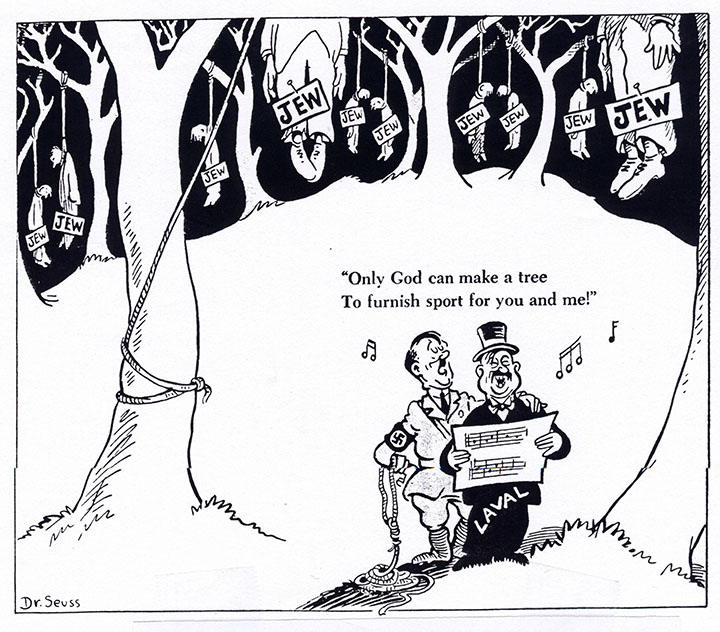
In P.M., Seuss drew a cartoon showing Laval and Hitler, in a forest, singing the words of the famous poem “Trees,” by Alfred Joyce Kilmer. All around them, the corpses of dead French Jews hang from the trees. Seuss showed Laval and Hitler adding a line of their own to the poem, describing the murder of the Jews as “sport for you and me.”
Killing Jews for “sport” has been all too common throughout history, whether by the Nazis and their helpers in 1942, the Munich Olympics attackers in 1972, the killers of Ilan Halimi in 2006, or Hamas in 2023. The best way to honor Ilan’s memory is both to condemn those who desecrated his memorial, and to stand up against all those who commit anti-Jewish atrocities.
Dr. Medoff is founding director of The David S. Wyman Institute for Holocaust Studies and author of more than 20 books about Jewish history and the Holocaust. His book The Road to October 7: Hamas, the Holocaust, and the Eternal War Against the Jews will be published on October 1, 2025, by The Jewish Publication Society / University of Nebraska Press.)

France, Antisemitism and Dr. Seuss
Rafael Medoff
“An act of antisemitic hatred.”
That’s how French President Emanuel Macron described the recent chopping down of a tree in a Paris suburb that had been planted in memory of Ilan Halimi, a French Jew who was tortured to death by a Muslim gang in 2006.
Ironically, the French authorities initially denied the antisemitic nature of the murder, despite ample evidence. The government also insisted on keeping the trial of the killers behind closed doors, on the grounds that two of the 27 defendants were slightly under 18 years of age. The Halimi family suspected the authorities were trying to downplay the role of antisemitism in the killing.
Today, however, there is no dispute that the crime was motivated by antisemitism. And now France’s president says that the chopping down of the Halimi memorial tree also qualifies as antisemitism.
One wonders if Macron would be willing to acknowledge the role of antisemitism in numerous French actions and policies in past decades.
For example, if cutting down a tree is antisemitic, was it antisemitic to protect an indicted Nazi war criminal?
For more than a year after World War II ended, the French authorities allowed a notorious Nazi collaborator, Grand Mufti Haj Amin el-Husseini, to reside in a comfortable villa in a Paris suburb—even after he was indicted as a war criminal by the government of Yugoslavia, for assisting the Nazis in various ways, including committing atrocities.
When international pressure for the Mufti’s arrest intensified in 1946, the French allowed him to “escape.” The Palestinian Arab leader boarded a TWA flight to Cairo and was granted asylum in Egypt.
Is it antisemitic to say that all Jews are “domineering” (dominateur)? That’s what French president Charles DeGaulle said at a press conference in 1967. He alleged that Jews “through the ages” acted like “an elite people, sure of itself and domineering,” and thereby “provoked—caused, more exactly—a tide of ill-will in certain countries and at certain times…”
DeGaulle insisted he was not antisemitic. A poll by the French magazine L’Express found 44% of the French public agreed with what DeGaulle said about Jews. No doubt they, too, would have denied being antisemitic.
How about protecting modern-day killers of Jews, and condemning Israel for fighting them? Is that antisemitic? The French government condemned Israel for killing Arab airplane hijackers during its rescue at Entebbe in 1976. The following year, the French detained and then quickly released Munich massacre mastermind Abu Daoud, enabling him to find haven in Algeria.
Yet when Islamist terrorists struck in Paris—rather than against Israeli Jews—hypocritical French leaders used language that they denounced when Israeli officials spoke similarly.
French President Francois Hollande said the ISIS attacks in Paris in 2015 were carried out by “barbarians,” towards whom France should show “no mercy.” The French responded to those attacks with air strikes on medical clinics, a soccer stadium, and a museum that were near ISIS terror encampments in Syria. Yet last October, President Macron declared an arms embargo against Israel because some civilians in Gaza were harmed as a result of Hamas barbarians embedding themselves in medical clinics and other civilian sites in Gaza.
Today, President Macron waxes indignant about the Halimi tree, while threatening to recognize the “State of Palestine.” One might ask which is more antisemitic—cutting down a tree, or rewarding the mass murder, torture, and gang-rapes of 1200 Israeli Jews?
It should be noted that there are separatist movements active in the northwestern French region of Brittany; in Savoy, along the French-Swiss border; and on the French-occupied island of Corsica. But Macron has not said a word about recognizing their claims to statehood.
According to the IHRA definition of antisemitism—used by 46 countries, including the United States—one example of antisemitism is “Applying double standards by requiring of [Israel] a behavior not expected or demanded of any other democratic nation.” In the case of Macron, it’s even worse—he’s demanding that Israel do something which he himself is not willing to do. And it’s something much more consequential than cutting down a tree.
Dr. Seuss, the beloved creator of children’s books such as The Cat in the Hat, once drew a remarkable cartoon on the subject of France, Jews and trees. It was in 1942, when Seuss was the editorial cartoonist for the New York City newspaper P.M.
That summer, the Nazi forces occupying France began the mass deportation of Jews from France to Auschwitz. The collaborationist French government headed by Prime Minister Pierre Laval helped carry out the mass arrests.
In P.M., Seuss drew a cartoon showing Laval and Hitler, in a forest, singing the words of the famous poem “Trees,” by Alfred Joyce Kilmer. All around them, the corpses of dead French Jews hang from the trees. Seuss showed Laval and Hitler adding a line of their own to the poem, describing the murder of the Jews as “sport for you and me.”
Killing Jews for “sport” has been all too common throughout history, whether by the Nazis and their helpers in 1942, the Munich Olympics attackers in 1972, the killers of Ilan Halimi in 2006, or Hamas in 2023. The best way to honor Ilan’s memory is both to condemn those who desecrated his memorial, and to stand up against all those who commit anti-Jewish atrocities.
Dr. Medoff is founding director of The David S. Wyman Institute for Holocaust Studies and author of more than 20 books about Jewish history and the Holocaust. His book The Road to October 7: Hamas, the Holocaust, and the Eternal War Against the Jews will be published on October 1, 2025, by The Jewish Publication Society / University of Nebraska Press.)
Did you enjoy this article?
You'll love our roundtable.
Editor's Picks
Israel and the Internet Wars – A Professional Social Media Review
The Invisible Student: A Tale of Homelessness at UCLA and USC
What Ever Happened to the LA Times?
Who Are the Jews On Joe Biden’s Cabinet?
You’re Not a Bad Jewish Mom If Your Kid Wants Santa Claus to Come to Your House
No Labels: The Group Fighting for the Political Center
Latest Articles
Rosner’s Domain | Meet Galit: Israel’s Decider
Torah Portion: Noah
Noah’s Ark: Building a World of Giving
Abraham and the Tower of Babel: What Is the Connection?
Pray Go On
Three Years After October 7, Israelis Parallel Americans’ Post-9/11 Mood Swings
Baseball’s Bounce Through the American Founding
As the Dodgers continue their march toward a World Series three-peat during America’s 250th year, it’s worth revisiting the relationship between baseball and the American Founding.
Building After Destruction: The Resilience of Am Yisrael
The story of Am Yisrael is one of a people that has endured extraordinary suffering and nevertheless continues to look ahead with faith and hope.
Light and Joy
Inspired by the unbridled bliss of the Simchat Torah holiday, I promised myself that whenever I am overwhelmed, I will focus on things that remind me of why I should be grateful.
On Counterfeit Meaning: Flower Children to Manson, Gen Z to Hamas
How can something as beautiful as the search for a meaningful life connect to something as evil as murder?
Voter ID Proposition: Not Important, But Not Terrible
Proposition 39 can do little harm, might do a little good and is nothing to rush to the ramparts about.
Nobel Rewards Anti-Israel Crusade
Just as disturbing as the award itself has been the satisfaction with which it has been greeted across much of the international press, television and political establishment.
Will the Saudis Look to Israel?
10,000 frontline Houthi militia could determine the outcome of this month’s election and indirectly select the Jewish state’s next leader.
N.Y. Times Whitewashes Israeli Sex Predator
Trybal Gatherings Brings Jewish Summer Camp to Young Adults in Ojai
More than 100 participants recharged, made new friends, and reflected on summer camp nostalgia, while spending meaningful time with 10 campers from Israel.
The Portugal Most Travelers Never See: A Journey Through Sephardic Heritage
Busting Antisemites
It’s a relief to see Jew-haters finally receive some just deserts.
Turning the Tables on Lie of the Century
We have a bunker buster: 10,000 words of evidence that Hamas committed genocide on Oct. 7. What are we planning to do with it?
How I Lost My Composure in Front of 2,000 People
Memorials, especially a memorial for an unspeakable tragedy, are a reminder that, in the end, we can never really “move on.”
Newsom Signs Safe Worship Act, Ira Gershwin Initiative, Technion Society Names Board President
Notable people and events in the Jewish LA community.
Religious Violence and Other Failures
When our service of God degenerates into a paganism of self-worship, the deepest religious failures, including violence, take hold.
The End of the Beginning – A poem for Parsha Bereshit
This is the end of the beginning…
A Bisl Torah ~ Sharp Anchoring
When we teach our children, the lesson they glean should be sharp and clear enough, so they feel anchored by our tradition and confident in our values.
A Moment in Time: October 7 – We Will Not be Defined by Loss
Simchat Torah is the Antidote of Hevel
Print Issue: The Genocide Case Against Hamas | October 9, 2026
Was a single day’s attack, no matter how savage, too brief to qualify as genocide? It turns out that duration has never been the legal test.
More news and opinions than at a Shabbat dinner, right in your inbox.