Moving to Los Angeles so my husband could pursue his career meant leaving family, friends and the city in which I was born—the one with Yankee Stadium, Coney Island, and pizza by Ray. To add insult to injury, I also gave up bialys. Who knew it would take 40 years to taste the yeasty onion-strewn bread of my youth again? When I spotted some, next to the bagels on a generous buffet table at a recent event, I had to pinch myself. For a girl from the Bronx, it was my madeleine moment.
The occasion for the buffet was the opening of Bagel + Slice, a new food concept in Highland Park. The brainchild of chef/food scientist/entrepreneur Brad Kent, co-founder of the Blaze pizza chain, the earth-friendly eatery is set to serve two foods that people adore—pizza and bagels. With a tip of the hat to his New Jersey, Jewish heritage, Kent also decided to put bialys on the menu. He had been tinkering with a recipe for years.
“I always felt bad for the poor bialy baker. He was probably some poor schnook at the lowest rung of the bakery hierarchy, undoubtedly working at a station in the very back,” explains Kent. “A dozen bagels, please, and toss in four bialys,” was not an unusual order back in the day. Bialys were an afterthought.
The grandson of a Jewish deli-owner, Kent went deep once he decided to pay homage to a childhood favorite. The finished product, the size of a small bagel, is made with his special combination of regenerative rye and organic wheat, hand-cut onions, water and salt. It gets a three-day ferment, a hand-made hole, and most importantly, it’s baked briefly at super high temperatures—kind of like a pizza! Though sublime, the result is not exactly what I remembered from my 1950s Bronx childhood. I’m not sure anything made today could taste the same. But I wanted to find out.
Many of those who survived, like the Kossar family, migrated to New York—carrying a taste for bialys in their DNA.
My search took me back to the source, New York City, bialy capitol of the world since Jews were more or less eliminated from Bialystok in Poland. Many of those who survived, like the Kossar family, migrated to New York—carrying a taste for bialys in their DNA. My first pit-stop was Kossar’s, the original gangster of bialy shops on the Lower East Side. After walking through the storied streets of our ancestors—the ones with names like Hester, Orchard, and Essex—I reached the holy spot on Grand Street. It was transformed. In place of the schmutzy storefront where tired, old Jews in dusty aprons took your order and filled it fast—who had time to waste?—there were tasteful black and white subway tiles on the walls and a shiny, up-to-date, bright red logo in the window. The counter people were not in such a rush. And they were polite! The younger Kossars had rebranded for the Instagram age but the ambience left me cold.
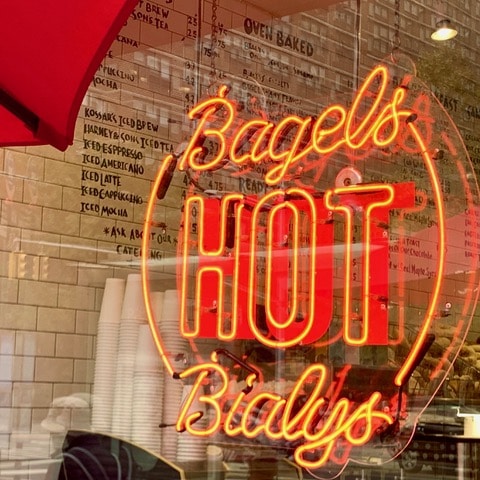
How were the bialys? Kossar’s current product is a facsimile: about 3-inches wide, the bialys are perfect circles with less of everything: fewer onions, a couple of poppy seeds, tiny air pockets, no blistered spots. It felt more like a mini-bagel than a true bialy, though the price was right. The mostly Chinese and Hispanic clientele were happily munching them with a schmear on top, in the hygienic, outdoor seating area, ironically across from the original Settlement House on Eldridge Street.
To reach back for context I turned to former New York Times restaurant critic Mimi Sheraton and her book “The Bialy Eaters.” In the late 1990s the reporter travelled the world to track down the remaining Jews of Bialystok—a voyage that included stops in Israel, Buenos Aires, Paris and Melbourne. She learned that all roads lead back to Bialystok, now the tenth largest city in Poland. Back in the day, when 65% of the city’s population was Jewish, inhabitants were affectionally known throughout Europe as “Bialystoker kuchen fressers” for their love of that food. The humble bialy was knit into their DNA.
Cajoled by his daughter, he once even tasted bialys in California, but he wasn’t impressed. “Without poppy seeds they are ridiculous,” he sighed.
“No one born in Bialystok can forget kuchen,” explained Jerusalem baker Ariel Shamir, a survivor. “Rich Jews ate it as bread with the meal; poor Jews ate it as the meal. Cajoled by his daughter, he once even tasted bialys in California, but he wasn’t impressed. “Without poppy seeds they are ridiculous,” he sighed.
Renowned international attorney, diplomat and former Bialystoker Dr. Samuel Pisar was thinking of bialys in Paris when he gave Sheraton an interview toward the end of the last century.
“I search for them everywhere I go. It’s not the taste so much as the symbol. It reminds me of coming home safely from school in the late afternoons of long dark seasons [in Poland]. I can still hear the women selling hot kuchen in big straw baskets as they went through the street yelling at the top of their lungs, ‘Kuchen, heisse [hot] kuchen.’ My grandmother… would spread butter or cream cheese on the back of the kuchen without cutting it open, and I would munch it as I went out to play with friends.”Pisar would be happy to know that thanks to a new generation of bakers, the intrepid bialy is making a comeback in America. Here in 21st-century Los Angeles, seekers can once again find a soulful bialy suffused with the taste of home.
How to eat a bialy: Once you do find a great bialy, here is how the experts recommend you eat it. Never slice in half. Toast it whole and then slather with butter—no cream cheese, smoked fish, or red onion allowed! Those rich trimmings would only distract from the distinct taste of bread. Bialys can be stored in the freezer—just toast to defrost. They should toast up light and fluffy with a thin crackly crust and onions that cannot be contained by that crater in the center. They will make a mess. Enjoy!
My research results: In addition to Bagel + Slice in Highland Park, the new Wise Bros. deli in Culver City makes a very good version with lots of onions and poppy seeds and a satisfying blast of char on the crust. In New York right now, you won’t be disappointed by Mark’s Off Madison started by the former chef of Barney’s New York, who also stocks excellent smoked fish.
Los Angeles food writer Helene Siegel is the author of 40 cookbooks, including the “Totally Cookbook” series and “Pure Chocolate.” She runs the Pastry Session blog. During COVID-19, she shared Sunday morning baking lessons over Zoom with her granddaughter, eight-year-old Piper of Austin, Texas.
Are Bialys Having a Moment?
Helene Siegel
Moving to Los Angeles so my husband could pursue his career meant leaving family, friends and the city in which I was born—the one with Yankee Stadium, Coney Island, and pizza by Ray. To add insult to injury, I also gave up bialys. Who knew it would take 40 years to taste the yeasty onion-strewn bread of my youth again? When I spotted some, next to the bagels on a generous buffet table at a recent event, I had to pinch myself. For a girl from the Bronx, it was my madeleine moment.
The occasion for the buffet was the opening of Bagel + Slice, a new food concept in Highland Park. The brainchild of chef/food scientist/entrepreneur Brad Kent, co-founder of the Blaze pizza chain, the earth-friendly eatery is set to serve two foods that people adore—pizza and bagels. With a tip of the hat to his New Jersey, Jewish heritage, Kent also decided to put bialys on the menu. He had been tinkering with a recipe for years.
“I always felt bad for the poor bialy baker. He was probably some poor schnook at the lowest rung of the bakery hierarchy, undoubtedly working at a station in the very back,” explains Kent. “A dozen bagels, please, and toss in four bialys,” was not an unusual order back in the day. Bialys were an afterthought.
The grandson of a Jewish deli-owner, Kent went deep once he decided to pay homage to a childhood favorite. The finished product, the size of a small bagel, is made with his special combination of regenerative rye and organic wheat, hand-cut onions, water and salt. It gets a three-day ferment, a hand-made hole, and most importantly, it’s baked briefly at super high temperatures—kind of like a pizza! Though sublime, the result is not exactly what I remembered from my 1950s Bronx childhood. I’m not sure anything made today could taste the same. But I wanted to find out.
My search took me back to the source, New York City, bialy capitol of the world since Jews were more or less eliminated from Bialystok in Poland. Many of those who survived, like the Kossar family, migrated to New York—carrying a taste for bialys in their DNA. My first pit-stop was Kossar’s, the original gangster of bialy shops on the Lower East Side. After walking through the storied streets of our ancestors—the ones with names like Hester, Orchard, and Essex—I reached the holy spot on Grand Street. It was transformed. In place of the schmutzy storefront where tired, old Jews in dusty aprons took your order and filled it fast—who had time to waste?—there were tasteful black and white subway tiles on the walls and a shiny, up-to-date, bright red logo in the window. The counter people were not in such a rush. And they were polite! The younger Kossars had rebranded for the Instagram age but the ambience left me cold.
How were the bialys? Kossar’s current product is a facsimile: about 3-inches wide, the bialys are perfect circles with less of everything: fewer onions, a couple of poppy seeds, tiny air pockets, no blistered spots. It felt more like a mini-bagel than a true bialy, though the price was right. The mostly Chinese and Hispanic clientele were happily munching them with a schmear on top, in the hygienic, outdoor seating area, ironically across from the original Settlement House on Eldridge Street.
To reach back for context I turned to former New York Times restaurant critic Mimi Sheraton and her book “The Bialy Eaters.” In the late 1990s the reporter travelled the world to track down the remaining Jews of Bialystok—a voyage that included stops in Israel, Buenos Aires, Paris and Melbourne. She learned that all roads lead back to Bialystok, now the tenth largest city in Poland. Back in the day, when 65% of the city’s population was Jewish, inhabitants were affectionally known throughout Europe as “Bialystoker kuchen fressers” for their love of that food. The humble bialy was knit into their DNA.
“No one born in Bialystok can forget kuchen,” explained Jerusalem baker Ariel Shamir, a survivor. “Rich Jews ate it as bread with the meal; poor Jews ate it as the meal. Cajoled by his daughter, he once even tasted bialys in California, but he wasn’t impressed. “Without poppy seeds they are ridiculous,” he sighed.
Renowned international attorney, diplomat and former Bialystoker Dr. Samuel Pisar was thinking of bialys in Paris when he gave Sheraton an interview toward the end of the last century.
“I search for them everywhere I go. It’s not the taste so much as the symbol. It reminds me of coming home safely from school in the late afternoons of long dark seasons [in Poland]. I can still hear the women selling hot kuchen in big straw baskets as they went through the street yelling at the top of their lungs, ‘Kuchen, heisse [hot] kuchen.’ My grandmother… would spread butter or cream cheese on the back of the kuchen without cutting it open, and I would munch it as I went out to play with friends.”Pisar would be happy to know that thanks to a new generation of bakers, the intrepid bialy is making a comeback in America. Here in 21st-century Los Angeles, seekers can once again find a soulful bialy suffused with the taste of home.
How to eat a bialy: Once you do find a great bialy, here is how the experts recommend you eat it. Never slice in half. Toast it whole and then slather with butter—no cream cheese, smoked fish, or red onion allowed! Those rich trimmings would only distract from the distinct taste of bread. Bialys can be stored in the freezer—just toast to defrost. They should toast up light and fluffy with a thin crackly crust and onions that cannot be contained by that crater in the center. They will make a mess. Enjoy!
My research results: In addition to Bagel + Slice in Highland Park, the new Wise Bros. deli in Culver City makes a very good version with lots of onions and poppy seeds and a satisfying blast of char on the crust. In New York right now, you won’t be disappointed by Mark’s Off Madison started by the former chef of Barney’s New York, who also stocks excellent smoked fish.
Los Angeles food writer Helene Siegel is the author of 40 cookbooks, including the “Totally Cookbook” series and “Pure Chocolate.” She runs the Pastry Session blog. During COVID-19, she shared Sunday morning baking lessons over Zoom with her granddaughter, eight-year-old Piper of Austin, Texas.
Did you enjoy this article?
You'll love our roundtable.
Editor's Picks
Israel and the Internet Wars – A Professional Social Media Review
The Invisible Student: A Tale of Homelessness at UCLA and USC
What Ever Happened to the LA Times?
Who Are the Jews On Joe Biden’s Cabinet?
You’re Not a Bad Jewish Mom If Your Kid Wants Santa Claus to Come to Your House
No Labels: The Group Fighting for the Political Center
Latest Articles
The Unusual Urge to Meet a Stranger
Rabbis of LA | Rabbi Engel’s ‘Shabbos in a Gas Station’
Sinai Akiba Masquerade Ball, Builders of Jewish Education’s 2026 Annual Benefit
The Architecture of Will: Decision and the Structure of Transformation
We Need More Jewish Babies
Congregation Beth Israel: Fond Memories of My Childhood Synagogue in LA’s Fairfax District
A Moment in Time: “When Losing an Hour Inspires Holiness”
A Bisl Torah — The Story You Need to Tell
May the story you share be a reminder that through our fears and uncertainty, alongside the bitterness we experience, redemption awaits.
Is Religious Knowledge Receding or Revealed via Tephilllin, Phylacteries?
Dutch Mistreat: Anti-Zionists in the Netherlands Tried Disrupting My Zoom Lecture
Denouncing my invitation, anti-Zionists smashed over 25 plate-glass windows in two nights of vandalism. Their graffiti proclaimed: “Stop your Zionist war propaganda” and “stop zios.”
Dancing While The War Raged On – A poem for Parsha Vayakhel-Pekudei
I just returned from B’nei Mitzvah in Chicago … War broke out in the middle of the festivities
Suspect Dead after Car Crash, Shooting at Detroit-area Reform Temple, Largest in North America
The director of security at Temple Israel was injured in the attack, the Reform congregation said.
Print Issue: The Year Everything Changed | March 13, 2026
Crazy as it might sound, it all started with the Dodgers, and how they won back-to- back World Series in 2024 and 2025. That year, with those two championships on either end, is the exact same year l became a practicing Jew. And I don’t think that’s a coincidence.
Rabbi Jerry Cutler, 91
In 1973, he founded Synagogue for the Performing Arts, drawing the likes of Walter Matthau, Ed Asner and Joan Rivers.
Racing Back to War: Israelis Stranded Abroad Desperate to Return Home
From Los Angeles to Thailand, Israelis are sitting anxiously, waiting for a notice from El Al or other airlines, hoping for a chance to board a flight back to Israel.
Healing Through Play: Mobile STEAM Unit Delivers Trauma Relief to War-Affected Communities
We are delivering hands-on learning and building resilience for a generation growing up under conflict in a region that lacks a dedicated children’s museum.
Friday Night Star – Spicy, Saucy Salmon
We made this recipe Passover-friendly because who doesn’t need an easy one-skillet dish that is healthy and delicious!?!
Pies for Pi Day
March 14, or 3/14 is Pi Day in celebration of the mathematical constant, 3.14159 etc. Any excuse to enjoy a classic or creative pie.
Table for Five: Vayakhel
Funding The Mishkan
The Light of Wonderment: A Letter to My Sons
Crazy as it might sound, it all started with the Dodgers, and how they won back-to-back World Series in 2024 and 2025.
Rosner’s Domain | Why Israelis See the War Differently
American malaise involves gloomy thoughts about spiking gas prices, or depressing flashbacks to previous wars where days stretched into decades. Israeli malaise is accompanied by gloomy thoughts about the Americans.
God: An Invitation
No single philosophical system can contain God.
For the Dogs? The Delightful Surprises of Jewish Medieval Art
Canines’ renowned loyalty was a natural representation of the “loyal transmission of the divine mandate from generation to generation.”
Honoring Palestinian Women Terrorists on International Women’s Day
Even those self-described human rights groups that are strongly biased in favor of the Palestinian Arab cause acknowledge the PA’s systemic mistreatment of women.
It Didn’t Start with Auschwitz
Jews today do have a voice. For the moment. But we have not used it where it counts – in the mainstream media, the halls of power, on campuses, on school boards, in the public square.
Regime Humiliation: No, You Won’t Destroy Israel
After years of terrorizing Israelis with existential threats, the Islamic regime is now worried about its own existence. In a region where the projection of power is everything, that is humiliation.
More news and opinions than at a Shabbat dinner, right in your inbox.