fbpx

October 20, 2021

Comedian Highlights Satirical Songwriter Tom Lehrer in New Musical

Tom Lehrer was a musical comedic force in the 1950s and ‘60s. He wrote and performed satirical songs about everything from war to religion to death and politics, and was known for tunes like “The Elements,” “Poisoning Pigeons in the Park” and “The Masochism Tango.” His work went international, and he ended up inspiring the likes of Monty Python, Weird Al Yankovic and Flight of the Conchords.

Now, in a new solo Hollywood Fringe show called “The Layers of Tom Lehrer,” comedian Allan Murray is performing Lehrer’s songs and telling the world about the satirist he’s always enjoyed. 

“My folks had his album ‘That Was The Year That Was,’ and I would listen to it as a kid,” Murray told the Journal. “I didn’t understand all of the references, but I heard this guy singing and playing the piano to huge laughs from the crowd. I was hooked. He’s one of the reasons that I learned piano. I’ve been a fan forever.”

Murray, a stand-up comic with credits from Comedy Central, Showtime, MTV and NBC, said that he chose to do a show on Lehrer not only because he was a fan, but also because of how important the singer was to the culture during his time. He wrote songs about nuclear tensions between countries when the Cold War was happening, and wasn’t afraid to parody any topic. Plus, nobody had written a show about Lehrer before. 

“Sometimes I’d see reviews of his music pop up, but never a one-person show about Tom’s journey from math to showbiz to math again. I’ve wanted to create a show about him for years and finally made it happen.”

One of the most surprising things about Lehrer is that when he reached the top of show business – without much effort, Murray noted – he left it to focus on being a mathematician instead. Lehrer earned a gold record, got nominated for a Grammy and was featured in the same Time Magazine article featuring Lenny Bruce, but Murray said he never cared about being famous.

‘His enigmatic qualities only helped grow his cult following.’ – Allan Murray 

“He wouldn’t even put a picture of himself on his albums. His enigmatic qualities only helped grow his cult following, though. His first love was math, not fame. If some people don’t know his name today that’s all by his design. But sing ‘The Elements,’ and they will know the song. That’s fine by him.”

Murray reached out to Lehrer, who is now 93, to discuss the show prior to its debut. “I called him to ask for his blessing,” said Murray. “We’ve had some pleasant conversations and emails back and forth about the project. He splits his time between Boston and Santa Cruz. I plan to send him a video.”

While Lehrer is Jewish, Murray said he didn’t make it part of his act like his contemporaries Mel Brooks or Allan Sherman did. 

“Tom did write ‘(I’m Spending) Hanukkah in Santa Monica,’ “said Murray. “If that’s not part of a Jewish legacy, I don’t know what is.”

To prepare for the show, Murray sat at his piano daily to fine tune the songs. “There was a lot to rehearse and a whole script to write as well,” he said. “I have a five-year-old daughter who knows all the words to ‘Poisoning Pigeons in the Park.’”

Even though COVID-19 restrictions are in place, Murray has had full houses since his first show. “The audience wearing masks didn’t affect a thing,” he said. “You hear the laughs, you feel the connection [and] you get the responses.”

When people come to see the final performance of “The Layers of Tom Lehrer” on October 23, Murray said he hopes they gain “a greater knowledge of this great man and his music. And, also, [I hope they] have a blast at the theater again.”

You can purchase tickets for “The Layers of Tom Lehrer” on the Hollywood Fringe website.

Comedian Highlights Satirical Songwriter Tom Lehrer in New Musical Read More »

Are We Losing Our Imagination?

The state of the national discourse has become so ugly, hostile and tribal it may be eroding one of the great human traits—the power to imagine.

It’s hard to think creatively when you’re always fighting or virtue signaling. Self-righteousness, snark and smugness—three of the more popular tones of the day—are ideally suited to snuff out the innocent tendency to dream and imagine.

We may be “rational animals” pursuing knowledge for its own sake and living “by art and reasoning,” as Aristotle wrote 2,000 years ago, comparing us to other species. But the great philosopher could never have imagined a time when digital instruments would allow anyone to attack, pester and demean anyone else in a nanosecond. Our Twitter age of rage is the very antithesis of “pursuing knowledge for its own sake” and “living by art and reasoning.”

And yet, we are also madly enchanted with our digital lives—with the ability to Facetime with family members 8,000 miles away, with access to vast knowledge within seconds, with a greater array of quality entertainment than at any time in history.

But even then, let’s be honest, we are recipients and consumers more than we are creators. This is our dual reality: Whether we’re in attack mode or consumption mode, our digital addictions have dimmed the fires of our imagination. It’s a high price to pay for the convenience of instant everything.

Whether we’re in attack mode or consumption mode, our digital addictions have dimmed the fires of our imagination. It’s a high price to pay for the convenience of instant everything.

One hope for salvation is the simplicity of nature, preferably nature with terrible Wifi.

Nature is also a metaphor for any place of serenity and harmony that allows us to reconnect with our deeper selves. In my recent visit to the mystical city of Tsfat in northern Israel, I would see people pray at the break of dawn, with dramatic views of the Galilee in the background. That felt like harmony and serenity to me.

Things like meditation, mindfulness training, silent retreats, nature hikes and escaping to the great outdoors are all humanity’s way of regaining what digitized life is sucking from us. They are spaces where human imagination can still triumph over the cerebral junk food of a nasty Twitter troll. It’s telling that a primary use of our imagination today is at the service of regaining our imagination.

Judaism offers an ancient instrument that also reaffirms the best of our human traits, and is eons away from any Wifi connection.

It’s called Shabbat.

Judaism offers an ancient instrument that also reaffirms the best of our human traits, and is eons away from any Wifi connection. It’s called Shabbat.

For one day a week, we float in what Rabbi Abraham Joshua Heschel famously called a “sanctuary of time.” Sanctuary is the perfect term to describe a place where we can slow down, calm down and reconsider the things that matter most.

And one of those things must surely be, “How do we best use our time here on earth?”

When we ponder such questions in a sanctuary of time, the answers reside in the questions: Is our time best spent fighting or creating? What gives us more joy, consuming or imagining? Are we happier pursuing knowledge for its own sake or pursuing knowledge to take someone down? Is human connection more rewarding than mindless confrontation?

The ultimate uniqueness of being human is the never-ending search to imagine better possibilities. Just as our tech geniuses keep imagining more digital tools to keep us constantly hooked, we must stay ahead of these possibilities and imagine our own paths to more meaningful and creative lives.

Shabbat Shalom.

Are We Losing Our Imagination? Read More »

DC Climate Group Won’t Participate in Voting Rights Rally Because of “Zionist Groups”

The Washington D.C. affiliate of the climate change group Sunrise Movement announced in an October 19 statement that they won’t be participating in an upcoming voting rights rally because “Zionist groups” will be a part of it.

The statement specifically cited the participation of the Jewish Council of Public Affairs (JCPA), National Council of Jewish Women (NCJW) and Religious Action Center of Reform Judaism (RAC) in the October 23 Freedom to Vote Relay – Rally at the Finish Line as being “in alignment with and in support of Zionism and the State of Israel.” “Given our commitment to racial justice, self-governance, and indigenous sovereignty, we oppose Zionism and any state that enforces that ideology.”

Sunrise DC’s statement went on to accuse Israel of using “violent and oppressive tactics” against the Palestinians. “As a colonial project, Israel routinely displaces Palestinians through the construction of settlements and the wholesale theft of homes and land. It also treats all Palestinians, as well as Black and brown Jewish-Israelis, as second-class citizens who have virtually, often subjecting them to extreme policing and brutality.” They also said that Palestinians in the Gaza Strip and West Bank are unable to vote in Israeli elections even though Israel occupies and controls those areas. Sunrise DC argued that the “fight for [D.C.] statehood and sovereignty are incompatible with Zionism and the political erasure of Palestinians that the ideology calls for.” The environmentalist group called for the Declaration for American Democracy, which sponsored the rally, expunge JCPA, NCJW and RAC from the coalition.

The Jewish groups cited by Sunrise DC all said they would continue their efforts to pursue voting rights in statements to the Journal.

“In keeping with our 77-year history, JCPA will continue our ongoing engagement on voting rights efforts in coalition with interfaith and diverse communities, including our involvement in the freedom to vote rally and in support of fair, free and accessible elections for all people,” JCPA Senior Vice President Melanie Gorelick said.

Sheila Katz, CEO of NCJW, also said: “National Council of Jewish Women works for the safety and wellbeing of Americans, Israelis, and Palestinians. We fight for access to the ballot, an end to gender-based violence, increased equity, and for women to build power despite systemic barriers at every turn. All of this work is done in coalition, often led by impacted communities, to center those with lived experiences. Our commitment to working across lines of difference includes our willingness to engage in dialogue with groups that take issue with our policies. Let’s move forward together to advance human rights and dignity for all people.”

Rabbi Jonah Presner, the director of RAC, similarly said, “It’s unfortunate that any organization would refuse to join together to protect voting rights. The work of our coalition to ensure that every American has access to the right to vote is too important not to remain in partnership as we push Congress to act. As an organization committed to social justice and our progressive Zionist values, we will continue to work toward the passage of comprehensive voting rights legislation.”

Several Jewish groups and Twitter users criticized Sunrise DC over their statement.

“This is the vilification of Jewish nationhood and a litmus test for all who support it,” Anti-Defamation League (ADL) CEO Jonathan Greenblatt tweeted. “This is antisemitic – plain and simple.”

He added in a subsequent tweet that the JCPA, RAC and NCJW “all provide invaluable services and support to the Jewish community, and vilifying them is nothing short of disgraceful. @ADL fully supports these organizations and is thankful to have them as an ally in the fight against hate.”

The American Jewish Committee similarly tweeted, “Zionism is the movement for Jewish self-determination in [Israel]. Anti-Zionism is considered antisemitic by over 80% of American Jews. To shun Zionists is to shun the overwhelming majority of Jews. This is antisemitism, plain and simple.”

StandWithUs tweeted that Sunrise DC’s statement is essentially saying that “the Jewish people’s movement for freedom and self-determination is ‘incompatible’ with … supporting the right to self-determination. ‘No Jews who support their own rights allowed!’ It would be funny if it weren’t so sad, ignorant, and hateful.”

“Sadly, antisemitism has COMPLETELY engulfed the progressive space,” Stop Antisemitism tweeted. “It’s not about the settlements.  It’s not about Jerusalem.  With these fanatics and their ilk it’s solely about the complete [eradication] of the Jewish state.”


The American Jewish Congress said in a statement that Sunrise DC’s message was “deeply dangerous” because “American Jews have fought for civil rights, civil liberties, the separation of church and state, and multiple other positions that have helped to make America a more just society. We American Jews have an equal right to share our voices, just as all Americans do. Silencing our voices, as the Sunrise Movement demands, is the antithesis of democracy.”

Laura E. Adkins, Opinion Editor of The Forward, tweeted: “National Council of Jewish Women funds organizations that connect Palestinian women with legal aid, social services, and help them grow grassroots political power. But tell me more about how you’re the ones who *really* care about Palestinians.”

Eve Levenson, a progressive organizer and advocate, tweeted that she found Sunrise DC’s statement to be “flawed” and “anti-Semitic.” She praised, the JCPA, NCJW and RAC as being “some of the largest Jewish advocacy orgs who have historically & today do important work on domestic progressive priorities. It’s one thing to refuse working [with] a Zionist group like AIPAC. This is about not wanting to work with Jews.”

Sunrise DC and the national Sunrise Movement organization did not respond to the Journal’s requests for comment.


DC Climate Group Won’t Participate in Voting Rights Rally Because of “Zionist Groups” Read More »

Are Bialys Having a Moment?

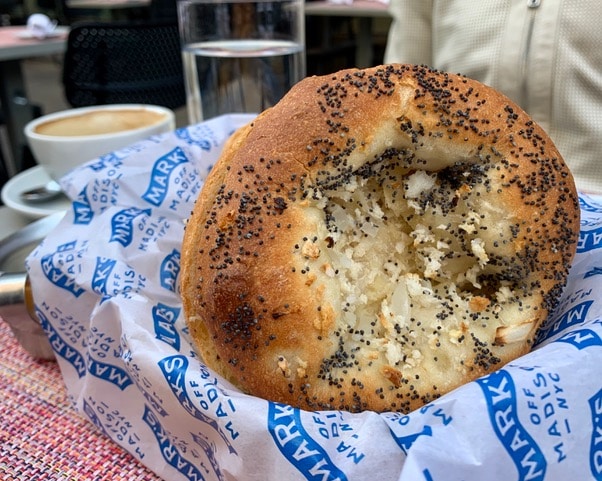
Moving to Los Angeles so my husband could pursue his career meant leaving family, friends and the city in which I was born—the one with Yankee Stadium, Coney Island, and pizza by Ray. To add insult to injury, I also gave up bialys. Who knew it would take 40 years to taste the yeasty onion-strewn bread of my youth again? When I spotted some, next to the bagels on a generous buffet table at a recent event, I had to pinch myself. For a girl from the Bronx, it was my madeleine moment.

The occasion for the buffet was the opening of Bagel + Slice, a new food concept in Highland Park. The brainchild of chef/food scientist/entrepreneur Brad Kent, co-founder of the Blaze pizza chain, the earth-friendly eatery is set to serve two foods that people adore—pizza and bagels. With a tip of the hat to his New Jersey, Jewish heritage, Kent also decided to put bialys on the menu. He had been tinkering with a recipe for years.

“I always felt bad for the poor bialy baker. He was probably some poor schnook at the lowest rung of the bakery hierarchy, undoubtedly working at a station in the very back,” explains Kent. “A dozen bagels, please, and toss in four bialys,” was not an unusual order back in the day. Bialys were an afterthought.

The grandson of a Jewish deli-owner, Kent went deep once he decided to pay homage to a childhood favorite. The finished product, the size of a small bagel, is made with his special combination of regenerative rye and organic wheat, hand-cut onions, water and salt. It gets a three-day ferment, a hand-made hole, and most importantly, it’s baked briefly at super high temperatures—kind of like a pizza! Though sublime, the result is not exactly what I remembered from my 1950s Bronx childhood. I’m not sure anything made today could taste the same. But I wanted to find out.

Many of those who survived, like the Kossar family, migrated to New York—carrying a taste for bialys in their DNA.

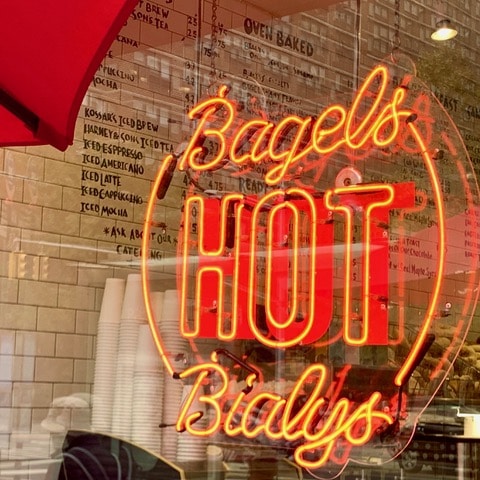
My search took me back to the source, New York City, bialy capitol of the world since Jews were more or less eliminated from Bialystok in Poland. Many of those who survived, like the Kossar family, migrated to New York—carrying a taste for bialys in their DNA. My first pit-stop was Kossar’s, the original gangster of bialy shops on the Lower East Side. After walking through the storied streets of our ancestors—the ones with names like Hester, Orchard, and Essex—I reached the holy spot on Grand Street. It was transformed. In place of the schmutzy storefront where tired, old Jews in dusty aprons took your order and filled it fast—who had time to waste?—there were tasteful black and white subway tiles on the walls and a shiny, up-to-date, bright red logo in the window. The counter people were not in such a rush. And they were polite! The younger Kossars had rebranded for the Instagram age but the ambience left me cold.

How were the bialys? Kossar’s current product is a facsimile: about 3-inches wide, the bialys are perfect circles with less of everything: fewer onions, a couple of poppy seeds, tiny air pockets, no blistered spots. It felt more like a mini-bagel than a true bialy, though the price was right. The mostly Chinese and Hispanic clientele were happily munching them with a schmear on top, in the hygienic, outdoor seating area, ironically across from the original Settlement House on Eldridge Street.

To reach back for context I turned to former New York Times restaurant critic Mimi Sheraton and her book “The Bialy Eaters.” In the late 1990s the reporter travelled the world to track down the remaining Jews of Bialystok—a voyage that included stops in Israel, Buenos Aires, Paris and Melbourne. She learned that all roads lead back to Bialystok, now the tenth largest city in Poland. Back in the day, when 65% of the city’s population was Jewish, inhabitants were affectionally known throughout Europe as “Bialystoker kuchen fressers” for their love of that food. The humble bialy was knit into their DNA.

Cajoled by his daughter, he once even tasted bialys in California, but he wasn’t impressed. “Without poppy seeds they are ridiculous,” he sighed. 

“No one born in Bialystok can forget kuchen,” explained Jerusalem baker Ariel Shamir, a survivor. “Rich Jews ate it as bread with the meal; poor Jews ate it as the meal. Cajoled by his daughter, he once even tasted bialys in California, but he wasn’t impressed. “Without poppy seeds they are ridiculous,” he sighed.

Renowned international attorney, diplomat and former Bialystoker Dr. Samuel Pisar was thinking of bialys in Paris when he gave Sheraton an interview toward the end of the last century.

“I search for them everywhere I go. It’s not the taste so much as the symbol. It reminds me of coming home safely from school in the late afternoons of long dark seasons [in Poland]. I can still hear the women selling hot kuchen in big straw baskets as they went through the street yelling at the top of their lungs, ‘Kuchen, heisse [hot] kuchen.’ My grandmother… would spread butter or cream cheese on the back of the kuchen without cutting it open, and I would munch it as I went out to play with friends.”Pisar would be happy to know that thanks to a new generation of bakers, the intrepid bialy is making a comeback in America. Here in 21st-century Los Angeles, seekers can once again find a soulful bialy suffused with the taste of home.

How to eat a bialy: Once you do find a great bialy, here is how the experts recommend you eat it. Never slice in half. Toast it whole and then slather with butter—no cream cheese, smoked fish, or red onion allowed! Those rich trimmings would only distract from the distinct taste of bread. Bialys can be stored in the freezer—just toast to defrost. They should toast up light and fluffy with a thin crackly crust and onions that cannot be contained by that crater in the center. They will make a mess. Enjoy!

My research results: In addition to Bagel + Slice in Highland Park, the new Wise Bros. deli in Culver City makes a very good version with lots of onions and poppy seeds and a satisfying blast of char on the crust. In New York right now, you won’t be disappointed by Mark’s Off Madison started by the former chef of Barney’s New York, who also stocks excellent smoked fish. 


Los Angeles food writer Helene Siegel is the author of 40 cookbooks, including the “Totally Cookbook” series and “Pure Chocolate.” She runs the Pastry Session blog. During COVID-19, she shared Sunday morning baking lessons over Zoom with her granddaughter, eight-year-old Piper of Austin, Texas.

Are Bialys Having a Moment? Read More »

Why Jews Laugh

These are serious times in America. Seasonal fires rage, like clockwork, in California and elsewhere up the Pacific coast. Hurricanes and floods, persistently taunting the Gulf Coast and beyond, are no longer the purview of the biblical Noah, no longer metaphors for collective cleansing and redemption. Mass shootings, though they don’t always make the news these days because we’ve grown accustomed to them, are part of the new American fabric. Last year, we recorded the highest increase in the national rate of homicide in modern history. We are, literally, killing each other more than ever before. Violent hate crimes against religious and ethnic minorities, including and especially Jews, are becoming more brazen. And while the pandemic continues, hope for its inevitable end ebbing and flowing, so do the culture wars that prove our penchant for hate rather than tenacity. 

Almost nothing remains bubbling under the surface anymore. We keep very little at bay. Hate, violence, fearmongering, division—no longer simply percolating, they have become our default mode, our most apparent and distinctive feature. We are Americans, and our world is a ticking time bomb.

The antidote may feel elusive, but in the meantime, there’s something we can do: We can laugh.

One might say that making others laugh is a mitzvah; one might also say that laughing at ourselves is an even greater mitzvah.

It sounds insensitive, I know. But in the expanse of such a dark horizon, it’s easy to forget the great Jewish tradition of finding humor in things. In such a serious moment in which everything is politicized and partisan—we are all right, all of the time—and in which so many of us have become self-righteous about our politics and ideologies, maybe we have an even greater responsibility to laugh. One might say that making others laugh is a mitzvah; one might also say that laughing at ourselves is an even greater mitzvah. When we laugh at ourselves we are telling the world that we know how to be introspective, that we don’t take ourselves too seriously. Self-reflection is truly an under-appreciated quality.

We could all take ourselves a little less seriously. But Jewish comics are in the lead when it comes to this race.

“Why we laugh, I’m not quite sure. But why we MAKE people laugh is because you can’t get girls when you’re under six feet, have a deviated septum, flat feet and gastrointestinal issues. So you’d better have good jokes.” — Dan Ahdoot

Dan Ahdoot is a stand-up comic, podcaster, and actor best known for his role as Anoush in the Emmy-nominated global hit series “Cobra Kai.” His show “Raid the Fridge” premieres on Food Network December 28. I asked Dan to tell me why Jews laugh, and he said: “Why we laugh, I’m not quite sure. But why we MAKE people laugh is because you can’t get girls when you’re under six feet, have a deviated septum, flat feet and gastrointestinal issues. So you’d better have good jokes.”

Dan Levy, television writer/showrunner, stand-up comic, and co-host of “House Hunters: Comedians on Couches” had a similar response to my question: “Jews laugh because we are self-aware and self-deprecating. We also love to get laughs because we are self-involved.”

Comedy—at least, good comedy—is about truth-telling and honesty. It’s transparency at its finest. When unbridled and unrestrained by political correctness it is the ultimate cultural commentary. It says the things we cannot say, but often want to or should say. And, in many cases, we are all better because of it, if for no other reason than we have agreed to be honest with each other for a moment. It’s an unwritten contract that’s a win-win for both parties. No compromise.

“The Holocaust itself is not funny. There’s nothing funny about it. But survival, and what it takes to survive, there can be humor in that.” — Rob Reiner in the documentary “The Last Laugh”

But, as most Jewish comics will tell you, it’s also about darkness in many cases. I’ve written in various places, including for the Journal, about how some of the most traumatic and insidious moments in history have given rise to some of the wildest explosions of humor. Whether it’s the Holocaust, the events of 9/11, the pandemic, or anything else that saddens us, distresses us, or makes us feel afraid, many of us—both Jews and non-Jews—feel the impulse and even the palpable need to laugh. Filmmaker Ferne Pearlstein, director of the documentary “The Last Laugh,” told me that humor “has always been a coping mechanism, a means of resistance, and a way to fight back for the oppressed, so it’s not a coincidence that humor has long been associated with the Jewish people.” She continued: “As Rob Reiner says in ‘The Last Laugh’: ‘The Holocaust itself is not funny. There’s nothing funny about it. But survival, and what it takes to survive, there can be humor in that.’” 

Dark humor is a complex beast. It’s also subjective. Years ago when I taught a Holocaust literature and film class at UCLA, we discussed Holocaust humor. There were six students in the class who were grandchildren of survivors. All of them spoke with their grandparents about what was happening in class and reported back to me. The responses were split. Three of the grandparents were thrilled that humor was being used to confront the Holocaust. The other three were horrified, and said that the Holocaust is off-limits when it comes to humor. 

Both responses were correct. Humor is subjective. It can be deeply personal. But regardless of how we feel about it, the reality is that it’s a tool that people are going to use to make sense of the world and their place in it. You can cancel it, censor it, or outlaw it—but people will still use and rely on humor. They will still be drawn to it. It will flourish no matter what kind of guard rails are in place.

“When we’re doing comedy, we’re arguing and making analogies, and that’s what the Talmud is.” — Elon Gold

For Elon Gold, stand-up comedian and actor who will be featured in the upcoming season of “Curb Your Enthusiasm,” the question isn’t why Jews laugh. “I can tell you that Jews, in fact, do not laugh,” says Gold, who jokes about the difference between Jewish and non-Jewish audiences. “When Jews laugh, it’s like a short, quick, reserved laugh followed by thinking and planning—‘he’d be good for a fundraiser we’re having next month!’—so we don’t give the full laugh.” The bigger question is about why Jews make others laugh. Where does this impulse come from? Why do we do it? “It’s because we have that observational eye,” says Gold. “When we’re doing comedy, we’re arguing and making analogies, and that’s what the Talmud is.” Jews have a long history of engaging with the world in this way. The Talmud is about argument and analysis—it’s about engaging with complex ideas and subjects and making sense of them. If you know anything about the Talmud, you know that in many cases disagreements are often left unresolved, and that’s the beauty of it. The value is in the process of analyzing an issue and confronting it, and in seeing it from various perspectives. In much the same way, comedy provides us with a way into some of the most pressing issues of our time, giving us a space for thoughtful analysis, even as we laugh and even if we disagree.

Jews have a long history of being persecuted and facing things like pogroms, genocide, and loss; and while the idea of Jews as comic geniuses may be somewhat recent, we can find traces of it since the beginning, perhaps gently foreshadowing what would come hundreds of years later. In Genesis, Sarah laughs when God reveals to her that she, an old woman, will not only enjoy sexual pleasure again with her husband Abraham, but also will bear a child. You’re hilarious, God, her laugh says. I’ve often wondered if this is the moment we learned it may be acceptable to laugh even at God sometimes; perhaps even God doesn’t need to be taken so seriously. Comedy and laughter can be lessons too. Sometimes we laugh because, deep down inside, we understand the absurdity of our situation, and laughing about it means we are being honest with ourselves.

Throughout the centuries things get pretty dark for the Jews, and while Jewish writing throughout the medieval and middle eras was mostly serious given the trials of the day—hello, crusades—the popular genres of animal fables (think Aesop’s Fables) and riddles were for both Jews and non-Jews an outlet for making jokes. Jeremy Dauber, in “Jewish Comedy: A Serious History,” gives a detailed accounting of this trajectory, but reminds us that as recently as the 19th century, Jews were not known particularly for their humor. Ruth Wisse, in her study from a few years prior to Dauber’s, recounts something similar, which raises the question of why Jews, in their American context, have become so synonymous with comedy.

It’s easy to say that Jews laugh because it’s a way of dealing with persecution—that it’s a coping mechanism. And, sure, that’s true in some cases. But the subtext of that perspective is the story of Jews as perpetual victims, and that’s not who we are. Laughing in the face of persecution doesn’t mean it’s coming from a place of victimhood. To be able to laugh in the face of adversity or tragedy can also signify mastery over a person or subject or history. It can be a way to take back the story from the oppressors or perpetrators—to own it. Humor has often flourished in oppressive regimes (as shown in Rudolph Herzog’s book “Dead Funny: Telling Jokes in Hitler’s Germany,” for example). We instinctively understand the potential for comedy and laughter to rob the most horrific atrocities and disasters of their power to frighten and control us. But American Jews in particular have really nailed it when it comes to laughing in the face of tragedy and disaster. The question is why. What is it about America that has brought out the impulse to laugh, to tell jokes, and to frame everything we encounter in the context of humor?

Laughter is freedom. But the freedom to laugh, and to make others laugh, isn’t something that should be taken for granted. There is power in laughter. When we laugh at something we think is ridiculous, we bring it down. We show that it doesn’t define or control us. Jeff Ross, stand-up comedian, author, actor, and writer/producer best known as The Roastmaster General, had a straightforward response to my question of why Jews laugh: “In my opinion, Jews laugh because it keeps us from crying.” Emmy award-winning comedy writer Rob Kutner had a similar answer: “Because if we didn’t, we’d never be able to stop crying.”

Making a joke about something dark or something about which we’re self-conscious puts us in a position to own the story, rather than allowing the story to own us.

Making a joke about something dark or something about which we’re self-conscious puts us in a position to own the story, rather than allowing the story to own us. Some might think that laughing instead of crying is about escaping, about not dealing with something. But I disagree. Humor isn’t always about looking away. It’s about facing something directly, confronting and acknowledging it. It can, in fact, be the most authentic way to confront sensitive or distressing material.

Sometimes that makes people feel uncomfortable. And we happen to be living in a time where the growing sentiment is that no one should ever feel uncomfortable. Every space should be safe. Jokes should be at no one’s expense. The recent controversy over Dave Chappelle’s Netflix special, “The Closer,” in which he makes a number of jokes about transgender people, is an example of this. But whether Chappelle’s or anyone else’s humor is appropriate or not shouldn’t be the question. Instead, we should be asking why there is a growing movement to curtail comedy by censoring what we can and can’t laugh at. The answer seems fairly obvious: It’s about power. A comic standing on stage in front of tens of thousands of people (not to mention their likely millions of Twitter or Instagram followers) has power.

Making jokes about things that seem off-limits is an unusual freedom. In America, we have a history of taking pride in our freedom. As Americans, we love our rights. We love having the freedom to speak our minds. We love being able to laugh at anything and everything, whether it’s appropriate or not. This is increasingly true of younger generations. A former student at UCLA once told me: “I love our generation. We make everything hilarious.” It’s not only college students; it’s teenagers and younger children as well. My 8-year-old son tells me that his peers talk and laugh about memes constantly. And most of these young people probably have no idea that the kinds of jokes they laugh at every day would be illegal in some countries.

Will they soon be illegal in ours as well? It’s hard to imagine. And yet.

Some people call what’s happening “cancel culture.” Others mock these accusations and suggest that nothing of the sort is happening. Either way, as veteran comedy director Jay Karas says, “It’s on everyone’s mind. Many comics are treading cautiously on stage, and it’s only a few brave souls who are putting their acts out there, unfiltered, exactly the way they want to right now.” 

The idea that some comics—historically the people we could count on to tell it like it is—are self-censoring is bad news for all of us. In the short term we might convince ourselves that self-censorship and political correctness makes places and spaces safer, and that watching what we say is a hallmark of a compassionate society. But the truth is the more we work to curtail authentic comedy, the closer we are to finding ourselves in a society that is untenable. The things we laugh at might not always be appropriate, and we certainly have a right to say that. It’s also true that not everyone will agree on what kinds of jokes work. But the important thing is that we keep trying, that we keep giving comics and writers the space to fail and fall short. Even jokes that fail or upset people have a purpose. They, too, tell us something about who we are. And those who want to shut down the comedy they find offensive—well, history is littered with stories of people who want to silence the prophets and truth-tellers, lock them away. But those people rarely emerge as anything other than villains.

“Had I done ‘The Inquisition’ as a movie in 1492, I would’ve been in a lot of trouble.”— Mel Brooks in the documentary “The Last Laugh”

And, anyway, in a world in which people are not allowed to be offended, what happens to the hallowed and indispensable Jewish tradition of laughter? When classic Borscht Belt comedian Jackie Mason died recently, my social media newsfeed was filled with polarizing responses. Some lamented the loss of such a comedic giant, while others said good riddance, citing his many offensive and arguably inappropriate jokes about various races and ethnicities. What may have been funny two decades ago is no longer funny to some people. And that’s okay. Time changes how we tell stories and jokes; it also changes how we read and hear those stories and jokes. As Pearlstein says, “The political context is always changing, and the line about what is fair game for comedy is ever-shifting. For the Holocaust in particular, humor about it is much more prevalent than it was a decade or even five years ago. Time is a subject that comes up in ‘The Last Laugh’ quite a bit. Mel Brooks jokes that, ‘Had I done ‘The Inquisition’ as a movie in 1492, I would’ve been in a lot of trouble. But five centuries had gone by, and so it was okay. Time opens up different avenues of thought and acceptance.’”

Just think: what may not be funny today, has a good chance of being funny 10, 20, or 100 years from now. So maybe the only thing we need to do now is to laugh, or at least to allow others to laugh even if we don’t think what they’re laughing at is funny. There’s a lot of freedom in laughter, for both the one telling the jokes that inspire the laughter and those who laugh. And the space to tell jokes that may or may not land in their intended place is one of the safest we can find.

Without this freedom to laugh and to tell jokes, the Jewish story would be very different. The story of Jewish laughter is the story of Jews.

Without this freedom to laugh and to tell jokes, the Jewish story would be very different. The story of Jewish laughter is the story of Jews.

Esther D. Kustanowitz, award-winning comedy-adjacent writer, chronicler of #TVGoneJewy, and The Bagel Report podcast co-host, tapped into the idea of the Jewish story in her answer to my question: Why do Jews laugh?

“Why do Jews laugh? Because our survival was so unlikely that we have no choice: we have to tell our story. A band of desert travelers who grumbled on their way out of slavery and into a promised land encounters conflict after conflict, arguing with each other all the way while making contribution after contribution to every field imaginable. Our story prompts an existential shrug-sigh that often becomes laughter—until someone gets offended. Lather, rinse, repeat. We love comedy until we are offended by it. We’re loving and inclusive until we’re not. We’re demanding and understanding and then demanding again. Plus, we have God’s writers’ room throwing us situations that test our mettle, sanity and humor at all times: people plan, and the angels provide the studio audience. We’re the best surreal meta-historical sitcom out there, and everyone from Larry David to The Jews Are Coming knows it. Laughter forces air into and out of our lungs … it keeps us alive and motivated even in the worst of circumstances.”

If violence, wild fires, and pandemics—the world as we currently know it—aren’t the worst of circumstances, I don’t know what is. 

Austin Winsberg, prolific writer/producer and creator of “Zoey’s Extraordinary Playlist,” gave me a few different answers to my big question, but his final thought was one that stuck with me: “All this question has done is made me wonder why I don’t laugh more.”

Indeed. Why aren’t all of us laughing more? Rather than policing laughter and attempting to dictate what is and isn’t funny, perhaps we should be focusing on laughing at the jokes and stories we do find funny. Perhaps we should be making sure that the world we leave for the next generation is one where the freedom to laugh and to tell jokes (even if they’re offensive or inappropriate) is an unquestionable right. In his famous essay “Laughter,” philosopher Henri Bergson cautions us against attempting to imprison the “comic spirit” in any one definition. His insistence that we “regard it, above all, as a living thing” speaks to its significance as a signifier of all things human. We want to be more human, not less human. We want to laugh.


Monica Osborne is Editor-at-Large at the Jewish Journal. She is a former professor of literature, critical theory, and Jewish Studies, and is the author of “The Midrashic Impulse and the Contemporary Literary Response to Trauma.” Follow her on Twitter @DrMonicaOsborne

Why Jews Laugh Read More »

Israeli Pride and Prejudice

Ofer Newman and Liana Merom Asif are two Israelis who made time to meet me for coffee last week. We had just left the Israeli Consulate in New York, where Ofer and Liana educated a handful of American Jews on Israeli Gay Youth (IGY), an organization that seeks to offer a “social space” for young LGBT Israelis, many of whom find themsleves in oppressive environments. Cars screeched by and jackhammers pounded into the pavement, but from our conversation, I was able to catch deeper insight into the world of “queer Israel”– the good, the bad, and the uncertain. 

Ofer is the CEO of IGY, a job he took after serving as the senior advisor to now Israeli President Isaac Herzog, who was then the leader of the opposition in the Knesset. Liana, a former combat soldier in the IDF, is the Vice President of IGY. Both were active members of Hashomer Hatzair, a socialist, Zionist and secular youth movement that dates back to Mandatory Palestine. This no doubt informs the progressive angle on Israeli social issues they both expressed. IGY began in 2002 as an underground operation in Tel Aviv, but now has over 400 volunteers and over 4,000 youth participants in ongoing activities throughout the year. Such activities include weekly meetings, marching in the Tel Aviv Pride Parade, researching LGBT issues in Israel (such as the “situation” of gay men in the IDF), and attending workshops and lectures with the goal of making social spaces more “inclusive, egalitarian, and empowering.” IGY is currently working with the Ministry of Welfare and Employment to establish a training center where “at risk” Israeli LGBT youth can earn a degree in a specific skill after their military service.

Ofer and Liana tell me they’re shocked “on a daily basis” by the stories of the children who walk into IGY’s doors, a number of them being homeless. One girl was sleeping for nights on end in the women’s section of a local synagogue after coming out as lesbian to her father. Both acknowledged the iconoclasm of Israel in comparison to its Middle Eastern neighbors when it comes to rights for sexual minorities, but also acknowledged the two communities which continue to stall on such liberalism — Orthodox Jews and Israel’s Arab community. IGY promises an accepting home for young people, many of whom are in these two circles.

Not only does IGY champion LGBT rights, but also relationships between those who are consistently portrayed as enemies. Perhaps outcasts from societal factions can bridge divides more successfully than politicians and legislation.

As a result, not only does IGY champion LGBT rights, but also relationships between those who are consistently portrayed as enemies. Perhaps outcasts from societal factions can bridge divides more successfully than politicians and legislation. 

“We like to say that around our Shabbat tables, we host all of Israeli society,” Liana explained. “We can use our identity to fix things not just related to LGBT issues, for example Jewish and Arab relations. During our seminars, everything is in Hebrew and Arabic. We celebrate all holidays together. We are tackling the idea of how to combine queer identity and religion, and we tackle problems in small communities. This, I think, is a way to make Israeli society not only diverse, because we’re not only living next to each other, but we’re friends with each other, so we are building a society that is together.   

I asked Ofer and Liana about their upbringings,  in the hope of hearing of how their experiences shaped their activism. Ofer grew up on a Kibbutz in the north, a tight-knit community of almost seven-hundred people. “Everyone knew everything about everyone,” he says, “and for me, this was an incentive to come out of the closet pretty soon. I realized everyone was already talking and thinking.” Ofer recalls visiting his childhood Kibbutz after beginning his work with IGY as very emotional. He met with his former Kindergarten teacher and friends of his parents to describe living as a gay man in Israeli society, a universe still very far away for most Kibbutzniks. Liana grew up in Jerusalem, “the city where everything happens,” and was inspired to begin work in social activism after seeing her community fall short in regards to how young LGBT people are treated. 

The perspective I heard over iced Americanos was one of optimism, passion, but also of grievance. As much as Israeli society is known for its celebration of love in the infamous gay bars of Tel Aviv, so also are the walls of reality–the unsustainable occupation of the West Bank, the blatant homophobia of the religious right, and the violence between Jews and Arabs– closing in. 

“The work that we do,” Ofer noted, “applies not only to our participants. They go back to their homes, they go back to their communities, they go back to their synagogues, to their mosques–and they create a change. Because they’re more in love with themselves. And as RuPaul says, if you can’t love yourself, how the hell are you going to love someone else?” 

After thanking Ofer and Liana for their time and stepping back into midtown traffic, I looked back on the two Israelis staring into the epicenter of Diaspora Jewry. I wondered if New York City feels alluring to gay people from Israel, where the collision of often conflicting identity is baked into their society. I decided I do not want to believe this, simply because the Zionist project calls for a Jewish and democratic state. In order to fulfill this dream, LGBT Jews in our ancestral homeland need boots on the ground.


Blake Flayton is New Media Director and columnist at the Jewish Journal.

Israeli Pride and Prejudice Read More »

Rabbis of LA | Deborah Schuldenfrei: The ‘Wartime’ Head of School

Deborah Schuldenfrei can’t stop laughing. 

She’s recounting the chaos and difficulty of running the conservative synagogue Valley Beth Shalom’s Day School during the pandemic, a story best described as a cross between a slapstick comedy and a horror movie, and Schuldenfrei, Head of School, is positively giddy. Well, perhaps delirious is the more appropriate term.

She says things like, “It was ugly,” “It was crazy,” and “Avoid! At all costs” as she recalls the K-6 school’s seemingly apocalyptic closure in the spring of 2020, the cautious but partial re-opening that followed, the challenges of distance learning, the tightly guarded in-person pods, the midnight zoom meetings, the traumatized kids, the frightened teachers, the desperate parents, even the logistical acrobatics of orchestrating bathroom breaks for 5-year-olds, lest they have a toilet-side encounter with a student outside their “pod” and possibly kill some unsuspecting grandparent. 

“So I’m tired,” Schuldenfrei says with a sigh. 

I ask how did she not go insane. How did she know what to do?

She laughs again, and picks up a Magic-8 ball from her desk. “This,” she said, “saved my life.”

She laughs again, and picks up a Magic-8 ball from her desk.

“This,” she said, “saved my life.”

The pandemic was a lesson in humility and uncertainty for pretty much the entire human population, but for Schuldenfrei, 43, a well trained educator and rabbi, it was an opportunity, as the kids say, to level up. “One of my board members put it in a complimentary fashion,” Schuldenfrei said with a sly smile. “‘You are a wartime head of school.’” 

While most everyone contended with one pandemic challenge or another, Schuldenfrei had to find a way to satisfy the sometimes opposing interests of kids, parents and teachers while also navigating the intricate, often schizophrenic city and state guidelines that turned childhood education into a tightrope walk. And just like in a military battle, all of this took place in a perennially high-risk environment where the slightest error could mean the difference between life and death.

“I guess most people have never considered in their life that everything is uncertain,” Schuldenfrei said. “You don’t know when your last breath is going to be, or if you can drop your kid off at school the next day. But here it was in practice; suddenly everyone was in this philosophical place.” 

Schuldenfrei may feign the art of being overwhelmed, but in truth she sounds quite pleased with how quickly the school got its house in order, opening VBS’s day camp only three months after the start of lockdown. 

“I actually think we saved lives doing that,” Schuldenfrei said. “We made families whole again. Because spending that much time with family in such uncertainty was very stressful on the parent-child dynamic, the sibling dynamic, the whole family structure. The children were deeply suffering.” 

While students from America’s poorest families suffered most, with many missing school altogether, the social, emotional and academic toll of the lockdown on children of all ages and backgrounds was incalculable. For months on end, children were unable to socialize with peers or learn in an educationally-conducive environment. They spent most of their day on a screen, sometimes attending school in pajamas. There was no physical education or recess time on the playground. And it took awhile before the usual structured breaks for physical activity and lunchtime were integrated into remote learning schedules. Not to mention, the terrible burden placed on parents who found themselves not only working their own jobs from home, but having to monitor their childrens’ home schooling as well.

“We made the decision early on that prioritizing in person instruction was essential for the mental health and well being of both parent and child,” Schuldenfrei said. 

After they succeeded with camp, VBS opened their Early Childhood Center and Kindergarten, gradually incorporating first and second grade in rolling percentages in order to maintain social distancing. As the months wore on, they folded in the other grades, until, eventually, everyone was back. Throughout the process, Schuldenfrei had the added challenge of convincing frightened teachers who were not yet vaccinated that in person learning was a tolerable level of risk. There was never a dull moment. 

“I have recreated the school 12 times,” Schuldenfrei said. 

Her home life was no picnic either. Schuldenfrei and her husband Brian, a pulpit rabbi at Adat Ari El, are both full time professionals raising three school-age sons, ages 13, 11 and 9, two of whom attend VBS and were experiencing the same pandemic hardships as Schuldenfrei’s other students. 

“It was very, very hard and my kids told me just how hard it was,” she said.  

In addition to coping with their mother’s round-the-clock schedule, her sons returned to school only to encounter a strange, unfamiliar routine. “I’m thinking to myself, ‘I have rigged a situation where you get to be at school instead of logging in, and you’re angry,’” Schuldenfrei said. “It’s almost like I got them to school and they were like, ‘This is not what we meant.’”

But Schuldenfrei soldiered on.

“What equipped me to handle all of it is, frankly, I’m a little stubborn,” she said. “I was committed to finding a way to make it work.” She said she found inspiration in the reality series “Project Runway” and on-air mentor Tim Gunn’s fluid, adaptable style. “Things might be sloppy, messy, unpleasant, but I had to make it work.”

Schuldenfrei also preserved her own health and sanity by exercising regularly and maintaining her spiritual practice. “Having Jewish community at that time was very helpful even though we were all so disconnected,” she said. “At a certain point I stopped using the term ‘social distancing’ because I felt the essential nature of having a social network.”

It wasn’t all bad. Schuldenfrei said some important innovations were spurred by the adjustment to distance learning, including VBS’s development of an online Jewish curriculum that can now be used to educate Jewish students in other cities. 

Being a rabbi helped her, too.

“The pastoral side helped me tremendously with empathy,” Schuldenfrei said. “Part of the clarity and the drive I have is because a psychologist briefed us early on and said, ‘Please keep in mind that for some of these families, seeing the teacher on zoom is the only regular reliable force in their lives right now.’ Financially, politically, everything was bananas; everything was unstable. 

“We were the stable force.” 

In the end, the wartime leader restored the peace.

Fast Takes with Deborah Schuldenfrei

Danielle Berrin : What’s currently on your night table?

Deborah Schuldenfrei: I just finished The Song of Achilles by Madeline Miller and a very light book called Miss Communication by Elyssa Friedland which was kind of ridiculous and wonderful. Also The Tunnel by AB Yehoshua. And I’m re-reading Ruth Gruber’s Raquela, A Woman of Israel. Clearly I have ADD.

DB: Last show you binge-watched?

DS: The Other Two on HBO and Nine Perfect Strangers on Hulu.

DB: Your day off looks like…

DS: I sleep and exercise. And go to the beach.

DB: Favorite thing to do in Israel?

DS. Eat. It might be shop. But eat sounds better.

DB: Something about you most people don’t know?

DS: I live with someone who brings a puppet to work. You know, for Tot Shabbat.

DB: Most essential Torah verse?

DS: Exodus 25: You shall accept gifts for me from every person whose heart is moved.

DB: Biggest challenge facing the Jewish world?

DS: There’s this joke from ‘The Other Two’ about when there’s a gap in conversation and you don’t know what to say, you can say, ‘In this climate…’ I’ve been using that a lot. Well, what can you say in this climate? 

DB: Guilty pleasure?

DS: (Pause) Maybe I don’t feel guilty about things anymore. That’s good. Otherwise, candy. 

DB: Favorite Jewish food?

DS: Challah. 

DB: If you weren’t a rabbi you’d be…

DS: A stylist. 

Rabbis of LA | Deborah Schuldenfrei: The ‘Wartime’ Head of School Read More »

Checking White Privilege at the Beverly Hills Public Library

I have always found librarians to be unfailingly helpful. Whether I’ve asked them to add a new title to the library’s collection (admittedly, sometimes those titles were my own), or where I’d find a particular book genre, librarians have leaped into service with kindness and enthusiasm.

But the other day at the Beverly Hills Public Library, I found that some librarians are a little too enthusiastic about leaping into service, even before they are asked. I was headed to the circulation desk to check out several books, but as I passed the shelves featuring new hardback releases, I stopped and stared. Many, though not all, of the new non-fiction titles were political, written by authors ranging from Stacey Abrams on the left to John Boehner on the right. One book per shelf had been selected to face out on a generous vista of open space, beckoning readers to notice them. Every book granted this prime real estate was not only political in nature, but anti-Trump or left-of-center. Where bookstores still exist, publishers pay for such valuable display opportunities.

The books given pride of place were “Rage,” by Bob Woodward and Robert Costa; “Persist,” by Elizabeth Warren; “The Room Where It Happened,” by John Bolton; and “Bag Man,” by Rachel Maddow. While Bolton is a Republican, this tell-all by Donald Trump’s former National Security Advisor heaps scorn on the former president.

I tilted my head to read the titles on the spines of the other new releases snugly fitted on the shelves and smiled ruefully at the irony of what the library had done. The publishing and writing professions are obsessed with “marginalized” writers and issues of diversity, inclusion, and equity. Several publishers of literary magazines or book imprints have announced they would only accept submissions from people of color, gender non-binary, and other favored minority categories for the time being. Yet these anti-Trump or anti-conservative titles were all written by whites; their privilege had not been checked at the Beverly Hills Public Library.

Meanwhile, no new titles written by conservatives earned any such favored placement. These included works by writers who really are marginalized: Candace Owens’ “Blackout;” Ben Shapiro’s “The Authoritarian Moment;” Dan Crenshaw’s “Fortitude;” and Ayaan Hirsi Ali’s “Prey.”

Hirsi Ali and Owens are women of color. Hirsi Ali, a Somali-born former Dutch politician, is a leading activist against the brutal treatment of girls and women in the Muslim world. It is bizarre and disturbing that her courage in standing up for the rights of females makes her a pariah of the left. Shapiro is an Orthodox Jew, certainly a minority within a minority. Crenshaw, a Republican Congressman from Texas, was blinded in one eye and lost a leg as a Navy SEAL fighting in Afghanistan. No special accommodations for access were made for this disabled American in the library.

Librarians and booksellers naturally promote titles and authors they like, and I have watched with growing frustration over the years as their “recommended” books on display nearly all favor a clear political agenda.

Librarians and booksellers naturally promote titles and authors they like, and I have watched with growing frustration over the years as their “recommended” books on display nearly all favor a clear political agenda. This includes at children’s bookstores. As an Orthodox Jew working in the writing field, I feel increasingly marginalized—the views of traditionally religious Jews and Christians are nowhere sought by publishers. The concern for inclusive language, taught by many editorial organizations and publishers, is fixated on sexuality and race. 

This ham-handed politicking was too egregious to ignore. The library is not privately owned; it is a public trust. And so, I decided to take a stand for diversity and equity on my own. I checked the privilege of Bolton, Maddow, Woodward, and Warren and let them rubberneck with the other new titles, even if it meant they’d touch a conservative book. I set Owens, Hirsi Ali, Shapiro, and Crenshaw free to inhale deeply of the library air, facing out.  

How I wish I could have been there to see the shock on the face of the librarian who discovered my moment of mischief. It’s doubtful that the librarians will understand the message I left—that their hard-sell of their own political views is unwelcome and inappropriate. When we want their advice on what new books to read, we’ll ask for it.


Judy Gruen’s books include The Skeptic and the Rabbi: Falling in Love with Faith.

Checking White Privilege at the Beverly Hills Public Library Read More »

Jews Need More Allies

The most important existential threat to the Jewish community is neither Iran or intermarriage. Rather it is our increasing political and cultural isolation, and the resulting hostility that we face from both ends of the ideological spectrum. The fringes of the nationalist hard right continue to traffic in Charlottesville-style blood and soil antisemitism, and such ugly racism will always constitute an intolerable threat to Diaspora Jews around the world. But it is the growing anti-Zionism from the far-left fringes of the debate that represents a less obvious but equally dangerous menace, when hostility toward the Jewish homeland expands into hatred of the Jewish people.

The most recent flank in the latter of those two battles is reflected in the argument over whether to impose mandated ethnic studies classes in California’s public schools. The vast majority of ethnic studies supporters see such a requirement as a helpful way to teach students from underrepresented communities about their own heritage and to expose young people from varying backgrounds to each other’s traditions, histories and perspectives. These people are prospective allies for the Jewish community. Right now, most are not.

Unfortunately, a small but vocal faction of ethnic studies advocates see such programs as a means through which to disseminate reprehensible anti-Zionist and antisemitic falsehoods. The original proposed curriculum included numerous examples of objectionable language and ugly stereotypes against Jews. It was fiercely opposed not only from the Jewish community, but from Governor Gavin Newsom as well. A second effort was only marginally less odious. To his credit, Newsom vetoed that bill.

The legislative Jewish caucus has since been working with other stakeholders to fashion a solution that could highlight the experiences of a range of communities,  both those customarily included in ethnic studies research (African Americans, Latinos, Asian Pacific Islanders and Native Americans) as well as other ethnic groups whose stories are an integral part of California’s diversity (Sikhs, Armenians, Jews and others). The caucus fought successfully to remove the distasteful language from the original proposal and to ensure that the Jewish experience was included in lesson plans. They ultimately helped forge a compromise that included an imperfect but vastly improved model curriculum. Earlier this month, Newsom signed this new version into law.

The final legislation still has significant shortcomings, most notably allowing local school districts to ignore the proposed model curriculum and instead use the earlier, uglier version. Already, proponents of the original proposal are aggressively moving to convince principals, teachers, and school administrators to adopt their alternative –- antisemitic tropes and all. .

But while the final version is flawed, it’s difficult to see how a better outcome could have been achieved. Had the Jewish caucus continued to fight the bill, the result would have been for the already strained relationship between Jewish Americans and other minority communities to become even more difficult. A scorched-earth battle over ethnic studies would not have prevented the bill from passing and would likely have led to even worse relationships — and subsequently to even more troublesome legislation.

Ultimately, the path to better policy must begin with stronger relationships that will allow California Jews to work more closely with these other communities rather than continue to be pitted against them. Newsom’s creation of a Governor’s Council on Holocaust and Genocide Education and his signature on legislation that authorized a California Commission on the State of Hate create an opportunity for the Jewish community here to join with other marginalized ethnic, racial and religious communities to confront common challenges and look for joint solutions to push back against prejudice regardless of its target.

Strengthening relationships with those minority community leaders who do share our goals through these two projects will also allow us to shape an ethnic studies program that teaches our students productive lessons about the benefits of California remarkable diversity. Those promoting the divisive and hate-filled alternative ethnic studies curriculum already have a head start. We are much more likely to defeat their challenge if we can bring new allies on our side to the debate – and soon.


Dan Schnur is a Professor at the University of California – Berkeley, USC and Pepperdine. Join Dan for his weekly webinar “Politics in the Time of Coronavirus” (www/lawac.org) on Tuesdays at 5 PM.

Jews Need More Allies Read More »

Make A Little Magic Chicken

Recently, my middle daughter (and Sephardic Spice Girls photographer) Alexandra Gomperts said to me “I’m so glad that you never fed us chicken nuggets, schnitzel and pasta when we were little. I feel that I like a lot of different foods. Foods that my friends would never try.”

I just smiled at her. 

I have never revealed my guilty secret: I was simply too lazy to cook separate meals for the kids. 

My cooking is inspired by a wide variety of cuisines—Iraqi, Israeli, Indian, Moroccan, Chinese, Thai, Japanese. I learned to love the clean simplicity of Australian recipes during my antipodean childhood. 

Our children just ate what we ate. Spicy food. Salads. Soups. Sushi. Stews. And my specialty, roast chicken and veggies. So they acquired eclectic taste buds. 

But there is one recipe that is tailored for children (and loved by adults). 

When I was in 8th Grade at Sydney Girls High School, I had a choice between Home Science and Textiles and Design (fancy terms for cooking and sewing). My mother worked in the fashion business, so she really wanted me to take sewing. I was like, heck, I can buy a skirt for $19.99. But I have to eat every single day. I chose Home Science as my elective and so began my cooking career. 

The first recipe I ever “made up” as a teenager was a chicken in sauce. I would make it every Friday night for my younger cousins. When I went away to college, they missed it so much that I had to teach their housekeeper to make it. The sauce has gone through many versions and many names. Sometimes it included ketchup and duck sauce, so it was called Sweet and Sour Chicken. Sometimes it included that so yummy, so unhealthy, bright red La Choy sweet and sour sauce and was called red chicken. 

When my daughters were little, they ate it at least once a week. I must have blackened the skin once because they started calling it “burnt chicken”.

It was just my standard go to, make everyone happy chicken recipe. 

When Alexandra was in second grade, she and her bestie Talia became friends with Roni, who had recently come from Israel. Roni went home from every play date telling her mother that I made the best Israeli salad and the best chicken. 

Her mother insisted that I demonstrate exactly how I made the chicken. 

Michal and our friends Melanie and Rosie stood in my kitchen and we made a vegetarian curry, a Chinese salad dressing and several jars of my sweet and sour sauce. 

The next day Michal called and said your chicken is magic! It just disappears!

The notoriously picky eaters in her home loved it. And from then on, it was magic chicken.

Whenever I don’t know what to make for dinner or when I’m entertaining my young nieces and nephews or friends with children, I make magic chicken. 

I always have a big jar of this sauce in my refrigerator. Whenever I don’t know what to make for dinner or when I’m entertaining my young nieces and nephews or friends with children, I make magic chicken. 

There’s no marinating, nothing to sauté. I just sprinkle chicken pieces with paprika, ginger and garlic powder, drizzle some “magic chicken” sauce and bake in the oven. 

Make it for the big and little kids in your life. 

Magic Chicken 

Magic Chicken Sauce
1 cup ketchup
1 cup apricot jam
1 cup strawberry jam
1 cup honey
1 cup apple cider vinegar
1 cup soy sauce
1/4 cup sesame oil
2 teaspoons sweet paprika

Place all the ingredients in a large jar and shake well.

1 3 lb chicken, cut into 8 pieces and
patted dry or chicken wings and
drumsticks
1 teaspoon paprika
1 teaspoon powdered ginger
1 teaspoon garlic powder
Fresh ground black pepper
1 orange, cut into wedges
1 1/2 cups magic chicken sauce

Preheat oven to 350°F.
Lightly coat a baking dish with non-stick cooking spray.
Arrange chicken in the dish and sprinkle with all the spices.
Gently squeeze orange wedges over chicken to release juice and place wedges between the chicken.
Spoon sauce over the chicken and bake uncovered for 75 minutes.
Store remaining sauce in the refrigerator.


Rachel Sheff and Sharon Gomperts have been friends since high school. They love cooking and sharing recipes. They have collaborated on Sephardic Educational Center projects and community cooking classes. Find recipe video clips and recipes on Instagram SEPHARDIC SPICE GIRLS and Facebook SEPHARDIC SPICE SEC FOOD.

Make A Little Magic Chicken Read More »