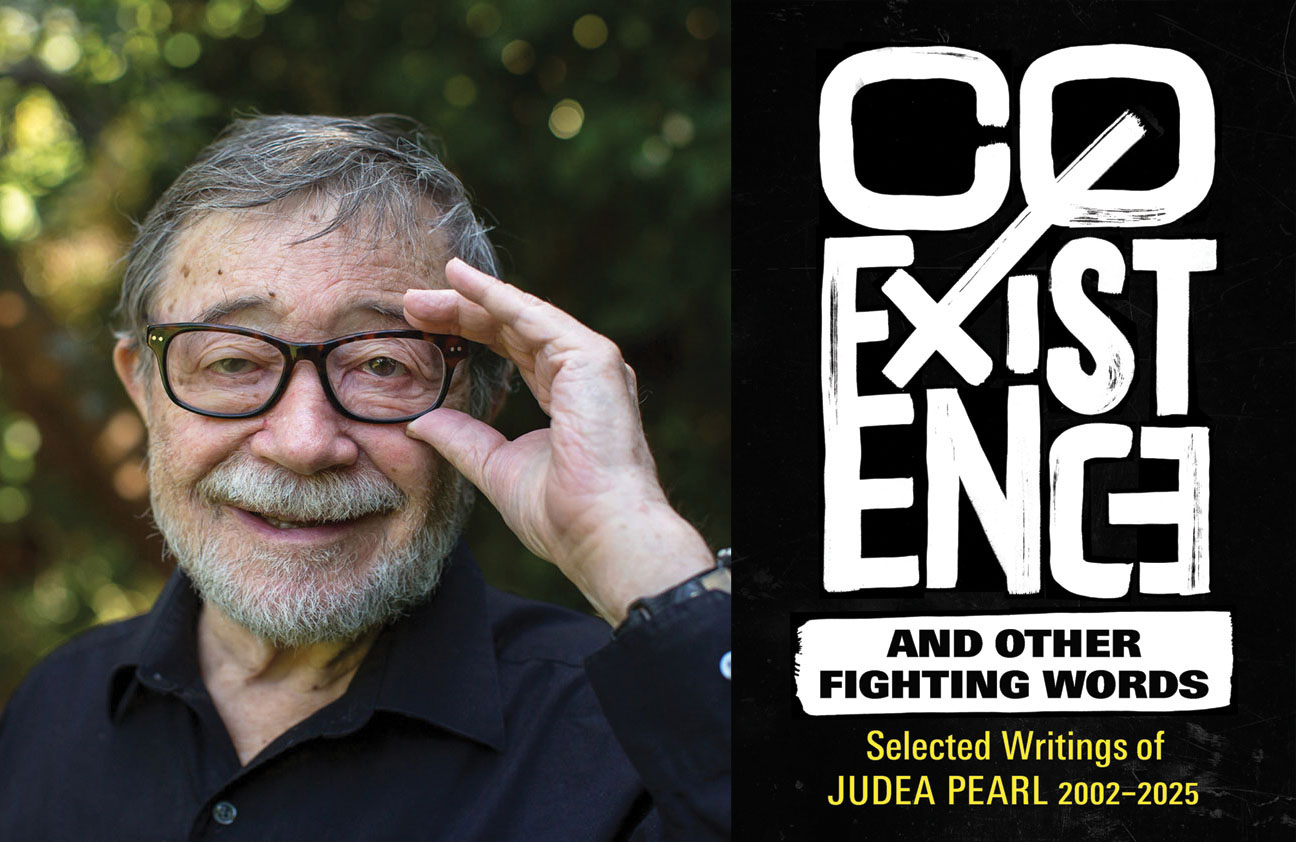
It’s impossible to review a book with 45 thought pieces, in this case “Coexistence and Other Fighting Words: Selected Writings of Judea Pearl, 2002—2025,” and hope to do it justice. How do you absorb a kaleidoscope of so many different ideas on some of the most pressing issues of our time and still make sense of the whole?
You can’t.
The ambitious reviewer will try to find some overall theme that somehow will capture the kaleidoscope. But that’s no easy task, because Pearl himself can’t easily be captured; his personality covers a broad canvas from whimsical to deadly serious to everything in between. He seems allergic to predictability.
When he writes about his son Daniel’s murder 24 years ago, which shook up the world, he surprises the reader with a message of “hope” from “the horror of my son’s murder.” One doesn’t usually associate such horror with hope. Pearl finds a way.
That tendency to keep us off balance announces itself immediately in the book’s title, as he mischievously calls “coexistence” a “fighting word.” It continues with the dedication page to his late wife, Ruth, whom he thanks for being “my compass and comfort for the past 5,786 years.”
A world-renowned scientist who goes through so much and still has a sense of whimsy is not something to be taken lightly.
This reflex to surprise takes him to unexpected places, as in the essay, “You Have the Right to Be Offended.” After receiving an email from a colleague that accused Israel of being an “apartheid regime,” Pearl writes that an “invisible force” jolted him into this response:
“The word ‘apartheid’ is offensive to me. In fact, it is very, very offensive. And, since I am not situated on the extreme end of the political spectrum, I venture to suspect that there are others on your e-mail list who were offended by it and who may wish to tell you that this word is not conducive to peace and understanding.”
How does a sophisticated scholar decide on a rather primitive response like being “very, very offended”? His email suggests an answer: he thinks it works. He’s showing us how raw emotion can sometimes cut through the dull terrain of clichés and conventional wisdom.
He’s also showing us that “fighting words” don’t have to look like fighting words. Telling a colleague you’re “very, very offended” are fighting words that work because they disarm, rather than anger.
This may well be the throughline of Pearl’s life as a passionate Zionist: fighting with words that work.
But he’s also a passionate scientist. The book shows us that “scientist” and “Zionist activist” don’t have to be mutually exclusive.
After all, much of his award-winning academic career at UCLA has revolved around the study of cause and effect, as demonstrated in a recent book on causality, “The Book of Why.” So the man looking for the right ideas to fight for his beloved Israel is the same man credited with “developing a theory of causal and counterfactual inference based on structural models” and “for fundamental contributions to artificial intelligence through the development of a calculus for probabilistic and causal reasoning.”
His causal reasoning gives him the chutzpah to challenge a widely accepted term like “antisemitism,” arguing that the word has limited impact because it’s too easy to deny. Instead, he has championed the term “Zionophobia” to capture the irrational hatred of Jews and Israel.
Another way Pearl mixes it up is to zero in on key words that make all the difference, as he did while attending a Muslim American conference in Doha in 2005.
At dinner, an Arab leader asks him why Israel didn’t accept the Saudi peace proposal of 2002: “Did it not offer them everything that they ever wished for: peace, recognition, security, you name it?”
Pearl quickly pounced on the missing word.
“Do you know what Israelis see when they read a peace proposal in the newspaper?” he asked. “They skip the text about peace, recognition and security and seek the one word that counts: ‘refugees.’ The rest is trivial. If that word is embedded in ‘right of return’ or ‘a just solution’ or ‘Resolution 194’ or some other euphemism for dismantling Israel, the proposal is automatically deemed a nonstarter.”
Cutting through verbal clutter with sharp words doesn’t stop Pearl from offering practical ideas.
“Here comes my humble suggestion, resting again on Saudi wisdom and good will,” he writes. “Instead of drawing fancy peace proposals, the Saudis, together with other oil-rich countries, should immediately launch a ‘Palestinian Marshall Plan’ to build permanent housing for Palestinian refugees in the West Bank.”
Then he gets philosophical: “We are constantly being told that the ball of peace lies entirely in Israel’s court, because Palestinians have no control over their destiny and Israel’s economy is so much stronger. It ain’t necessarily so. Here is a peace proposal that depends entirely on Arab good will and peaceful Palestinian intentions. It should start today.”
In “Jews of Discomfort,” Pearl takes his fight to Jews who are celebrated for how they bash Israel. These Jews are a “prophetic voice for many Jews of Discomfort,” he writes. “They used to feel guilty for Israel’s actions while conscious of her problems; no more. Elevated in virtue, they now see every blemish on Israel’s face as ‘the litmus test’ for her impure personality — hers, not theirs.”
Knowing the power of contrast, he brings up the approach of his friend, the French philosopher Bernard-Henri Lévy: “He too, feels uncomfortable with some of Israel’s actions, and he, too, proposed ways to correct them. Yet instead of pointing fingers at the Jewish establishment … he tells his leftist colleagues: Stop this madness, look at yourself in the mirror. Is your liberalism dead when it comes to Israel?”
Beyond the fighting spirit, the book reminds us of Pearl’s sentimental side, as when he reflects on the blessing of belonging to an eternal people. When asked what it means to be a Jew today, he writes: “Being Jewish is to see oneself as a member of an extended family, bonded by shared history and shared destiny.” He talks about ancient Jewish characters as if they were friends.
In “Wearing My Purim Rabbi’s Hat,” he writes:
“I have come to see a profoundly personal meaning in the story of Purim, especially in this powerful message that Mordecai sends to Queen Esther: ‘Do not imagine that you, of all the Jews, will escape with your life by being in the King’s palace,’ says Mordecai. ‘For, if you keep silent in this crisis, relief and deliverance will come to the Jews from another quarter, while you and your father’s house will perish. And who knows, perhaps you have attained to royal position for just such a crisis.’”
When Mordecai says, “Who knows, perhaps you were destined for this very moment,” Pearl sees a message for his Ivory Tower colleagues, but one can’t help thinking that Pearl himself was indeed destined for this very moment.
What is most striking about this quirky professor is that his fighting spirit coexists with his cheerfulness. We’re friends, so I’ve seen it. He loves to laugh, he loves to sing, he loves to live. There’s never a bad time for him to pull out an old Zionist song.
The Zionist story moves him like none other. He collects original letters from David Ben-Gurion and an original “J’Accuse” front page from the days of the Dreyfus affair. He brings these precious documents to a Shabbat gathering like a doctor might bring a medical kit to make a house call.
When asked what Jews bring to the world, he can’t help but weave in Israel: “Empowered by Israel, we offer the world an unprecedented role model of a society that was blighted by oppression and managed to lift itself from the margin of history to become a world center in art, business and science.”
Even with the well-known founding of the Zionist project, he throws in a surprise. He calls it the “unexpected result” that came out of the Basel Congress in 1897, when a Viennese journalist named Theodor Herzl faced opposition from all sides. He wrote in his diary: “In Basel I founded the Jewish state,” but then added, “If I were to say this out loud today, everybody would laugh at me. In five years, perhaps, but certainly in 50, everybody will agree.”
The unexpected result, Pearl writes, is that “[Herzl] understood that the very act of bringing the Jewish question to the international arena, regardless of its outcome, would change the cultural ills of the Jewish masses and rally them to the cause.”
True to form, he finds the “one forgotten statement” Herzl made in his first speech at Basel that Pearl says has the “most significant impact” on our lives as Jews: “Zionism is a homecoming to the Jewish fold even before it becomes a homecoming to the Jewish land.” Few issues are more hotly discussed in the Jewish world today than the connection between Zionism and Judaism.
What compelled Pearl to share his writings of the past 22 years with readers troubled by the madness of the past two years?
The simple answer, he writes in his introduction, is that “the madness did not start today, but at least 22 years ago. More specifically, as we are grappling with the worldwide surge in anti-Westernism, antisemitism, and anti-Zionism in the wake of Oct. 7, we must understand the latent forces that had been fueling these convulsions for decades before they exploded into our view.” The book is, in part, his take on these latent forces.
His essays, whether dealing with “science and human freedom,” “our new Marranos,” “inspiration and a rallying cry for graduates,” how Hamas became the “darlings of the West,” “the moral dimension of Palestinian statehood,” or “the crater of Oct. 7,” all offer fresh insights from a restless mind looking for just the right words.
Perhaps the most salient essay in the book is a love letter to words.
Pearl takes the world’s most intractable conflict into his lab and concludes that “It’s Time for Words to Lead the Peace Process.”
“If we cannot move on the ground,” he writes, “we should move above it — in the metaphysical sphere of words, metaphors and paradigms — to create a movement that not only would maintain the perception of ‘keeping the momentum going,’ but could actually be the key to any future movement on the ground.”
Pearl never says that words can resolve the peace process, only that they should lead it.
Indeed when Pearl uses fighting words that work, you realize they’re no longer the “fighting words” in the book’s title. They’re more like lively words that can hold even a cynical reader’s attention.
All this may suggest an overall summary for this kaleidoscope of a book: A lively, fearless writer with big thoughts, a big heart, a fighting spirit and verbal precision.
Oh, and who loves Israel, loves to sing, loves his people, loves searching for truth, loves to laugh, loves irony but not snark, can’t stand clichés, takes conflicts very seriously, lives with his son’s memory at all times, is not afraid to put his reputation on the line, loves to surprise…
OK, I give up.
There will be a UCLA Book Launch webinar on Feb 12, 11 am, moderated by Steve Zipperstein. To register, go to: https://international.ucla.edu/israel/event/17499