
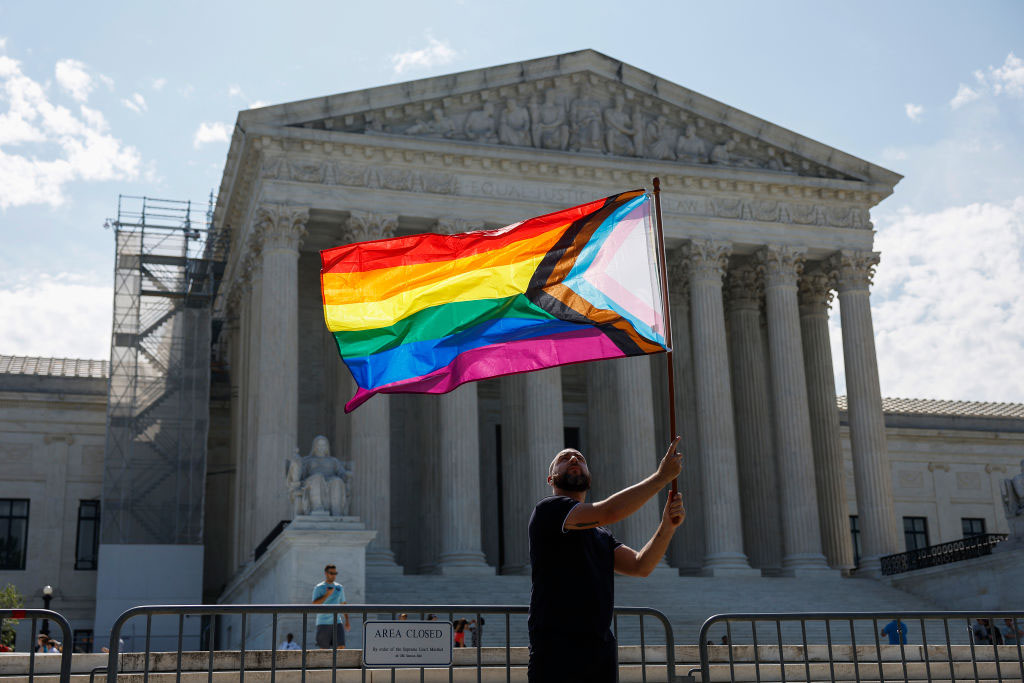
Is it possible for Americans to reach a majority consensus on issues that historically were the topic of intense discord? This week, a decision made by the Supreme Court offers us significant hope that we are still not beyond the point of no return when it comes to our toxically polarized discourse.
On Nov. 10, the Supreme Court denied, without comment, a petition filed by former Kentucky county clerk Kim Davis who captured the nation’s attention in 2015 after the Supreme Court legalized same-sex marriage in Obergefell v. Hodges. Davis refused to issue marriage licenses to same-sex couples based on her Christian faith. Her petition requested the reversal of an order requiring her to pay hefty damages to a couple to whom she denied a marriage license, and a reversal of Obergefell.
Frankly, I was never too worried about the Court overturning the case. My approach to law is best described as one that understands law as a human product based on cultural influences arising in historically specific contexts. This legal theory is known as cultural analysis, and it contrasts with the more traditional view of law as an objective, neutral system that does not explicitly consider outside factors or influences.
The Obergefell litigation and its aftermath is a perfect illustration of how the legal theory of cultural analysis can move us beyond the endless spiral of polarization and strife we now face. The social acceptance of civil, same-sex marriage became a hot topic of public discourse in the early years of the 21st century. Massachusetts was the first state to recognize same-sex marriage in 2003, a result that was not socially popular at the time. One year later, the Pew Research Center found that only 31% of Americans supported same-sex marriage. Even Barack Obama stated in a 2004 interview during his bid for the Senate that he believed marriage should be between a man and a woman.
But by the time the United States Supreme Court legalized gay marriage in Obergefell, many states had already done so. In 2019, the Pew Research Center found that over 60% of Americans supported the legalization of same-sex marriage, including 44% of Republicans. This history amply demonstrates how changing social norms impact not only legal decisions but also the political stands that spur legal action. It also demonstrates that majorities can emerge on issues that were once highly contested.
The Respect for Marriage Act, enacted with bipartisan support in 2022, a few months after Dobbs v. Jackson Women’s Health Organization, offers more evidence of America’s social acceptance of civil, same-sex marriage. The impetus for this legislation was the concurrence in Dobbs by Justice Thomas calling the reasoning of Obergefell into question and raising new insecurities about same-sex marriage. The passage of the Respect for Marriage Act essentially guarantees the future of civil, same-sex marriage through the federal legislative route.
Taken together, the importance of these events is that when it comes to the issue of civil, same-sex marriage, the law has now caught up to the social norms embraced by the majority of Americans. Even the Orthodox Union supported the Respect for Marriage Act following a Senate amendment ensuring that nonprofit religious groups would not have to perform these marriages under the new law. Although reaffirming its commitment to marriage as a union between a man and a woman, the OU stated: “Our hope is that the Respect for Marriage Act will expand civil rights for LGBT Americans while at the same time protecting principles of religious liberty and diversity which are central to our constitution.”
The weaponization of both religion and politics creates what I call in my forthcoming book about American Jewish polarization a toxic “political-religious” stew. As a result of this stew, more people are feeling both politically and religiously homeless. I applaud the Supreme Court’s decision to refrain from creating more strife by re-opening the issue of civil, same-sex marriage given the current social consensus. Plus, the story of civil, same-sex marriage in America should be comforting to Americans on both sides of the aisle because it shows that it is still possible to reach a consensus on once contested issues.
Roberta Rosenthal Kwall is law professor, author and Jewish educator with a focus on American Judaism. Her latest book is “Polarized: Why American Jews are Divided and What to do About It” (forthcoming 2026, Bloomsbury Press).