fbpx

November 11, 2025

The Law and Culture of Civil Same-Sex Marriage

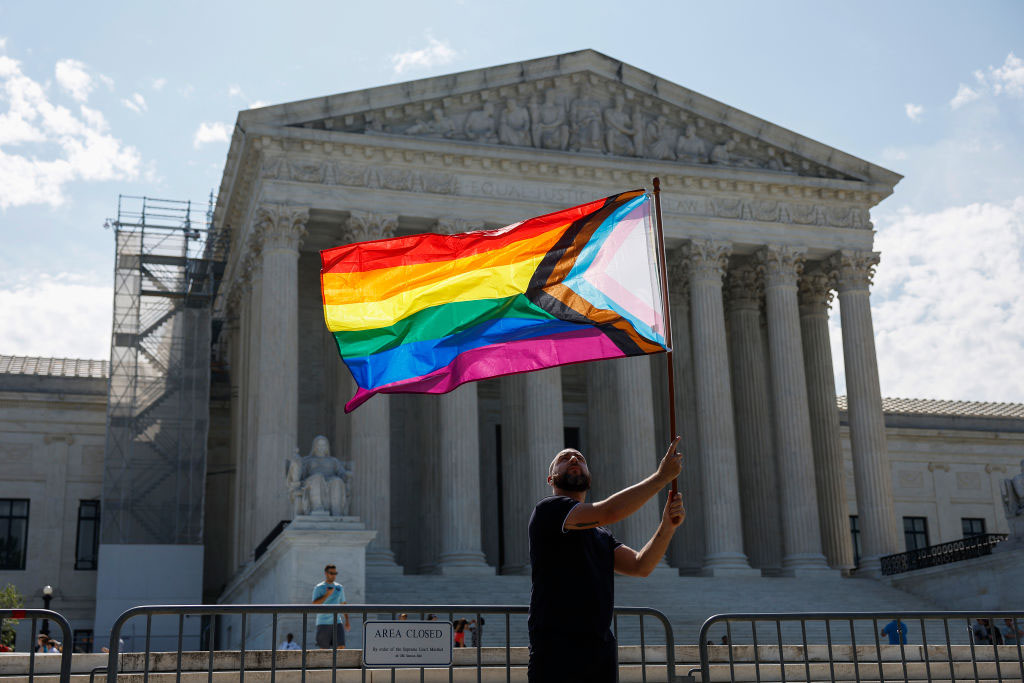
Is it possible for Americans to reach a majority consensus on issues that historically were the topic of intense discord?  This week, a decision made by the Supreme Court offers us significant hope that we are still not beyond the point of no return when it comes to our toxically polarized discourse. 

On Nov. 10, the Supreme Court denied, without comment, a petition filed by former Kentucky county clerk Kim Davis who captured the nation’s attention in 2015 after the Supreme Court legalized same-sex marriage in Obergefell v. Hodges. Davis refused to issue marriage licenses to same-sex couples based on her Christian faith. Her petition requested the reversal of an order requiring her to pay hefty damages to a couple to whom she denied a marriage license, and a reversal of Obergefell.

Frankly, I was never too worried about the Court overturning the case. My approach to law is best described as one that understands law as a human product based on cultural influences arising in historically specific contexts. This legal theory is known as cultural analysis, and it contrasts with the more traditional view of law as an objective, neutral system that does not explicitly consider outside factors or influences.  

The Obergefell litigation and its aftermath is a perfect illustration of how the legal theory of cultural analysis can move us beyond the endless spiral of polarization and strife we now face.  The social acceptance of civil, same-sex marriage became a hot topic of public discourse in the early years of the 21st century. Massachusetts was the first state to recognize same-sex marriage in 2003, a result that was not socially popular at the time. One year later, the Pew Research Center found that only 31% of Americans supported same-sex marriage. Even Barack Obama stated in a 2004 interview during his bid for the Senate that he believed marriage should be between a man and a woman. 

But by the time the United States Supreme Court legalized gay marriage in Obergefell, many states had already done so. In 2019, the Pew Research Center found that over 60% of Americans supported the legalization of same-sex marriage, including 44% of Republicans.  This history amply demonstrates how changing social norms impact not only legal decisions but also the political stands that spur legal action. It also demonstrates that majorities can emerge on issues that were once highly contested.  

The Respect for Marriage Act, enacted with bipartisan support in 2022, a few months after Dobbs v. Jackson Women’s Health Organization, offers more evidence of America’s social acceptance of civil, same-sex marriage. The impetus for this legislation was the concurrence in Dobbs by Justice Thomas calling the reasoning of Obergefell into question and raising new insecurities about same-sex marriage. The passage of the Respect for Marriage Act essentially guarantees the future of civil, same-sex marriage through the federal legislative route.

Taken together, the importance of these events is that when it comes to the issue of civil, same-sex marriage, the law has now caught up to the social norms embraced by the majority of Americans. Even the Orthodox Union supported the Respect for Marriage Act following a Senate amendment ensuring that nonprofit religious groups would not have to perform these marriages under the new law.  Although reaffirming its commitment to marriage as a union between a man and a woman, the OU stated: “Our hope is that the Respect for Marriage Act will expand civil rights for LGBT Americans while at the same time protecting principles of religious liberty and diversity which are central to our constitution.”

The weaponization of both religion and politics creates what I call in my forthcoming book about American Jewish polarization a toxic “political-religious” stew. As a result of this stew, more people are feeling both politically and religiously homeless. I applaud the Supreme Court’s decision to refrain from creating more strife by re-opening the issue of civil, same-sex marriage given the current social consensus.  Plus, the story of civil, same-sex marriage in America should be comforting to Americans on both sides of the aisle because it shows that it is still possible to reach a consensus on once contested issues. 


Roberta Rosenthal Kwall is law professor, author and Jewish educator with a focus on American Judaism. Her latest book is “Polarized: Why American Jews are Divided and What to do About It” (forthcoming 2026, Bloomsbury Press).

The Law and Culture of Civil Same-Sex Marriage Read More »

Jews Getting It from Both Sides

I closed last week’s column by referencing the two-front challenge that the American Jewish community faces in our country’s deeply divided political landscape. The recent controversy over conservative commentator Tucker Carlson’s obsequious interview with notorious Jew-hater Nick Fuentes has roiled the Republican Party. Almost simultaneously, Democratic Socialist Zohran Mamdani was elected mayor of New York City by a sizable margin. Which means that neither of the battles on those two fronts will de-escalate anytime soon.

These twin reminders intensify an already-difficult dilemma for the growing number of American Jews who no longer feel comfortable in either major political party. There was a time in the past when Pat Buchanan’s racially-charged nationalism represented only a tiny sliver of the GOP. More recently, many Democratic leaders dismissed the election of Alexandria Ocasio-Cortez, Ilhan Omar and their fellow Squad members as only four outliers in an otherwise strongly pro-Israel party congressional caucus.

But the extremes continue to ooze inward from the fringes, and the number of Democratic leaders who dutifully endorsed Mamdani’s candidacy and the equally disconcerting number of Republicans who have ignored or minimized the spectacle of a leading conservative commentator’s overt embrace of an avowed anti-Semite, are evidence that both parties now harbor a rapidly increasing number of members who exhibit unbridled animosity toward the Jewish state.

Of equally significant concern are those Jews who tacitly approve such hateful conduct. Very few members of our community have verbally supported these bigots, but their willingness to overlook such prejudices within their own party’s ranks (this impacts both parties, for those of who afflicted with selective outrage) acts to enable such behavior by reassuring party leaders that they can tolerate such behavior in exchange for ideological agreement on other issues.

We are beginning to see an increase in the numbers of those who will attempt to run independent candidates for Congress next year and it is very likely that those candidates, free of the obligation to accept ethnic or religious intolerance among a party’s outliers, will be disproportionately pro-Israel. But it will still be some time before a third party or independent movement attracts a sufficient following to provide additional options to most voters. In the meantime, how does the Jewish community choose between two parties seemingly so comfortable with ani-Zionists and anti-Semites within their ranks?

The answer is that we don’t. It has been twenty-five years since Israel was a vote-determining issue for most Jewish Americans. But these challenges rise to another level and a stronger and bolder response from our community is overdue. As long as either the Republicans or Democrats are willing to harbor the haters, they should no longer be rewarded with knee-jerk loyalty from our community.

According to polling and voter registration, American Jews who regularly vote for Democratic candidates outnumber Republican partisans by roughly a 2-1 margin. That is unlikely to change even if we decide to become more selective in our candidate support. But without fully renouncing either party, our post-Gaza and post-Fuentes community should be willing to cross party lines to reward Israel’s supporters and deny our detractors.

Even as the ranks of anti-Semitic zealots continue to grow, there are still stalwarts who deserve our assistance even across party lines. For the American Jews who vote Republican, I would point you to U.S. Representative Jake Auchincloss (D-MA) who last week bravely became the first Democratic member of Congress to oppose the Senate candidacy of Graham Platner, the Maine oyster farmer who sports a Nazi tattoo. For the majority who are loyal Democrats, take a moment to appreciate the courage of Senator Ted Cruz (R-TX) who has continued to lead the charge demanding Republicans renounce not just Fuentes but Carlson.

If we limit our decisions to whether a candidate has a “D” or an “R” after their name, few among us will cross party lines to congratulate a defender of the Jewish state and the Jewish people. The unhappy result of such close-mindedness is that more and more of us will reside in a party with little use for us. We can do better. We must.


Dan Schnur is the U.S. Politics Editor for the Jewish Journal. He teaches courses in politics, communications, and leadership at UC Berkeley, USC and Pepperdine. He hosts the monthly webinar “The Dan Schnur Political Report” for the Los Angeles World Affairs Council & Town Hall. Follow Dan’s work at www.danschnurpolitics.com.

Jews Getting It from Both Sides Read More »

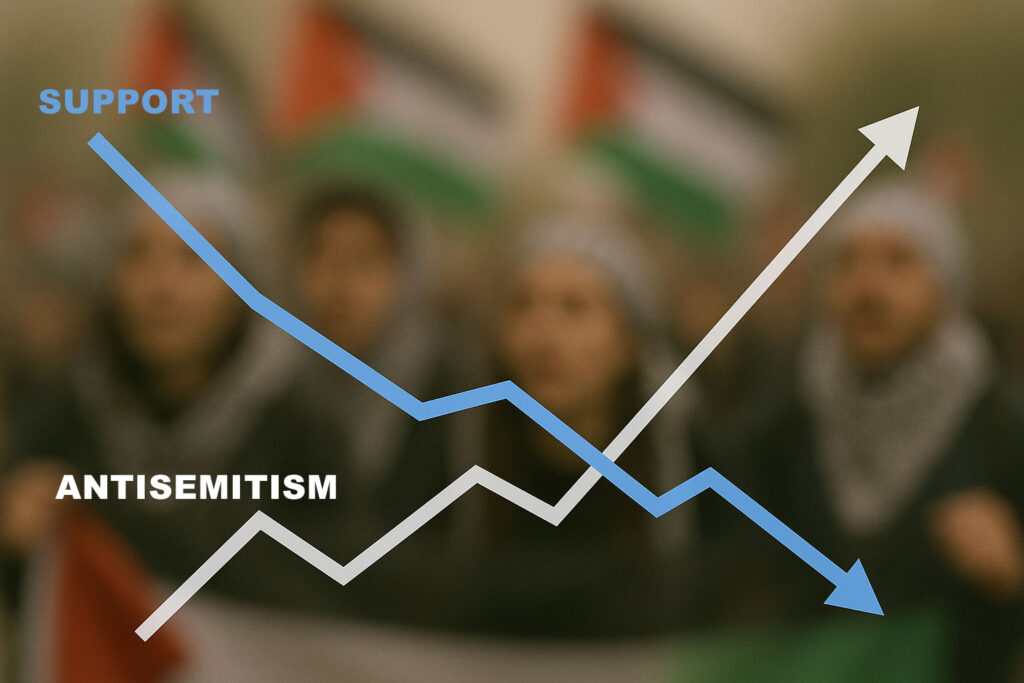
New ICC Poll: Antisemitism Surges on U.S. College Campuses as Support for Israel Falls

Two years after October 7, a new national survey by Schoen Cooperman Research, commissioned by the Israel on Campus Coalition (ICC), shows that there has been an alarming rise of antisemitism and anti-Israel sentiment on U.S. college campuses.

The poll of 500 college students, which was conducted between October 15 to 21, revealed that 54% of students say antisemitism on campus has increased since the Israel-Hamas war, and 54% believe Israel commits war crimes, which is up from 43% two years ago. Additionally, 70% oppose Israel’s conduct in Gaza; only 25% say the war was justified following October 7, and 55% support pro-Palestinian protests, even as most acknowledge these demonstrations have fueled rising antisemitism.

The tracking poll, which has been ongoing since the war’s outset, shows the lowest favorability for Israel ever measured among U.S. college students, as well as a persistent climate of intolerance toward Jewish identity and expression.

“This data lays bare the daily reality for Jewish students: more than half (54%) of college students now say antisemitism on campus has increased since the October 7 massacre, confirming that campuses have grown profoundly hostile to anyone who is Jewish or pro-Israel,” said Jacob Baime, CEO of ICC, an organization that promotes pro-Israel messages, fellowships, and programs on college campuses around the United States.

The poll also demonstrated that Israel’s favorability has plunged 24 points since October 2023, with 53% now viewing the country unfavorably. When forced to choose, 45% of students agree that continued anti-Israel protests during a ceasefire are antisemitic rather than legitimate political expression.

Over the past two years, incidents like pro-Palestinian encampments, hate speech directed at Jews, and hostilities towards pro-Israel and Jewish people from students, staff, and administration have occurred on universities nationwide. The persistence of the problem led to the creation of the Federal Task Force to Combat Antisemitism, which has been investigating campuses where antisemitism has come to light. Just this week, Jewish students at New York University, Columbia, Barnard College, and Baruch College revealed to Fox Digital how extremist professors allegedly yelled at students and put up “Free Palestine” signs on their doorways, showing that even after the ceasefire, it’s an ongoing issue.

Carly Cooperman, CEO of Schoen Cooperman Research, emphasized how the situation on campus has gone downhill as of late.

“College students hold deeply negative views of Israel, with attitudes having worsened over the last two years.” – Carly Cooperman

“College students hold deeply negative views of Israel, with attitudes having worsened over the last two years,” she said. “While a majority of college students supported Israel’s original goals in Gaza, they broadly oppose Israel’s conduct there – and in turn, are highly unfavorable toward Israel itself. This has strongly impacted sentiments on campuses, as a majority are concerned about rising antisemitism due to the war, even while 55% support the pro-Palestinian protests, which represents a net 11-point increase since spring 2024.”

New ICC Poll: Antisemitism Surges on U.S. College Campuses as Support for Israel Falls Read More »