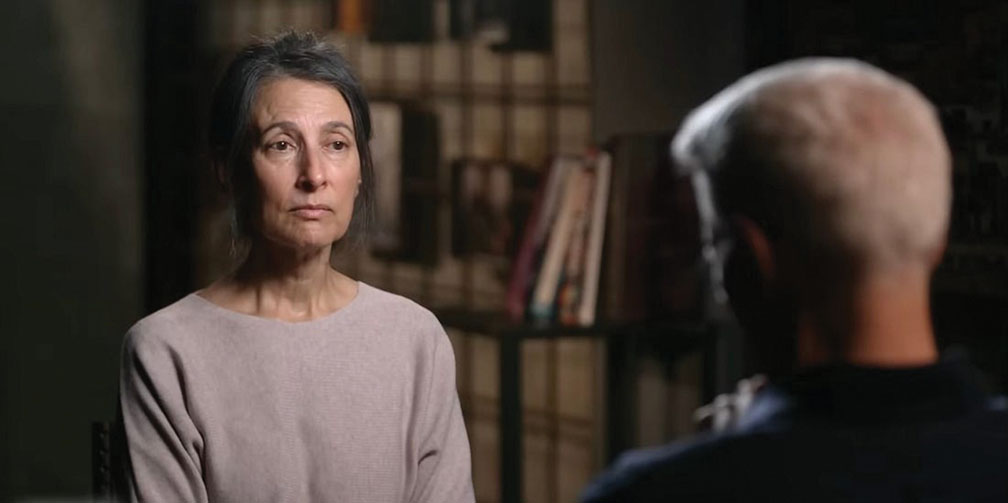
Writer-director Debra Granik is Jewish, upper-middle-class and a New Yorker. So it is all the more remarkable that her thriller, “Winter’s Bone,”(which has received four Oscar nominations, including best picture and adapted screenplay) is so accurate in its depiction of life in the Ozarks that, in the words of The Independent, “You can almost taste the fried squirrel.”
Actually the 47-year-old Granik labored to move beyond “hillbilly” stereotypes to tell the story of Ree (the Oscar-nominated Jennifer Lawrence), a 17-year-old from a meth-cooking clan who in effect becomes the heroine of a dark fairy tale. As the sole caretaker of her two younger siblings and severely depressed mother, Ree is stunned to learn at the beginning of the film that her father has disappeared after putting up the family property for his bail bond.
She then embarks upon a dangerous quest to find him, dead or alive, lest she lose the house and land whose wildlife is often the source of her family’s meals. And she remains fiercely determined, even when her search puts her in grave danger at the hands of her secretive (and menacing) relatives.
As an urban Jew, Granik felt pressured to depict her protagonists’ hardscrabble lives without any “Deliverance”-style sensationalism. “It was severe and it was huge and it was daunting,” she said of that responsibility. “But I’m hoping that once audiences get to know Ree, they will move past their preconceived notions. Once they get to see her inside this [ramshackle] house they may have made judgments about, there should be an opening for an extension of compassion.”
“Winter’s Bone” is not Granik’s first movie about a strong young woman in trouble – a heroine living “close to the bone.” Her debut feature, “Down to the Bone,” (2005) spotlighted a working-class mother (Vera Farmiga in a career-making role), struggling to break out of cocaine addiction.
Granik traces her fascination with women who persevere, in part, to her own immigrant great-grandmother, Rebecca Deitch, who would have had a more personal understanding of Ree’s rustic poverty. Deitch was one of many siblings of a family in rural Lithuania before she arrived, virtually on her own, in the United States at age 12.
“You cannot underestimate your initial impressions of what a human being can be like,” Granik said of her great-grandmother’s influence on her work. “I came into the world meeting this woman who was truly autonomous, although not all options had been open to her in life. She was four feet tall, but there was nothing frail or dependent about this person.”
A photograph of Deitch taken atop a building on Rivington Street, in the Lower East Side, proved inspirational for Granik. “My great-grandmother was probably about 17; she was in her bloomers, and she looked like such a tomgirl,” the filmmaker said. “As I was looking at the picture, I had this intense desire to have known her when she was younger. I also understood that some women became quite emancipated far earlier than many people realize—not necessarily within their family context but within the immigrant experience. It was within their understanding of who they were and what it meant to come to New York City when you’re young and to have to navigate this big metropolis.”
Granik has taken her own 6-year-old daughter to the Tenement Museum on the Lower East Side and plans on many future visits: “It’s close to Rivington Street, and it’s a great, vivid kind of thing to see how they have reconstructed a tenement that is historically correct. You can see how the plumbing and shared spaces looked, and they have actresses who recreate tableaux of what life was like.”
Creating realistic tableaux of life in the Ozarks was an arduous yet exhilarating task for Granik; see updates on jewishjournal.com for much more on that story. And also for a write-up of our planned interview with best actress nominee Jennifer Lawrence, whose Kentucky upbringing helped the Jewish director gain even more insight into the world of the rural South.