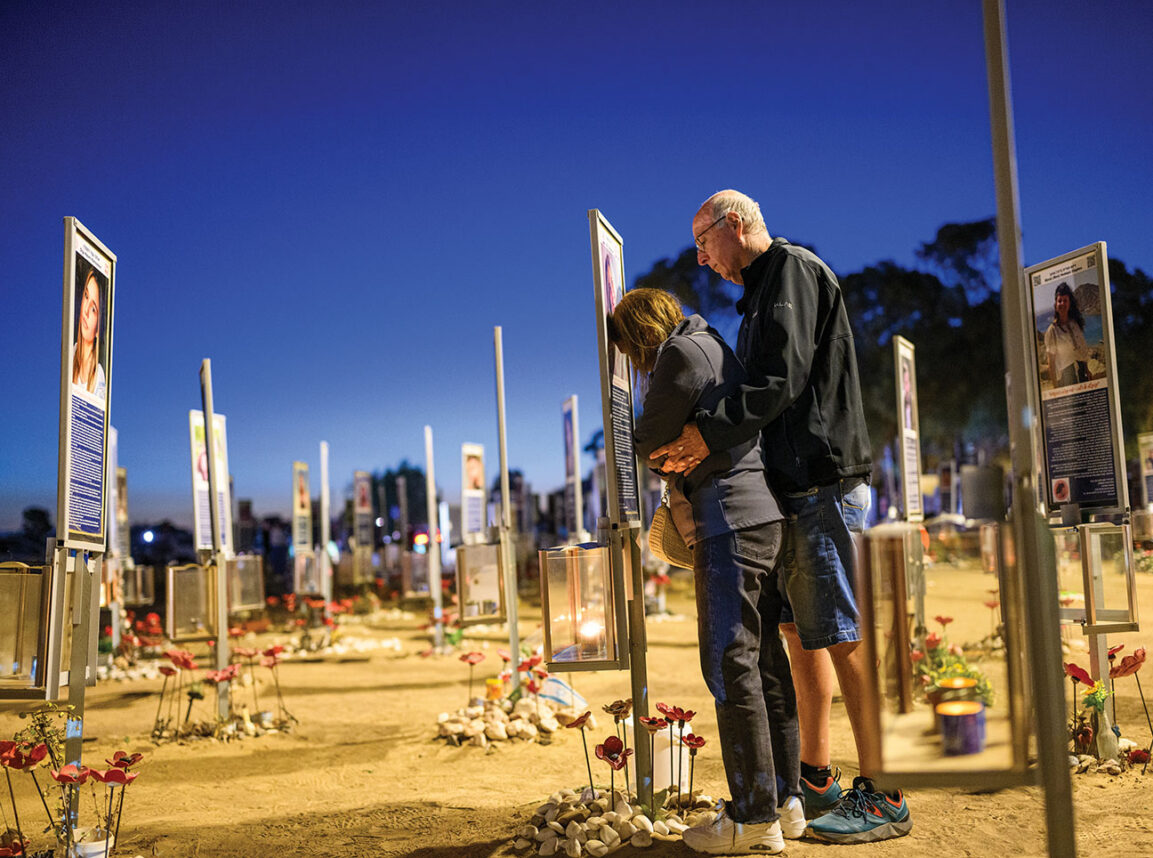
Silent slideshow shows images of the funeral in Jerusalem
Condolence visits are part of a rabbi’s life, but no one ever taught us how to make nine visits in a 48-hour period.
We arrived in Israel on the morning of Tuesday, March 11, and left Israel the following night. Our mission, representing the Rabbinical Council of America, was to express solidarity with the families of the victims of the terror attack at yeshivat Mercaz Harav, comfort the injured in the hospitals and visit the yeshiva.
We were joined at different parts of our trip by Rabbi Joseph Pollack of Boston, Rabbis Milton Polin and Jay Karzen of Jerusalem, and Richard Joel, president of Yeshiva University, and Rabbi Joshua Joseph, his chief-of-staff.
During our two days in Israel, we never heard anyone call for revenge. What we heard was a determination to enhance Torah study, prayer, concern for the welfare of the nation and a vision to double the Mercaz High School enrollment from 250 to 500. This, it was said, would be the appropriate answer to the terrorist’s destruction.
We immediately traveled to Ashdod to visit the family of Doron Meherte, 26. Meherte arrived in Israel from Ethiopia at the age of 8 during Operation Solomon. He was an outstanding Talmud student who was studying for the rabbinate.
Known for his keen concentration, Meherte did not even notice the terrorist entering the library and was the only student killed while sitting at his table immersed in his studies. The volume he was studying became saturated with his blood and was buried with him.
Ro’ie Roth, 16, of Elkana, was passionate about prayer and would often be the last in the yeshiva to complete his daily prayers.
Yonatan Eldar, 16, of Shiloh was part of a close-knit group of friends. Because of his great love for the land of Israel, he became an avid hiker.
Yehonadav Hirschfield, 19 of Kokhav Hashahar was the grandson and great-grandson of two prominent American rabbis. He had completed studying the entire Mishna 70 times, and on that fateful night, he was completing the Mishna once again.
Avraham Moses, 16, of Efrat, the son of American immigrants, was beloved in his community for his exceptional acts of kindness.
Segev Avihail, 15, of Neve Daniel, was a prolific writer at his very young age.
Yohai Lifshitz, 18, of Jerusalem, blessed with an analytical mind, spent his days and nights in the study hall.
Neria Cohen, 15, the youngest victim, was an eager student who wrote sophisticated questions to Israel’s leading rabbis.
At each home, we were received with warmth. Each family remarkably demonstrated an incredible spirit and an awe-inspiring faith. We were shown blood-stained and bullet-burned books that the boys had been studying, and we heard remarkable stories about each boy’s commitment to Torah and acts of kindness.
Each family expressed the feeling that they were not alone in their grief and that the entire Jewish nation was mourning with them. One father remarked that he received calls from all over the world.
Our trip included hospital visits to the three most seriously wounded boys. The oldest was a 26-year-old father of two who suffered a serious arm injury. The youngest was ninth-grader Nadav Samuel. Nadav calmly recounted his experience of being shot six times in his arms and legs while taking cover behind a bookcase.
The most gravely hurt boy was Naftali Sheetrit, 16, from long-suffering Sderot. At the time of our visit, he was in a medically induced coma, with serious abdominal and leg wounds. We met his family sitting outside the intensive-care unit next to an Arab family also waiting on a loved one.
The surgeon who operated on Naftali had rushed to the hospital when he heard about the attack. He was the first to open the door of the ambulance, and when he saw how grave Naftali’s situation was, he wheeled him into the operating room without scrubbing. The boy had to be resuscitated twice during the procedure.
Our call to Mercaz Harav, together with Yeshival University’s Joel, was very emotional. Rabbi Yaakov Shapiro, head of the yeshiva, gave us a walking tour of the library and a full description of the murderous attack. The signs of the horror were still visible. Contrary to press reports, the terrorist never had any association with the school.
Our brief visit reaffirmed our pride in Israel and its many unsung heroes. The boys who were murdered take their place among our nation’s martyrs, and the courageous survivors are a great inspiration.
Hershel Billet is the rabbi of Young Israel of Woodmere, N.Y. Elazar Muskin is the rabbi of Young Israel of Century City.