The very word Siberia evokes a cold, distant place — it’s so, well, Soviet. But Siberia just got a little warmer and a little more Jewish because of San Fernando Valley resident Elaine Berke, who arranged for the b’nai mitzvah of 61 Siberian Jews ranging in age from 12 to 26.
The longtime community volunteer first traveled to Siberia in September 2004 as part of a charitable effort. There she met some of the 70,000 Siberian Jews and discovered that, despite Russia’s Jewish renaissance, many had not yet had a bar or bat mitzvah.
Berke resolved to arrange ceremonies for some Hillel students in Khabarovsk. Word got out, and people from Birobidjan and Vladivostok wanted in, too. Eventually, Berke raised $31,500 in Los Angeles for the July 2 event.
“I am certain that every Jewish child all over the entire world is entitled to a Jewish education, bar or bat mitzvah, and Jewish wedding,” said the grandmother of two.
Berke worked in conjunction with the local Joint Distribution Committee (JDC) office in Krasnoyarsk and other Jewish organizations in Siberia. Two fifth-year rabbinical students, David Kosak and Bradley Greenstein, presided at the synagogue in Khabarovsk, which had been donated to the local Chabad congregation by Russian President Vladimir Putin.
Chabad couldn’t provide the service because it “insists on a certain lineage,” said Berke, meaning that participants would have to verify a Jewish mother or have had converted according to Chabad’s Orthodox requirements.
“We don’t ask who is from an intermarriage,” Berke said. “If children come forward and say, ‘We are Jewish,’ God bless them. A lot of these families are descendants of people who were in the gulags, and the Holocaust.”
Preparation began in November 2004. Vladimir Khazanov, a local Jewish educator, drew up a course for those taking part, which he sent by e-mail to Jewish community centers in the three cities.
“We don’t ask who is from an intermarriage,” Berke said. “A lot of these families are descendants of people who were in the Gulags, and the Holocaust.”
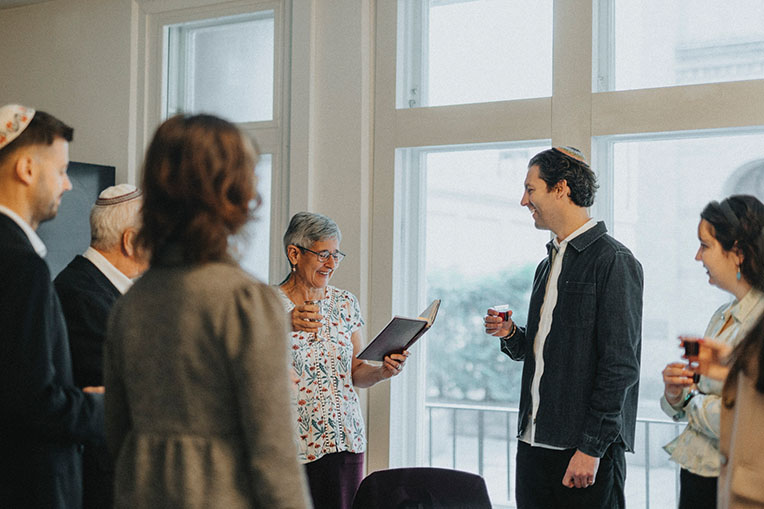
Then on Friday night, services started with the students singing a niggun (Jewish melody). The b’nai mitzvah itself took place on Shabbat. The students, called up in groups of nine, recited the blessing over the Torah in Hebrew, using a Russian transliteration. As a gift, the JDC presented the boys with a talit and a chumash; the girls received a challah cover and a chumash.
“I found the Russians to be far more serious than American students of the same age,” said Kosak, who’s enrolled in the Ziegler School of Rabbinic Studies at the University of Judaism. “They were much hungrier to learn about their tradition.”
“The most moving thing was how David Kosak and I could show them how Judaism was alive and could relate to their lives,” said Greenstein. “It was very moving to see them excited to be Jewish.”
Since her return, Berke has received letters and e-mails from participants describing how the event changed their lives. She plans to continue raising money, hoping to bring the bar mitzvah project to other cities in the Russian Far East.
“My family was originally from Russia,” Berke said. “It is only a quirk of history that they are there and I am here. Why are they less entitled to a Jewish education than my family was?”
“They deserve this,” she added, “they really deserve this.”