Looking back at the history of the Middle East, the mind’s eye usually skips over the six centuries that elapse between the destruction of the Second Temple in 70 C.E. and the rise of Islam with Prophet Mohammed in the seventh century. Yet the area was continuously inhabited. What was it politically? Whom did it worship?
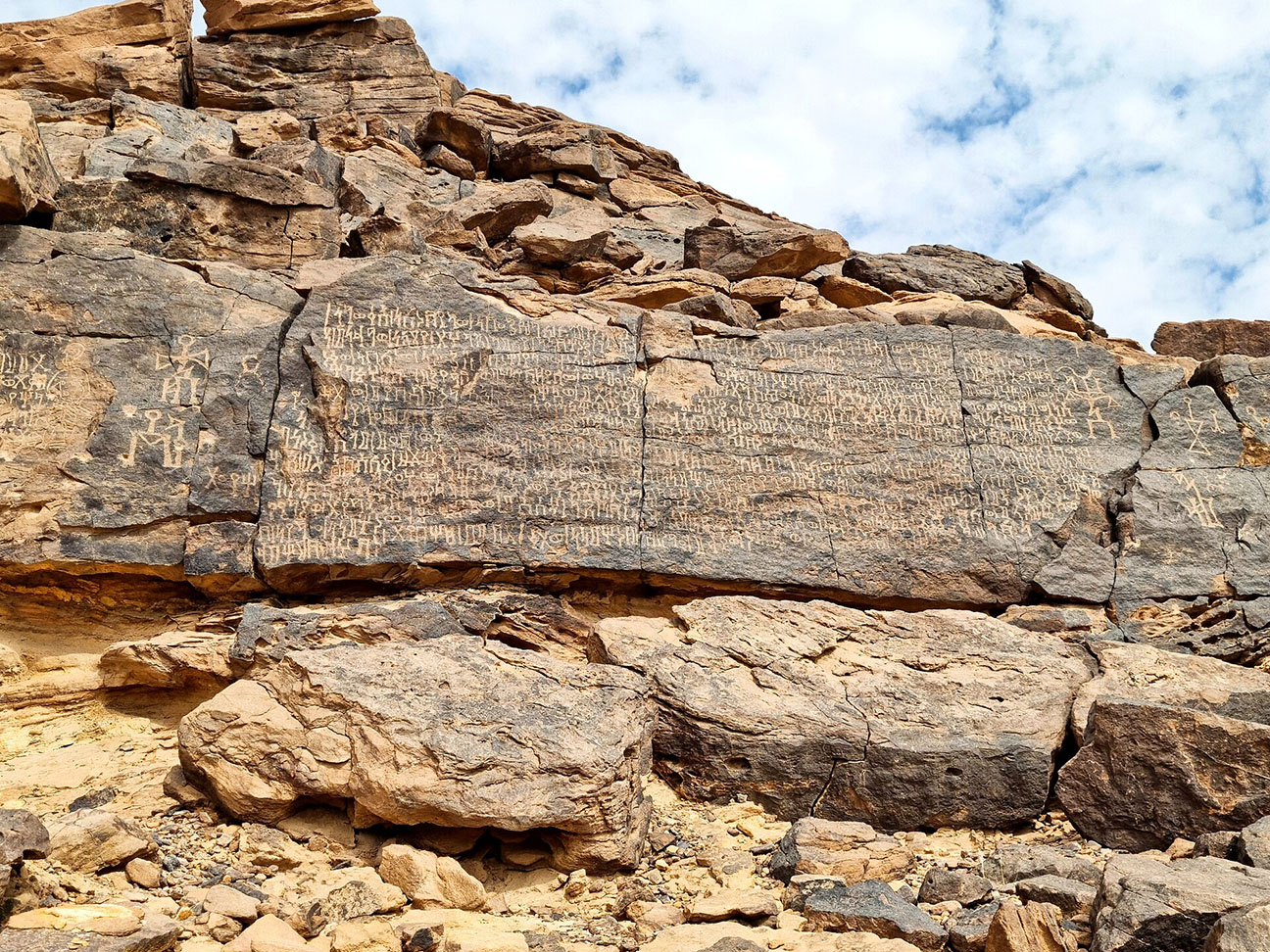
Two well-documented academic works shed light on the mysterious kingdom: “The Throne of Adulis: Red Sea Wars on the Eve of Islam” by G. W. Bowersock (Oxford University Press) and “The Judaism of the Ancient Kingdom of Himyar In Arabia: A Discreet Conversion” by the French historian Christian Robin in volume 3 of Cambridge Semitic Languages and Cultures. Their scholarship is based on historical chronicles written in Arabia and Ethiopia, contemporary reports from Indian and Syrian travelers, Byzantine diplomatic dispatches, as well as hundreds of stone inscriptions found on both sides of the Red Sea.
For much of the 3rd-6th centuries C.E. and through the time of Mohammed’s birth, two empires battled over the control of the Arabian Peninsula: Byzantium and Persia, with much of the conflict played out through smaller local proxies. The Coptic Christian kingdom of Axum (Ethiopia) aligned with the Christian Byzantium, while the Jewish communities throughout the region aligned with Persia. Independent Arab tribes controlled various parts of the peninsula, and their alliances shifted constantly.
Religiously, before Islam, G. W. Bowersock explains, those tribes divided into those that practiced indigenous, polytheistic cults, Arab Christian denominations, and Arab Jews, that is Arab tribes that converted to Judaism, alongside, or likely connected with, diasporic ethnic Jewish communities of Judean origin.
Contributing to the political and religious instability was the recurring Ethiopian migration into parts of the Arabian Peninsula: the Strait of Bab el-Mandeb dividing East Africa from Yemen is barely 18 miles, four times closer than Florida and Cuba.
In the 4th century C.E., Himyar becomes the leading power in Arabia, imposing its rule on the large part of the peninsula, specifically in the south and the west, and later conquering eastern Arabia in 474 C.E. It is during that time, in the 380s C.E., that an abrupt religious change takes place in the kingdom. Mentions of polytheistic gods disappear from historical evidence, replaced by consistent references to a single God, named as “Rahmanān” (“The Merciful,” a name for God frequently used in the Talmud and similar in meaning to “El Maleh Rahamim,” the Jewish funeral prayer), “Eln” (God), and the descriptive “The Lord of the Sky and the Earth.”
In some inscriptions, Bowersock adds, “He is also explicitly invoked as the ‘Lord of the Jews’, and persons with Jewish names are found imposing burial regulations designed to segregate Jews from non-Jews. . . The Himyarites took over such words as Amen and Shalom, and a Himyarite seal, now in a private collection, bears a representation of a menorah.”
Christian Robin counts at least 10 Himyarite inscriptions referring to the mikrāb, a new word denoting a synagogue, which also survives in the Ethiopian Ge’ez language. One such inscription made by King Madikarib Yun’im (c. 480–485 C.E.) commemorates the construction of a mikrāb while also using the word knesset, apparently, to denote an assembly room within the synagogue.
The inscription of Hasi in the vicinity of Yemen’s present-day capital Sanaa, cited by Robin, describes “the transformation of four plots to create a cemetery only for Jews. It details that a fourth plot was added to the three plots and the well . . . The mikrāb, which is entrusted to a custodian (hazzān), drawing its subsistence from the revenues of a well, owns landed estates.”
Such a radical shift to Judaism as a state religion allows Himyar to set itself apart. Twice during the 4th century, the Byzantine Empire sends delegations with sumptuous gifts to convince the Himyarite kings to convert to Christianity, but to no avail. Probably, as Robin surmises, it is because Himyar’s main enemy, the Ethiopian kingdom of Axum is already Christian and an ally of Byzantium. Describing one of these embassies, “The Ecclesiastical History” by Philostorgius notes “quite a large number of Jews are living among them” and blames them for the mission failure.
From 470 C.E. onwards, Christian chroniclers report the rising anti-Christian repression in Himyar and mention the trial against the Christian priest Azqīr of Najrān in the country’s north, accused of “introducing a new religion into the country.”
Around the start of the sixth century, the Himyar kingdom falls under Ethiopian control, but, in 522 C.E., their local Jewish appointee, King Yusuf (Joseph), rebels. He massacres the Ethiopian garrison in the capital and goes on a rampage through the Christian areas of his kingdom. Yusuf’s policies provoke the Christian rebellion in Najrān, but he represses it with massacres well documented by his contemporaries.
Assisted by the Byzantines, the Ethiopian king sails with his army across the Red Sea to aid the Christians. “Upon their arrival sometime after Pentecost Day, 525 C.E., [Yusuf] was killed. Himyar’s conquest,” Robin adds, “was followed by the systematic massacre of Jews. The country then became officially Christian. Churches were built and an ecclesiastical hierarchy was established.”
The story of the Jewish kingdom, however, does not end here. Around year 570 C.E., Persians invade Arabia directly and expel the Ethiopian rulers from Himyar. They go on to capture Jerusalem in 614, where the Jewish population welcomes them as liberators. In Arabia itself, the Jewish community endures in the southwestern corner, Yemen, all through the creation of the State of Israel.
The tale of Himyar reminds us of the ongoing Jewish presence in the Middle East, its important history, but also of the danger of religion interwoven with state politics. Then and now, empires inevitably enter the fray of the conflict after a period of proxy fights. It may also be a lesson in how the political alliances in the region can sweep and sway unpredictably like the shifting sands of the desert.
Lane Igoudin, Ph.D., is the author of the memoir “A Family, Maybe.” He teaches English and linguistics at Los Angeles City College and is a past Andrew W. Mellon Fellow with UCLA EPIC-Humanities. Find him @laneigoudin or at laneigoudin.com.