In describing the political and religious perspectives of the North and South during the Civil War in his Second Inaugural Address, President Abraham Lincoln noted that “Both read the same Bible and pray to the same God and each invokes His aid against the other.” He was, of course, describing a country with a Christian majority. Yet of course, the small Jewish community at the time was also divided.
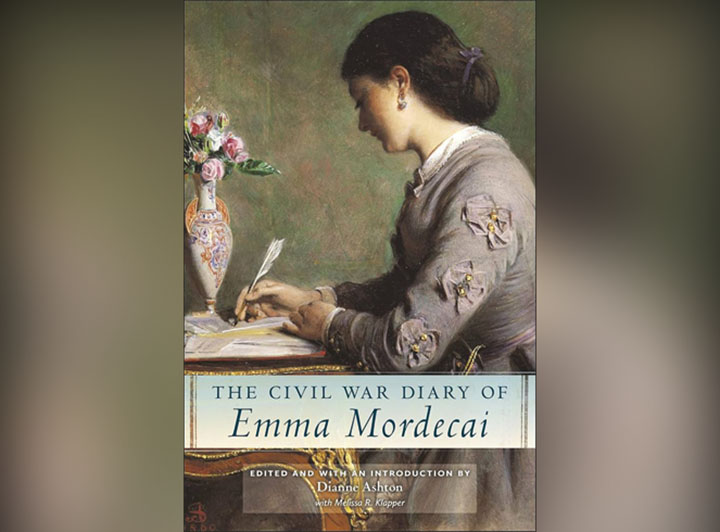
Though history, it is said, is a tale told by the victors, in “The Civil War Diary of Emma Mordecai” one gains a window into one Southern Jewish woman’s experience. The work, begun by the late historian Dianne Ashton and completed by her colleague Melissa R. Klapper, offers a rare and fascinating snapshot of how Southern Jews participated in synagogue services and observed holidays during wartime. Of course, Jews today will find her defense of slavery distressing and as inconsistent with Jewish values and beliefs.
Emma was from a prominent family based in Richmond, Virginia, who, as the book’s introduction notes, had lived in North America since before the American Revolution.
Many of her musings are, as in any diary, quotidian. The casualness with which Mordecai documents her devotion to her religion makes clear the comfort with which she practiced her faith in America’s first hundred years. “I had intended visiting the Hospitals to day,” she writes on June 10th, 1864, “but on consulting my Heb. [Hebrew] Calendar, I found it was the first day of Pentecost [Shavuot], so I remained at home to observe the day as well I could by reading the services, and reminding myself of my peculiar duties as an Inheritor of law given to us by Him who said, ‘I, the Lord, change not.’” One Friday entry lists her activities as taking “a delightful warm bath, not neglecting my Sabbath Eve services.”
Many entries juxtapose holiday observance with news of the war’s progress, or lack thereof. “Went to synagogue,” reads one Saturday entry. “Very few there – Our cousins staid at home to assist in dressing Willie Barton’s wound.” “Went to town with Gusta prepared to stay a week to keep the feast of Tabernacles [Sukkot] which commenced that evening,” reads another. “I visited most of my friends & acquaintances… The pleasure of my visit was damped by the unfavorable news from the Valley, which filled me with uneasiness about our boys there.” Emma, as a Southerner, observed Passover, the Festival of Freedom, while owning slaves – a jarring juxtaposition she did not pause to reflect upon.
Mordecai mourns coreligionist soldiers as having represented their religion proudly. “Went to see Mrs. Levy,” she writes, “whose son Isaac was killed near Petersbg. (sic) on Sunday 21st … Isaac was an example to all young men of any faith – to those of his own most especially. A true Israelite without guile – a soldier of the Lord & a soldier of the South – a noble patriot.” Isaac and his brother, she noted earlier, “have observed their religion faithfully, ever since they have been in the army, never eating forbidden [non-kosher] food.”
Even Mordecai’s fear of Northern troops is expressed through a biblical lens, seeing her story as resembling that of Samson’s battles against Israel’s enemies in the Book of Judges. “The firing continues to be heard here at about the same distance as an hour ago. I have hidden the few valuables I have here … We were aware that at any moment the Philistines might be upon us, but we went on quietly with our occupations.”
The diary concludes with a lament from one who senses she was on the losing side of history. “My very heart and soul were bound up in our cause, & while I can truly say I do not murmur at God’s will, I feel utterly cast down, at our failure…”
Thankfully, of course, the North won the war and America rid itself of the scourge of slavery. As historian Shari Rabin notes in her “The Jewish South: An American History,” for the individuals like Emma and families and communities that survived in the South, the war was over, but they were now confronted “with important new choices about how to understand the recent past and what kind of future to build.” American Jews subsequently played a crucial role in advancing civil rights. Three years after Mordecai’s death in 1906, Henry Moscowitz joined W.E.B. DuBois in founding the NAACP. Decades later, Rabbi Abraham Joshua Heschel walked alongside Dr. Martin Luther King Jr. in the 1965 March on Selma.
Emma’s diary, then, represents testimony of an America, and an American Jewish community, torn asunder during America’s strenuous effort to manifest its founding ideal of the equality of all people who were created in the image of God. As Klapper told the “Times of Israel” after completing the project of publishing the book her colleague had started, “Trying to understand how someone could support Confederate nationalism — those are the reasons why this diary is important. It’s one of the very few diaries published by a Jewish woman during the Civil War — very few.”
Thankfully for us all, in the century since Mordecai lived and wrote, the country, and the Jewish American community, have moved forward collectively dedicated to the faith that to properly fulfill the Founders’ vision of the United States as a biblically-inspired Promised Land, liberty should be granted to all its citizens. This Passover, then, is an occasion to further appreciate how Jews, and Americans, are at the forefront of the fight for freedom to this day.
Rabbi Dr. Stuart Halpern is Senior Adviser to the Provost of Yeshiva University and Deputy Director of Y.U.’s Straus Center for Torah and Western Thought. His books include the newly released “Jewish Roots of American Liberty,” “The Promise of Liberty: A Passover Haggada,” “Esther in America,” “Gleanings: Reflections on Ruth” and “Proclaim Liberty Throughout the Land: The Hebrew Bible in the United States.”