
Since the destruction of the Second Temple in Jerusalem in 70 C.E., the mourning for which is commemorated this Saturday night and Sunday on Tisha b’Av, the argument has been made that Jewish history was over. Christianity premised itself on having superseded its older brother in God’s eyes and on the world stage.
Much to the consternation of antagonists of Israel, however, the Jewish story remained a wellspring of inspiration for the West, even as the historical script awaited the rebirth of Jewish national sovereignty in 1948. Over a millennium and a half after the destruction of Jerusalem at the hands of the Romans, European political thought, spurred by a revitalized passion for reading the Bible, turned to the story of ancient Israel to shape its self-perception. This was true of Britain from the late 16th century until the mid-17th century in particular, despite England having expelled its Jews by the decree of Edward I in 1290. They would not return until doing so informally during the middle of the 1650s, during the reign of Oliver Cromwell. The absence of Jewish citizens didn’t prevent the British from seeing in ancient Israel a prism for their own polity.
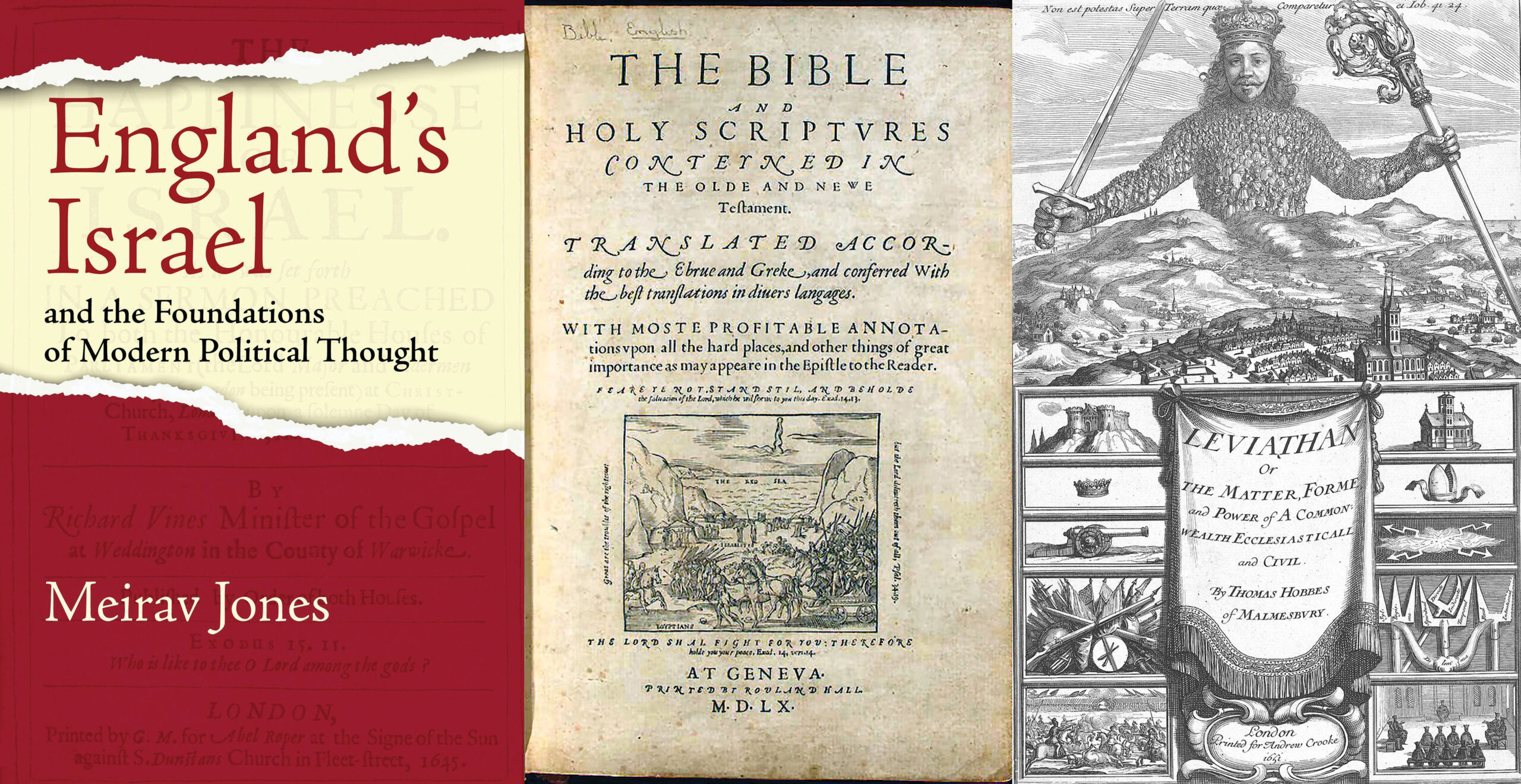
As Meirav Jones’s “England’s Israel and the Foundations of Modern Political Thought” chronicles, the affinity for viewing the British enterprise through a Hebraic lens arose through a combination of factors. King Henry VIII, seeking to break from the Pope following the pontiff’s refusal to grant him a divorce from Catherine of Aragon, sought Jewish textual support. Guided by scholarly Italian Jews, Henry established spiritual independence from Rome by way of scriptural and Talmudic argumentation. This newfound affinity for Jewish texts led to his establishment of the Regius Professorships in Hebrew at Cambridge in 1540 and Oxford in 1546, cementing England as a center for Hebraic study.
The availability of the English Bible was another contributing factor. Printed in 1539, it was among the first vernacular Bibles printed in the world. The Geneva Bible arrived in 1560, and saw 150 editions printed over the next 80 years. The Good Book had become both affordable and pocket-sized. And the rapidly growing Protestant movement sparked widespread interest in direct access to the text.
Christian Hebraists led a revitalized interest in the language that had been reserved for Jewish prayer and Bible reading. Sometimes these scholars, studying classic Jewish works in their original language, even called each other “rabbi” as they swapped sources of Jewish wisdom. One such “rabbi,” the polymath John Selden (1584-1654), possessed an expertise in Jewish law and was twice elected to Parliament. John Milton, the author of “Paradise Lost,” the beloved retelling of the Bible’s story of Adam and Eve, called Selden as “the chief of learned men reputed in this land.”
Additionally, the chaotic nature of British politics, including the judicial execution of King Charles I on Jan. 30, 1649, amidst general European millenarianism, enhanced the societal feeling history was undergoing what Jones describes as “biblically prophesied chronology, toward an ultimate end.” With people believing they were living through long-predicted end-times, they naturally turned to ancient texts for understanding and inspiration.
So it was that on Nov. 7, 1640, a pair of sermons were offered to Parliament during a public fast. In one, the nation’s elected officials were compared to Ezra, the post-Babylonian-exile spiritual leader of Israel during Second Temple times who ensured that the Israelites returned to God’s covenantal law. “Were you all as innocent as Ezra was?” questioned preacher Stephen Marshall. “What if you yourselves were guilty … You that are the flower of your Tribes … what a terror round about you there will be, when God comes to find you, and to reckon with you.”
In the second address, Cornelius Burges described how “in those dates, and in that time, saith the Lord, the children of Israel shall come, they and the children of Judah together, going and weeping, they shall goe [sic] and seek the Lord their God.” He expressed the wish “that I may yet more effectually bring home this to all our hearts … to parallel the slow pace of our deliverance out of mystical Babylon with that of Judah, and some of the remnant of Israel.”
During the English Civil War, the prominent theologian John Goodwin authored a 1642 tract urging armed resistance against the king. In it, he expressed the wish that the wrath of God wielded against Pharaoh in Moses’ time during the plague of the Slaying of the Firstborn be brought to bear once more. Though now, like then, it would be bloody, it would be justified. “There was a grievous cry throughout the whole land of Egypt upon it: But this cup was given to the Egyptians to drink,” since they deserved it. Goodwin hoped “the Israell [sic] of God amongst us” would emerge similarly victorious.
Petrus Cunaeus’ “Republic of the Hebrews,” translated from Latin into English in 1653, offered its readers in search of a stable and flourishing exemplar of governance, “a commonwealth, the most holy and the most exemplary in the whole World. The rise and advance whereof it well becomes you perfectly to understand, because it had not any mortal man for its Author and Founder, but the immortal God.”
The public debates over the crucial question as to whether a king could be deposed by his human subjects drew from Deuteronomy and Samuel for justification.
Thomas Hobbes’ “Leviathan” (1651), which took its name from a mythical sea creature mentioned in the Hebrew Bible, offered an articulation of social contract theory steeped in Judaic imagery. Citing Isaiah no fewer than 12 times, it offers a redemptive vision of God’s rule on earth described by the ancient prophet as a model for human rule. It is in the 33rd chapter of Isaiah’s book, Hobbes wrote, “In which words we have the place from when Salvation is to proceed, Jerusalem, a quiet habitation; the eternity of it, a tabernacle [i.e. Temple] that shall not be taken down.” Hobbes also lyrically describes the eternal value of Shabbat as a model political institution, cultivating humility and social cohesion. The Jews, he tells his readers, have “every seventh day, a Sabbath, in which the law was read and expounded; and in the solemnity whereof they were put in mind, that their King was God; and that having created the world in six dates, he rested the seventh day.”
As Jones concludes, “by 1640 when King Charles I convened the parliament that would ultimately see to his execution, the scope of this Hebrew revival had exceeded anything orchestrated or planned: the language, Israel’s story, its dramas and the wisdom and mission of a Godly people had permeated the English political imagination to such an extent that tapping into the beliefs and motivations of this people involved employing Hebraic terms. From the pulpit and the printing press, English politics was the politics of Israel, its wars, the wars of Israel, its leaders, the leaders of Israel. Israel was the people to whom God spoke, and in the mid-seventeenth century God spoke to England.”
This Hebraic political philosophy, of course, informed and inspired the Puritans and Pilgrims who traveled to the New World during this period, and later, the Founders who forged the United States.
“The holy city of Jerusalem did not die,” reflected the late political philosopher Russell Kirk, “though Nineveh and Babylon and Memphis and Susa and Antioch, and other mighty imperial capitals of the ancient world, were destroyed utterly. The buildings of Jerusalem might be razed, the city’s walls thrown down, its population put to the sword … [but] the Jew would find his way back to the sanctuary of Zion, lamenting beside the Wailing Wall that was said to be a fragment of the ancient Temple, renewing community on those blood-soaked sacred hills.”
This Tisha b’Av, then, as we sadly commemorate the loss of the Temple in Jerusalem, we also take solace in knowing the story of Israel continues. It serves now, as it has for centuries, as a source of inspiration for all those seeking redemptive covenantal community.
Rabbi Dr. Stuart Halpern is Senior Adviser to the Provost of Yeshiva University and Deputy Director of Y.U.’s Straus Center for Torah and Western Thought. His books include “The Promise of Liberty: A Passover Haggada,” which examines the Exodus story’s impact on the United States, “Esther in America,” “Gleanings: Reflections on Ruth” and “Proclaim Liberty Throughout the Land: The Hebrew Bible in the United States.”