Often overlooked amidst the fire and brimstone of the Ten Commandments’ delivery from atop the mountain in last week’s Torah portion is the articulation of Judaism’s national aspiration. “And you shall be to Me a kingdom of priests and a holy (kadosh) nation” God charges the Children of Israel in Exodus 19:6.
But what exactly does it mean to be a holy nation serving as the priestly spiritual inspirations to the world?
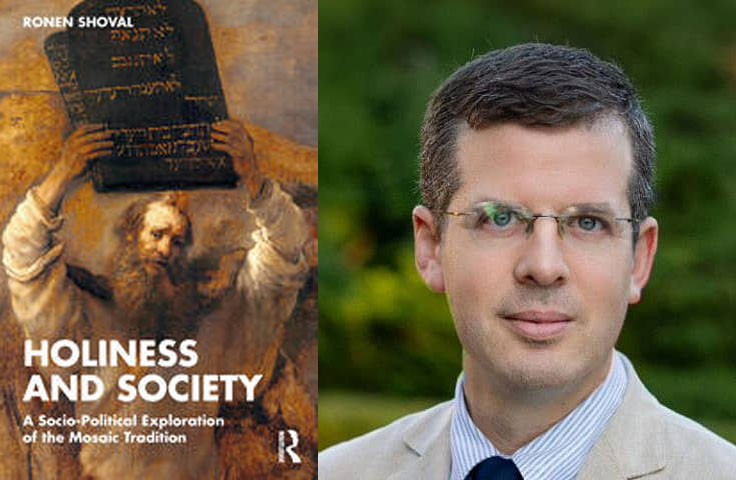
In a new book, “Holiness and Society,” the Israeli scholar Ronen Shoval seeks to understand the philosophical implications of the phrase and its contemporary resonance.
Holiness, he argues, is a political category. Many of us assume politics and civil society to be separate from spirituality and faith. No doubt this is a result of Christianity’s encouragement to “Render unto Caesar the things which are Caesar’s, and unto God the things that are God’s.” The American principle of “separation of church and state” also signals a stark distinction between the holy and the secular.
Not so the Jewish tradition. After all, as Shoval notes, the spectrum of commandments, governing drinking to divorces, tattoos to tithing, and personal injury to prayers, covers the gamut of our daily interactions. The Torah, he writes, “sees all of existence as operating along the spectrum of holiness and impurity.” As Isaiah puts it, “the whole earth is filled with His glory.”
The Bible’s declaration “you shall be holy” is thus a transcendental imperative unlike modern philosophers’ commitment to personal virtues or categorical imperatives. To be kadosh, Shoval suggests, is not to be the most pious, righteous, or ethical but to be “selected” for a purpose. Thus a spouse is mekudeshet, selected from other potential mates, and Shabbat is kadosh, selected from among the rest of the days of the week. The Beit HaMikdash, the Temple, was designated as God’s House. God Himself of course is kadosh from the physical realm, but enables us to be the same — selected from among the nations — through observance of His commandments.
As Shoval puts it, “sanctification [is] an ongoing process marked by the repeated observance of His commandments.” We are, through our fealty to our faith, God’s partner, seeking to imitate His virtues and obey His word within the dynamics of our ongoing relationship to Him.
“Holiness,” the book argues, “is a function of obligation, action, loyalty and a decision to bear the burden” of obedience to the divine. It is “not a given fact,” a reflection of some inherent superiority, “but a task.” (Korach, who, as the Book of Numbers details, rebelled against Moses, did not understand this. He had declared as his motto “everyone is holy,” inherently, without having to dedicate themselves towards obedience to the divine. God Himself quickly disavowed Korach of this notion).
“And you shall be to Me a kingdom of priests and a holy nation” is therefore a mission statement. Unlike more mystical faiths, Judaism seeks not abstract spiritual elevation and purely internal adherence to a mysterious divine being. And unlike Babel, with its Tower of mandated uniformity, “the shared foundation will be based not on force but on spirit. Zion will not control humanity, but inspire it.” In Judaism’s vision of the future, national and cultural differences will be maintained, but nation shall not lift up sword against nation.
Brazil has soccer. Italy has pasta. The U.S. centers on capitalism. Israel’s calling card is meant to be God’s commandments. Individual and collective commitment to the covenant with God is to serve as a model for all countries.
Brazil has soccer. Italy has pasta. The U.S. centers on capitalism. Israel’s calling card is meant to be God’s commandments. Individual and collective commitment to the covenant with God is to serve as a model for all countries. As Isaiah envisioned, “Many nations will come and say, ‘Come, let us go up to the mountain of the Lord, to the temple of the God of Jacob. He will teach us his ways, so that we may walk in his paths.’ The law will go out from Zion, the word of the Lord from Jerusalem.”
The nation of Israel, both in biblical times and our own, Shoval writes, “is supposed to serve not identity- and context-free citizens, but a nation composed of individuals tied to shared memory and hope.”
“The State of Israel is,” therefore, “supposed to be a moral beacon for the conduct of other nations, an example for a different path compared to the current zeitgeist,” Shoval concludes. “The covenant offers us a way to look back on the given, transcendent moral values in the Bible, observe the generation’s challenges, and translate them into law in the service of the desired goals.”
So much distance remains, of course, as we seek, individually and as a modern nation, to meet the challenge of God’s ancient charge and navigate what it means to have a democratic and Jewish country. But as the Rabbis taught, though the task is not ours to finish, we are not free to pause our progress towards it. We must continue to hearken to Heaven’s call to be holy.
Rabbi Dr. Stuart Halpern is Senior Adviser to the Provost of Yeshiva University and Deputy Director of Y.U.’s Straus Center for Torah and Western Thought. His books include “The Promise of Liberty: A Passover Haggada,” which examines the Exodus story’s impact on the United States, “Esther in America,” “Gleanings: Reflections on Ruth” and “Proclaim Liberty Throughout the Land: The Hebrew Bible in the United States.”