fbpx

February 18, 2025

The Whole of Holiness

Often overlooked amidst the fire and brimstone of the Ten Commandments’ delivery from atop the mountain in last week’s Torah portion is the articulation of Judaism’s national aspiration. “And you shall be to Me a kingdom of priests and a holy (kadosh) nation” God charges the Children of Israel in Exodus 19:6.

But what exactly does it mean to be a holy nation serving as the priestly spiritual inspirations to the world?

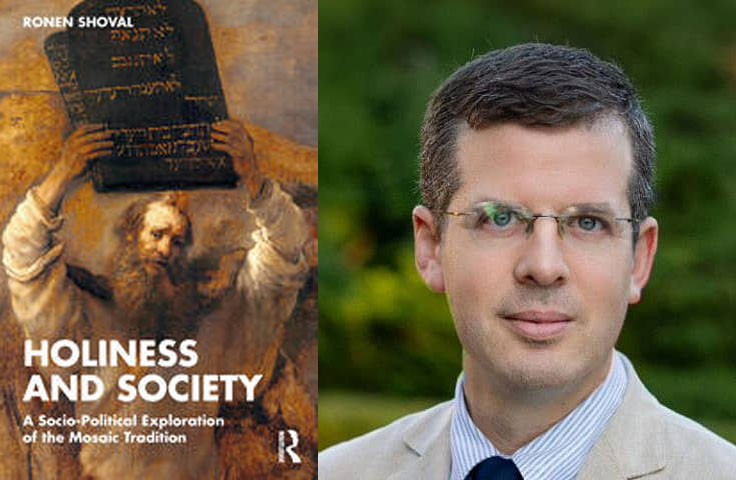
In a new book, “Holiness and Society,” the Israeli scholar Ronen Shoval seeks to understand the philosophical implications of the phrase and its contemporary resonance. 

Holiness, he argues, is a political category. Many of us assume politics and civil society to be separate from spirituality and faith. No doubt this is a result of Christianity’s encouragement to “Render unto Caesar the things which are Caesar’s, and unto God the things that are God’s.” The American principle of “separation of church and state” also signals a stark distinction between the holy and the secular.

Not so the Jewish tradition. After all, as Shoval notes, the spectrum of commandments, governing drinking to divorces, tattoos to tithing, and personal injury to prayers, covers the gamut of our daily interactions. The Torah, he writes, “sees all of existence as operating along the spectrum of holiness and impurity.” As Isaiah puts it, “the whole earth is filled with His glory.” 

The Bible’s declaration “you shall be holy” is thus a transcendental imperative unlike modern philosophers’ commitment to personal virtues or categorical imperatives. To be kadosh, Shoval suggests, is not to be the most pious, righteous, or ethical but to be “selected” for a purpose. Thus a spouse is mekudeshet, selected from other potential mates, and Shabbat is kadosh, selected from among the rest of the days of the week. The Beit HaMikdash, the Temple, was designated as God’s House. God Himself of course is kadosh from the physical realm, but enables us to be the same — selected from among the nations — through observance of His commandments. 

As Shoval puts it, “sanctification [is] an ongoing process marked by the repeated observance of His commandments.” We are, through our fealty to our faith, God’s partner, seeking to imitate His virtues and obey His word within the dynamics of our ongoing relationship to Him.

“Holiness,” the book argues, “is a function of obligation, action, loyalty and a decision to bear the burden” of obedience to the divine. It is “not a given fact,” a reflection of some inherent superiority, “but a task.” (Korach, who, as the Book of Numbers details, rebelled against Moses, did not understand this. He had declared as his motto “everyone is holy,” inherently, without having to dedicate themselves towards obedience to the divine. God Himself quickly disavowed Korach of this notion).

“And you shall be to Me a kingdom of priests and a holy nation” is therefore a mission statement. Unlike more mystical faiths, Judaism seeks not abstract spiritual elevation and purely internal adherence to a mysterious divine being. And unlike Babel, with its Tower of mandated uniformity, “the shared foundation will be based not on force but on spirit. Zion will not control humanity, but inspire it.” In Judaism’s vision of the future, national and cultural differences will be maintained, but nation shall not lift up sword against nation.

Brazil has soccer. Italy has pasta. The U.S. centers on capitalism. Israel’s calling card is meant to be God’s commandments. Individual and collective commitment to the covenant with God is to serve as a model for all countries.

Brazil has soccer. Italy has pasta. The U.S. centers on capitalism. Israel’s calling card is meant to be God’s commandments. Individual and collective commitment to the covenant with God is to serve as a model for all countries. As Isaiah envisioned, “Many nations will come and say, ‘Come, let us go up to the mountain of the Lord, to the temple of the God of Jacob. He will teach us his ways, so that we may walk in his paths.’ The law will go out from Zion, the word of the Lord from Jerusalem.”

The nation of Israel, both in biblical times and our own, Shoval writes, “is supposed to serve not identity- and context-free citizens, but a nation composed of individuals tied to shared memory and hope.” 

“The State of Israel is,” therefore, “supposed to be a moral beacon for the conduct of other nations, an example for a different path compared to the current zeitgeist,” Shoval concludes. “The covenant offers us a way to look back on the given, transcendent moral values in the Bible, observe the generation’s challenges, and translate them into law in the service of the desired goals.” 

So much distance remains, of course, as we seek, individually and as a modern nation, to meet the challenge of God’s ancient charge and navigate what it means to have a democratic and Jewish country. But as the Rabbis taught, though the task is not ours to finish, we are not free to pause our progress towards it. We must continue to hearken to Heaven’s call to be holy.


Rabbi Dr. Stuart Halpern is Senior Adviser to the Provost of Yeshiva University and Deputy Director of Y.U.’s Straus Center for Torah and Western Thought. His books include “The Promise of Liberty: A Passover Haggada,” which examines the Exodus story’s impact on the United States, “Esther in America,” “Gleanings: Reflections on Ruth” and “Proclaim Liberty Throughout the Land: The Hebrew Bible in the United States.”

The Whole of Holiness Read More »

Don’t Be Jealous

When I was in college, I fell in love with comedy. I got internships at “The Daily Show with Jon Stewart” and The Onion, I took improv classes and I did standup at open mics. I dreamed of being a famous comedian. 

After graduation, I met someone, let’s call him Mike, who was also doing standup. We became good friends. We would go to open mics together and see other comedians perform. He had also done improv and wrote sketches all the time. 

One day, I found out that Mike had won a prestigious comedy competition. He was going to appear on television with a famous comedian and do a standup set on late night, even though he was only one year into doing comedy, just like me. 

My immediate reaction when I found out about Mike’s success was jealousy. Even though I hadn’t entered the competition, I thought, “Why does he deserve this? Why am I not doing as well as him? How is he so lucky?”

Mike was funny and a nice person to be around. However, my feelings towards him were tainted as soon as I saw that his star was rising. After that, he went onto writing for a major TV star, and we lost touch. I pursued journalism and marketing and let my husband, Daniel Lobell, also a comedian, be the funny one in the relationship. 

I recently checked up on Mike, as I hadn’t heard about him in years. He’s still grinding away in the comedy business. He’s had a number of great opportunities. But he’s not some huge star. He didn’t “make it” from that one comedy competition. 

I realized just how unhealthy it was for me to be jealous of Mike. I should have been happy for my friend. I should have said to myself, “He worked hard, and he deserves this.” 

I’ve grown so much since then. I don’t really feel jealous of others anymore, and the rare times that I do, I’m able to quickly stop it from getting out of hand. 

I now know that you should always look at others with the “good eye” – if you do not, you invite negative energy into your life – and that can destroy you. 

We also have no clue what’s going on with someone behind the scenes. Maybe they look wealthy on the outside but they’re secretly in millions of dollars’ worth of debt; maybe someone has hundreds of thousands of Instagram followers, but they bought them all to look bigger than they actually are; maybe that guy or girl with the beautiful face and high fashion clothes feels terrible about themselves. You never know about the struggles people are facing just by seeing a snapshot of their lives. You may think they have it all, but trust me, they don’t.  

We have no clue what’s going on with someone behind the scenes … You never know about the struggles people are facing just by seeing a snapshot of their lives. You may think they have it all, but trust me, they don’t.

I talk to influencers all the time. These are people with huge followings and seemingly perfect lives who appear to be at the top of their game. Often, they tell me about how they wish they were as big as the person with a larger following than them. And so on it goes – everyone will always be better than you in some way. You could be infinitely jealous if you wanted. It’s not worth it. 

If we are jealous of someone else, it’s because we are lacking something in our lives. When it came to Mike, I could have said to myself, “Wow, he really knows what he’s doing.” I could have asked him for tips on doing standup comedy or perhaps see if he needed someone to assist him with joke writing. I could have learned from him, but my competitive and jealous mentality got in the way.

I learned my lesson: I shouldn’t let jealousy eat me up inside. I should be happy for others, see everyone favorably and focus on improving my own life. If you are struggling with jealousy, I encourage you to do the same. You’ll be a happier person and invite many more blessings into your life.


Kylie Ora Lobell is an award-winning writer and Community Editor of the Jewish Journal. You can find Kylie on X @KylieOraLobell or Instagram @KylieOraWriter.

Don’t Be Jealous Read More »

Serious Semite: A Kaddish for George Michael

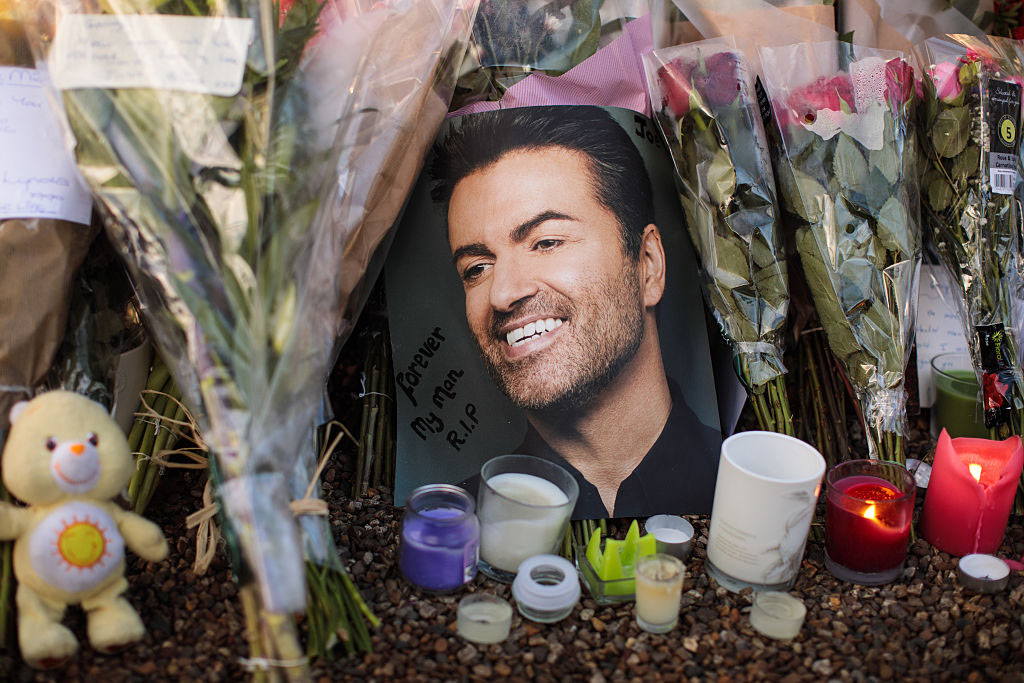
The death of George Michael was a shock when he passed away at the relatively young age of 53 on Dec. 25, 2016. It was literally his “Last Christmas,” and his iconic crucifix earring in the “Faith” video seemed a suitable symbol for the day he died. The only catch is that he later revealed that he was halachically (legally) Jewish on his mother’s side. As music fans mourned his passing, shedding tears and sharing eulogies across the world, I realised a harsh truth: nobody was saying kaddish for George Michael’s neshama.

I’d first heard of his Jewishness many years earlier from a close friend who is an osteopath and regularly treated George. The LA Times covered it in 2008, “George Michael embraces his dualities” (surely it should have been “jew-alities”?), and on BBC Radio’s “Desert Island Discs” program in September 2007, George told the story in his own words: “my mother, strangely enough, found out when her mother died, that her mother had been Jewish…[she] had been disowned for marrying a gentile.” How fitting then, that the title song from his breakout solo album had everyone singing a profoundly Jewish message of emunah; “you’ve got to have faith”.

How fitting that the title song from his breakout solo album had everyone singing a profoundly Jewish message of emunah: “You’ve got to have faith.”

After his death in December 2016, I realized it was unlikely his record company and management agency would have arranged for the Jewish daily memorial prayer to be said for the 11 months following his passing, so we arranged for a friend-of-a-friend to say kaddish every day for George. 

For some strange reason, there seems to be a vast over-representation of Jewish wives among modern British pop stars, although hopefully no more kaddishes will be required for a long time.

The recent Robbie Williams biopic “Better Man”, is a brilliant, creative retelling of his career challenges, depicting him as a performing monkey, and directed by “The Greatest Showman’s” Michael Gracey (not Jewish!). It includes the romantic and sad story of Robbie’s relationship with former fiancee Nicole Appleton — the Canadian-Jewish member of UK band All Saints — who later married Oasis’ Liam Gallagher (now divorced). Robbie later married Ayda Field, who is an Ashkenazi-Jewish LA native. Williams is very pro-Israel and said he would convert to Judaism if it didn’t involve circumcision, but nevertheless self-identifies as Jewish.

Meanwhile the elder statesman of British pop, Sir Paul McCartney, has had two Jewish wives (first wife Linda Eastman, and current wife Nancy Shevell) but it is George Michael who keeps drawing me in. Perhaps it is the personal connections. George went to high school in Bushey, England, back when his name was Georgios Kyriacos Panayiotou. Bushey is the town where my family lives, my nephews attended the same school where he met Andrew Ridgeley and formed Wham! His first live performance was in a Scout hut near my parents’ house, and the local pub — The Three Crowns — has a Wham! corner where the pop stars would go for a drink after school to meet with their manager (England in the 1980s never required ID to buy alcohol). 

Above all, soon after arriving in Los Angeles, my first music video was a parody of “Faith,” which we recreated shot-for-shot in our spoof song “Am I in the wrong Faith?” It was only in the preshoot preparation when studying the storyboards for the classic 1987 video that I realized the depth of George’s brilliance, the explosive energy of his performance, and the genius of one of our greatest showmen. My one regret is that I never sent him a DVD of our video before he died, despite my osteopath-friend offering to hand-deliver it to him.

Despite arranging the kaddish for George Michael, I never got around to lighting a yearly yahrzeit memorial candle on the anniversary of his passing. The Hebrew date for Dec. 25, 2016 was 25 Kislev, which is also the first night of Hanukkah. Last Christmas has passed, but if you’d like to light an extra candle on the first night of next Hanukkah, let’s light one for the man who brought faith to the dancefloor.


Marcus J Freed is an actor and writer. His Faith parody is on Youtube https://www.youtube.com/watch?v=a780aBtPHRQ. IG: @marcusjfreed 

Serious Semite: A Kaddish for George Michael Read More »

I Still Can’t Sleep

In today’s column I am revisiting the topic of insomnia because insomnia keeps revisiting me. I last wrote about this more than two years ago, and heard from loads of other sleep-deprived Journal readers who told me how much they related to it. Yes, misery loves company. Well, here you go again, friends. May this column serve you better than five milligrams of melatonin and a white noise machine, transporting you to the land of Zzzzs for several solid hours. 

Why do I have stretches of weeks when I sleep very well and then suddenly, that streak ends and I’m tossing and turning again? I don’t see any pattern or reasoning. It’s a riddle, wrapped in a mystery, in a bottle of Tylenol PM. Lying in bed, I try to force myself to relax, a ludicrous contradiction in terms. Please don’t call sleep “shut-eye” because many of us are pretending to be asleep with our eyes closed. Really, we are glumly awake under our eyelids. 

The Talmud says that sleep is considered to be 1/60th of death, because we have reduced consciousness and even our heart rate and respiration are lowered. That may sound a little morbid, until we learn that despite our conscious powers being suppressed during sleep, the soul is being rejuvenated, our spiritual connections recharging. I like this idea very much, but all I can tell you is that when I am seriously sleep deprived and finally get out of bed (note I did not say “wake up”) I sometimes feel more like 10/60ths of death out of exhaustion. Not only did I miss out on restorative sleep, but I also missed out on partying with God! That’s why I continue to try to tame this beast.  

At night, we say a special Shema that includes a prayer not to have bad dreams and to wake up refreshed in the morning. Yes, sleep is really a blessing from God, one that I’ll continue to pray for.

In the Torah, we learn about sleep and dreams through several people. God put Adam into a deep sleep, and when he woke up, he was married to a woman with whom he hadn’t gone on a single date. Then, she convinced him to eat a fruit that got them evicted from Eden, and he had to work the land for the next 920 years. Maybe he would have preferred insomnia.

While traveling, the patriarch Jacob managed to fall asleep while using a hard rock as a pillow. (He hadn’t packed his Tempur-Pedic.) He dreamed a prophetic dream in which angels went up and down that famous ladder. Commentators offer different interpretations of the dream, but all agree that it points to a future where Jacob will have countless descendants. When Jacob awakes, not only does he not have a headache, but God Himself is standing there, promising him the Land of Israel. Maybe memory foam pillows aren’t all that they’re cracked up to be.   

Jacob’s favorite son, Joseph, famously blabbed to his parents and brothers about his dreams that one day they would bow down to him. This didn’t play well with his brothers, who were already jealous of him. They dumped Joseph, whom they derisively dubbed “the dreamer,” into a pit, from which he was saved, only to languish in an Egyptian prison for 12 years. 

But dreams became his ticket to freedom and power, when Pharoah could not understand his dreams about the seven fat cows and the seven skinny cows. This was child’s play for Joseph, who explained it all for Pharoah and as a reward became viceroy of Egypt. Meanwhile, his prophetic dream about his brothers bowing down to him came true.

Ordinary people like me have dreams that are bizarre and sometimes unnerving. Lacking the spiritual insights of a Joseph or a Jacob, we are left to puzzle over their meaning. I suppose that somehow, even weird dreams must serve a spiritual purpose. Understanding more than that is beyond my pay grade. 

At night, we say a special Shema that includes a prayer not to have bad dreams and to wake up refreshed in the morning. Yes, sleep is really a blessing from God, one that I’ll continue to pray for, blackout shades drawn, sleep mask on, and gentle waterfall sounds playing softly in the background.


Judy Gruen is the author of “Bylines and Blessings,” “The Skeptic and the Rabbi,” and other books. She is also a book editor and writing coach.  

I Still Can’t Sleep Read More »

The Gaza Conundrum

Let’s agree that it is unlikely that the Gaza Strip will ever become “the Riviera of the Middle East,” at least not in our lifetimes. But let’s also agree that none of us has any idea what Donald Trump might accomplish in Gaza in the aftermath of his improbable commitment for the United States to assume control over the war-battered region, move its residents to neighboring Arab countries and oversee a massive rebuilding of the area into a prosperous multi-national development.

The president’s critics immediately disparaged the forced displacement of almost 2 million Palestinians as ethnic cleansing and dismissed the concept as logistically impossible. Arab leaders also strongly objected to the plan, making it clear that they would not host such a large number of refugees and would consider the relocation to be a violation of international law. The leaders of Jordan and Egypt, the two countries that Trump specifically mentioned as possible destinations, reacted nervously, recognizing both the domestic havoc that such a refugee influx would create and the realities of opposing Trump on such a high-stakes matter given the immense amounts of American financial assistance that both receive each year.

But Trump’s supporters responded just as quickly and aggressively. While few of the president’s backers have argued that the removal and reconstruction that he described will actually happen, many of them have made the case that Trump’s seemingly outlandish proposal could open the way to an equally favorable but more realistic outcome. Israeli conservatives praised Trump for his boldness and used his declaration to pressure Benjamin Netanyahu to exhibit similar aggressiveness by reclaiming the territory for Israel. In this country, the focus turned to whether Trump could pressure Jordan and Egypt into accepting the displaced Gazans.

So all eyes were on Jordan’s King Abdullah II last week, when he became the first Arab head of state to visit the White House since Trump’s return to office. The king walked a delicate line while in Washington, reiterating his opposition to Trump’s proposal in an online statement while remaining much more circumspect during their joint press availability. Abdullah’s humanitarian offer to take in 2,000 wounded or ill Palestinian children appeared to buy him some goodwill with Trump, but he was unable to get the president to back down during their private meeting. While Trump did not repeat his earlier threat to withhold military and economic aid if Jordan doesn’t cooperate, there is also no indication that he has rethought his position.

But while Abdullah was tap-dancing through his time with Trump, Egyptian President Abdel Fattah al-Sisi has been taking another approach. Sisi has refused to meet with Trump if the agenda includes Trump’s relocation plan and sent his foreign minister to Washington in his place to buy him some time. Sisi has instead been aggressively reaching out to other Arab leaders about the possibility of them funding the Gaza rebuilding effort rather than the Americans. Sisi is well aware of Trump’s enthusiasm for saving money and he calculates that a pan-Arab reconstruction would not only be a huge cost-saver for the U.S. but also relieve Trump of the potential need to deploy troops to the volatile region.

Secretary of State Marco Rubio may have been sending a message to the Arab world last weekend, when he acknowledged that Arab states “don’t like” the Trump Gaza plan. “Now, if someone has a better plan – and we hope they do,” he went on, “now’s the time to present it.”

It’s entirely possible that this is what Trump had in mind all along, and that he thought he could goad the Arab world into stepping up in order to block what they saw as a far more unacceptable American stewardship. Or maybe the president was just bored talking about his plans to purchase Greenland and invade Panama, and he was just making noise to see what type of reaction he would receive. We simply don’t know. But watching Egypt’s next steps in the weeks ahead may finally give us a sense of what post-war Gaza might become.


Dan Schnur is the U.S. Politics Editor for the Jewish Journal. He teaches courses in politics, communications, and leadership at UC Berkeley, USC and Pepperdine. He hosts the monthly webinar “The Dan Schnur Political Report” for the Los Angeles World Affairs Council & Town Hall. Follow Dan’s work at www.danschnurpolitics.com.

The Gaza Conundrum Read More »

For Immigrants, Is America the Ultimate Therapist?

You were bound to find out sooner or later. Los Angeles may have the country’s second largest Jewish community, but we’re still a small village where it counts. 

Two weeks ago, my community of Iranian American Jews was horrified to learn that a 64-year-old man had allegedly shot and killed his 54-year-old wife in Encino. He is an Iranian Jew. So was she. 

It happened early in the evening, in an otherwise quiet residential street outside the home of the victim’s close friend. The woman was allegedly shot to death in the presence of the couple’s teenage son. Police found her with a gunshot wound to her head. They located her husband several blocks away and took him into custody. 

I’m not here to speculate any further on details of this horrific incident, or to spread rumors. Or worst of all, to pour salt on the throbbing wound of the victim’s loved ones. I have friends who knew the victim and described her as a modest, sweet woman and an unbelievably devoted mother. 

No, I am not here to cause more pain. But I will say this: Murder in the local Iranian Jewish community? Unfathomable. 

Iranian American Jews are our community doctors, lawyers, dentists, realtors, entrepreneurs, shopkeepers, handymen, startup founders, teachers and in this case of this writer, your friendly neighborhood weekly columnist. There’s a bigger reason why the greater Jewish community is so shocked over this tragedy, and it goes beyond a well-known truth — not a stereotype, but a truth — that most Iranian American Jews, whether in Los Angeles, New York, Atlanta or Baltimore, are educated, more traditional, not prone to violence and yes, often successful. 

There is a myth, one that is at the core of why this tragedy has sent such shockwaves throughout Jewish LA, that assumes that once immigrants and refugees set foot in America, their redemption is such a given that any problems they face in this country seem miniscule compared to the ones they faced in their former lands. 

For example, when I was suddenly caught in painful throes of postpartum anxiety after the birth of our first child in LA, I was so disappointed with myself. I had survived both Ayatollah Khomeini and Saddam Hussein when I was a young girl in Iran (Khomeini ruined Iran and Hussein launched the eight-year-long Iran-Iraq War, of which I am a child survivor). I had survived two of the worst dictators in recent history, and a war that took over 1 million lives, but there I was, several years ago, unable to access peace and basic happiness, despite living in America and being a new mother. I was so hard on myself for struggling.

There’s an unwritten promise about the life of an immigrant or refugee that the problems we face in America will never be as bad as the ones we had back home. But what if those problems only worsen? 

In hindsight, almost every Iranian Jew who was given refuge in this extraordinary country after escaping Iran should have been granted immediate access to a compassionate therapist. And that includes mothers, fathers, children, and even grandparents. 

This is hardly a critique of my wonderful community. In fact, it’s the ultimate compliment. 

The next time you visit a local Iranian Jewish doctor, lawyer, dentist, shopkeeper, entrepreneur or anyone else over the age of 35, I hope you may appreciate that this caring, talented person most likely needed intervention to treat Post Traumatic Stress Disorder (PTSD), especially as a youth, and probably did not receive it. But here they are, treating our disorders, founding groundbreaking start-ups, educating our children, and throwing the best parties in the Western world (sorry for all that loud music at 1 a.m. last week; someone’s son or daughter was admitted to medical school and a celebration was in order).

How remarkable that our community has soared to such great heights despite having been torn from its former homeland after 2,700 years, enduring a cycle of intergenerational trauma, and for the most part, having had little access to mental health support until now. Through Divine Providence, unrelenting optimism and sheer grit, we persevered. 

There is no doubt that America saved us, but was America itself our intervention? For a refugee or immigrant, is America itself the ultimate therapist?

Perhaps. After living here for just one year and delighting in the sights, sounds, and tastes of all-things American, I nearly forgot the trauma of my early childhood in Iran. Kids often tap into their own resilience and selective memory to emotionally survive chaos and violence. 

For two-and-a-half decades, I thought I was fine. And then, after I had children, and as if it had made an appointment, PTSD knocked at my door and reminded me of our overdue visit. Since then, I have understood that those who are given refuge in America do not magically lose their inner demons by the simple virtue of being here. I was reminded of that truth several weeks ago, when an innocent wife and mother was shot and killed in an otherwise peaceful neighborhood in Encino. 

Her death has sparked an onslaught of outrage and lamentations among local Iranian American Jews regarding our community’s near-obsessive concern for keeping up appearances, and that includes not adequately addressing domestic violence more publicly. For her part, the victim of the Encino shooting was seeking help from friends and local authorities, and I would never blame her for her own death. I simply hope that she felt loved and supported while she was alive.

Last week, Santa Monica-based pediatrician Dr. Parisa Khorsandi, who moved from Iran to the U.S. in 1994 and has worked in pediatrics for 25 years, posted a moving plea in which she implored our community to abandon its obsession with saving face (“aberoo” in Persian). “I was really shaken by this,” she told me regarding the alleged murder in Encino. “In general, there is a lot going on behind closed doors and people are afraid to speak up. ‘Aberoo’ prevents them from seeking help.” 

Khorsandi told me about one Iranian Jewish mother who arrived at her office with a bruised face and insisted that her two-year-old child, not her husband, had hit her. She feared her family’s reputation, and as well as a grueling divorce process that might take away her child. Another mother refused to tell the medical staff at Khorsandi’s office the reason for scheduling a visit: her daughter’s drug abuse. She insisted on only speaking with Khorsandi. “Instead of gossiping, we must use our mental energy to help each other,” said Khorsandi, who also knows “countless” female doctors who choose to stay in abusive marriages, fearing a disruption to their public image. I understand all these fears, especially when we believe our community will be so unforgiving in the face of crisis. 

Perhaps this tragedy will serve as a warning. Perhaps it will inspire a generous philanthropist in our community to fund the first-of-its-kind safe house for immigrant Jewish women escaping physical or emotional abuse. Perhaps donations on behalf of the victim’s family will be directed partly toward ensuring that her children and those who witnessed her death have access to a caring mental health specialist for as long as they need, even if it means a lifetime. 

This year, with the release of the haunting film, “The Brutalist,” Hollywood finally caught on to the notion that someone may arrive in America believing they have been granted the ultimate redemption, only to endure pain that shatters that dream into a thousand pieces.  

Perhaps one day, we can finally shed the impossibly difficult demands of constantly trying to control our public image. 

Ironically, for all of our efforts as Iranian Jews in America to avoid the kind of assimilation that has affected older Jewish communities here, and has resulted in weaker Jewish identity and soaring intermarriage in those communities, there is one silver lining to having newer generations of Iranian American Jews who are becoming more Americanized by the day: perhaps one day, we can finally shed the impossibly difficult demands of constantly trying to control our public image. 

I know we will get there one day. Remember the young mother I mentioned above who blamed her two-year-old for the bruise on her face? Khorsandi told me that she eventually left her husband and enrolled in graduate school to ensure her own professional success and freedom. By doing so, she tapped into the best that America has to offer. 


Tabby Refael is an award-winning writer, speaker and weekly columnist for The Jewish Journal of Greater Los Angeles. Follow her on X and Instagram @TabbyRefael.

For Immigrants, Is America the Ultimate Therapist? Read More »

Shabbaticide: Hamas’ Deliberate Campaign to Desecrate the Sabbath

Since the start of the war, Israel has been accused not only of genocide, but also scholasticide, domicide, urbicide, politicide, ecocide, and culturcide, words that mean, according to Al Jazeera, killing a people, killing a home, killing a city, killing political representation, killing the environment, and killing “a sense of self.”

Aside from genocide, none of these words make much sense. The suffix “-cide” is more commonly found in words like homicide (killing a person); patricide (killing one’s father); or even herbicide (killing a plant), which is to say, it has always been used to refer to biologically living entities, which, definitionally, are the only entities that can be killed.

Any use of “-cide” to refer to the destruction of nonliving things is a recent invention, and is useful in making Israel’s war seem uniquely monstrous. A building destroyed by a bomb is no longer collateral damage. It is now a unique crime against humanity — the killing of knowledge itself, for instance.

In some cases, these terms were coined to condemn Israel. Scholasticide, for instance, was first used in 2009 by Palestinian scholar Dr. Karma Nabulsi, who stated that Palestinian education is something Israelis “cannot abide … and seek to destroy.”

In other cases, the words were not specifically invented to condemn Israel, but are nevertheless almost exclusively used for this purpose.

“Domicide” was nothing more than an obscure bit of academic jargon before it was taken up by the anti-Zionist movement. Now it’s close to being a household term. The same can certainly be said of the other cides as well. The Wikipedia articles for both Domicide and Ecocide call out Israel specifically and at length, without bothering to mention Hezbollah’s habit of firing anti-tank missiles at private homes in Israel with no military justification, or Hamas’ tactic of using flaming kites to ravage farmland in southern Israel. 

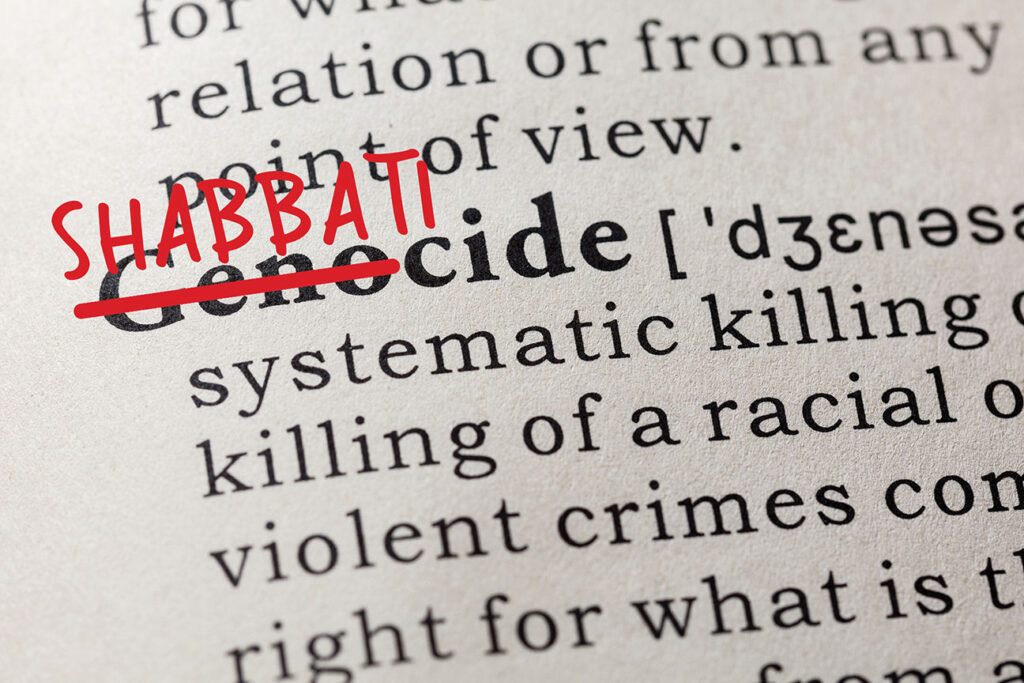
We can criticize the proliferation of these terms, or we can try and fight back in kind. We might point out, for instance, that the Palestinians are guilty of Shabbaticide — a word I just invented meaning “the killing of the Jewish Sabbath.” 

We might ask why Hamas has chosen Shabbat for its gruesome hostage release ceremonies. According to MK Amit Halevi, this is “a deliberate humiliation” and an attempt to make the State “desecrate Shabbat publicly” for a cheap propaganda win. 

The added benefit for Hamas is that Shabbat-observant Jews are prevented from bearing live witness to the return of our people and are forced to spend the holy day in anxiety.

The Oct. 7 massacre itself took place on Shabbat, and not just any Shabbat but Simchat Torah, an important holiday celebrating the giving of the Torah. 

But Hamas didn’t invent Shabbaticide. It has long been practiced by Israel’s enemies. Let’s not forget that Oct. 7 was the 50th anniversary of the Yom Kippur war — when Israel was invaded on the holiest day of the Jewish calendar, with many Jews at their most vulnerable, wrapped in tallitot and praying in shul. 

Hamas’ Shabbaticide campaign, cruel as it is, has backfired. Stories of Israeli hostages observing Shabbat in captivity have only strengthened our faith in the Sabbath. 

Agam Berger, who has been released, has discussed how she kept Shabbat in captivity. Her captors would force the young women to cook for them, but on Shabbat Agam would refuse to light a flame. Even when threatened by the terrorists, she didn’t back down from her commitment to this commandment. 

We have also heard from hostages that have been released that Omer Shem Tov, who has yet come home, has begun keeping Shabbat in captivity.

Some have asked how this is possible? Isn’t every day in captivity Shabbat? After all, there is no television or iPhone to turn off. This question confuses the essence Shabbat with its outward manifestations. There is nothing external that is needed to observe and keep the sabbath. 

With a piece of toilet paper on his head for a kippah, Omer reportedly recites the Kiddush blessing on Friday evenings. And though his captors gave him a flashlight to eat with at night, on Shabbat he eats in the dark.

This decades-long effort to desecrate Jewish holidays through invasions and massacres reveals something that people in the West fail to understand — the war against Israel is not an anti-colonialist struggle, but a religious war aimed at rooting the Jews out of Muslim land.  

This decades-long effort to desecrate Jewish holidays through invasions and massacres reveals something that people in the west fail to understand — the war against Israel is not an anti-colonialist struggle, but a religious war aimed at rooting the Jews out of Muslim land. 

In pursuit of this holy war, Hamas has transformed Gaza into a hotbed of extremism and hate. 

They rule the strip with an iron fist, appropriating all public funds for their war efforts, turning schools and hospitals into military installations, building terror tunnels underneath residential neighborhoods, sending burning kites over the border to torch the land they claim to love, using the facade of UNRWA to turn the school system into a factory of indoctrination, and invading Israel whenever possible with the aim of burning kibbutzim, throwing grenades into houses, and murdering every man, woman and child that they encounter — excepting those that they kidnap.

If one was so inclined to use them, there are some handy neologisms to describe all of these actions—scholasticide, urbicide, domicide, ecocide, culturecide, and yes, genocide. 

But we all know that these words are reserved for the special purpose of slandering the Jews alone.


Matthew Schultz is a Jewish Journal columnist and rabbinical student at Hebrew College. He is the author of the essay collection “What Came Before” (Tupelo, 2020) and lives in Boston and Jerusalem.  

Shabbaticide: Hamas’ Deliberate Campaign to Desecrate the Sabbath Read More »