
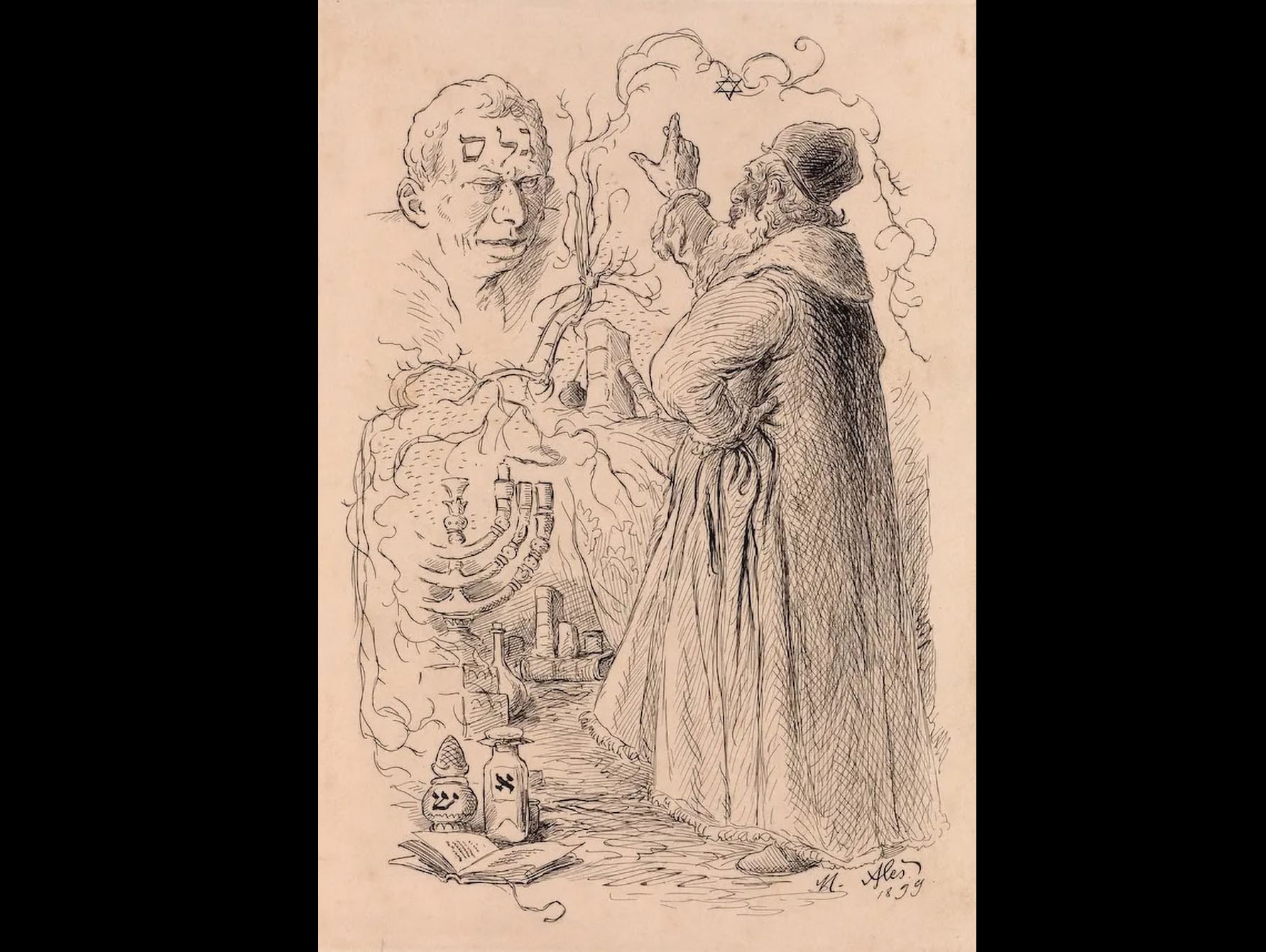
Might a golem help make a minyan? Over 300 years ago, a rabbi considered the question, now cited in countless discussions about the implications of artificial intelligence and Judaism.
As Rabbi Dr. Yosie Levine, a Los Angeles native now serving as the rabbi of Manhattan’s Jewish Center, notes in his magisterial new biography “Hakham Tsevi Ashkenazi and the Battlegrounds of the Early Modern Rabbinate,” the itinerant sage and former Chief Rabbi of Amsterdam included in his book of responsa an analysis of the question.
The golem, a man-made Frankenstein’s monster-like creature, was made famous in fictional tales ascribed to the 17th-century Rabbi Judah Loew ben Bezalel of Prague but actually composed in the 19th century. Golems were also discussed a millennium earlier in Talmudic legends. But it wasn’t until the Hakham Tsevi writing in 1712 that the figure was brought into the realm of Jewish law.
As Levine notes, at the time, mechanization had become a source of fascination both within and beyond the Jewish world. The lines separating science and superstition were blurry, if they existed at all.
As Levine notes, at the time, mechanization had become a source of fascination both within and beyond the Jewish world. The lines separating science and superstition were blurry, if they existed at all.
Hakham Tsevi had learned that his ancestor, Rabbi Elijah of Chelm, had supposedly used the mystical text “Sefer Yetsirah” to create a golem. Hakham Tsevi’s son, Rabbi Jacob Emden, later recounted that “when [Rabbi Elijah] saw that the golem was growing larger and larger, he feared that he would destroy the universe. He therefore removed the holy name [of God] that was still embedded in his forehead, thus causing him to disintegrate and return to dust. Nonetheless, while he was in the process of forcibly extracting the holy name from him, the golem injured him, scarring his face.”
So it was that Hakham Tsevi examined the implications of golems and prayer quorums. On the one hand, he noted, the figure was obviously not born from a woman, and therefore could not be considered Jewish in accordance with Jewish law. On the other hand, the Talmud rules that one who adopts a child is considered to have birthed the child. The handiwork of a righteous individual, even a human-like creature formed from clay, the rabbi reasoned, was like that person’s child. So perhaps the golem could count.
To resolve the competing factors, Hakham Tsevi cited the following Talmudic tale: “Rava created a golem using the forces of sanctity. Rava sent his creation before Rabbi Zeira. Rabbi Zeira would speak to him but he would not reply. Rabbi Zeira said to him: You were created by one of the members of the group, one of the Sages. Return to your dust.”
Since Rabbi Zeira was not considered a murderer for rendering the golem back into its constitutive elements, it must be, concluded Hakham Tsevi, that the creature had never been fully human. As Levine summarizes the responsa’s verdict, “A golem – or any other artificial life form – cannot be considered a human life unless and until it issues from a human womb … the golem might have been alive, but it was little more than a soulless brute.”
Having introduced the golem into the realm of Jewish law, the responsum of Hakham Tsevi sparked subsequent discussions. Could a golem perform ritual slaughter? Would its corpse generate ritual impurity? If a golem found a lost object, would he be able to claim it or would the object belong to the person that created the golem?
“In our day,” Levine writes, “with the arrival of questions generated by modern scientific advances, Hakham Tsevi’s responsum has taken on new relevance. His treatment of the issue began to inform discussion about questions never before considered. What is the halakhic status of a robot, a clone, or another form of artificial intelligence? How might the status of a golem bear on matters of reproductive biotechnology or the disposition of human embryos? For ethicists and policy-makers alike, Hakham Tsevi’s responsum became required reading, and often served as the starting point for the conversation.”
The implications of AI on Jewish law will no doubt continue to be debated. In the meantime, if a golem shows up to shul, though it can’t count for a minyan it probably couldn’t hurt to invite it to kiddush. Who knows? You might even be able to get it to become a dues-paying member.
Rabbi Dr. Stuart Halpern is Senior Adviser to the Provost of Yeshiva University and Deputy Director of Y.U.’s Straus Center for Torah and Western Thought. His books include “The Promise of Liberty: A Passover Haggada,” which examines the Exodus story’s impact on the United States, “Esther in America,” “Gleanings: Reflections on Ruth” and “Proclaim Liberty Throughout the Land: The Hebrew Bible in the United States.”