In the introduction to his book “American Judaism,” Jonathan Sarna shares the following anecdote:
“When I first became interested in American Jewish history, I mentioned my interest to a scholar at a distinguished rabbinical seminary, and he was absolutely appalled. “American Jewish history,” he growled, “I’ll tell you all that you need to know about American Jewish history: the Jews came to America, they abandoned their faith, they began to live like Gentiles, and after a generation or two they intermarried and disappeared. … Don’t waste your time. Go and study Talmud.”
This scholar had a point. American Judaism is the noisy younger brother of Jewish history: always talked about, but lacking in serious contributions. Bagels and lox Judaism thrives here; in America, Jewish mediocrity is an achievement and assimilation is the norm.
It is easy to dismiss American Judaism.
But that would be a mistake. American Jews need to take pride in this history, because without the American Jewish community, the Jewish world would be far weaker and smaller today.
For Jews, America was always different.
America was a safe haven. Rabbi Moshe Feinstein wrote that Jews need to be particularly grateful to the United States, which is governed by “a government of kindness whose entire purpose is to do good for all residents of the country.” Having grown up in Czarist Russia, Feinstein knew that wasn’t the case elsewhere.
Ever since September 1654, when the Sainte Catherine ship arrived in New Amsterdam carrying 23 Jewish refugees who had fled Recife, Brazil to escape the Portuguese Inquisition, Jews have come to America to escape pogroms and persecution.
The prominent Yiddish writer Sholem Aleichem, who lived his final years in New York, spoke for millions of European Jews in the words of a Yiddish song he wrote:
“America is for everyone,
they say, great good fortune,
and a Paradise for the Jews,
something extraordinary.”
Jews had fallen in love before with other countries like Spain, Poland and Germany. But the United States was different; it was a true home.
A 1790 letter from George Washington to Touro Synagogue in Newport, Rhode Island, begins a unique relationship. Washington wrote that the United States didn’t just tolerate the Jews; it embraced them as full partners in creating this new country, “which gives to bigotry no sanction, to persecution no assistance.” This new democracy in the New World would be very different from anywhere else Jews had been.
American Jews served in the army, ate turkey on Thanksgiving, and threw Fourth of July barbecues. They played baseball, served on the Supreme Court, and ran for president. They built hospitals and media empires. They were not only true Americans; they helped shape the American Dream.
For once, Jews could feel at home.
But that posed a problem. Jews have a genius for surviving at the worst of times; success is far more challenging.
Jews have a genius for surviving at the worst of times; success is far more challenging.
In Babylonia, Ezekiel rebuked the Jews for shedding their Jewish identity, but they assimilated anyway. When Napoleon invaded Russia, Rabbi Shneur Zalman of Liadi, the first Rebbe of Chabad, prayed for the Czar to be victorious. He recognized that “if Bonaparte is victorious, the wealth of the Jewish people will be increased and the dignity of Israel will be restored.” But he worried that because of that, “The hearts of Israel … will become more distant from their Father in heaven.”
And that happened in the United States. One European rabbi who visited the U.S., Rabbi Yaakov Dovid Wilovsky, would tell audiences to return to Europe because “America is a treif land, even its stones are impure.” (During that tour, Wilovsky served as the Rabbi of Kehilath Jeshurun for the 1904 High Holidays.)
America was a “melting pot.” This term was taken from the title of a play by Israel Zangwill. In it, a Jewish man who fled Russia after the Kishinev pogrom marries the daughter of a Russian officer responsible for the death of his family. In the old world, they were mortal enemies, but in America love conquers all. He saw America as a great melting pot that fuses together diverse immigrants from around the world into “Americans.”
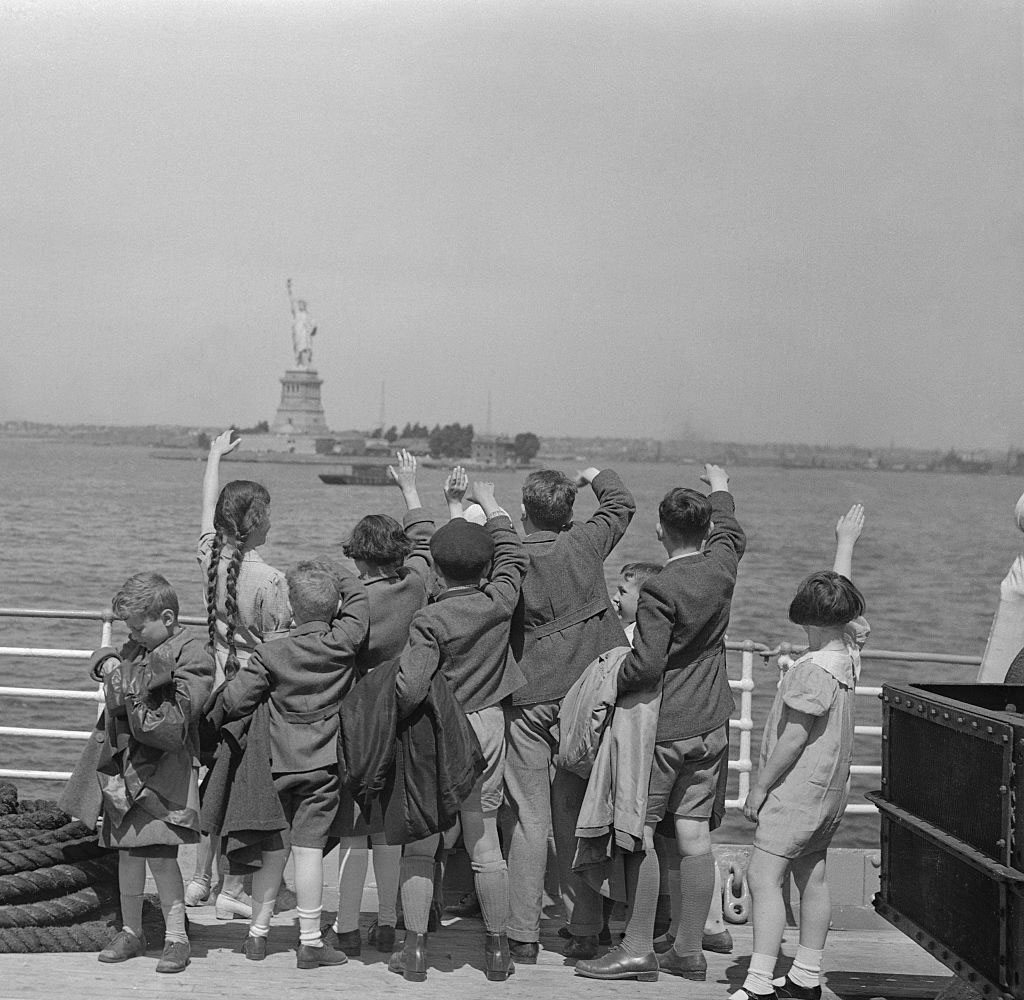
Sadly, many Jews got off the boat at Ellis Island and jumped right into the melting pot. In America, Jews could choose whether they wanted to be Jewish.
But many Jews spurned the melting pot. Horace Kallen wrote a sharp critique of the play and its worldview, and advocated instead what he called “cultural pluralism.” Kallen argued that healthy diversity made societies stronger. One didn’t have to discard their Judaism to be a good American; on the contrary, being a better Jew made one a better American.
Many Jews agreed. They chose to be both proud Jews and proud Americans, and thanked God for the privilege. Many synagogues added special prayers and sermons on Thanksgiving and the 4th of July, and proudly display the American flag at the front of the synagogue.
For 250 years, Jews have been at home in the United States of America. And even though antisemitism has always been a problem for American Jews, it was never as bad as elsewhere.
After the Holocaust, antisemitism was in retreat. Movies like Frank Sinatra’s short film “The House I Live In” and Gregory Peck’s Oscar-winning box office hit “Gentleman’s Agreement” made antisemitism socially unacceptable.
The emergence of Israel also changed the image of Jews. Many Americans admired the plucky little democracy that was fighting off Soviet client states. The Six Day War and the rescue at Entebbe cemented Israel’s image as the little country that could.
There was a brief moment when it seemed like American antisemitism might disappear. But about ten years ago, everything changed.
There was a brief moment when it seemed like American antisemitism might disappear. But about ten years ago, everything changed.
In incident after incident, Jews were attacked. This tragic list keeps growing, from Pittsburgh to Jersey City to Colleyville, and Boulder, Washington DC, and so many more. And this only intensified after October 7th.
Universities exploded with hatred. Jews had fought long and hard to get accepted to Ivy League universities, but now, on the training grounds of the American elite, Jewish students were being threatened. In the media, a slew of media personalities like Tucker Carlson and Hasan Piker made their living by Jew baiting. In politics, the rise of the DSA in the Democratic Party and the isolationist wing of the Republican Party have left Jews politically homeless.
I am now repeatedly asked the same question: Is this the final chapter of the Jews in America?
This question ignores 300 years of American Jewish history. American Jews have been here before. And every time, they fought back.
So, no, it isn’t the final chapter.
American Jews have changed the course of Jewish history. Henry Morgenthau’s pressure on President Roosevelt towards the end of World War II allowed 200,000 Jews to escape the Holocaust. And nearly five million Jews escaped Hitler simply by living here. Eddie Jacobson, a business partner and good friend of President Truman, persuaded him to ignore the State Department and recognize the new State of Israel. He and so many other American Jews were critically important in creating the State of Israel. American Jewish philanthropy has changed the lives of Jews around the world.
And we still can.
Things have been too easy for too long. We have forgotten that it is up to us.
Things have been too easy for too long. We have forgotten that it is up to us.
Rabbi Soloveitchik, in his essay “Fate and Destiny,” emphasizes a basic Jewish lesson about agency. At times we have no choice in life and are a mere object acted upon by others, but most of the time we can take control of our destiny if we choose to.
It is time for American Jews to take control of their destiny. Just like they have in the past.
During the Damascus Blood Libel of 1840, the tiny American Jewish community (then just 15,000 people in a country of 17 million) sprung into collective action for the first time. Protests were organized in the six cities with significant Jewish populations; the community sent letters to President Van Buren and got a very positive response from the Secretary of State.
American Jews would be different. They would be unafraid, and they would be activists.
In the early 1900s, a time far more antisemitic than today, American Jews responded. Since athletic clubs excluded Jews, they built their own, the YMHAs. Leading hospitals refused to take Jewish doctors. So, they built their own, and today, there are hospitals with Jewish names like Mount Sinai or Beth Israel all over the country. After pogroms in Russia, they established the American Jewish Committee; after the lynching of Leo Frank, they created the ADL.
American Jews would be activists. They would buy Israel Bonds and organize for Soviet Jewry. At a moment’s notice, 300,000 Jews traveled to Washington after October 7th.
American Jews have always known how to grasp their destiny. And that is exactly what we need to do now.
We can succeed because America is different.
Rabbi Chaim Steinmetz is the Senior Rabbi of Congregation Kehilath Jeshurun in New York.