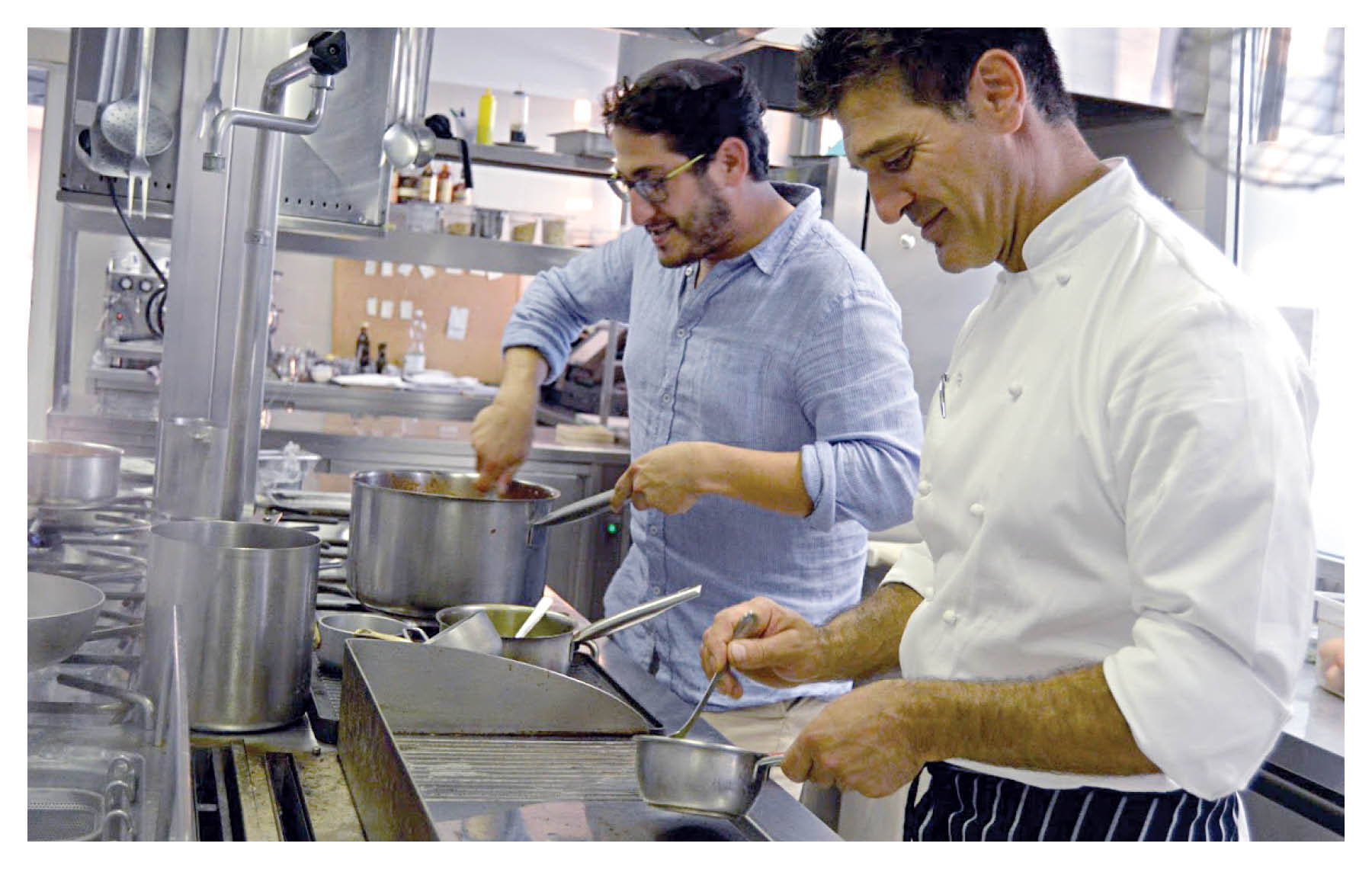
Avicam Gitlin has no shortage of swashbuckling vignettes to tell about his job cooking and planning vacations for observant Jews through his work at the Kosher Culinary Travel.
Four years ago, Gitlin was sleeping on the deck of a yacht he had chartered for a family vacationing around the Greek Isles. The yacht was moored off a desert island some 40 nautical miles from the Greek coast. In the middle of the night, Gitlin awoke to shouts of ‘Help!’ coming from the island. He filled a dinghy with water and food and together with a couple of crew members rowed to the island. There, they found two Syrian refugees fleeing their war-torn homeland. Gitlin called the coast guard, which picked up the men, who eventually were able to start a new life in Europe. Back on the yacht, his clients remained asleep in their opulent cabins, completely unaware of the adventure that had transpired.
On another occasion, Gitlin, 38, was in Tuscany, Italy, when he walked into a butcher shop owned by the legendary Dario Cecchini. Cecchini loomed over half a cow splayed open on the block, knife in hand with a crazed look in his eye. But when he noticed Gitlin’s yarmulke he dropped the knife and ran over to greet him with an ebullient “Shalom.” Over a glass of kosher wine he kept for special occasions, Cecchini told Gitlin how, as a young orphan, a Jewish family took him in and, since then, he has had an unwavering affinity for the Jewish people. During their shop-talk, Cecchini also divulged the recipe for a semolina olive oil cake, which Gitlin uses to this day.
“I was always interested in seeing the world and this was my way of combining my passion for food and my passion for travel.”
“My take on travel is to be immersed in as much of the local aspect as you can,” Gitlin said. That’s why his business has been designed to allow observant Jews to experience global travel without forgoing one of the paramount aspects in encountering foreign cultures: food.
You won’t, for example, find Gitlin in Zambia boiling gefilte fish for his clientele. Wherever he is in the world — and he’s been just about everywhere — he sources local ingredients and recipes. In Tuscany, for example, Gitlin took over a restaurant for an entire week. The restaurant was owned and operated by four generations of the same family. Gitlin kept the staff and chef on, and they served a slightly modified version of the existing Tuscan menu, without the pork. He found a local liquor-maker who made the hard stuff kosher; a cheese maker who agreed to make kosher cheese; and partnered with a local, kosher organic winery.
Israeli-born but raised in Orlando, Fla., Gitlin said cooking has always been a part of his life. As a child, he clung to his mother’s skirts in the kitchen, helping her cook traditional Iraqi fare. He made aliyah in his early 20s, earned his undergraduate degree in political science, and opened a telemarketing call center before packing it all in to pursue a culinary career.
Nearly a decade later, Gitlin has cooked up a kosher storm alongside renowned chefs in some of the world’s most famous restaurants, including Montage in Maui; La Cabro d’Or in Provence, France; and La Taverna del Pittore in Tuscany.
“I was always interested in seeing the world,” Gitlin said, “and this was my way of combining my passion for food and my passion for travel.”