fbpx

March 6, 2019

Highlighting the Importance of Anti-BDS Legislation

Focusing on legislation that cracks down on the boycott, divestment and sanctions (BDS) movement, was the focus of one of  StandWithUs’ “Israel in Focus” International Conference sessions this past weekend at the Hyatt Regency at Los Angeles International Airport.

Joseph Sabag, executive director of the Israel Allies Foundation, told around 30 attendees that anti-BDS legislation is an important way to defend Israel from “economic terrorism” while upholding free speech.  He said while BDS was once the purview of non-government organizations the mantle has now been taken up by student groups including Students for Justice in Palestine and outside organizations including Americans Muslims for Palestine.

“Israel didn’t just need [the] iron dome [to destroy incoming] rockets, Israel needed an iron dome policy-wise” to protect its economy, he said.

StandWithUS (SWU) Midwest Executive Director Peggy Shapiro, who moderated the session,  said that anti-BDS legislation tends to have one or both of the following components: requiring companies to pledge not to boycott Israel when entering into a business contract with state government, and banning companies that boycott Israel from receiving state investment funds. She added  it’s important to ensure that anti-BDS legislation prevents businesses like Airbnb from claiming they’re not supporting BDS since they still operate in Israel, but rather they’re just de-listing from Israeli properties in the West Bank.

Stephanie Hausner, deputy director of the Israel Action Network, told attendees that BDS is a “discriminatory” movement and state governments can decide not to do business with companies that engage in discriminatory behavior. “We’re not saying individuals can’t boycott Israel,” Hausner said, adding that businesses “are not obligated to a state contract.”

Sabag said that the current federal anti-BDS bill, S. 1, enshrines state government’s right to choose not to do business with companies that boycott Israel. He added that claims that such laws inhibit free speech “is really a red herring. We’re not talking about speech in this instance, we’re talking about commercial policy,” he said.

Hausner cited a Jan. 23 case in Arkansas where a federal judge dismissed a lawsuit against the state government’s anti-BDS law on the grounds that the law regulated commercial policy, not speech.

With 26 states adopting anti-BDS laws and anti-BDS legislation being considered at the federal level, Sabag argued that proponents of anti-BDS laws should focus on “enforcement and litigation” of those laws and then take the fight against BDS to the “cultural” arena.

“[It’s] important for you guys to invoke that many state governments agree that BDS is discriminatory in nature,” Sabag said, adding that it’s a “mistake to think that this is only about financial regulation.”

Highlighting the Importance of Anti-BDS Legislation Read More »

‘Mad About You’ to Return Later this Year

Twenty years after it ended is seven-year run on NBC, “Mad About You” is getting a reboot. Paul Reiser and Helen Hunt will reprise their roles in the sitcom in a limited series for Sony Pictures Television that will launch on Charter Communications’ Spectrum Originals in late 2019. Peter Tolan (“Rescue Me”) will be the showrunner.

The series will be set in the present day and focus on Paul and Jamie Buchman and their daughter, Mabel. Hunt will direct the reboot’s first episode.

“We are so excited to finally be doing this and thrilled to have Peter Tolan as our fearless captain,” Reiser and Hunt said in a joint statement. “We promise you the same funny and heartwarming show – as soon as we can remember what’s funny about being older. It’s going to be great!”

“Two decades ago, fans fell in love with this show, and this time will be no different as Paul, Helen and Peter explore modern marriage through the eyes of two people who have just become empty-nesters,” Katherine Pope, Head of Content at Spectrum Originals said. “We can’t wait for everyone to fall in love with the Buchmans all over again.”

Reiser is also playing composer Cy Feuer in the new FX limited series “Fosse/Verdon,” premiering April 9.

‘Mad About You’ to Return Later this Year Read More »

Letters: Mideast Nuclear Technology, Defending Israel

Mideast Nuclear Technology
The Feb. 21 Daily Roundtable (online) asked a curious question: Was the current administration planning to give the Saudis nuclear technology?

The Pandora’s box of Middle Eastern nuclear technology was opened many years ago. Iraq’s nuclear reactor was destroyed in 1981.

According to The New York Times, Pakistan supplied nuclear technology to North Korea in exchange for missiles. North Korea then “gave” Syria’s Bashar Assad a nuclear facility almost identical to the Nyongbyon nuclear complex, which produced plutonium for nuclear bombs, as reported by media citing Israeli intelligence.

What history suggests is that if the Saudis want nuclear technology, they will get it, and they will not need an unmarked plane loaded with pallets of cash ($400 million) to help them realize any such ambitions.
Julia Lutch, Davis, Calif.

Defending Israel
Dan Schnur is right that the legislation sponsored by Sens. Marco Rubio (R-Fla.) and Joe Manchin (D-W.V.) is constitutional and necessary (“The Right to Punish Free Speech,” Feb. 15).

The Rubio-Manchin bill enables local and state governments to withhold money from those who advocate the destruction of Israel and shields such governments from retaliation from would-be boycotters. Contrary to the argument proffered by proponents of the boycott, divestment and sanctions (BDS) movement, this in no way inhibits freedom of speech and accordingly does not merit opposition on such grounds.

The BDS movement, as admitted by its originators like Omar Barghouti, seeks the eventual elimination of Israel, not mere change of any particular government policy. It seeks to achieve this by harming the Israeli economy and producing the ostracism and diplomatic isolation of Israel.

To this end, BDS activists are free to defame Israel as much as they choose; Their First Amendment rights aren’t endangered. However, BDS activists seem to believe that freedom of speech equals immunity from criticism or consequences, one of which via this legislation would be the withholding of government contracts from them or their associates.

As Schnur correctly observes, “elected officials who disagree with their animosity for Israel are just as entitled [as BDS activists] to express their disagreement — in writing, in speeches, and in votes for anti-BDS legislation. Which is what courageous pro-Israel leaders will continue to do.”
Morton A. Klein, National President Zionist Organization of America

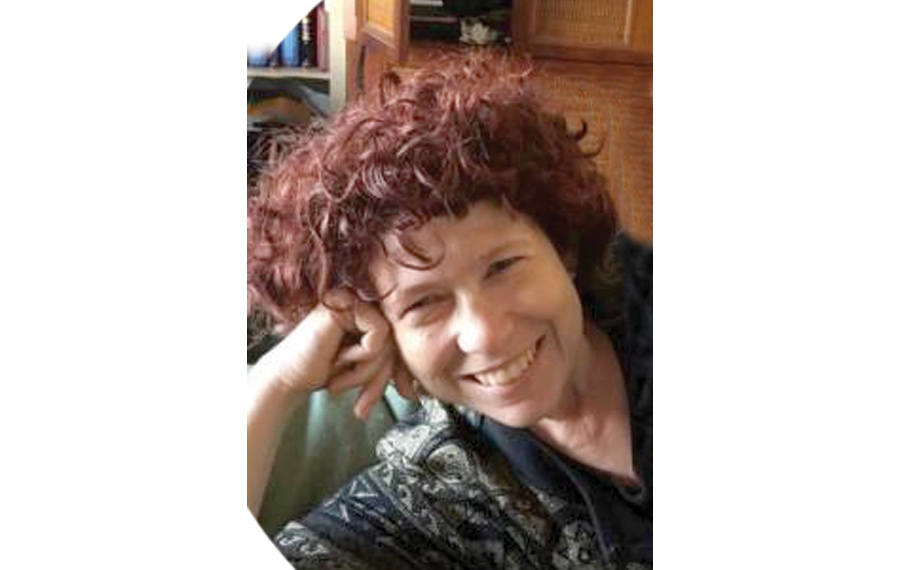
Your story on modern Conservative Judaism says that Rabbi Julie Schonfeld is the first woman to serve as the chief executive of any major rabbinical organization. Schonfeld served in 2009; however, in 2003, my daughter Rabbi Janet Marder served as the first female president of the Central Conference of American Rabbis (the Reform movement).

Except as noted, your story was excellent.
Alan Ross, Encino 

Netanyahu and Politics
Shmuel Rosner argues that Israeli Prime Minister Benjamin Netanyahu allies with Kach supporters to prevent a repeat from 1992, when his right-wing government lost power in favor of the Yitzhak Rabin government, which led to the Israel-Palestinian Oslo Accord, “a turnaround Netanyahu and most Israeli voters came to regret and reject.” (“Why Would Bibi Make a Deal With Kahanists?” March 1)

I submit that even if most Israelis oppose the Oslo Accords, they have greatly enhanced Israeli security. The reasoning is clear and obvious: Without the accord, Israel would be in the position of directly governing the Palestinians, rather than the Palestinian Authority. It would have a far more difficult challenge to deal with Palestinian needs in the absence of a Palestinian governing authority. And Israel would not be able to blame the Palestinian authority, as it does today, for the absence of a peace agreement. 

While Netanyahu speaks of the dangers of the Oslo Accord to satisfy his constituents, I believe he would agree with this supporting argument.
Barry H. Steiner, Professor Emeritus of Political Science, Cal State Long Beach

There is a story about our sage, Rabbi Hillel, that goes like this: He was approached on the street by a nonbeliever who said to him, “Rabbi, I’ll become observant if you can explain all of Torah to me while standing on one foot.” Hillel raised one foot and said, “What is abhorrent to you, do not inflict upon others. The rest is commentary.” 

Of the many ways there are to analyze the Torah, one valid approach is as a blueprint for a successful society — how to live together to achieve harmony and success as an organized people. Doing the right thing is difficult, but hardly beyond our reach, Hillel tells us. If the State of Israel is going to stand for anything, its leaders ought to at least stand for that. In choosing to align himself with Jewish Power, Netanyahu has not only fallen dismally short, but trampled and spit on a cherished, foundational idea. Shame on him for putting power above principle and not caring about how a Jewish state is perceived in the world.
Mitch Paradise, Los Angeles

Yes, Netanyahu has gone too far. By embracing the Jewish Power party he has highlighted these vile, malicious and immoral beliefs to the world. How can we now defend Israel as an egalitarian, democratic and non-apartheid country on our college campuses, in Congress, at the United Nations, and most importantly, to ourselves? It is a slap in the face to Jews who still believe that values matter. Or does none of that matter to Netanyahu and his cohorts as long as they stay in power? That is the road to fascism, not pluralistic democracy. I hope that the good people of Israel see it that way when they go to the polls.
John F. Beckmann, Sherman Oaks 

One Column, Two Sides
I thank Rabbi Robin Podolsky for her important column (“Bibbi’s Disgraceful Act Tarnishes All Jews,” March 1). It is a sad day when a rabbi takes a moral position against supporters of racist murders and is subject to personal online attack for that position. I am heartened by another story in the same issue of the Journal: Deborah Danan’s Humans of Israel story (“The Teenage Peacemaker”) about Joel Pinkovitch at the Eastern Mediterranean International Boarding School in Kfar Hayarok. I recently heard a talk by Israeli Nurit Gery speaking about a similar enterprise, the Givat Haviva International School, a high school focused on conflict resolution with a student population of one-quarter Israeli Jews, one-quarter Israeli Palestinians, and half  international students from Armenia, Kosovo, South Sudan, Liberia, Russia, Georgia, Kazakhstan and other countries. Gery’s presentation and Danan’s story highlighted youth who know that all humans share a common humanity and a common future; these youth are determined to find pathways for us all to live together. They know there will be no future for any of us otherwise.
Michelle Gubbay, via email

I suggest Podolsky has joined that club of tarnishing all Jews as well. In the second paragraph of her column, she throws in the phrase “much like President Donald Trump” without as much as one word to explain why she wrote that.

Gratuitously putting Trump’s name in a column that has nothing to do with Trump is clearly a way of using emotion to create a negative impression of Trump. Defaming the president, without a word of justification, would certainly be considered “lashon harah.” A rabbi should know better.

She may not be aware of this but there was another person who used emotional words and speech for creating a negative image of people: Adolf Hitler. He said, “I use emotion for the many and reserve reason for the few.”
Paul Vann, Orange County

History of ‘Social Justice’
In discussing Jonathan Neumann’s book “To Heal the World? How the Left Corrupts Judaism and Endangers Israel,” Rabbi David Seidenberg claims that “any fair-minded reader of tradition would agree that social justice is a deep Jewish value.” (March 1) This is misleading. First, the origins of the term “social justice” are Catholic, not Jewish, dating back to Italian Jesuit writer Luigi Taparelli in 1840. Second, while justice and charity are undoubtedly Jewish values — both are discussed in meticulous detail in the Talmud — the idea of social justice is another matter. It’s nowhere in our canon. Moreover, those who advocate for it never define it, raising more questions than answers. Are our traditional Jewish notions of justice and charity inadequate in some way? With the adjective “social” in front of the word “justice,” does the Jewish concept of justice now need to be altered in some way? Did the great sages of the Talmud miss something? How does social justice differ from justice and from charity?
Curt Biren, via email


Don’t be shy. Send your letters to letters@jewishjournal.com Letters should be no more than 200 words and must include a valid name and city. The Journal reserves the right to edit all letters.

Letters: Mideast Nuclear Technology, Defending Israel Read More »

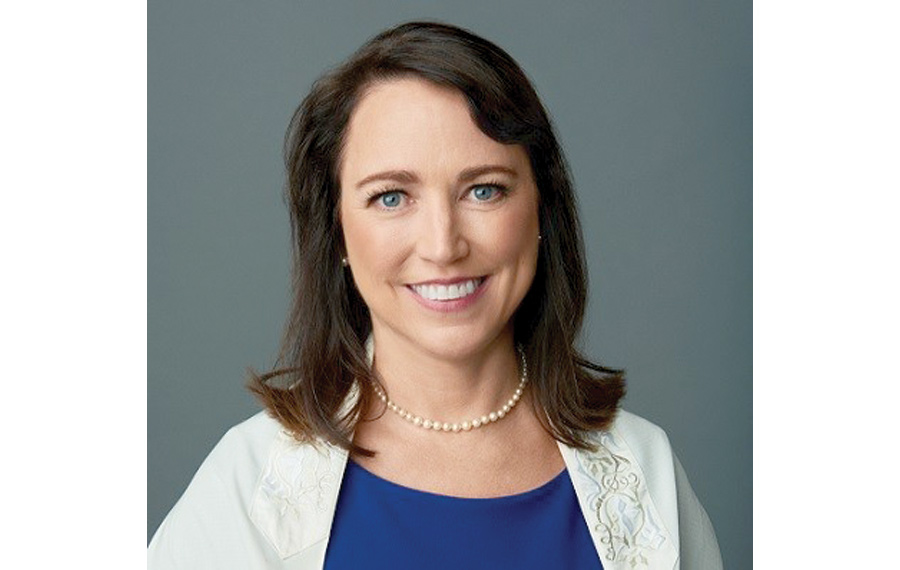
Cybersecurity Correspondent Talks Tachlis About Tech

In her role as cybersecurity correspondent for The New York Times, Sheera Frenkel expects that her devices will be hacked and protects herself using her own expertise. She also knows a thing or two about how tech giants deflect their culpability when they fail to protect consumers. 

Last November, Frenkel and four other reporters’ exposé, “Delay, Deny and Deflect: How Facebook’s Leaders Fought Through Crisis,” revealed Facebook’s internal maneuvers to deny and hide its involvement in controversies ranging from Russian involvement in the 2016 U.S. presidential election to data sharing that has consumers and lawmakers concerned about Facebook more than ever before. 

A former Angeleno, Frenkel is based in San Francisco and spent over a decade as a correspondent in the Middle East, reporting for BuzzFeed, NPR, The Times of London and McClatchy newspapers.

Jewish Journal: You conducted six months of research and over 50 interviews for your Facebook exposé. How did the final story coalesce? 

Sheera Frenkel: When you start working on a story like this, you have no idea what the final version is going to look like. We interviewed dozens and dozens of people and filled notebooks with what they told us. Once we felt like we had built a pretty solid picture of what had happened at Facebook — namely, what they knew about Russian election interference and how they handled that information — we had meetings with our editors to discuss where we needed more details and more corroboration. That process went on for months as we fine-tuned and triple-checked every detail of what we had been told. 

We set out to give our readers an inside look at Facebook and, specifically, at the highest levels of Facebook. I think we succeeded. 

JJ: How did Facebook respond to the story?

SF: Their response, perhaps unsurprisingly, mirrored what we had established as their pattern in our reporting. First, they delayed. Then, they denied. Finally, they deflected. Most recently, CNN reported that Facebook felt The New York Times had treated them unfairly and that we were just out to win Pulitzers, which, I can tell you, is not how this works. We set out to cover a story we think is underreported or needs telling. Facebook is an incredibly wealthy, powerful company. As such, we will continue to hold it to account. 

JJ: Shortly after the October 2018 Tree of Life shooting in Pittsburgh, you wrote about the onslaught of hate, particularly against Jews, on social media. What more needs to be done to identify and halt hate speech on social media?

SF: Hate speech is one of the things that social media companies really struggle with, and often fail at, keeping off the internet. It’s hard to train an automated program, or AI, to accurately identify hate speech. So much of it is specific to cultures and language. And if a person really wants to post something hateful, they’ll use coded language or symbols. The experts I spoke to think a lot more can be done, and there are all sorts of strategies that have been suggested. But ultimately, [social media companies] need more people dedicated to looking for it, and our society might need to ask itself why hate speech is on the rise.

“We set out to cover a story we think is underreported or needs telling. Facebook is an incredibly wealthy, powerful company. As such, we will continue to hold it to account.”

JJ: What’s your No. 1 piece of advice for keeping our devices safe?

SF: Don’t use your birthdays, or your kid’s birthday, or your spouse’s birthday as a password. Please! I’m constantly shocked at how many people still do that. I would say that my top tip is to keep it simple and use basic tools that can make you safer. I tell everyone to use a password manager. It’s a program that stores all your passwords for you and can suggest when the passwords you are using are not strong enough. I also encourage people to think about what they post online. If you are going to use your birthday and your pet’s name as your password, maybe don’t tweet, Instagram, Facebook post constantly about them. Also, whatever data you give tech companies is theirs to keep. While social media can be great for catching up with friends and posting photos, I encourage people to think about what they are sharing.

JJ: You spent a decade reporting from the Middle East. How did your first assignment as a foreign correspondent in 2005 compare with your final assignment in 2015?

SF: The Middle East is always changing, and yet there is a part of it that always feels the same. During my first few years, the news was focused on the wars. U.S. troops were in Iraq and Afghanistan. Israel and Gaza went to war, Israel and Lebanon went to war, and there was endless talk of regime change across the Middle East. By the time I left, the Arab Spring had come and gone. So many of the changes people celebrated in 2011 were erased by 2015. The region was forever changed and yet, when I went back to visit Cairo and Gaza, the conversations were the same. Young men wanted more jobs. Women wanted more rights. Parents wanted a chance to send their kids to school and to watch them grow up and have better lives than their parents. Everyone wanted peace.

JJ: Do you draw the line at too much tech use at home?

SF: It’s a constant struggle. We try to make rules, like not using the phone during mealtimes or right before we go to bed. But there are days where work is crazy or news is breaking and I find myself breaking those rules. I think what is important is the sentiment. We don’t want our daughter growing up watching both her parents glued to their screens, so we make a real effort, especially in front of her, not to use our phones too much.

JJ: How do you see the future of cybersecurity, both for governments as well as nonstate actors, evolving — or perhaps devolving?

SF: A lot of cybersecurity, on a government level, is becoming privatized. It’s a huge field right now, with a lot of snake oil companies selling identical products that I think will go out of business in the coming years. State actors are also getting more sophisticated, and I think we are going to see, on a global level, more of an effort to come up with norms and behavior around the rules of cyberwarfare.


Tabby Refael is a Los Angeles-based writer, speaker and co-founder and former executive director of 30 Years After.

Cybersecurity Correspondent Talks Tachlis About Tech Read More »

‘Shabbat Shalom’ Scrabble Tile Coasters

When you’ve gathered a group of friends and family for Shabbat dinner, do you ever go searching for more coasters? Look no further, as your linens and wood tabletops will be protected in style with these coasters that spell out “Shabbat Shalom” in Scrabble tiles. They would also make a nice hostess gift the next time you’re invited over for a Friday evening. You’ll definitely be considered a triple-word score kind of guest.

If you make this project, we’d love to see it! Post it on social media with
#JJcrafts

What you’ll need:
Scrabble tiles
Cork sheet
E-6000 adhesive
Scissors
Polyurethane spray


1. Find the Scrabble tiles that spell out “Shabbat Shalom.” Don’t plunder your current Scrabble game, however. You can purchase bags of extra tiles on Amazon.


2. With E-6000 (or a similar permanent adhesive), glue them in a four by four grid to a cork sheet with the words spelled out. For the blank spaces, use the underside of the most plentiful tiles, e.g., the letter E.


3. After the glue has set, cut off any excess cork with scissors. 


4. To protect the coasters from spills, spray a few layers of clear polyurethane on the wood tiles. 


Jonathan Fong is the author of “Flowers That Wow” and “Parties That Wow,” and host of “Style With a Smile” on YouTube. You can see more of his do-it-yourself projects at jonathanfongstyle.com.

‘Shabbat Shalom’ Scrabble Tile Coasters Read More »

Jewish Composer’s Works Get New Life

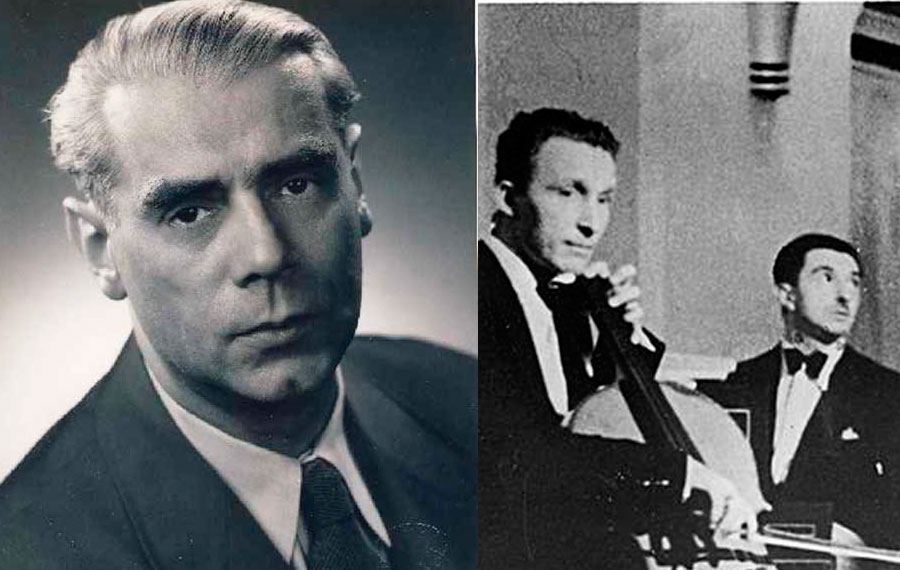
Every morning since 1936, All India Radio has started its broadcast day with the same music. With its droning strings and haunting violin, the tune sounds quintessentially Indian. But it was a Jewish emigré from Czechoslovakia, Walter Kaufmann, who composed it.

That story was the first of several surprises revealed at “From India to Indiana: Melding Music,” a lecture and concert presented by UCLA’s Herb Alpert School of Music at Schoenberg Hall on Feb. 27. Before an audience of about 300 people, the ARC Ensemble, a Canadian group that specializes in shining a light on musical works suppressed or marginalized under the 20th century’s repressive regimes, performed six of Kaufmann works that he composed while living in India from 1934–1946. Unlike that radio theme song, however, the Indian influences in the other pieces were easy to miss — a subtle droning cello line or a fluttery violin melody would only occasionally emerge from being tucked inside the music. 

After Kaufmann left India, he moved to London, then Canada, where he spent 10 years leading the Winnipeg Symphony before finally becoming a faculty member at Indiana University. He died in 1984 at the age of 77.  

Before the concert, UCLA ethno-musicology professor Amy Catlin-Jairazbhoy summarized what she called Kaufmann’s “magnificent life in music.” He wrote scores for early Indian films, worked at All India Radio as the head of its European music department, started the Bombay Chamber Music Society and traveled throughout India seeking out the country’s various musical styles. 

William Lazer, Kaufmann’s brother-in-law, told the Journal in a phone interview that when Kaufmann took an interest in a subject, he became an “authority,” incorporating much of what he heard into his own compositions.

Simon Wynberg, ARC’s artistic director, said the music Kaufmann wrote in India “jumps out at you immediately,” describing it as a “mix of his Western training and his enthusiasm for Indian music.” ARC plans to record a selection of Kaufmann’s music, with an expected release in spring 2020.

“[Kaufmann was] never impressed with money. He was never impressed with ceremony and he was never impressed with honors.”
—William Lazer 

Although Kaufmann had well-known peers, including Albert Einstein, who wrote references for Kaufmann when the composer was trying to immigrate to America, his work is not well known, partly because he did little to promote his creations. He also tended to, well, follow his own tune. The trends in post-World War II classical music — such as serialism and minimalism — did not interest him, which was another reason why, despite composing throughout his life, only a five-minute recording of his music exists, Wynberg said. 

“[Kaufmann] was an incredibly modest and self-effacing kind of man,” who never even bothered to publish his music, Wynberg said. “He finished one piece and then it was onto the next.” Kaufmann even stipulated that “The Scarlet Letter,” the well-received 1959 opera he wrote based on Nathaniel Hawthorne’s novel, could be performed only at Indiana University. 

William Lazer’s daughter, Simone, who traveled from Nashville for the concert, said Kaufmann, her uncle, was  “a gentle genius” who at parties took more joy in playing with the children than talking to adults. 

Kaufmann, William Lazer said, was “never impressed with money. He was never impressed with ceremony, and he was never impressed with honors. He loved to do research and he loved to write music.” 

Neither of the Lazers remembered Kaufmann as especially religious, but Wynberg commented dryly: “If he didn’t identify as Jewish, others did it for him.” 

Asked how Kaufmann would have responded to the renewed interest in him and his music — in addition to ARC’s projects, Kaufmann was a character last year in an off-Broadway play, “The Music in My Blood” — William Lazer said the composer probably would have shrugged it all off with a Yiddish grunt: “Nu?”  

Jewish Composer’s Works Get New Life Read More »

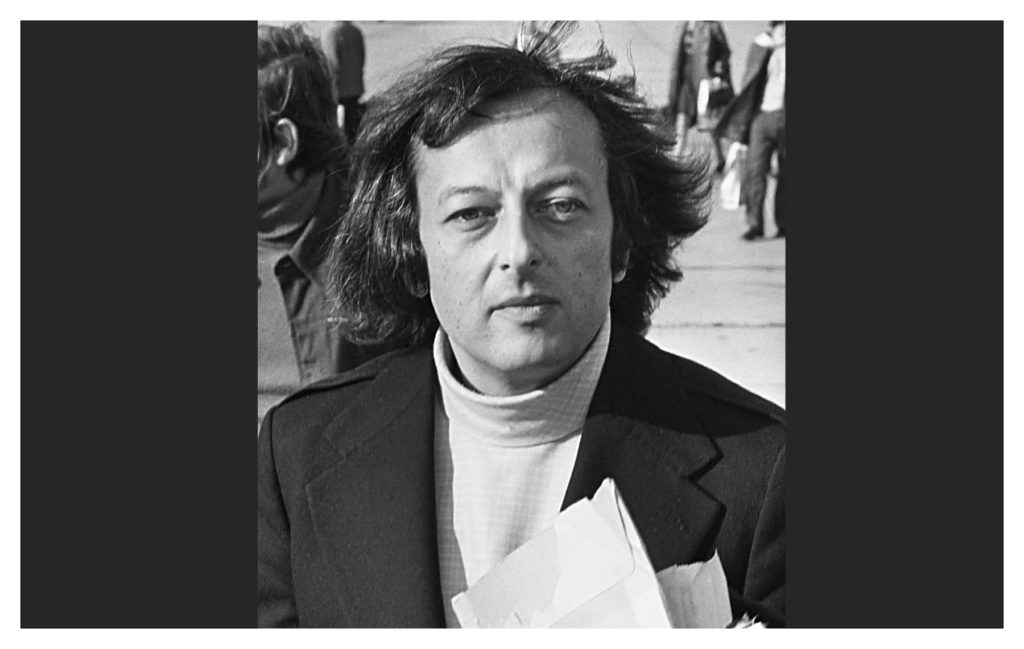
Award-Winning Composer, Conductor André Previn, 89

André Previn, whose Career in classical, jazz and popular music spanned more than seven decades — during which he won four Academy Awards and 11 Grammy Awards and led the Los Angeles Philharmonic for four years — died Feb. 28 at his home in New York City. He was 89.

Andreas Ludwig Priwin was born on April 6, 1929, in Berlin, the youngest of Charlotte and Jakob Priwin’s three children. The pianist showed musical aptitude from an early age and enrolled in the Berlin Conservatory at age 6. In 1938, he was denied entry to the school’s building because he was Jewish, and the family left Germany for Paris, where it stayed for a year before emigrating to the United States and settling in Los Angeles.

Success came quickly for him in America. While still in high school, he arranged music for MGM and wrote the first of his more than 50 film scores, for the 1949 Lassie vehicle “The Sun Comes Up.” He explained his rapid rise to British newspaper The Guardian in 2005: “They were always looking for somebody who was talented, fast and cheap, and, because I was a kid, I was all three.”  

“They were always looking for somebody who was talented, fast and cheap, and because I was a kid, I was all three.”

— André Previn

The work was mostly on B-movies, but by the late 1950s he was getting more prestigious assignments. He won Oscars for his musical score for “Gigi” in 1959 (original music by Frederick Loewe) and adapting the music for “Porgy and Bess” (1960), “Irma La Douce” (1964) and “My Fair Lady” (1965). A fan of jazz pianist Art Tatum, Previn led a trio that performed at the Newport Jazz Festival and recorded with jazz greats including saxophonist Benny Carter, guitarist Barney Kessel, drummer Shelly Manne and singers Ella Fitzgerald and Doris Day. He tried his hand on Broadway, composing the music for “Coco.” The show, based on the life of French fashion designer Coco Chanel, with lyrics by Alan J. Lerner and starring Katharine Hepburn, ran for 329 performances in 1969 and 1970. 

His career moved in a surprising new direction when he decided to quit film work and accept the job of principal conductor of the London Symphony Orchestra in 1968, a position he held for 10 years. He was named the music director of the Pittsburgh Symphony in 1976. A year later, his appearances on the PBS series “Previn and the Pittsburgh” expanded his renown. 

Previn returned to Los Angeles in 1984 as the music director of the Los Angeles Philharmonic, but he clashed with the orchestra’s management and left the podium after four years. He continued composing until the end of his life, including two operas — both based on movies adapted from stage plays (“A Streetcar Named Desire” and “Brief Encounter”). A duet for violin and piano commissioned by Carnegie Hall, “The Fifth Season,” received its premiere last year. A piece commissioned by the Los Angeles Philharmonic as part of the orchestra’s centennial celebration is scheduled to premiere this fall. 

A glamorous, youthful figure, Previn was famous as much for his personal life as for his music. He was married five times, most notably to actress Mia Farrow in 1970; his other marriages were to jazz singer Betty Bennett (1952), singer/songwriter Dory Previn (nee Langan) (1959), Heather Sneddon (1982) and violinist Anne-Sophie Mutter (2002). All ended in divorce.

In addition to his Oscars, Previn won 10 Grammys, including a lifetime achievement award in 2010. He was knighted by Queen Elizabeth II in 1996 and received a Kennedy Center Honor in 1998. A fine writer, he wrote an acclaimed 1991 memoir “No Minor Chords: My Days in Hollywood.”

Award-Winning Composer, Conductor André Previn, 89 Read More »

What’s Happening: Joseph Pulitzer, RBG and Andrew McCabe

FRI MARCH 8

Pulitzer Documentary
Nearly a century before the emergence of “fake news,” Joseph Pulitzer was fighting against the dissemination of false information in America. The new documentary “Joseph Pulitzer: Voice of the People,” opening at Laemmle theaters, tells the story of the penniless, young Jewish immigrant from Hungary who challenged a popular president and fought for freedom of the press as an essential element of U.S. democracy. Adam Driver (“BlacKkKlansman”) narrates and Liev Schreiber (“Ray Donovan”) provides the voice of Pulitzer. Various times. $12 Monday–Thursday, $13 Friday–Sunday. Playhouse 7, 673 E. Colorado Blvd., Pasadena; Music Hall, 9036 Wilshire Blvd., Beverly Hills; Town Center 5, 17200 Ventura Blvd., Encino. (310) 478-3836.

SAT MARCH 9

“It’s a Life”
A niece accidentally creates a viral obituary about her character-actor uncle; a mountain climber finds his passion not atop a mountain but in a coffee shop; and daughters feel their father’s presence when they find feathers or see football games. These stories and more comprise “It’s a Life,” the latest production from the Jewish Women’s Theatre that explores the many facets of death and how memories, fears and new understandings transform grief into positive, healing thoughts and actions. Opening tonight at The Braid, the show travels to the Westside, Mid-Wilshire, the San Fernando Valley and the South Bay through March 28. For tickets, times and locations, call (310) 315-1400 or visit the website. 

SUN MARCH 10

Sara Berman

“Mental Health First Aid”
Rabbi Sara Berman leads the adult education class “Mental Health First Aid,” about how to identify, understand and respond to signs of mental illness and substance use disorders. 8:30 a.m.–1 p.m. $20. Adat Ari El, 12020 Burbank Blvd., Valley Village. (818) 766-9426.

USC Hillel Day of Service
In partnership with USC’s Alumni Day of Service, the Jewish Alumni Association holds a service project at Beit T’Shuvah, a faith-based recovery center, with participants meeting current residents and preparing and packaging meals for those enduring homelessness. All friends of USC Hillel and children 10 and older are welcome to fulfill this mitzvah and to join the association’s members for lunch. 10 a.m. Free. Beit T’Shuvah, 8831 Venice Blvd., Los Angeles. (213) 747-9135.

Sundays in the Park With Camp Alonim

Sundays at Alonim
During “Sundays in the Park With Camp Alonim,” children can ride horses, feed goats, climb the Alpine tower, play on the swings, make arts-and-crafts and enjoy a kosher barbecue with their families at the 2,700-acre Brandeis-Bardin Campus in Simi Valley. Noon–4 p.m. $5 adults and children ages 3 and older; free for children 2 and younger. Brandeis-Bardin Campus of American Jewish University, 1101 Peppertree Lane, Simi Valley. (805) 582-4450.

“Grandparent & Me”
Get ready for Purim when American Jewish University and the PJ Library hold “Grandparent & Me,” a story-time and song session for preschoolers 2 to 6 years old and their grandmas and grandpas. Doda Mollie provides the music. Attendees enjoy singing, crafts and an interactive story. 1–2:30 p.m. $25 pre-registration per family, $30 door. Burton Sperber Jewish Community Library, American Jewish University, 15600 Mulholland Drive, Bel Air. (310) 440-1572.  

Continuing Ginsburg’s Legacy
Jessie Kornberg, president and CEO of Bet Tzedek Legal Services; attorney Katherine Ku, a former clerk for U.S. Supreme Court Associate Justice Ruth Bader Ginsburg; and Sonya Passi, founder and CEO of FreeFrom, an organization for domestic violence survivors, discuss who will carry on the 85-year-old Ginsburg’s legacy into the next generation. Titled “Succession Planning for the Revolution,” the event coincides with the final day of the popular Skirball Cultural Center exhibition “Notorious RBG.” 3 p.m. $12 general, $10 seniors and full-time students, free for Skirball members. Skirball Cultural Center, 2701 N. Sepulveda Blvd. (310) 440-4500.

TUE MAR 12

Aliyah Fairs
Nefesh B’ Nefesh invites anyone considering making aliyah to Israel to “Aliyah Fair & Talks” on the Westside on March 12 and in the San Fernando Valley on March 13. Nearly two dozen vendors and service providers answer questions, and TED Talks-style presentations about life in Israel explore health care, taxes, how to handle investments while becoming a citizen, finding a home and how to land a job. March 12: 5:30–9 p.m. Young Israel of Century City, 9317 W. Pico Blvd., Los Angeles. March 13: Sherman Oaks Courtyard by Marriott, 15433 Ventura Blvd., Sherman Oaks. (866) 425-4924.

“Anti-Semitism: A Brief History”
Temple Beth Am Rabbi Emeriti Joel Rembaum kicks off the seven-part series, “Anti-Semitism: A Brief History,” which meets on Tuesday evenings through May 7. Blending lectures, text readings and discussion, Rembaum explores the phenomenon that is again at the forefront of Jews’ minds around the world. 7:45 p.m. Free. Temple Beth Am, 1039 S. La Cienega Blvd., Los Angeles. (310) 652-7353.

Connecting Dads and Teens 
In a program for fathers of teenagers, clinical psychologist Babak Kadkhoda discusses “Connecting With Your Kids on a Deeper Level.” 8 p.m. Free. Sephardic Temple, Levy Hall, Third Floor, 10500 Wilshire Blvd. (310) 475-7000.

A Night at the Entwinery
During an evening called “A Night at the Entwinery,” young adults celebrate the Joint Distribution Committee’s (JDC) Entwine community-building initiatives in Argentina, the Balkans and the country of Georgia by pairing a glass of red or white from these countries with a discussion of their customs and the important work being done in these regions. Ages 21 and older. 7–9 p.m. $10 in advance, $15 door. V Wine Room, 903 Westbourne Drive, West Hollywood.  (310) 339-9202.

WED MAR 13

Amy Bernstein

“Planet Purim”
One week before Purim, Sinai Temple’s “Planet Purim” offers popular traditional and innovative attractions to celebrate the holiday. Guests at the family-friendly event wear their favorite costumes and enjoy a petting zoo, go-karts, mega-slides, a DJ, live entertainment, carnival games, Xbox sports games, a prize booth, social action projects, basketball games and arts-and-crafts. Adult 18 or older must accompany children. 3:30–7:30 p.m. 4:30 p.m. Purim play and costume parade. $48 all-inclusive wristbands. $15 kosher barbecue meal. Free for adults and children ages 1 and younger. Tickets available at the door. Sinai Temple, 10400 Wilshire Blvd., Los Angeles. (310) 481-3228.

Jewish Mindfulness
Kehillat Israel Senior Rabbi Amy Bernstein explores “Jewish Mindfulness and Spirituality: Creating Lives of Depth and Meaning.” 7–9 p.m. Free. Kehillat Israel, 16019 W. Sunset Blvd., Pacific Palisades. (310) 459-2328.

THU MARCH 14 

Shir Chadash Concert
Composer and UCLA doctoral candidate Michel Klein reinterprets a selection of Jewish musical works of the past few decades during the inaugural program of a new Shir Chadash (“New Song”) Concert series. Professional musicians and students from UCLA’s Herb Alpert School of Music perform Klein’s works that challenge the concept of Jewish music. 9 p.m. Free. Art Share L.A., 801 E. Fourth Place, Los Angeles. (310) 825-4761.

Andrew McCabe

Andrew McCabe
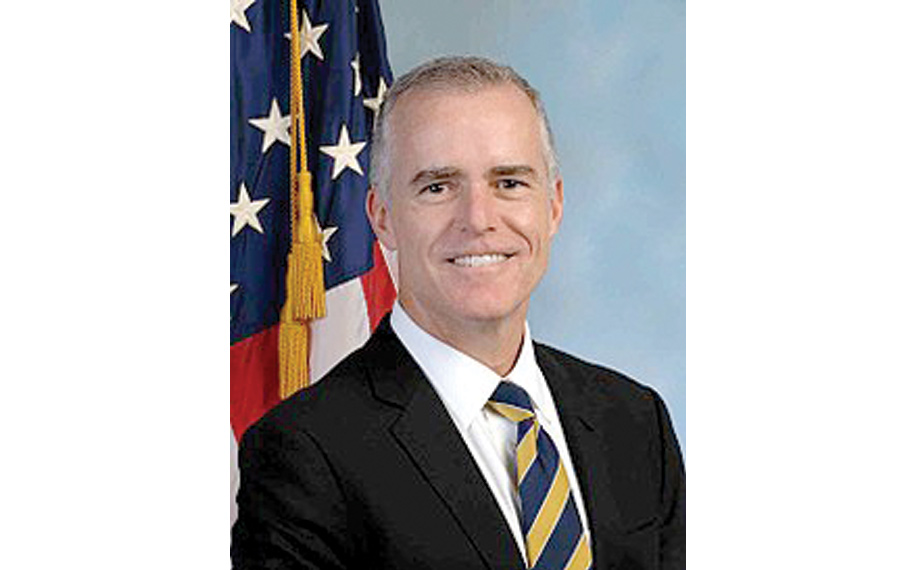
Andrew McCabe, former deputy director of the FBI, discuss his best-selling book, “The Threat: How the FBI Protects America in the Age of Terror and Trump” at American Jewish University. Just 26 hours before McCabe’s retirement last March, now-former Attorney General Jeff Sessions fired McCabe. Expect him to talk about his dismissal, his issues with the Trump administration and more. 7:30 p.m. $25. American Jewish University, 15600 Mulholland Drive, Bel Air. (310) 440-1572.


Have an event coming up? Send your information two weeks prior to the event to ryant@jewishjournal.com for consideration. For groups staging an event that requires an RSVP, please submit details about the event the week before the RSVP deadline.

What’s Happening: Joseph Pulitzer, RBG and Andrew McCabe Read More »

Officials, Jewish Community Discuss Gun Violence Prevention

It has taken more than two decades, but on Feb. 27, the House of Representatives made a significant step toward greater gun control legislation when it voted 240-190 in favor of the Bipartisan Background Checks Act of 2019. 

The bill (H.R. 8) requires mandatory background checks on any guns sold in the country. Up until now, only licensed dealers have been required to perform background checks if someone wishes to buy a gun.

The bill will now head to the Senate, and if passed, would have to be signed by President Donald Trump to become law.

On Feb. 17, 10 days before that vote, and a year after the Marjory Stoneman Douglas High School shooting in Parkland, Fla., Rep. Ted Lieu (D-Torrance) said, “[We know], based on study after study, states in America and countries around the world that have stronger gun safety laws have lower incidents of gun violence.”

Lieu, who co-sponsored the bill, made his comments during a conversation with Rabbi Sarah Bassin in front of close to 300 people at Temple Emanuel of Beverly Hills.  

He also discussed a separate House bill (which passed on Feb. 28) that will close the “Charleston loophole,” named for the June 17, 2015, mass shooting when a gunman killed nine African-Americans during a prayer service at the Emanuel African Methodist Episcopal Church in South Carolina. The loophole allows a gun dealer to sell a gun to a person without doing a background check if that check would take more than three days. 

Lieu said he couldn’t see certain reforms, including an assault-weapons ban, happening anytime soon, because the Republican-controlled Senate wouldn’t pass it.

“[We know], based on study after study, states in America and countries around the world that have stronger gun safety laws have lower incidents of gun violence.”

— Rep. Ted Lieu

While the conversation with Lieu focused mainly on legislative steps aimed at reducing gun violence, 11 days later, Hadassah, the Women’s Zionist Organization of America, held an event that focused on how to halt shootings in schools.

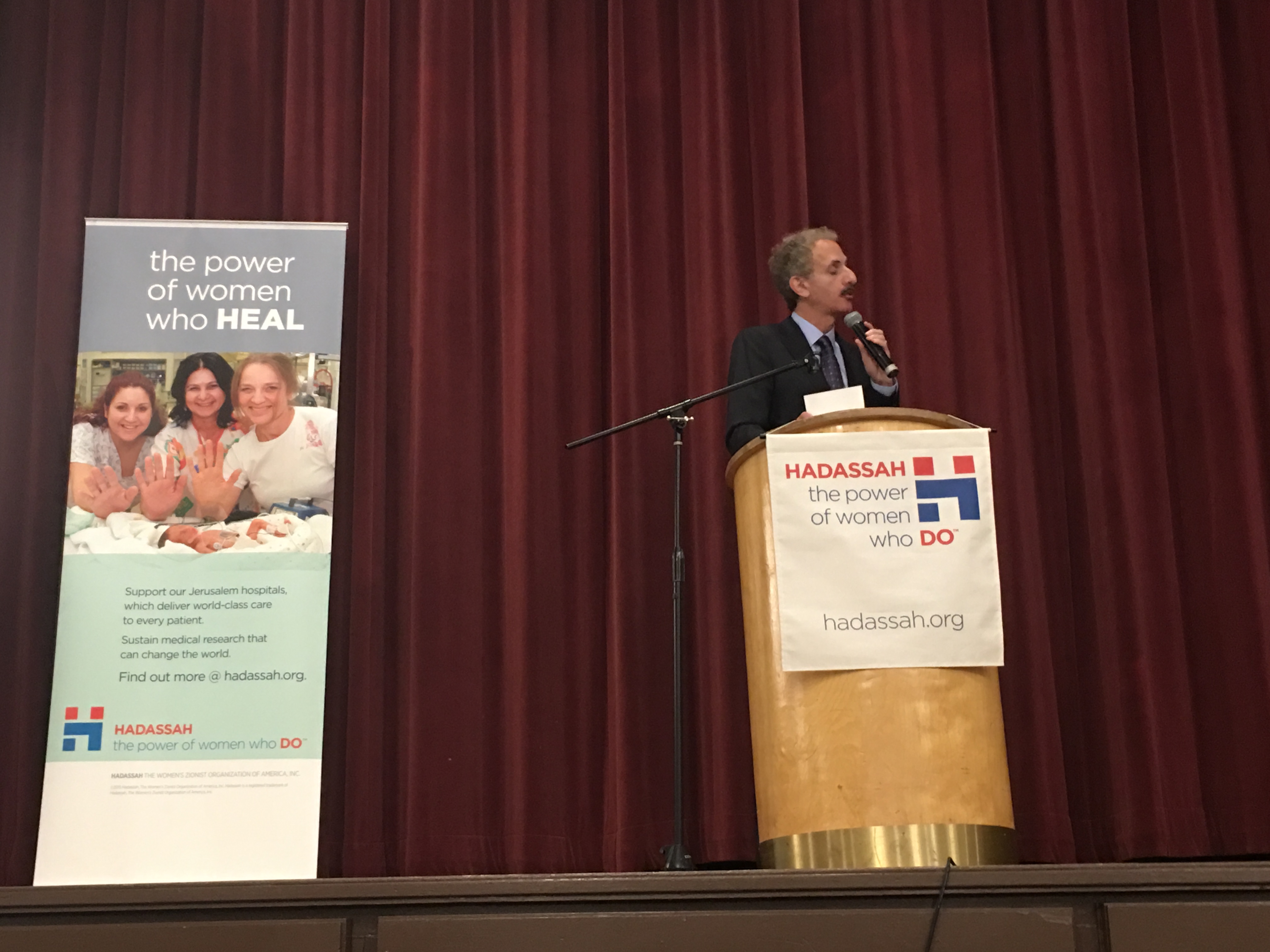
L.A. City Attorney Mike Feuer moderated a panel discussion during Hadassah’s gun violence discussion at Valley Beth Shalom. Photo by Ryan Torok

“If Not Now, When? A Conversation About Preventing Gun Violence in American Schools” was held at Valley Beth Shalom on Feb. 28. Los Angeles City Attorney Mike Feuer moderated the panel event. The speakers were Josh Stepakoff, who survived the 1999 shooting at the North Valley Jewish Community Center; Sgt. Joseph Camello of the Los Angeles School Police Department; and Marleen Wong, director of field education at the USC School of Social Work. 

Stepakoff was only 6 years old and playing Capture the Flag at the JCC when an armed white supremacist fired a semi-automatic weapon at the Granada Hills center. Stepakoff, 26, said the glorification of school shooters was a part of the problem. 

“I, to this day, refer to the man who shot me as ‘the man who shot me’ [or] ‘the shooter,’ ” Stepakoff said. “Anything but his name.”

In discussing ways to prevent further school shootings, Feuer noted that polls showed that a majority of parents supported the Los Angeles Police Department’s current practice of conducting random searches of students when they enter and exit school buildings. 

However, Wong said she opposed the searches. “I think it’s a destructive act to the culture of the school,” she said. “I think what they found are more colored markers than guns.”

Sandra Sadikoff, immediate past president of Hadassah Southern California, said she believed the solution to the gun violence problem was stronger leadership by elected officials.

“We deplore what’s going on with the shootings that are plaguing our schools and our workplaces today and that is the reason we came together tonight for this program,” she told the Journal before the event. “We’ve been a strong supporter of strict legislation and gun control initiatives and we believe the current laws do not go far enough nor are enforced rigorously enough to prevent gun violence.”

Officials, Jewish Community Discuss Gun Violence Prevention Read More »