fbpx

March 6, 2019

Downtown L.A. Mural Triggers Accusations of Anti-Semitism

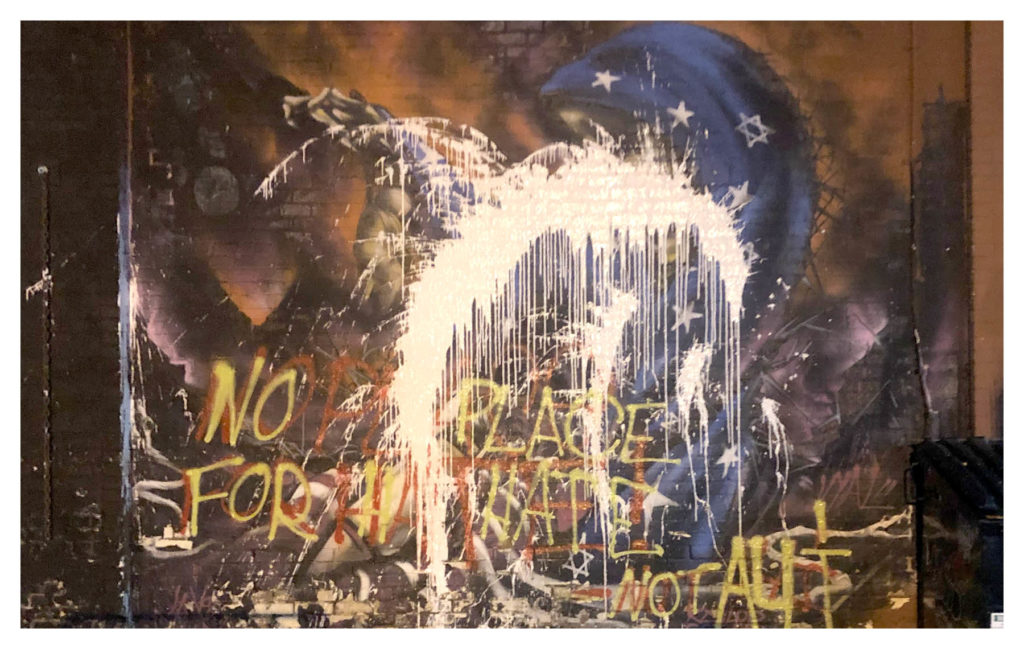
A mural in downtown Los Angeles depicting the Grim Reaper wrapped inside an American flag emblazoned with Jewish stars, gripping a baby, cradling a missile and surrounded by snakes, has been deemed anti-Semitic by several civic leaders and organizations, including Los Angeles Mayor Eric Garcetti’s office. 

“This mural is a shameful act of anti-Semitism,” Alex Comisar, a spokesman for Garcetti, said in a statement. “Imagery like this should have no place in our city.”

The image, on the exterior wall of The Vortex, a performance and event space in an industrial downtown neighborhood, was first painted in 2011 by local artist Vyal Reyes as part of an art show titled, “LA vs. WAR.” In 2018, Reyes said on his Instagram page that the work was inspired by a trip he took “to Palestine some years back.” 

However, the controversy didn’t erupt until Feb. 25, when Zhenya Rozinskiy of boutique consulting firm Mirigos shared a photograph of the mural on his Facebook page and it went viral. 

Among those condemning the mural was Progressive Zionists of the California Democratic Party. The group posted a picture of the mural on its Facebook page and tagged the Vortex, stating: “Hey The Vortex, Is this a real thing on your building? If yes, why? It’s wildly anti-Semitic. If not, you should probably clear up the confusion. Signed, Some confused and concerned community members.”

“This mural is a shameful act of anti-Semitism. Imagery like this should have no place in our city.” 

— Alex Comisar

But in an email to the Journal, Reyes said he isn’t anti-Semitic and that he intended the mural to be “critical of the U.S. and its increasing focus on war.

“That particular neighborhood that the mural was painted in was in worse shape at the time and homeless people lived all around there,” Reyes said. “It seemed to me at the time that the U.S. was more into funding war than helping its homeless. Even at that time, the U.S. was funding massive amounts of money to Israel, as they still are. That’s not anti-Semitic; that’s just a fact.”

Jeff Norman, a representative of the Vortex, also defended Reyes. “The Vortex stands for free expression,” Norman said in an email to the Journal. “The artist whose mural includes the Star of David (created for the LA vs. WAR show to acknowledge 9/11 about 5-6 years ago) did not intend to express an anti-Semitic message. We believe his intent deserves considerable weight. We invite those who feel otherwise to paint another mural next to it. We are also open to hosting a public discussion about this controversy at The Vortex.”

But on the night of Feb. 25 or the morning of Feb. 26, the words “No place for hate” were painted over the mural. While it’s unclear who was responsible for defacing the mural, the artists’ rights organization Artists 4 Israel sent a photograph of the defaced mural to their email list subscribers on Feb. 26. 

When asked if his group was responsible for painting over the mural, Artists 4 Israel CEO Craig Dershowitz told the Journal that he did not have any comment, although he conceded that he was troubled by the mural’s imagery.

As of press time, The Vortex had not made any effort to repair the mural or to notify the police about the defacement, Norman said.

Meanwhile, the Anti-Defamation League has called for the mural’s removal.

“For a venue that purports to welcome the community, The Vortex should join us in condemning hateful imagery that invokes anti-Semitic canards conflating Jews with death, snakes, bombs and killing babies,” the organization said in a statement.

Downtown L.A. Mural Triggers Accusations of Anti-Semitism Read More »

Buenos Aires Jewish Center Bombing, 25 Years (and No Convictions) Later

At 9:53 a.m. on July 18, 1994, in Buenos Aires, Argentina, a suicide bomber in a Renault van detonated more than 600 pounds of explosives near the entrance to AMIA (Argentine Israelite Mutual Association in English), a five-story center that has, for generations, provided and sponsored a variety of crucial services for the largest Jewish community in Latin America. 

The terrorist killed himself and 85 people who were in or near the Jewish center and injured hundreds. In the nearly 25 years since, there have been trials, accusations, public demonstrations, private lawsuits, volumes of testimony, videotaped bribery, at least one suspicious death and countless articles about Argentine malfeasance and the suspected involvement of Iranian, Hezbollah and Hamas officials. To date, no one has been convicted. 

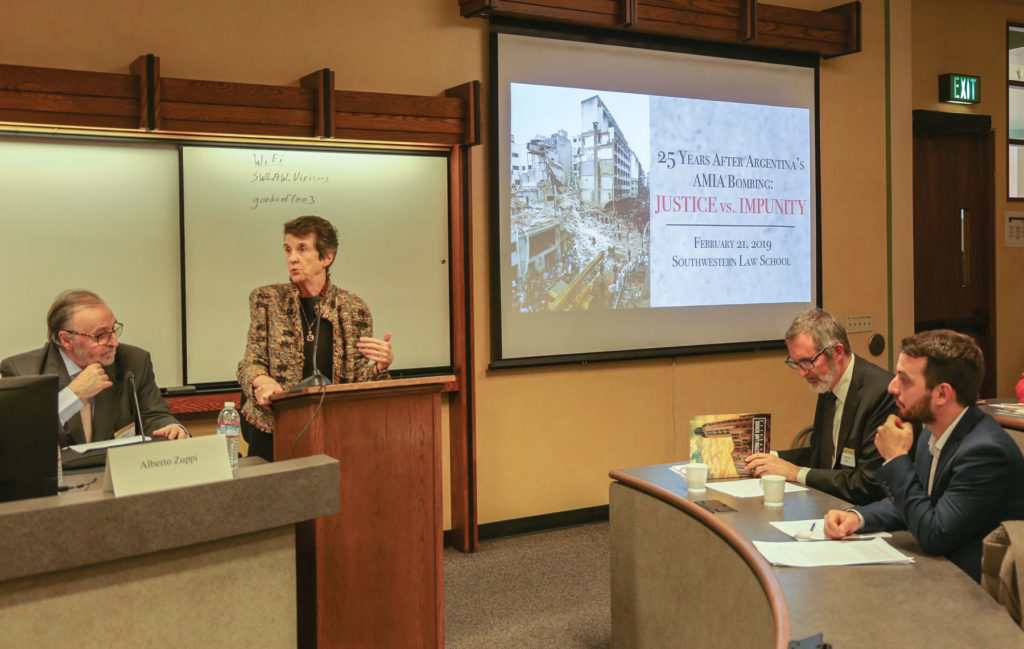
“Justice” and “impunity” were key words in a symposium about the incident, held on Feb. 21 at Southwestern Law School in Los Angeles. The event, “25 Years After Argentina’s AMIA Bombing: Justice vs. Impunity,” featured American and Argentine speakers, mostly attorneys, many of whom have been personally involved in unsuccessful attempts to fully learn the facts and hold the perpetrators and their allies responsible, whether in Iran, Lebanon, Syria or Argentina. 

The first half of the symposium took place in a large classroom. Around 50 people attended. Each presentation was followed by critiques from experts and questions from the audience. One of the presenters was Gastón Chillier, an Argentine attorney and human rights activist, who spoke from Buenos Aires via Skype. He summed up the current state of the investigation, saying, “As of this day, Argentines do not know what happened.” 

Speakers at the event, however, recounted what is, in fact, known about the convoluted history of the attack and its aftermath.

In 2001, 22 Argentines were tried for abetting the bombing, the so-called “local connection.” After a three-year trial, not one was found guilty of anything. 

In 2005, the judge who had been in charge of the case, Juan Galeano, was accused of serious irregularities, including having been videotaped bribing a potential witness to give false testimony against some of the defendants. Galeano was impeached and removed from the judiciary. 

In 2006, Argentine authorities accused Iranian government officials, including then-President Hashemi Rafsanjani, of masterminding the plot. Interpol issued arrest warrants for them in 2007, a move that was ignored by Iran and countermanded by a later Argentine government, which, in 2013, agreed to work with Iran to find the culprits. One symposium speaker said that Iran’s cooperation in this matter was like having Nazis in charge of the Nuremberg Trials. 

“What matters to Argentine leaders is how things look, not how they really are. That’s why a cover-up is the instinctive way the country behaves when faced with a problem.”
— Rabbi Daniel Mehlman

In 2015, former Argentine President Carlos Menem went on trial for receiving bribes from Iran and for hindering the AMIA investigation. To date, no decision has been handed down. In 2017, former Argentine President Cristina Fernández de Kirchner was indicted for treason and obstruction of justice due to her alleged cover-up of Iran’s involvement in the bombing. Since she’s still a senator, she has immunity, though steps are being taken by legislators to strip her of it.

Speakers at the AMIA symposium disagreed on many points, but they all stressed the frustration of trying to get to the bottom of a matter in which Argentines in positions of public trust —police, judges, cabinet ministers and two presidents — have been accused of corruption and other crimes.

One of the bizarre twists of the case occurred in January 2015, when Alberto Nisman, a Jewish Argentine attorney who was investigating the AMIA case and was prepared to accuse then-President Fernández of having covered up Iran’s involvement in the bombing, was found dead from a gunshot wound. Fernández’s government declared it a suicide, which was disputed by those who were sure Nisman had been murdered to prevent him from testifying against Fernández.

At the symposium, Toby Dershowitz, an American whose background is in public relations, presented evidence of Iran’s culpability. “Alberto Nisman was my friend,” Dershowitz said. “He represents courage and the battle against corrupt forces.” 

Most speakers pointed to Iran as the bad actor behind the attack, but Argentine civil rights lawyer Alberto Zuppi, who has represented families of AMIA bombing victims and published a book on the case last year, offered an alternative view. He said that when the attack took place, Israeli-Palestinian negotiations were at a delicate point. In its desire to salvage a possible Middle East accord, the Israeli government pushed the idea that only Iran was behind it, not Hamas or Hezbollah, and the established Jewish organizations in Argentina, including AMIA, went along with this. 

Several speakers acknowledged that finding the truth behind Argentina’s worst terrorist attack is not a priority to most Argentines but that apathy about an old case hardly rises to the level of anti-Semitism.

During a break, over sushi and empanadas, several Argentine Jews who now live in Los Angeles discussed the case. Rabbi Daniel Mehlman said that Argentina has a long history of social and political amorality and a fragile grasp on human rights. He pointed out that Argentine leaders exploited indigenous people and Afro-Argentines in the 19th century, in effect, wiping them out, and they “disappeared” dissidents a century later, brutally killing 30,000 people in the 1970s. 

“What matters to Argentine leaders is how things look, not how they really are,” Mehlman said. “That’s why a cover-up is the instinctive way the country behaves when faced with a problem.”

The final speaker of the night was Claudio Grossman, a Jewish Argentine and retired dean of American University’s law school. Grossman was an observer for the Inter-American Commission on Human Rights at the first AMIA trial, from 2001 to 2004, and subsequently issued a report sharply critical of the investigation and the trial.

Grossman’s tone was somber, chastening those who still hope for justice in the AMIA case. He said we should not expect countries to “do the right thing simply because it’s the moral thing to do. States take actions only out of self-interest, either political or economic, or both.”      

Behind Grossman as he spoke was the event’s title, which read “Justice vs. Impunity,” as if it were not just a court case but also a martial arts death match for the soul of Argentina. Some of the symposium’s participants had offered a glimmer of hope that someday the truth will emerge, but Grossman’s analysis left little doubt that in the AMIA case, impunity has defeated justice.

Buenos Aires Jewish Center Bombing, 25 Years (and No Convictions) Later Read More »

Community Responds to Nazi-Saluting Orange County Teens

On the evening of March 2, a group of Newport Beach high school students at a party posted a photo online of themselves giving the Nazi salute over a series of red-solo cups formed into the shape of a swastika. 

One partygoer wrote “ultimate rage” in one photo while another was captioned “German rage cage,” perhaps in reference to a drinking game, before posting it on Snapchat.

Orange County’s Temple Bat Yahm’s Senior Rabbi Gersh Zylberman told the Journal that it was “unnerving” that anti-Semitism is on the rise. “Did they learn it from peers or pick it up from home?” Zylberman asked. “Or social media? We don’t know.” 

The Los Angeles Times reported March 4 that some of the partygoers in the images are believed to be current students or recent graduates of Newport Harbor High School.

Newport-Mesa Unified School District President Charlene Metoyer told the Orange County Register she was “devastated” by the photo. “As a school board, we’re not only concerned by the underage drinking, but also the mental health of the students who participated in this horrendous act and all their fellow students who will be affected by it,” Metoyer said. “This is appalling to not just our Jewish student community, but to all of us who care about human rights.”

In a statement she provided to the Journal, she wrote: “At this time we are focused on investigating the situation, listening to our community, and working with community partners and determining next courses of action. We are taking action!”

On March 4, Newport Mesa School District held a town hall meeting attended by more than 500 people. 

“We all, collectively, bear responsibility for the hijacking of these symbols of human misery and destruction for casual entertainment.” — Paul S. Nussbaum

Arlene Miller, CEO and President of Orange County Jewish Federation and Family Services, who attended the event, told the Journal she was impressed by the number of elected officials, members of the community, Jewish officials, students and Holocaust survivors who attended the town hall. 

Miller said Orange County’s Jewish community is vibrant, with 30 congregations of all denominations, three Jewish day schools and 300 Holocaust survivors. “The fact that  [Holocaust survivors] live within our midst, it was upsetting to them to hear that there are swastikas scratched into the desks at schools,” Miller said.

Miller said the next step is to understand how the district teaches the Holocaust and how the Jewish community can help. “That is our focus,” she said. “How do we listen to the schools and understand the gaps and let them know of the resources and access to programs regionally and nationally, and how do we create a roadmap moving forward?” 

“I’ve been impressed with the swift action by the schools and how they handled it,” Zylberman said. “I don’t know the students personally but I know they’ve expressed regret and claimed they didn’t understand the significance of those symbols. That may be the case but I hope their apologies are sincere and I hope those lessons become a teachable moment that they will keep in mind for the rest of their lives.”

The Los Angeles Museum of the Holocaust President Paul S. Nussbaum also wrote in a statement, “We all, collectively, bear responsibility for the hijacking of these symbols of human misery and destruction for casual entertainment. Parents, teachers, educators and our elected leaders need to emphatically condemn these incidents and pledge to enlighten and educate our youth.”

Roz Rothstein, CEO of the nonprofit Israel advocacy group StandWithUs said in a statement to the Journal, “As the daughter of Holocaust survivors, I know that swastikas and Nazi salutes are not a joke or something to be taken lightly. To make light of the industrial-scale genocide committed against Jews and others during World War II is to dance on the graves of millions of people. That said, despite the insensitivity and ignorance this incident represents, I believe it also creates an opportunity for a powerful teachable moment.”

The next town hall will be at 6 p.m. March 7 at Corona del Mar High School.

Additional reporting by Staff Writer Aaron Bandler.

Community Responds to Nazi-Saluting Orange County Teens Read More »

House Anti-Semitism Resolution Vote Postponed

A vote on a resolution condemning anti-Semitism, initially scheduled for March 6, has been postponed.

Politico’s Jake Sherman said that Speaker of the House Nancy Pelosi (D-Calif.) told him that “she isn’t sure a resolution will get a vote this week” and she doesn’t think that Rep. Ilhan Omar’s (D-Minn.) recent Israel remarks were “intentionally anti-Semitic”:

According to U.S. News and World Report, the resolution is being written to address other forms of bigotry in addition to anti-Semitism, including Islamophobia.

The resolution is being drafted in light of Omar’s Feb 27 statement questioning Israel supporters’ “push for allegiance to a foreign country.” Anti-Defamation League CEO Jonathan Greenblatt tweeted on March 6 that Omar “has repeatedly used age-old anti-Semitic tropes that have marginalized & persecuted Jews for centuries, before Israel even existed.”

Omar didn’t answer questions from reporters when asked about the resolution on March 5.

House Anti-Semitism Resolution Vote Postponed Read More »

Weekly Parsha: Pekudei

One verse, five voices. Edited by Salvador Litvak, Accidental Talmudist

For the cloud of the Lord was upon the Mishkan by day, and there was fire within it at night, before the eyes of the entire house of Israel in all their journeys.
–Exodus 40:38


Dini Coopersmith
Women’s Reconnection Trips

There was a palpable presence of God surrounding the Tabernacle, during the days and nights of the travels and encampments of the Israelites. The cloud of glory by day and the pillar of fire by night would clear the way of scorpions and snakes, protecting the Israelites from their enemies’ arrows and stones. 

The Slonimer Rebbe explains in his commentary on the Torah, “Netivot Shalom,” “every Jew is a microcosm of the Tabernacle, and is expected to become a dwelling place for God’s presence.”

Similar to the Jewish nation in the desert, every individual goes through 42 journeys throughout one’s life. During these travels, he or she comes across difficult challenges, trials and tribulations, like the “snakes and scorpions” in the desert. 

There are the struggles of day: things are calm, but we don’t experience God readily. There is fog and lack of clarity. During that time, we must realize that “in the cloud is God.” HaShem is there, hidden but present, if we only realize he is watching over us. 

And the night struggles: our material and base urges get the best of us, like an all-consuming fire. We need to respond with a corresponding passion to connect to God, to study Torah, to use our talents to influence our society in an active, fiery and exciting way. 

If we sincerely yearn to connect with God, we will enjoy the protection of “the cloud of God” and the “pillar of fire” during the days and nights.


Rabbanit Alissa Thomas-Newborn
B’nai David-Judea Congregation

Why is God’s presence associated with a cloud? Keli Yakar explains that the cloud covered the Tent of Meeting, while God’s glory filled the tent itself. God’s glory wasn’t the cloud, but it was God’s light and fire that appeared from within the cloud. Just as we cannot look directly at the sun — otherwise we will not be able to see the light, but instead be harmed by it — so, too, a person cannot look directly at God’s presence and glory. And so the cloud is a protective shield that enables us to safely witness God’s light and warmth. 

Rebbe Nachman offers a very different interpretation of “the cloud of the Lord.” He explains that God hides himself in the obstacles in life — in the clouds. A wise person will look at the clouds and find God in them, while others will turn away. As we read this final verse of the Book of Shemot, I encourage us to reflect on how we relate to “the cloud of the Lord” in our own lives. 

Do we feel the aspect of protection — a distance that somehow enables us to draw closer? Or is the cloud our current obstacle, something that is foggy and hard to navigate, something we want — but can’t always find divinity in? 

Let’s each ask: “What does the cloud of the Lord mean to me? Do I need to feel embraced by the fog right now or strive to see through it?”


Rabbi Mordecai Finley
Ohr HaTorah Synagogue

There are heavens and stars, and there is a forest of humanity in which the waters of the fountains of the abyss flow up. Poised between the heavens and the abyss is the Teaching, first revealed in thunder, lightning and the blasting of horns, but now safely ensconced in the Ark of God, as it journeys from the abyss of the wilderness to the grandeur of Zion. Along this long, long journey, the primordial tensions between light and darkness, day and night, fire and cloud are played out over and over again. 

Perhaps the Teaching must undergo an annealing process — the primordial fire heating the primordial waters into vaporous clouds of unknowing where the Unknowable can become present. Perhaps the clouds become the unique vessel for the Kavod — Majestic Grandeur — of the divine, a cloud that, like the Sabbath, creates a place of rest for the restless creative energy that generates the universe.

We who bear a vaporous impression of the Teaching in lost chambers of aching souls must suffer an echo of the annealing of creation and chaos, waters above and waters below, wilderness and Zion, fire and cloud, for the Teaching to arrive back to its source. 

This is why we suffer — a mystery is being worked out within and through us, a mystery only known accurately through metaphors, myths, symbols, poems, art and music — the languages of the soul. Language of the mystery cannot name, it can only connote — fire and cloud. 


Sara Brudoley
Torah teacher and lecturer

In the last verse of the book of Exodus, the book of Exile and Redemption, HaShem promises his eternal protection to the nation of Israel.

“Before the eyes of the entire house of Israel,” young and old, everyone saw the cloud of the Lord. Whereas at first, the cloud and fire were in front of the people and not everyone merited to see them, once Moshe asked that “HaShem shall go in the midst of us,” HaShem promised “before all your people I will perform miracles,” and then the entire nation saw the cloud and fire. 

For the providence of HaShem and the blessing of the Torah are not a matter of “faith” that was invented in order to mercifully console earth dwellers. Rather, it is “knowledge,” a steadfast recognition that was formed by real experience into certain fact. 

In all their journeys and wandering, the nation of Israel will remember that HaShem will not abandon them. “By day,” during better times, the cloud of the Lord will go before them and guide them in the desert of their exile. As well as “at night,” during dark and hard times of torture and persecution, the cloud will be “fire” that will consume the devils who plot and scheme to destroy Israel.

The Torah teaches the individual as well, how to survive all the harsh journeys of his or her life. By sanctifying himself like the Mishkan, which is the life purpose of the Jew, he is granted constant higher protection. 


Rabbi Tal Sessler
Sephardic Temple Tifereth Israel

Abraham Joshua Heschel, in his seminal work, “Heavenly Torah,” intimates to us that there are basically two ways of understanding this verse. One way would be the way of the mystic — to literally profess that a tangible divine cloud, and a tangible pillar of fire, actually escorted our people. 

The alternative interpretation would be the rationalist paradigm, professing that that the cloud and the fire are mere allegories, symbolizing two profound theological truths. I will stick to this rationalist perspective. As you may recall, in Parashat Yitro, during the giving of the Torah, it is stated that God’s cloud descended on the mountain. And last week, in Parashat Ki Tisa, HaShem explained to Moses that no mortal can have a direct encounter with the almighty — and remain alive. Hence, the imagery of the cloud can symbolize the theological principle that we can never fully see or apprehend God’s very essence, even when it seems to us as lucid and pervasive as daylight. 

To borrow from Kant, God is the noumenal, the “thing-in-itself,” the essence of things which lies well beyond the constraints of the human cognitive horizon. The pillar of fire represents the talmudic notion that the divine presence also traveled with us during the fiery and calamitous centuries of exile, persecution and even genocide. Thus, here’s one meaning of this verse: You will never fully know God (cloud), and yet — God’s presence will never abandon you, as long as you remain connected to it here below (the pillar of fire).

Weekly Parsha: Pekudei Read More »

Poem: Miss Congeniality

It’s not so hard to pretend to listen, 

   they’re just not naturally industrious 

to take the path of least resistance, 

   half are in gangs and the other half 

the path of go-along-to-get-along, 

   you’ve got to admit they’ve ruined the schools 

I see your point, a lie

   want to be single mothers so they can

on the giant border wall of lies

   never mind it’s our taxes supporting 

required to set boundaries,

   crash into you for the insurance 

freshen poisoned air, 

   you’d think they’d make an effort to learn English

venom bottled, fangs capped  

   that’s why we’ve got to stop the flow 

behind a pleasant smile


Paula Rudnick is a former television writer and producer who has spent the past 30 years as a volunteer for nonprofit organizations.

Poem: Miss Congeniality Read More »

A Guide to Deciding If Netanyahu Should Stay or Go

“The attorney general has reached a clear conclusion, by which corrupt, improper motives, were at the core of Netanyahu’s actions.” So, this is it.

Or maybe not. Attorney General Avichai Mandelblit said he plans to indict Israeli Prime Minister Benjamin Netanyahu, pending a hearing. The decision was announced 40 days before election day. The hearing will come many months after election day. Mandelblit clarified — and muddled — the situation by the same action. He informed voters that there is evidence Netanyahu is criminally corrupt, pending a hearing and a trial. He also confused voters by revealing this information. How should they respond to it?

There are three typical responses in Israel to this new, if expected, development. One is to see Netanyahu as not guilty, despite the new information, some of it quite disturbing, that appears in the 50-page document that details how Mandelblit reached his conclusion. One is to see Netanyahu as guilty, despite the fact that there is still a hearing that can change legal minds, and possibly a trial, which can vindicate or implicate him. 

The third option is the that of the perplexed voters, those who don’t yet know how to respond to the new information. Pollster Menachem Lazar told me that about 1 in 5 voters haven’t decided whom to vote for. That’s 24 seats in the next Knesset. Professor Camil Fuchs of Tel Aviv University has tallied that about 15 percent of voters are undecided. But based on other questions he asked, Fuchs believes that there are many more voters who still might change their minds. Of course, not all of these voters are undecided because of Netanyahu or his looming indictment. But some are. What should they weigh as they make a decision? I am not sure that all of them run through all the options in a methodical way, but there is a way to do such a thing. It goes like this:

If you consider Netanyahu guilty, and a bad prime minister, then don’t vote for him (or for parties supportive of him).

If you consider him not guilty, and a good prime minister, then vote for him (or for parties supportive of him).

If you consider him not guilty, and a bad prime minister, then don’t vote for him (or for parties supportive of him).

“What should undecided voters weigh as they make a decision?”

But here is the tricky scenario: If you consider Netanyahu guilty, and a good prime minister,  then you must ask a follow-up question: Would you tolerate a corrupt prime minister for any reason? 

If not, don’t vote for Netanyahu (or for parties supportive of him). 

But if under certain circumstances — say, if you think that without him, the country would be in grave danger — you’re willing to consider a corrupt, yet efficient, prime minister, then another follow-up question is necessary: Is this the case of corruption, and is this the man, and are these the circumstances that could prompt you to elect a corrupt yet efficient prime minister?

This is where the 50-page document issued by Mandelblit becomes handy. Voters likely have a solid opinion of Netanyahu as prime minister. Voters also have a perspective of Israel’s current circumstances. So, all voters need to complete their assessment is the document. They should read it and make one of the following two conclusions:

One: This is too much corruption for me to tolerate Netanyahu because A) Israel’s circumstances are not grave; or B) There are people besides Netanyahu who can deal with the circumstances (grave or not).

Two: This seems corrupt, but I still want Netanyahu because A) Israel’s circumstances are grave; and B) Only Netanyahu can deal with such circumstances.   

Is it easy to reach a conclusion? For some it is, for others it isn’t. Try to understand the dilemma.


Shmuel Rosner is senior political editor. For more analysis of Israeli and international politics, visit Rosner’s Domain at jewishjournal.com/rosnersdomain.

A Guide to Deciding If Netanyahu Should Stay or Go Read More »

The Kosher Adventure Maker

Avicam Gitlin has no shortage of swashbuckling vignettes to tell about his job cooking and planning vacations for observant Jews through his work at the Kosher Culinary Travel.

Four years ago, Gitlin was sleeping on the deck of a yacht he had chartered for a family vacationing around the Greek Isles. The yacht was moored off a desert island some 40 nautical miles from the Greek coast. In the middle of the night, Gitlin awoke to shouts of ‘Help!’ coming from the island. He filled a dinghy with water and food and together with a couple of crew members rowed to the island. There, they found two Syrian refugees fleeing their war-torn homeland. Gitlin called the coast guard, which picked up the men, who eventually were able to start a new life in Europe. Back on the yacht, his clients remained asleep in their opulent cabins, completely unaware of the adventure that had transpired. 

On another occasion, Gitlin, 38, was in Tuscany, Italy, when he walked into a butcher shop owned by the legendary Dario Cecchini. Cecchini loomed over half a cow splayed open on the block, knife in hand with a crazed look in his eye. But when he noticed Gitlin’s yarmulke he dropped the knife and ran over to greet him with an ebullient “Shalom.” Over a glass of kosher wine he kept for special occasions, Cecchini told Gitlin how, as a young orphan, a Jewish family took him in and, since then, he has had an unwavering affinity for the Jewish people. During their shop-talk, Cecchini also divulged the recipe for a semolina olive oil cake, which Gitlin uses to this day. 

“I was always interested in seeing the world and this was my way of combining my passion for food and my passion for travel.”

 “My take on travel is to be immersed in as much of the local aspect as you can,” Gitlin said. That’s why his business has been designed to allow observant Jews to experience global travel without forgoing one of the paramount aspects in encountering foreign cultures: food. 

You won’t, for example, find Gitlin in Zambia boiling gefilte fish for his clientele. Wherever he is in the world — and he’s been just about everywhere — he sources local ingredients and recipes. In Tuscany, for example, Gitlin took over a restaurant for an entire week. The restaurant was owned and operated by four generations of the same family. Gitlin kept the staff and chef on, and they served a slightly modified version of the existing Tuscan menu, without the pork. He found a local liquor-maker who made the hard stuff kosher; a cheese maker who agreed to make kosher cheese; and partnered with a local, kosher organic winery.

Israeli-born but raised in Orlando, Fla., Gitlin said cooking has always been a part of his life. As a child, he clung to his mother’s skirts in the kitchen, helping her cook traditional Iraqi fare. He made aliyah in his early 20s, earned his undergraduate degree in political science, and opened a telemarketing call center before packing it all in to pursue a culinary career. 

Nearly a decade later, Gitlin has cooked up a kosher storm alongside renowned chefs in some of the world’s most famous restaurants, including  Montage in Maui; La Cabro d’Or in Provence, France; and La Taverna del Pittore in Tuscany.

 “I was always interested in seeing the world,” Gitlin said, “and this was my way of combining my passion for food and my passion for travel.”

The Kosher Adventure Maker Read More »

Embrace Ancient Wisdom, Not Modern Politics

Let’s escalate the “Tikkun Olam and American Judaism” debate by elbowing tikkun olam aside and targeting American Judaism directly. The issue isn’t really tikkun olam pro or con — everyone wants a better world. Debating “tikkun olamism” — making a value the value — risks getting pedantic. 

What’s problematic is BlueJews blurring liberal American Judaism and liberal Democratic politics. It’s rabbis politicizing their pulpits, educators politicizing their schools. The real issue is American Judaism’s hyper-Americanization. We are where we live. As that Incredible Cheapening Ray called American pop culture degrades civilization, vulgarizes language, sexualizes interactions, corrodes family ties, coarsens ethics, polarizes politics, ramps up hysteria, its black magic warps American Judaism, too.

Alas, the thoughtful debate these issues require has degenerated into another blue-red, liberal-conservative duel — meaning Reform, Conservative, Renewal and “just Jewish” versus mostly Orthodox. A young Brit, Jonathan Neumann, helped jump-start this overdue debate in his recent book, “To Heal the World? How the Left Corrupts Judaism and Endangers Israel.” David Seidenberg’s erudite but irrelevant rebuttal proves that tikkun olam is becoming a red (or blue) herring. Seidenberg’s interesting history of the value’s value in Religious Zionism sidesteps Neumann’s real critique of American Jewry. Seidenberg sounds like a surgeon admiring his handiwork at the patient’s funeral. It doesn’t matter how tikkun olam functioned before — beware the dysfunctional way liberal politics is hijacking Judaism now.

You know you’re a BlueJew if:

• You’re viscerally more pro-choice and anti-Donald Trump than pro-Israel.

• You applauded Barack Obama’s Iran deal but couldn’t cheer Trump’s Jerusalem embassy move.

• Trump gives you more agita than the Ayatollahs, Nasrallah, Abbas, Hamas or Pharaoh.

• You get why the liberal Jewish agenda tracks Democratic Party politics.

• The to-march-or-not-to-march Woman’s March mess distressed you more than a Palestinian terrorist’s recent rape and butchering of 19-year-old Ori Ansbacher, and you mourned the 17 people killed in the Parkland shooting while ignoring the 13 Israelis murdered by Palestinian terrorists last year.

• Your rabbi’s Kol Nidre sermon bashed Trump or Israel instead of challenging your congregation spiritually.

• Your synagogue supports asylum seekers more generously than poor Jews.

• You know more about Ruth Bader Ginsburg than the Book of Ruth or Asher Ginsberg — aka Ahad Ha’am, the Zionist thinker.

• You get virtue-signaled when you attend Jewish events, with the speaker making some obvious crack establishing “us” in the room as enlightened, unlike the boobs beyond, be they Trumpistas, Republicans or the Orthodox.

• No pro-Trump Republican would be comfortable in your synagogue or your seder.

This is a vision test, not a loyalty test, asking what do you see, what really makes you see red?

Most American Jews’ deep-blue hues make sense. People are like pasta: We absorb the flavors of the sauces we swim in. Living in Blue America steeps BlueJews in the concerns of their place at this time. Hurricane Trump is like a Category 5 storm that lingers, creating a perma-conversation topic, especially among his critics — about 80 percent of American Jewry.

Here’s the culture clash everyone fears debating. America threatens Judaism by not threatening Jews, while Jews often fail as Jews by succeeding as Americans.

We made it. We fit in. So even when we “do Jewish” — with those ever-dwindling time dollops we devote to being Jewish — our Jewish spaces, conversation topics, accents and obsessions are thoroughly Americanized. Earlier generations were illiterate (when you know you should know something but you don’t know it); today, we’re Jewishly a-literate (when you don’t even know or care what you don’t know).

“Beyond a lack of Jewish authenticity, we’re barreling down the wrong way of what should be a one-way street. Jewish values should infuse our politics, but partisanship shouldn’t poison our Judaism.” 

Injecting a legitimate passion for liberal Democratic politics into all facets of an ever-thinning Jewish life at least gives us something to talk about — and our rabbis to rile up congregants about. Yet it’s hypocritical when American Jews who advocate separating church and state blur their Jewish and political identities. If it’s arrogant to assume God is pro-life or pro-settlements, how can you assume God is anti-Trump and pro-Dreamers?

Constantly form-fitting our 3,500-year-old tradition to the ever-shifting progressive platform will strip Judaism of its own distinct shape. Neumann notes that in the 1960s, the haggadah had to be pro-civil rights, then anti-nukes, then green. Now, it better be immigrant-friendly. Beyond barring anyone from your seder who dares to disagree with you politically, what do we gain by reducing timeless documents to political tracts, christening Democratic Party orthodoxy as Jewish theology?  It certainly inhibits many BlueJews from confronting liberal allies who bash Israel or endorse anti-Semites.

Beyond a lack of Jewish authenticity, we’re barreling down the wrong way of what should be a one-way street. Jewish values should infuse our politics, but partisanship shouldn’t poison our Judaism. When Ruth Bader Ginsburg emblazons “Justice, justice you shall pursue” on her Supreme Court chambers, she’s headed in the right direction, integrating her Jewish values into her worldview. But if we emblazoned her partisan statements, such as “He [Trump] is a faker,” on our synagogue walls, our temples wouldn’t be sanctuaries. Our eternal tradition should transcend a prosaic political agenda.

As a way of life, Judaism is in constant conversation with politics, but it requires nuance, proportion. Sometimes, as when Rabbi Richard Hirsch gave Martin Luther King Jr. free office space in Washington, Jews should take moral-political stands as Jews. But in our era, when so much gets politicized, couldn’t we all benefit from sabbaticals — er, cease-fires — from our constant battles? Keep politics relevant, not dominant.

We’re debating our identity’s gravitational center: Is it theological or political, Jewish or liberal, tradition-enriched or headline-driven? Those Jewishly-centered view the world through blue-and-white-colored glasses, not all-blue partisan prisms. When you visit an Israel awash in guns, instead of railing about gun control, can you respect a society that can control its guns? When you see an Orthodox rabbi dressed in black and white, can you see the grays, appreciating aspects of his traditional life, rather than just disdaining him through your black-and-white lens? When you read the Bible, can you appreciate its deeper meanings without judging every word by the editorial line of The New York Times? And when you read about Birthright’s donors, rather than resenting Sheldon Adelson’s conservatism, can you marvel how he and liberals like Charles Bronfman and Lynn Schusterman check their politics — temporarily — to cooperate for our Jewish future?

I’m not proposing Jewish blinders to replace liberal blinders. And I don’t fear a creative, confusing mashup — just, please, respect boundaries, proportionality, directionality, keeping politics in the voting booth and religion in the synagogue whenever possible. Dismissing Michael Chabon’s slur against intramarriage as a ghetto of two, let’s embrace our time-traveling, big-question-asking kosher honeycomb of millions of people interconnected with one another and with beautiful values and stories streaming across millennia. Keep Judaism rooted in yesterday’s big ideas, unpolluted by today’s partisan poisons.

Finally, a reality check. How are we doing by treating our pulpits as political platforms and our synagogues as big-chandeliered, high-ceilinged cathedrals of the Democratic Party? Seems to me we’re driving young Jews away in droves. Maybe they’re seeking some respite, some ancient wisdom, some thoughts deeper than our kneejerk reactions, some perspectives wider than our increasingly narrow and narrow-minded partisan positions. Rather than grumbling how the next generation is letting us down, maybe TooBlueJudaism blew it and is letting them down.


Gil Troy, a distinguished scholar of North American History at McGill University in Montreal, is the author of “The Zionist Ideas: Visions for the Jewish Homeland — Then, Now, Tomorrow.”  

Embrace Ancient Wisdom, Not Modern Politics Read More »