fbpx

March 6, 2019

Federation Dinner; Jewish Disabilities Month

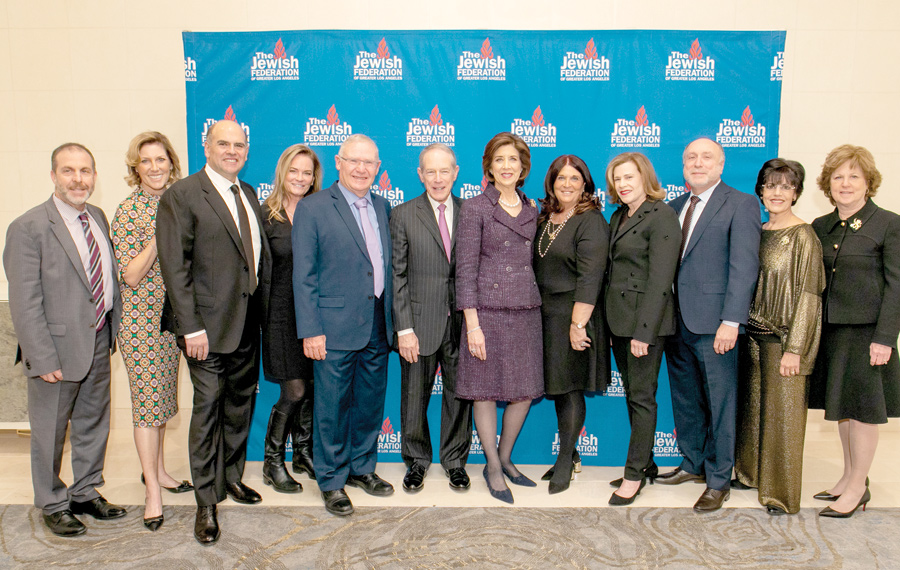
At the Jewish Federation of Greater Los Angeles’ annual King David Society dinner on Feb. 20, former head of the Israel Defense Forces’ Military Intelligence Directorate and retired Israeli Air Force Maj. Gen. Amos Yadlin spoke about his experience in the military and shared insights into the current state of Israeli security. 

Yadlin provided the attendees at the Beverly Hilton event with stories of his wartime escapades, which included serving as a fighter pilot during the Yom Kippur War and his more than 5,000 flight hours and 250 combat missions.

The King David Society is made up of philanthropists who contribute a minimum of $25,000 to the federation. 

King David Society co-chairs were Karmi Monsher and Jonathan Anschell. Dinner co-chairs were Andrea and Barry Cayton, Jeanne and Leonard Marks, and Allison and Steve Martini. Dinner vice chairs included Sheila and Aaron Leibovic, and Ellen Silverman.


Professor Anthony Futerman (second from right) of the Weizmann Institute of Science discussed his research on a link between Gaucher and Parkinson’s diseases at a Feb. 7 luncheon for supporters of the Israel-based science center. Joining him are (from left) Tom and Sondra Rykoff and Dave Doneson, CEO of the American Committee for the Weizmann Institute. Photo by Jani Rabin

Southern California supporters of Israel’s famed Weizmann Institute of Science met Feb. 7 for a luncheon at the restaurant in the Brentwood at Kiowa condominium development in Brentwood. The event was held under the auspices of the Vera and Chaim Weizmann Honor Society.

Janis Rabin, executive director of the Southern California region of the American Committee for the Weizmann Institute, introduced speaker Anthony Futerman, a professor in the Weizmann Institute’s Department of Biomolecular Science and past director of the institute’s Center for Neurological Diseases.

The London-born Futerman presented an overview of his team’s research pointing to a possible link between Gaucher disease, an inherited metabolic disorder, and Parkinson’s disease.

— Tom Tugend, Contributing Editor


Local Orthodox yeshiva YULA Girls High School held its inaugural STEAM Dream event on Feb. 25, with students, faculty and guests in attendance. Photo courtesy of YULA Girls High School

Six women with careers in various science, technology, engineering, arts and math (STEAM) fields were the featured speakers at YULA Girls High School’s inaugural STEAM Dream event on Feb. 25.

The speakers gave the students, faculty and other guests inspirational and informative TED Talks-style presentations describing what they do, how they got there, and how the students can get there too. 

The speakers were Katie Chironis, a senior game designer at video game developer Riot Games; an FBI forensic accountant who declined to be identified; Mika Epstein, a developer at web-host provider Dreamhost; Sharon Stein Merkin, a YULA Girls High alum and epidemiologist at UCLA; Denise Ngai, an engineer from the automobile resource company Edmunds.com; and Alexa Pavlovic, aka DJ Complex Lex, who has performed at turntables across Los Angeles. 

“STEAM Dream was truly an inspiring and female-empowered day, and planning for next year’s event has already begun,” Ethan Piliavin, YULA Girls’ director of educational technology and STEAM, said in an email to the Journal after the event.


From left: Simon Wiesenthal Center (SWC) Rabbi Meyer May, SWC board member Cheston Mizel, Museum of Tolerance Director Liebe Geft, U.S. Ambassador to Germany Richard Grenell and SWC Rabbi Abraham Cooper tour the Museum of Tolerance. Photo courtesy of the Simon Wiesenthal Center

U.S. Ambassador to Germany Richard Grenell took a break from his diplomatic duties — and the Berlin cold — to visit Southern California, the place he called home before assuming his Berlin post last year.

 On Feb. 22, two days before glamming it up with his partner, Matt Lashey, at Elton John’s Academy Awards after-party, Grenell went on a private tour of the Simon Wiesenthal Center’s (SWC) Museum of Tolerance with SWC board member Cheston Mizel, Associate Dean Rabbi Abraham Cooper and Executive Director Rabbi Meyer May; Museum of Tolerance Director Liebe Geft; and SWC Communications Director Michele Alkin.

Throughout the museum’s exhibitions on such subjects as civil rights in America, Nazi Germany and Anne Frank, Grenell spoke with visitors from San Diego, U.S. Army recruits and police officers from Rialto about the museum’s educational messages against hate, prejudice and racism. 

After the tour, Grenell gave an off-the-record briefing to several Jewish community leaders about his work in Germany, developing the Transatlantic Trade and Investment Partnership, and combating anti-Semitism and terrorism.

— Orit Arfa, Contributing Writer


More than 30 young professionals partied the night away at a Jewish National Fund House Party on Feb. 23. Photo courtesy of Neuriel Shore

More than 30 young PRO-ISRAEL professionals, Jewish National Fund (JNF) supporters and JNFuture board members partied the night away at a JNF House Party on Feb. 23 hosted at the home of Neuriel Shore, associate director of the JNF West L.A. region, and his wife, Neelie. 

“It was a chance for local JNF Los Angeles lay leaders and donors to mix and mingle in a more intimate, organic setting rather than at a traditional event,” Neuriel Shore said. 

The gathering highlighted JNF’s Go North strategic initiative, which aims to bring 300,000 people to live in the northern region of Israel.


From left: ETTA client Lexi Aaron, Jewish Federation of Greater Los Angeles volunteers Layla and Reuven Hellman and ETTA client Shaina Barnett celebrate Jewish Disabilities Awareness Inclusion Month. Photo by Harvey Farr Photography

More than 50 clients, family members and volunteers associated with the ETTA organization joined with staff of the Jewish Federation of Greater Los Angeles at ETTA’s offices on Feb. 24 to make no-sew blankets as part of Jewish Disabilities Awareness Inclusion Month.

The blankets will be donated to residents at the Los Angeles Jewish Home.  

ETTA is the largest social service organization in Southern California serving the needs of Jewish adults with disabilities. Jewish Disabilities Awareness Month has been held in February for the past decade to raise awareness around inclusion of people with disabilities and mental health conditions. provides free legal services for low-income individuals and families in Los Angeles.

Federation Dinner; Jewish Disabilities Month Read More »
Jewish Women’s Rich American History

The American Jewish woman has been depicted in popular culture in so many ways — ranging from Molly Goldberg to Mrs. Maisel, from the Jewish American Princess to the Notorious RBG — that she can best be described a shape-shifter.

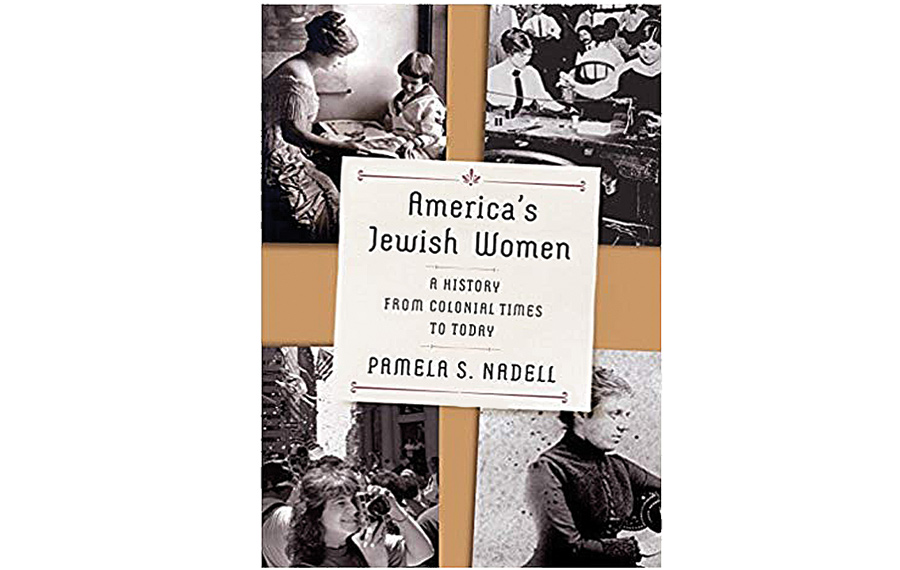
Pamela S. Nadell, one of America’s leading scholars on the subject, comes to something of the same conclusion in “America’s Jewish Women: A History From Colonial Times to Today” (Norton), a commanding survey of the roles they have played over the last 350 years, starting with the earliest origins of the Jewish community in North America and ending with a glimpse into the future.

“In family photos, I see America’s Jewish women changing over the years,” Nadell writes. “One of my great-grandmother shows her wearing a sheitel, a wig some observant married Jewish women wear, and a black brocaded dress with a high lace collar. Digital images of my daughter sliding across my computer screen reveal a student wearing skinny jeans and tall boots. As our clothing differed, so too did the fabric of our lives.”

Nadell is the director of Jewish studies at American University, where she holds the Patrick Clendenen Chair in Women’s and Gender History. Her previous work includes “Women Who Would Be Rabbis,” a National Jewish Book Award finalist, and “Three Hundred and Fifty Years: An Album of Jewish Memory,” which she co-authored with Jonathan D. Sarna, among others.

She previews her point of view at the outset of her rich, colorful and endearing study: “At its heart lies the assertion that Jewish women were a part of America’s women and yet, throughout history, have remained distinctly apart from them.” She begins by introducing us to Ricke Nunes and Judith Mercado, refugees from the Inquisition in Brazil who arrived in New Amsterdam in 1654 to become “America’s first Jewish women.” Soon enough, as Nadell shows us, America tempted its Jewish residents into assimilation, intermarriage and conversion, no less in colonial times than in our own.

 “At [the book’s] heart lies the assertion 

that Jewish women were a part of America’s women and yet, throughout history, have remained distinctly apart

from them.” — Pamela S. Nadell

Abigail Franks, for example, was an open-minded Jewish woman in New York. “Yearning for a modernized Judaism, long before others would start constructing one, she groused to [her husband] about her frustrations with its senseless ceremonies, absurd superstitions, and punctilious rituals,” as Nadell reveals. Abigail even claimed that if “a Calvin or Luther would rise amongst us, I would be the first of [their] followers.” But when her own daughter married out, Abigail complained that she was “Soe Depresst that it was a pain … to Speak or See Any one.”

Not surprisingly, Jewish women tended to embrace the values of the people among whom they lived. During the Civil War, Nadell writes, “Southern Jewish women stood with their neighbors in support their states’ right to secede.” She introduces us to a Jewish adolescent named Clara Solomon, who lived in New Orleans under federal occupation and confided her passions to her diary, including her murderous thoughts about the Union general who commanded the occupying troops: “If he could only have as many ropes around his neck as there are ladies in the city & each have a pull! Or if we could fry him!”

Other women in Nadell’s book will be deeply familiar, but she fills in the blanks in their biographies. Emma Lazarus, whose iconic poem is famously displayed on the Statue of Liberty (“Give me your tired, your poor, your huddled masses, yearning to breathe free”), was the descendant of Jews who had been expelled from Spain in 1492. When she beheld the latest arrivals who sailed past the statue of Lady Liberty — Jewish refugees from Russia and Eastern Europe — she saw among them “a new kind of Jewess.” Nadell reminds us that the women who caught Lazarus’ eye brought with them a willingness to engage in the American life in a way that “would eventually overwhelm the earlier American Jewesses of her world.” Significantly, she reveals that a magazine titled The American Jewess started publication in 1895, a moment when women were turning to social and political activism.

 The American Jewess, for example, advocated for feminist issues ranging from women’s suffrage to liberation of women from the corset and “endorsed equal pay for men and women, a law Congress would not enact until 1963, even if the current reality does not meet the law.” Meanwhile, Jewish women took to the streets to demonstrate against poor working conditions in garment factories and high prices in kosher butcher shops. Anzia Yezierska was “dubbed the Cinderella of the sweatshops after one of her novels set in the Jewish ghetto was made into a silent film.” A teacher asked a student who worked in a sweatshop, “When the Americans could no longer put up with the abuse of the English who governed the colonies, what occurred then?” The little girl replied, “A strike!”

Nadell also chronicles the changes in the role of women in American Judaism. On a Sabbath morning in 1922, Rabbi Mordecai Kaplan engaged in an act of revolution when he called his eldest daughter, Judith, to read from the Torah as a bat mitzvah. “Talk to your son,” her maternal grandmother told her paternal grandmother. “Tell him not to do this thing!” To which the paternal grandmother replied, “You know a son doesn’t listen to his mother. You talk to your daughter. Tell her to tell him not to do this thing!” And yet the thing was done, and it was the beginning of a slow transformation in Jewish practice that eventually led to the ordination of women as rabbis. 

The pace of change only accelerated after World War II, as Nadell signals with a roster of headline- and history-making Jewish women that includes “Miss America Bess Myerson, convicted spy Ethel Rosenberg, quiz-show champ Dr. Joyce Brothers, Holocaust survivor Gerda Weissmann Klein, Barbie’s Ruth Handler, Reform Judaism’s Jane Evans, songwriter Carole King, and journalist Betty Friedan.” The startling differences among these notable women is the whole point of her admirable book: “For America’s Jewish women,” the author concludes, “nothing would ever be the same.”


Jonathan Kirsch, attorney and author, is the book editor of the Jewish Journal.

Jewish Women’s Rich American History Read More »

Confronting Death in ‘It’s a Life’

Talking about death doesn’t have to be depressing. It can illuminate, uplift and entertain, as the Jewish Women’s Theatre (JWT) production of “It’s a Life” demonstrates. Playing through March 20 at The Braid in Santa Monica and other locations, the show presents 16 provocative pieces chosen to promote conversation about a topic most of us try to avoid.

JWT Artistic Director Ronda Spinak sorted through over 200 submissions to find a range of stories reflecting humor, irony and inspiration. “Even in the Kaddish, the word ‘death’ is not mentioned. We took our cue from that,” Spinak said after a rehearsal. “We wanted this show to be a celebration of life, for these stories to make us remember and feel and think about the future.”

“A lot of the stories are universal and others are specifically Jewish,” producing director Susan Morgenstern said. “The Last Mitzvah,” in which three women volunteers from the chevrah kadishah prepare a body for burial, is one of the latter. It’s about showing respect for the dead. It’s very beautiful and meaningful.”

 For JWT veteran Arva Rose, one of the actors in the piece, it’s something she’s experienced first-hand. When a fellow congregant died, she participated in the ritual with her (female) rabbi and called it “an extraordinary experience.” Rose also said she connects strongly with “My Zaydie,” which she wrote about the loss of her own grandfather. “He was everything a grandfather is supposed to be,” she said. 

Other stories include the tale of a young female rabbinical student whose first task involves counseling an Orthodox family; a woman who believes the feathers that suddenly pop up everywhere are messages from beyond the grave; and the daughter who finds the perfect way to comply with the final request of a father she loathes. A dead opossum, a bequeathed typewriter and an obituary that goes viral figure in three of the lighter pieces.

On the opposite end of the spectrum is “The Perfect Dive,” about facing the Angel of Death. “[It’s about ] grappling with mortality and the idea that life can change in an instant,” said writer Susan Baskin, who was inspired by her experience with breast cancer. Introduced to the JWT by a friend at the Santa Monica Synagogue, the screenwriter and essayist is making her theater debut.

“All of us are afraid to talk about death and dying or don’t like to. None of us are going to get out of here alive, and it’s OK to think about it more than we allow ourselves to.” — Susan Morgenstern

Lisa Robins, who performs in Baskin’s piece and several others, has been involved with the JWT since its inception. “All of the stories speak to me in some way,” she said. “Society is afraid to deal with anything to do with death. The more we talk about it and bring it into the light, the better off we all are.”

Harris Shore, a singer, actor and playwright who became a cantor 10 years ago, is making his JWT debut with “It’s a Life” and thinks it will resonate with audiences. “There’s a lot of universality in the experience because it’s all about the inevitable. We’re all in the same boat,” he said. “This is the life God gives us and ultimately it’s our decision how we see it.” 

Raised in a small Pennsylvania town where the one synagogue was his “second home,” Shore entertained on the Borscht Belt and Pocono circuits and for the troops in Vietnam before moving to Los Angeles. Best known for guest roles in “Seinfeld,” “Bones,” “Wings” and “Weeds,” he will appear in Hallmark Channel’s “The Crossword Mysteries” on March 10 as Detective Cherashney. His next project is “Killing Klaus,” a play he wrote about a man’s plan to assassinate Nazi Klaus Barbie.

Unlike Shore, Robins grew up Jewish in name only. “My father and stepfather were atheists,” she said. Fifteen years ago, she landed the first of several roles playing Jewish women, most notably a grieving mother in “The Blessing of a Broken Heart” at The Braid. “All these roles gave me my Jewish education,” she said. “Now I go to Nashuva and I’m a co-chair of the social action committee.” She plans to remount “Broken Heart” this year and is working on a solo show about her family. 

Baskin, who was raised in a traditional, observant home, has always felt connected to Judaism, and that connection strengthened when she joined a feminist Torah study group. “Whatever I got from it has stayed with me,” she said. “It gave me a deep appreciation and respect for the Jewish tradition.”

Learning Torah also brought Rose closer to her faith. “Being Jewish has always been really important to me, and about 25 years ago I began serious study,” she said. “It’s an extraordinary joy to be a Jewish woman among Jewish women who are artistic and grateful and proud Jews. It’s hard to be a Jew and it’s hard to be a woman and it’s especially hard to be a Jewish woman. But when Jewish women get together, we can make the world go round.”

There will be an audience Q&A session after each performance, and Morgenstern anticipates some interesting and meaningful exchanges. “All of us are afraid to talk about death and dying or don’t like to,” she said. “None of us are going to get out of here alive, and it’s OK to think about it more than we allow ourselves to.”


“It’s a Life” runs through March 20 at The Braid and at other locations. Visit jewishwomenstheatre.org for more information.

Confronting Death in ‘It’s a Life’ Read More »

The Universal Appeal of the Charedi World in ‘Shtisel’

The Netflix show “Shtisel” is addictive to many viewers, as the phenomenally popular Israeli drama about a Charedi family living in the Geulah neighborhood of Jerusalem immediately draws you into the characters’ lives. They include the 60-something Reb Shulem Shtisel, the widowed classroom rabbi; his daughter, Giti, whose nefarious husband has run off to Argentina, abandoning her and their five children; and Shulem’s youngest child, handsome 27-year-old Rabbi Akiva, or “Kive,” hiding the sketchbook filled with his outstanding illustrations, knowing that pursuing a career as an artist would be scandalous.

Developed by Abot Hameiri Productions for the Israeli satellite service yes, the show originally was broadcast in Israel in 2013. Over its two seasons, it racked up more than a dozen Israeli TV awards. 

The success of the show that trains its camera on a little-known world is due, in part, to the show’s creators having lived this life. Yehonatan Indursky grew up in a Charedi family and attended the Ponevezh Yeshiva in Bnei Brak, while Ori Elon attended a yeshiva in Efrat.   

When Netflix bought the rights to stream “Shtisel” in December 2018, a huge new fan base cropped up via a Facebook group called “Shtisel — Let’s Talk About It.”  The page is moderated by Detroit-based friends Nancy Kaplan and Mimi Markofsky. It currently has close to 6,000 members worldwide and is growing rapidly. Markofsky is Orthodox and Kaplan is Conservative. However, Kaplan’s Orthodox daughter and her family live on an Israeli moshav. 

The majority of the Facebook page’s members are women, although men occasionally offer commentary — in talmudic depth — questioning why characters made certain decisions or analyzing the deeper meaning behind a certain dream sequence.

Watching “Shtisel” feels like we are watching members of our own family. 

Many members, including some non-Jews, are fascinated by the lifestyle they see and are looking for answers: Why do the women sleep in snoods? Why do the men smoke so much? Why do they touch that little box on the doorpost when they enter the apartment?  

One man in the group, Doron Junger, originally from Frankfurt but now living in Miami Beach, explained why he is so moved by the show. He called it “simultaneously full of heart and devoid of sentimentalism. The characters are complex, and the world they live in absorbing. [Charedim] are portrayed here as many-layered, no better or worse than the rest of us at navigating moral dilemmas and life’s universal big challenges (including marriage and dating, sibling relationships, the passing of loved ones, and economic hardship), but passionately devoted to the rules, rituals and routines of their chosen way of life. The stories have beautifully long arcs, which richly reward the patient and attentive viewer, some associations being so subtle they come into focus only on a second or even third viewing.”

While I’m not Charedi and could not imagine living in such a sequestered environment, Junger’s comments ring true. Watching “Shtisel” feels like we are watching members of our own family. We are one people at our core and share an unbreakable bond with one another and with God. The Charedim also are subject to much more bad press than good, and this show humanizes them. Their struggles are in many ways universal.  

Amazon has made a deal with Marta Kauffman, a creator of “Friends,” and her daughter, Hannah K.S. Canter, to develop a Brooklyn-based version of “Shtisel,” but the Israeli show will be a tough act to follow. 

Still, there is cautious excitement percolating among “Shtisel” addicts, following a rumor that a third season is being written. I hope it’s true. If it is, I can only echo what Reb Shulem often would say, “Hasdei HaShem (praise God).”  


Judy Gruen’s most recent book is “The Skeptic and the Rabbi: Falling in Love with Faith.” 

The Universal Appeal of the Charedi World in ‘Shtisel’ Read More »

Best of 2019: Must-Have Kitchen Gear

When you grow up in a home with an inventor, you can either reject or embrace change. In our home, my father was the embracer; my mother and me the rejectors.

Dinner at our house was always a brainstorming session. Ideas floated above the dining room table like suds percolating out of a bubble machine. As my father’s inventions and gadgets gained popularity and his company grew, our family conversations became marketing-oriented, but he always was trying to get my mother and me to be more efficient in our tasks. Aside from patenting his inventions, he also designed a method for us to stack dishes, to put cutlery in the dishwasher efficiently and computerized our home before there was even a whiff of technology anywhere. 

We always had the latest: I was among the first of my friends to own a computer, use an electronic organizer, to play video games and own a cellphone. Yet, my mother and I didn’t always adopt all of my father’s time-saving strategies. 

But the desire for innovation must have subliminally taken hold because today I can’t resist buying cooking gadgets even though as I am buying them, I realize they will likely just be stuffed into my rarely opened gadget drawer. I own so much cooking equipment and gadgets that I could probably open a shop, not much smaller than Williams-Sonoma and live off the sales of my stash for a year. After all, I’ve used most of them only once.

After working at the American embassy for only a few months, one of the supervisors called me into his office and told me that I basically had a blank check to replace the 13-year-old embassy kitchen with all new and more modern equipment. “You mean I can order anything I want?” I asked with eyes as big as saucers. “Yes, within reason, feel free to order anything you’d like.”

The wild-eyed dervish who left his office that day spent the next few weeks scouring government-approved sites for kitchen equipment. This was much more difficult than I imagined, especially after it dawned on me that I was spending taxpayers’ money, not mine. I needed to choose wisely and buy only items that would get used regularly and would save time and energy during prep before a busy service. 

Here’s a list of some high- and low-tech kitchen equipment that an active home kitchen shouldn’t be without. You may own many of these items but if not, most of them are under $50. None of them will disappoint you or be seldom used. My mother’s latest acquisition recently arrived in the mail. It’s an automated grape leaf filling machine. I rest my case.

Immersion blender: This phenomenal tool will enable you to puree and blend in a pot of sauce or soup. It’s also the quickest way (30 seconds) to make homemade mayonnaise and certain dips. Some come with a whisk attachment so there’s no need to use a hand or stand mixer to whip cream. Favorite brand: Kitchen Aide five-speed with whisk attachment

Potato ricer: This may seem like a frivolous purchase but it’s the only way to ensure smooth mashed potatoes. Usually, items that can be used only for one task end up not being used often, but if you value lump-free potatoes — this is a must. Favorite brand: Chef’n FreshForce.

“I own so much cooking equipment and gadgets that I could probably open a shop.”

Magnetic knife strip: Storing your knives (even your most expensive ones) rattling around in a drawer is the surest way to ruin them and make them imbalanced and dull. An easy-to-hang magnetic knife strip will enable  you to easily store and peruse your knives without wasting valuable counter space with blocks. For everyday cooking, you’ll need a good chef’s knife, a paring knife, a serrated bread knife (which can double as a blade to cut through pineapples and tomatoes) and a knife sharpener.

High-speed blender: I love the new high-speed blenders that chop, mix, blend, whip, grind and puree for smoothies, dips, juices and soups. When you own a blender with blades that whip and grind quickly, you won’t know how you lived without one. Favorite brand: Magic Bullet

Storage containers: If you cook a lot at home at home I recommend storage containers that go from dishwasher to oven and are made of shatterproof, tempered glass. Favorite brand: Glasslock 18-piece oven safe

Salad spinner: There’s no replacing a salad spinner to dry vegetables and herbs and ensure salad greens stay dry before being dressed. Don’t settle for a pool of water at the bottom of a salad bowl. Favorite brand: OXO Stainless Steel Spinner with integrated colander

Instant pot: The most well-marketed electronic pressure cooker ever invented is a staple in many households these days and for good reason. Unlike a standard pressure cooker, which is one of the best tools ever created for busy cooks, an instant pot also steams, slow cooks, sous vides and can be used as a rice cooker. It even bakes and sautés. It’s an all-in-one that replaces a number of other kitchen items. Favorite brand: Instant Pot Smart Wifi 6 Quart

Food processor: There’s no replacement for a multipurpose food processor. It can make hummus, grate cheese, chop vegetables and even pie crust. I make scones and puff pastry in a food processor. Favorite brand: Of the many on the market, Cuisinart DFP-14BCNY stands out

Spiralizer: It may seem like a frivolous gadget but spiralizers are a versatile tool that can make ribbons and “noodles” out of a variety of vegetables. Great for salads and interesting vegetable dishes. Favorite brand: Veggetti

Digital scale: Proper baking relies on two things – proper measuring and proper oven temperature. Measuring cups can’t compete with weighing ingredients on a scale. If your baked goods and breads come out differently every time, start to bake like a professional: Get a scale. Favorite brand: The My Weigh KD-8000

Oven thermometer: Home ovens often are uncalibrated. In my bakery, we wouldn’t dream of baking something without an oven thermometer to gauge the oven’s true temperature rather than relying on the dial. Keep an inexpensive oven thermometer hanging in your oven and never over- or undercook your baked goods again. Favorite brand: CDN DOT2 ProAccurate

Bench scraper: This tool is indispensable when working with dough or pastry but also picks up excess flour or waste from countertops. It’s great for cleaning vegetable scraps and herbs and also makes a great dough cutter for rolls, pizza dough or scones. Favorite brand: Orblue pastry scraper and cutter

Mezzaluna: Italian for “half-moon,” the mezzaluna has been in use since the early 18th century, for mincing and chopping tasks, and as a pizza cutter. The big cutting surface catches all of the ingredients on your cutting board, ensuring all pieces are uniformly cut. Perfect for herbs, chocolate blocks, nuts or even lettuce. Nothing beats a vintage mezzaluna but a good one is hard to find. So go with the next best thing. Favorite brand: Wusthof Double-Handle.


Yamit Behar Wood, an Israeli-American food and travel writer, is the executive chef at the U.S. Embassy in Kampala, Uganda, and founder of the New York Kitchen Catering Co. 

Best of 2019: Must-Have Kitchen Gear Read More »

Director Sought to Put Hope in ‘Transit’

Director Christian Petzold’s movie “Transit” is set in a timeless France overflowing with refugees from various countries who, while flanked by advancing military forces, are attempting to flee the country.

Although the film evokes the Holocaust — the occupying army is from Germany, and there are references to “the camps” — we never hear the word “Nazis” or see swastikas, and only one of the many ambiguous characters admits to being Jewish. We’re told that some of the refugees are intellectuals and writers, but we’re left to guess why they are attempting to take flight. 

That said, the setting clearly is not in the 1942 timeframe depicted in Anna Seghers’ 1944 novel of the same name, which inspired the film. The story appears to take place in the present, but it’s devoid of computers and cellphones.

The German-born Petzold, 58, told the Journal in a telephone interview that he was deliberately vague about the film’s era, as he tried to create a “conversation between a historic time and the contemporary world.”

“I’m not saying that all refugees are the same,” Petzold said. “They’re totally different. In fact, I don’t really know very much about today’s refugees. I know much more about the refugees fleeing in 1942 because of the literature that I’ve read and because my own family talked about them. Still, refugees face many of the same responses from countries across the world that say, ‘We don’t need you. We don’t want you.’ Refugees live in camps or are put in prisons.”

Petzold said he found it ironic that today’s enlightened Germany is seeing an upswing in anti-Semitism. He attributed the increased expressions of bigotry to the rise of global capitalism, whose critics channel their hate and anger into virulent anti-Semitism. In times of crisis, he said, people in power will always use Jews as targets for their aggression.

Winnowing the 300-page novel into the screenplay was a complicated feat, Petzold said. One challenge was that, while the first half of the novel was set in Paris, Petzold wanted to focus on the location of the book’s latter half, Marseille, among people in transit who need to reinvent themselves as a survival tactic.

“All refugees try to be storytellers like Primo Levi,” Petzold said, referring to the Italian Jewish chemist, writer and Holocaust survivor who wrote several books, including his account of being a prisoner in “Survival in Auschwitz.” “They try to write something down that they can’t write down. I try to show people who find new identities as a lover, father or friend.”

To the extent that the characters succeed, there’s hope. Petzold believes the film concludes on an affirmative note. 

“I love it when characters at the end of the film don’t need me — an audience member — anymore,” Petzold said. “That’s a happy ending. And as the credits roll we hear the [band] Talking Heads, singing [“Road to Nowhere,” with the lyrics, “Well we know where we’re going, but we don’t know where we’ve been”]. It makes me feel that for the first time in my life I’m in a good church whose doors are open. You have a song in your head. You feel you can go outside with a tune.”


Simi Horwitz is an award-winning writer based in New York. 

Director Sought to Put Hope in ‘Transit’ Read More »

‘Transit’ Tells Timeless Story of Refugees’ Plight

The German-French film “Transit” works on two levels: as a very personal story of love (and love lost) and a universal tale of refugees wanted by neither their lands of birth nor their potential host countries.

The film’s central figure, Georg, is a German refugee from fascism who has joined equally desperate refugees in Marseille, seeking a way out as the German army closes in on the French port city. He eventually meets and falls in love with Marie, a woman desperately seeking her missing husband.

 In the movie, adapted from the 1942 novel of the same name by Anna Seghers, Georg is apparently not Jewish but has fled as a political opponent of its fascist regime.

As the film opens, a friend asks Georg to deliver a letter to a man named Weidel, a famous German author living in exile in a Paris hotel. As George enters the hotel room, he discovers the author has committed suicide, leaving behind an unfinished novel and two tickets for a transatlantic voyage. Georg takes the papers and assumes the author’s persona.

In Marseille, Georg waits at the Mexican and American consulates, listening to the endless woes of others, including a Jewish refugee. He is told by consular officials that Marie, a desperate woman with the same last name as his, has been haunting the consular offices, seeking some trace of her missing husband.

“[‘Transit’] puts into sharp relief the timeless tragedy 

of racial and political persecution and 

the plight of refugees.”

Georg and Marie meet and fall in love, with Marie unaware that Georg is impersonating her husband, who she assumes is still alive. Meanwhile, trading on his famous assumed name, George obtains entry visas for Mexico and the United States for himself and Marie. They book passage for a transatlantic ship before the unexpected happens.

Though Seghers’ novel is set during World War II, director Christian Petzold has chosen to conflate past and present, so that, for instance, the cars on the streets of Marseille are of current vintage. (See the Journal’s interview with Petzold on Page 39).

Though this approach is at times disorienting, it puts into sharp relief the timeless tragedy of racial and political persecution and the plight of refugees.

Despite this rather somber theme, the film has some touching moments, particularly in the relationship between Georg and a 5-year-old refugee named Driss, who bond over their mutual enthusiasm for soccer.

The film’s lead roles are impressively filled by two of Germany’s most popular actors: Franz Rogowski, who plays Georg, won the 2018 Berlin Film Festival’s Shooting Stars Award; and Paula Beer, who plays Marie, won the 2016 Venice Film Festival’s best young performer award for her role in “Frantz.”

Without spelling it out, the film calls attention to the heartlessness with which most refugees are treated, including by the present U.S. administration.

According to the latest United Nations statistics, a record-high 68.5 million refugees were driven from their homes by war, violence and persecution in 2017. More than two-thirds of those people came from Syria, Afghanistan, South Sudan, Myanmar and Somalia. Turkey accepted the largest number of refugees, some 3.5 million, followed by Pakistan (1.4 million), Uganda (1.4 million), Lebanon (998,900), Iran (979,400) and Germany (970,400), the U.N. reported.

In 2018, President Donald Trump lowered the United States’ annual admission quota of refugees to 45,000 — the lowest since enactment of the Refugee Act of 1980 — of whom only 21,292 were admitted. For 2019, Trump lowered the quota to 30,000, a ceiling
his administration is not expected to reach, according to the National Immigration Forum.

As a footnote, I arrived in the United States in 1939 as a refugee from Nazi Germany. Although my family left and arrived under relatively favorable conditions, the experience broke my father physically and spiritually.


“Transit” opens March 15 at Laemmle’s Playhouse 7 in Pasadena and Town Center 5 in Encino.

‘Transit’ Tells Timeless Story of Refugees’ Plight Read More »

Poll: 69% of Americans View Israel Favorably

A Gallup poll taken between Feb. 1-10 revealed that 69 percent of Americans view Israel favorably. In 2018, that number was 74 percent.

The poll, released on March 6, surveyed 1,016 Americans. Twenty-one percent of those polled viewed the Palestinian Authority (PA) favorably. That percentage remained the same in 2018.

Among political party and ideology, 87 percent of conservative Republicans, 72 percent of moderate and liberal Republicans, 66 percent of moderate and conservative Democrats and 58 percent of liberal Democrats viewed Israel favorably. In 2018, those numbers were 85 percent, 70 percent, 67 percent and 62 percent, respectively.

By contrast, 36 percent of liberal Democrats, 26 percent of moderate and conservative Democrats, 20 percent of moderate and liberal Republicans and 10 percent of conservative Republicans viewed the Palestinian Authority favorably. These were all increases from 29 percent, 21 percent, 14 percent and 9 percent respectively, in 2018.

Additionally, 59 percent of Americans sympathized with Israelis over the Palestinians in 2019, whereas 64 percent felt this way in 2018. Twenty-one percent of Americans sympathized with the Palestinians over Israelis in 2019, an increase from 19 percent in 2018. Seventy-six percent of Republicans said they sympathized with Israelis over the Palestinians, a sharp decline from 87 percent in 2018, and 43 percent of Democrats said they sympathized with Israelis over the Palestinians, a decline from 49 percent in 2018.

“Americans’ overall views toward Israel and the Palestinian Authority have changed little in the past year, with roughly seven in 10 viewing Israel very or mostly favorably and two in 10 viewing the Palestinian Authority in the same terms,” Gallup senior editor Lydia Saad wrote. “At the same time, the new poll finds a slight softening of Americans’ partiality toward Israel in the Israeli-Palestinian conflict, particularly among moderate/liberal Republicans and, to a lesser extent, liberal Democrats.”

Poll: 69% of Americans View Israel Favorably Read More »

The Life and Legacy of Joseph Pulitzer

In 1909, the world, the then most influential New York daily newspaper, accused President Theodore Roosevelt of orchestrating a $40 million cover-up of corrupt practices in the building of the Panama Canal. 

In response, Roosevelt sued The World’s publisher, Joseph Pulitzer, for libel. Pulitzer refused to back down. 

Any resemblance to a current president and a New York daily newspaper is purely coincidental. But following three years of legal battles, the U.S. Supreme Court ruled in Pulitzer’s favor, throwing out the case and declaring that even the president of the United States was not above the law.

The encounter between the one-time penniless Jewish Hungarian immigrant and the most powerful man in America is but one episode in the film “Joseph Pulitzer: Voice of the People.”The film not only covers this story but serves as a biography of Pulitzer’s remarkable life, including his ascent from Jewish immigrant to one of the most successful journalists in America, his struggles with neurasthenia (with its accompanying mental and physical exhaustion), his intense rivalry with fellow publisher William Randolph Hearst and the centrality of journalism to the workings of a democratic society.

Pulitzer was born in 1847 in Makó, a town on the Hungarian side of the border with Romania. One of eight siblings, only he and one brother lived to adulthood.

Pulitzer’s first ambition was to become a soldier, and at 17 he took a ship to America as a recruit in a German-speaking unit of the Union Army in the final year of the Civil War. His first post-war job was shoveling coal, but he soon embarked on his journalistic career with a German-language newspaper in St. Louis. On the side, he taught himself law and became an investigative reporter. By 1880, he had founded the St. Louis Post-Dispatch, pledging to “oppose all frauds and shams” and promoting a writing style of short, snappy paragraphs.

Pulitzer published the names of all tax dodgers in St. Louis and, in those rugged days, it was no big deal when his managing editor, confronted by a critic of the newspaper, pulled out his pistol and killed the unhappy reader.

The film serves as a biography of Pulitzer’s remarkable life, his ascent from Jewish immigrant to one of the most successful journalists in America.

Two years later, Pulitzer had accumulated and borrowed enough money to take out a sizable loan and purchase the New York World for close to $400,000. He proclaimed the paper’s policy by stating, “Accuracy is to a newspaper what virtue is to a woman.”

Around the same time, he married Kate Davis, an Episcopalian and distant relative of Jefferson Davis, the president of the Confederacy during the Civil War. The marriage of a member of the Southern aristocracy to an immigrant Jew was apparently not considered as scandalous as it would be in a later century, Oren Rudavsky, the film’s director, told the Journal.

“There was relatively less anti-Semitism in America in the 1870s and 1880s, before the start of the Jewish mass immigration in subsequent decades,” he said. However, that did not mean that some of Pulitzer’s numerous political enemies and journalistic competitors refrained from referring to the publisher as “Jewseph Pulitzer” and “Joseph Jewlitzer” or caricatured him with a huge hooked nose.

Pulitzer used his newspaper’s clout to challenge a levy on pedestrians for walking across the newly opened Brooklyn Bridge; to bring the Statue of Liberty to New York Harbor; and to acculturate the waves of new Jewish and other immigrants to the country.

During the run-up to the 1898 Spanish-American War, Pulitzer, with thw war-mongering Hearst papers, was accused of resorting to yellow journalism, but Rudavsky cited as a more fitting epitaph the appraisal of writer Nicholson Baker, who judged Pulitzer to be “the most original and creative mind in American journalism that has ever been.”

The one-time immigrant endowed the Columbia University School of Journalism and the Pulitzer Prize, which primarily recognizes excellence in newspaper journalism.

“Joseph Pulitzer: Voice of the People” is the latest of some 20 films, mostly documentaries, by Rudavsky, half of which explore Jewish themes. Among them are “A Life Apart: Hasidism in America,” “Hiding and Seeking” and  “Colliding Dreams,” which examines the history and impact
of Zionism.

Pulitzer, handicapped by poor vision throughout his life, became blind in his later years and died of heart failure aboard his yacht in 1911 at the age of 64.

As an exemplar of the fabled American success story, the penniless immigrant who slept on park benches when he arrived in America left a fortune of $30.6 million (roughly equal to $754 million today) to his wife and five surviving children.


“Joseph Pulitzer: Voice of the People” opens March 8 at the Laemmle Music Hall in Beverly Hills, Playhouse 7 in Pasadena and Town Center 5 in Encino.

The Life and Legacy of Joseph Pulitzer Read More »

StandWithUs Student Conference Primes Pro-Israel Activists

Last fall, during the public comments portion of a meeting held by the University of California Board of Regents in Westwood, UCLA student Justin Feldman, 21, voiced his displeasure with an upcoming National Students for Justice in Palestine (NSJP) conference billed as a “human rights conference” that was scheduled to take place on his campus. 

“Every year, SJP invites speakers with proven connections to terrorist organizations, such as Hamas. Some are even convicted terrorists themselves,” Feldman said. “These are SJP’s role models. Does this sound like a human rights conference to you?”

Feldman and his friend Naomi Kisel, 21, who isn’t Jewish but actively recruits her fellow Christian students on campus to join pro-Israel advocacy causes, waged an education campaign to counter the November conference. They held an Israel Celebration Day, distributed reading materials on Zionism and even hosted elected officials, including Los Angeles City Councilman Paul Koretz. 

Both Feldman and Kisel, who run pro-Israel clubs on campus and are in the midst of dual degrees at UCLA, lead busy campus lives. On March 2-4, they joined over 200 other college students from across the country at the fourth annual Israel In Focus international conference organized by StandWithUs (SWU), a nonprofit international pro-Israel education organization founded in 2001. 

“I’m here to inspire and be inspired,” Feldman told the Journal. Kisel added, “Being able to speak with other students who have experienced similar things on their campuses and making those lasting connections will give us people to call and share best practices with when we return to our campus.” 

In addition to the college students at the conference, held at the Hyatt Regency near Los Angeles International Airport, there were 120 high school students, 150 SWU staff and lay leaders from Jewish communities around the world and representatives from at least 33 partner organizations. 

The Adam and Gila Milstein Family Foundation sponsored the event with a clear focus on students and equipping the next generation of pro-Israel advocates. Along with a multitude of speakers, presentations, panel discussions and breakout sessions, there were Shabbat and interfaith services. Students also took advantage of ample reading material laid out on tables — pamphlets including “Israel 101,” “Israel Pocket Facts” and “Examining the BDS movement” — and an abundance of SWU-branded swag, everything from wristbands and sunglasses to chapstick. 

“Every year, this conference is filled with brand-new students who want to sharpen their skills to be able to have richer conversations about Israel,” SWU CEO Roz Rothstein told the Journal. 

Rothstein and others started SWU out of her living room and now oversee 18 offices around the world. With a sizable social media presence and departments focused on middle schools, high schools, college campuses and communities, SWU seeks to empower a global network of activists and educators for Israel.

 “A conference like this bolsters my network so I know I won’t be alone in this. I’m not scared. I’m just excited for what my future Israel advocacy will look like.”
— Danielle York

A panel called “A Christian, a Buddhist, a Muslim and a Hindu Walk Into a Pro-Israel Conference” was exactly that. The panel talked about the origins of their pro-Israel advocacy involvement and offered advice on how Jewish students can form partnerships with other campus groups. 

“Start with hummus,” Moussa Kone, 21, said. Kone, a Muslim student from Mali who attends Portland State University, said, “But know that more people than you realize are willing to listen. Be inclusive. Use discretion.”

Chelsea Andrews, director of special projects at Passages, affectionately known as the “Christian Birthright” organization, offers Christian college students trips to Israel. Andrews recruits Christian participants for these trips at colleges across the country and is no stranger to pro-Israel campus spaces. 

“Acknowledge the effort it takes for Christian students to learn about Israel and educate themselves on what’s going,” she said. “It takes a lot and Christian students on so many campuses are making the effort. Don’t assume they don’t know anything because oftentimes they do. Ask. Don’t assume.” 

Students also participated in panel discussions on fighting boycott, divestment and sanctions (BDS) legislation on campuses and mobilizing to condemn professors promoting anti-Israel agendas in classrooms. 

A few years ago, Alma Hernandez, 25, was an active pro-Israel advocate on the University of Arizona campus in Tucson. Last year, Hernandez, a Mexican-American Jewish Democrat, became the first Hispanic Jewish woman to hold elected office in Arizona, winning a seat in the state’s House of Representatives. After taking part in a panel discussion on “Feminism, Zionism and Anti-Semitism,” she told the Journal that despite a hectic schedule in her state legislature, it was important for her to be in Los Angeles for the conference. 

“I wanted to come connect with young students and share my story and encourage them to continue doing what they’re doing,” Hernandez said. 

One of the conference’s most buzzed about speakers was 29-year-old Hussein Aboubakr, an Egyptian-born Muslim who talked about growing up in a climate of anti-Semitic indoctrination. Aboubakr, who now works full time as a Hebrew teacher in Monterey, advocates for Israel through public speaking engagements.

“There’s no switch,” Aboubakr told the hotel ballroom filled with over 500 people. “It’s residual. There’s hope in all those Syrians, all those children getting treatment in Israel. There is hope for change. It requires a lot of work and a lot of education. The hardest thing to do is change people. I believe that’s what we’re doing, by being here.” 

Danielle York, 18, a Palisades Charter High School senior, goes to school just a few miles from UCLA students Feldman and Kisel. With studying at a four-year university likely in her near future, York came to the conference, in part, to learn about the climate of Israel advocacy on campuses. 

“I’ve never really faced much anti-Israel or anti-Semitic propaganda and as
strange as it may sound, I’m actually excited to combat it for the first time,” York said. “Everything comes with experience and having that experience of combating BDS, overt anti-Semitism or whatever the case may be is something I’m looking forward to. And a conference like this bolsters my network so I know I won’t be alone in this. I’m not scared. I’m just excited for what my future Israel advocacy will look like.”

Correction: A previous version of this article incorrectly stated that Roz Rothstein started SWU by herself out of a Santa Monica storefront. 

StandWithUs Student Conference Primes Pro-Israel Activists Read More »