
With the Fourth of July around the corner, it’s worth recalling how Americans’ favorite Independence Day food emerged thanks to members of the Hebrew faith.
As the late rabbi and chef Gil Marks documented in his “Encyclopedia of Jewish Food,” in the middle of the 19th century, Frankfurt sausages, called vurshtlekh (small wursts) in Yiddish, began appearing in American communities with large pockets of German immigrants, most notably New York City. The development of the mechanical meat grinder in the 1860s had made the sausages quick and cheap to produce. Into the packed pushcart vendor scene came a German Jewish immigrant Charles Feltman in 1871. Feltman installed a small charcoal stove and began selling sausages on Brooklyn’s Coney Island. “For neater and easier handling for his genteel customers,” Marks writes, “he served the warm sausages in a slit roll, which he kept warm in a special tin box in the cart, in essence transforming the Frankfurt sausage into the portable American frankfurter, also known as the hot dog.” The earliest written reference to a food by that name was in the October 19, 1895 issue of The Yale Record.
The entrepreneur’s invention proved profitable. In only three years, he had earned enough to build a restaurant on beachfront property.
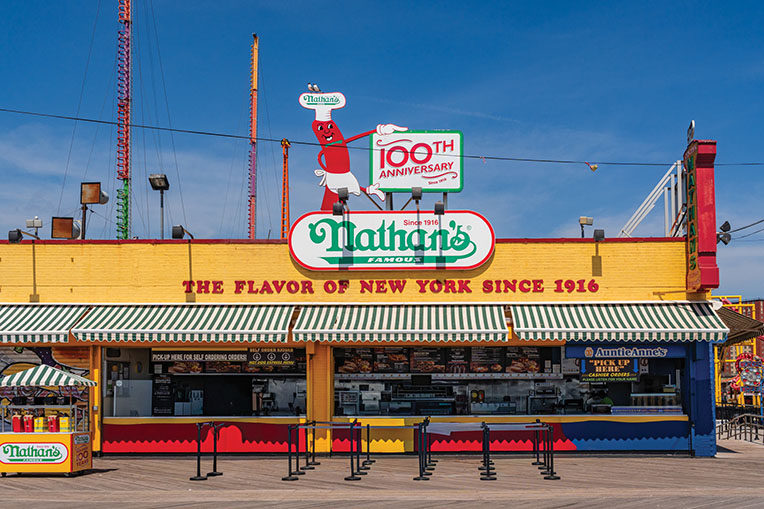
But the hot dog’s heyday didn’t happen until the arrival of another Jewish immigrant, Nathan Handwerker, in New York in 1902. Visiting Coney Island one day in 1915, Handwerker noticed a “help wanted” sign in Feltman’s window. There he put himself to work, and befriended two customers, struggling vaudeville performers named Eddie Cantor and Jimmy Durante. When Feltman jacked up his prices from five to ten cents, Cantor and Durante, worried that they had been priced out of their favorite food, encouraged Handwerker to start his own store and sell the goods at a lower price.
Handwerker, using a recipe created by his 19-year-old wife, Ida, used pure beef and added garlic and more pepper. His first shop, Nathan’s, was a weathered clapboard and a 20-foot-long counter. He cooked his wares on a smoldering grill that burst the casings as they cooked, resulting in an alluring aroma that wafted through the area.
Struggling to best his old boss, Handwerker came up with a promotional idea. He would offer free hot dogs to doctors and nurses at Coney Island Hospital, if they came in wearing their white coats. When only a few accepted the offer, he, undaunted, dressed some local vagabonds in doctor’s whites borrowed from a local theater. He posted a sign that read: “If doctors eat our hot dogs, you know they’re great.”
Ever the innovator, Handwerker then created a hot dog eating contest on the Fourth of July in 1916. But his big break came when vaudeville star Sophie Tucker released a popular song with the line, “Nathan, Nathan, why are you waitin’?” Someone quipped to Handwerker that he was becoming famous. So he renamed his stand “Nathan’s Famous.” It would prove prophetic.
Cantor and Durante became major stars. Their affinity for the friend that fed them further enhanced Handwerker’s momentum when they recommended his franks to their friends. Soon enough, Lucille Ball and Desi Arnaz, Jackie Gleason, Grace Kelly and the Marx Brothers were photographed munching on hot dogs, making hot dogs into a food icon.
Though he was Jewish, Nathan’s hot dogs were not kosher. But by the end of the 19th century, various kosher butchers and small factories began producing their own varieties in accordance with Jewish law. In 1905, a Romanian Jewish immigrant named Isadore Pinkowitz (who later changed his name to Pines) began making kosher sausages and frankfurters from his apartment in New York’s Lower East Side. The Hebrew National Kosher Sausage Factory was born.
This July Fourth, then, when you grab a sausage and pop it into its bun, take a moment to remember these great Jewish heroes. Their enterprising spirit and culinary capabilities have helped millions of Americans celebrate our independence, alongside countless more who will do so well into our next two and a half centuries – with hot dogs in hand.
Rabbi Dr. Stuart Halpern is Senior Adviser to the Provost of Yeshiva University and Deputy Director of Y.U.’s Straus Center for Torah and Western Thought. His books include the newly released “Jewish Roots of American Liberty,” “The Promise of Liberty: A Passover Haggada,” “Esther in America,” “Gleanings: Reflections on Ruth” and “Proclaim Liberty Throughout the Land: The Hebrew Bible in the United States.”