Almost 30 years ago, when our friend Yosi was dating his wife Esther, he was amazed that her family in Florida and Brooklyn served the same cookies that his grandmother had baked for him when he was a little boy growing up in Jerusalem.
Yosi’s maternal grandmother was born in Aleppo, Syria. When she was a little girl, her family emigrated to British Palestine in the 1920’s. She met and married his grandfather, who was from the eastern part of Turkey. They lived in the Nachla’ot neighborhood of Jerusalem, where they endured the siege of Jerusalem during the Israeli War of Independence in 1948.
Life was difficult and they had scant financial resources, but after the war, they managed to buy a small apartment in the Old Katamon. That is where they raised seven children.
Yosi remembers that every Shabbat, he and his parents, his sister Ronit and brother Yigal, his aunts and uncles and cousins, would walk from every corner of Jerusalem to gather at the apartment of Saba Itschak and Savta Batya.
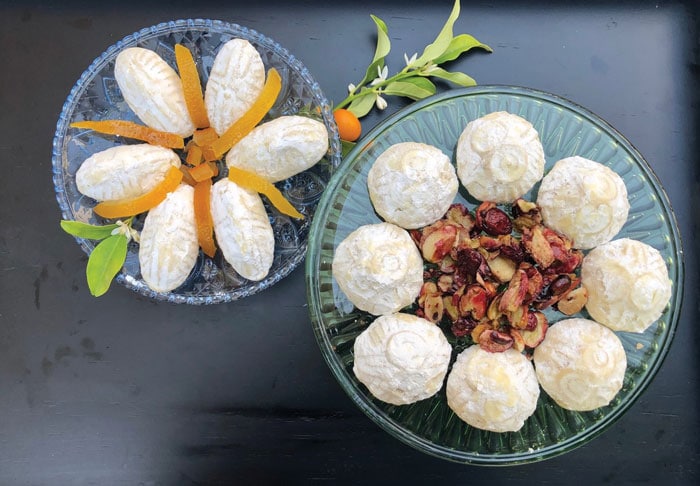
They would snack on fresh fruit and pitzu’chim (sunflower and pumpkin seeds). And from Savta Batya’s tiny kitchen would come delicious ma’amul, cookies stuffed with dates or nuts like walnuts, pistachios and almonds and coated in a snowy white layer of powdered sugar.
Yosi realized that Ma’amul wasn’t just a family delicacy lovingly baked by his grandmother, but part of the Aleppo culinary tradition.
Whenever Esther bakes Ma’amul, it brings Yosi right back to his childhood and his joyful grandparents.
The Ma’amul dough combines semolina and all-purpose flours, is not overly sweet and is subtly flavored with rose water essence.
The Ma’amul dough combines semolina and all-purpose flours, is not overly sweet and is subtly flavored with rose water essence.
The date and nut fillings are spiced with cinnamon and brightened with a dash of orange blossom water.
Ma’amul molds are passed down from generation to generation, but in our modern age, are easily found on Amazon.
Perhaps you’ll spend an afternoon baking these delightful treats for your family and friends.
Esther’s Ma’amul Recipe
Dough
2 cups all purpose flour
1 cup semolina flour
1/2 teaspoon rose water
1 cup (two sticks) unsalted butter or margarine or coconut oil
Nut Filling
1 pound walnuts, ground
2 tablespoons confectioners sugar
1 tablespoon unsalted butter or margarine or coconut oil, melted
1/2 teaspoon cinnamon
1/2 teaspoon orange blossom water
Date Filling
1 pound pitted dates
1/2 cup ground walnuts
1/2 teaspoon cinnamon
1/2 teaspoon orange blossom water
- Preheat oven to 350°F.
- Combine flour and semolina in a large bowl until it has a crumb consistency.
- Add rose water, fold in the butter and add 1/2 teaspoon lukewarm water.
- Knead the dough well (it should be smooth and shiny) and place in the refrigerator until ready to use.
- Prepare the fillings by combining the ingredients.
- Divide the dough into four portions.
- Work with one portion at a time, while covering the rest as you work.
Pinch walnut-size balls of dough, then press down on the center with your finger, to form a ½ inch indentation. - Fill the indentation with ¼ tsp of the filling, then close the pastry.
- If using a ma’amoul mold, press the top of the pastry firmly against the mold, then lightly tap the mold on a hard surface to remove the pastry.
- Place the pastries on a cookie sheet lined with parchment paper.
- Bake 10-12 minutes or until the bottom of the pastries are lightly browned and tops remain pale
- Sprinkle the cookies with confectioners’ sugar before serving
Rachel Sheff and Sharon Gomperts have been friends since high school. They love cooking and sharing recipes. They have collaborated on Sephardic Educational Center projects and community cooking classes. Follow them on Instagram @sephardicspicegirls and on Facebook at Sephardic Spice SEC Food. Website: sephardicspicegirls.com/full-recipes