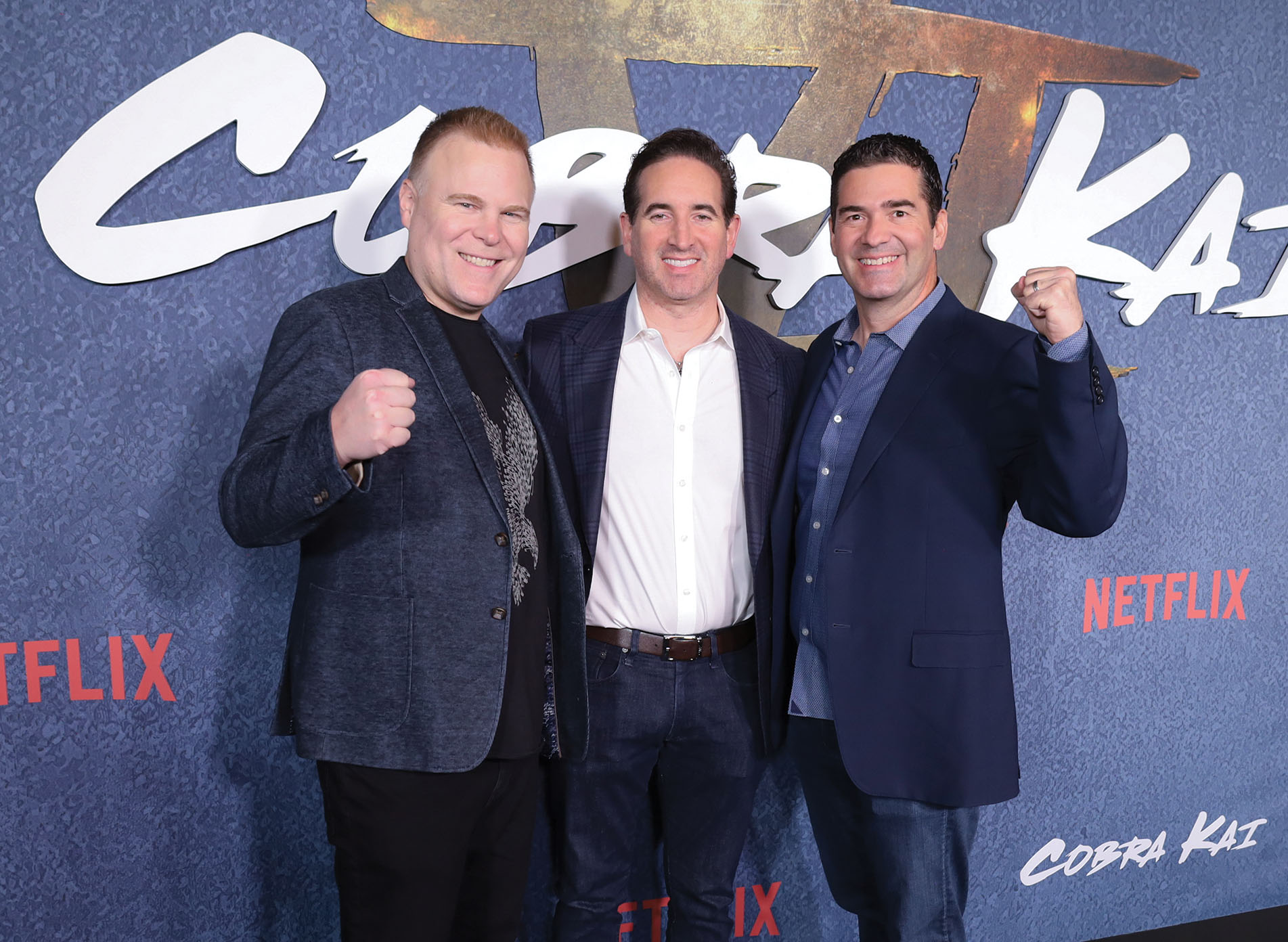
For fans of the 1984 film “The Karate Kid,” Netflix’s “Cobra Kai” has been more than just nostalgia — it has been an evolution of a beloved story. Created by three Jewish showrunners, Hayden Schlossberg, Jon Hurwitz, and Josh Heald, the show is now entering its final round, concluding with five more episodes in Season 6 — a 15-episode season instead of the usual 10.
“This is our Star Wars,” Hurwitz said when pitching the series to Martin Kove (John Kreese), Ralph Macchio (Daniel LaRusso), and William Zabka (Johnny Lawrence). What started as a YouTube Original in 2018 became a global hit. And that was before it exploded onto Netflix for Season 3 in 2021.
But “Cobra Kai” is about more than karate. It’s a show about buried trauma, grudges, redemption, betrayal, parenthood, and mentorship — all struggling for balance in a world where nobody is pure good or evil.
The showrunners all cited the films of the Zucker Brothers (“Airplane!,” “The Naked Gun”) as heavy influences on their film taste. They lean into parody as much as they tap the audience’s tear ducts. The show is a clinic on satisfying character arcs.
“My Jewish identity has always been very present in my life from the beginning of my childhood,” Hurwitz told The Journal. Both he and Schlossberg started in corporate jobs in New York before becoming screenwriters with their 2004 film “Harold & Kumar Go to White Castle.”
“I was very aware that there were a lot of Jews in Hollywood when I was growing up, so that did make it feel like it was an attainable career, even though the path to get there was always so murky,” Schlossberg said.
Their storytelling instincts and thirst for comedy raised audience expectations each season. That commitment to emotional authenticity is why the show resonates with audiences who grew up with the original John Avildsen film, which earned Pat Morita (Mr. Miyagi) an Oscar nomination for Best Supporting Actor. Most “Cobra Kai” characters have never met Mr. Miyagi, but they all feel his influence. There’s apt use of flashbacks and even nods to the virtues of the critically-panned “Karate Kid” sequels.
Heald spoke about the degree of responsibility they felt to respect what made them love “The Karate Kid” in the first place. “When you are in charge of something so important that you care about so deeply, you need to cherish that thing and hold it in a way that hopefully leads by example… in a way that makes people want to join and feel that energy,” he told The Journal.
“We always put the audience first. We’re never dragging ourselves to set miserably,” Hurwitz said. Referring to his partners Schlossberg and Heald, Hurwitz said, “We’re like brothers at this point.”
If we didn’t create this, we’d be right out there with you,” Schlossberg told a Troubadour crowd before a 2022 live performance of the show’s original score, composed by Zach Robinson and Leo Birenberg. Music was such a crucial part of 1980s films, and that comes alive in “Cobra Kai” with the score’s blend of 80s rock, modern synthpop and new takes on Bill Conti’s original “Karate Kid” cues.
The show remains one of Netflix’s most-watched half-hour series, introducing a new generation to a world much more dimensional than “wax on, wax off” or “sweep the leg.”
Johnny Lawrence’s inability to let go of the 1980s remains a 60-episode-long comedic goldmine, but its dramatic moments hit hard, as do the returning of characters from over 30 years ago. Their appearances are as emotional for the characters as they are for the audience. “It’s rare to get a second chance to play a character like this, and even rarer for that character to have real depth and growth,” said Sean Kanan (Mike Barnes).
Martin Kove credits the fans as much as the show’s creators. “The fans are loyal, and they expect more,” Kove said. “That pushes all of us to give them something great.”
With Season 6’s final five episodes dropping on Netflix on Feb. 13, there’s little doubt that “Cobra Kai” will finish victorious.