fbpx

February 13, 2025

The Modern-Day “Uncle Mordechai” Who Saved Countless Iranian Jews

On November 4, 1979, Iranian student supporters of Ayatollah Khomeini stormed the United States embassy in Tehran and took 52 American hostages, whom they held for 444 days. As part of U.S.’ response, On November 27, President Jimmy Carter issued executive order 12172, under which no Iranian would be allowed entry into the U.S. and those already here, including students, would be deported.

The setting of the event was an Islamic revolutionary Iran, an extremely frightened and defenseless Jewish community of 100,000 souls, and a mere few short months after the execution of Habib Elghanian, the head of the community, which had sent shock waves through the Jewish community of Iran, sending thousands fleeing the country in panic, including many who wanted to seek refuge in America where their student children, friends or relatives resided.

When the news of the executive order hit, my father, Moussa Kermanian, who, for decades was managing the community’s external relations, reached out to a dear friend, Morris (Morry) Katz with a request for help. Morry who had played a significant role in President Carter’s 1976 elections campaign and had a close friendship with the President agreed to help arrange a meeting at the White House for a delegation led by Kermanian to explain the predicaments of our community to the administration.

The momentous meeting took place in the spring of 1980. On the White House side, it was led by Stuart (Stu) Eizenstat, President Carter’s Senior Domestic Policy Advisor at the time, and included representatives from the Department of State, the then office of Immigration and Naturalization, Department of Justice, NSC and OMB.

Our community’s delegation consisted of 10 reputable community members from various walks of like who were joined by Mark Talisman, the head of the office of Council of Jewish Federations in Washington. The result of that meeting was an agreement by the White House delegation, led by Stu, to allow all Iranian minority groups to apply for asylum in the United States, eventually opening the way for tens of thousands of our brethren to immigrate to, and reside in this country permanently.

The full scope of what went into this effort and the decades’ long ensuing activities undertaken by the Iranian-American Jewish Federation (IAJF- formed about a year later) in close coordination with, and help from, our friends in the larger Jewish community in order to build upon the outcome of that meeting and ensure the continuity of admittance into the U.S. is beyond the scope of this short article. Suffice it to say that those activities did not end there. It will not be an exaggeration to state that most members of our community who currently live in this country owe their ability to be here to Stuart Eizenstat and the efforts of that community delegation.

To ensure that these activities did not harm the remaining Jewish Community of Iran, all activities surrounding this endeavor remained secret for nearly 40 years. As part of maintaining their confidentiality the code name given to Stu Eizenstat within the IAJF’s External Relations Committee, was “Uncle Mordechai” after Queen Esther’s uncle, who helped save the Jews of Iran from annihilation at the hands of Haman 2,500 years earlier.

In his book, “President Carter”, Stu recounts the events of that meeting. Many years later, he stated that what guided his decision to help was the knowledge of how Jewish requests to come to the U.S. during World War II were denied by the then U.S. administration and how that fact had led him to commit to help other Jewish communities escape persecution if he was ever placed in that position.

Stu went on to serve in numerous other high-ranking positions at the Departments of State and Treasury in the years that followed and among his many other accomplishments, he successfully negotiated compensation for the victims of the Holocaust and the return of Jewish looted art to their true owners.

Ambassador Stuart Eizenstat, our community’s Uncle Mordechai, will be visiting Los Angeles from the 24th to the 26th of February on a tour of his latest book “The Art of Diplomacy” and will be the guest of Stephen S. Wise Temple on the evening of February 25.


Sam Kermanian served as a director on the board of the IAJF for 30 years, of which he held the position of Secretary General for 15 years.

The Modern-Day “Uncle Mordechai” Who Saved Countless Iranian Jews Read More »
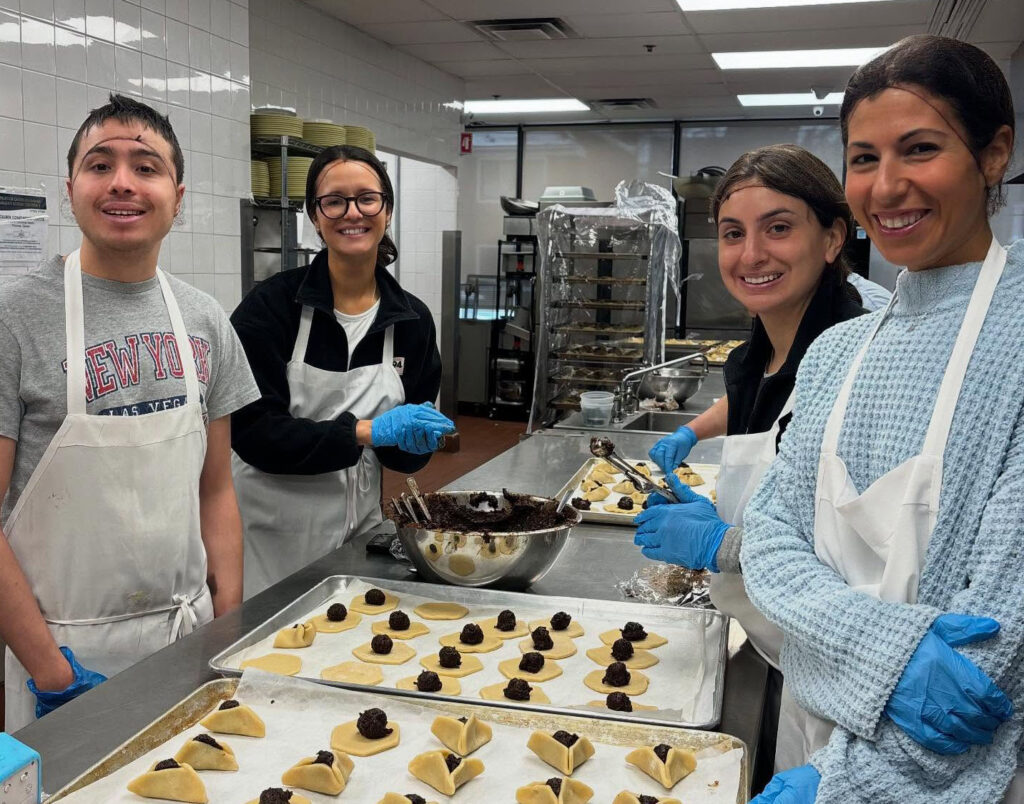
Zera Café – Food with a Purpose

When I shifted gears into full retirement mode last spring, after four years of part-time consulting work, Tuesdays became my favorite day of the week. Oh I still love celebrating Shabbat dinners with my family and spending quality time with my two young grandsons, and I still enjoy working on my Sunday morning radio show when I share my collection of music from the 1950’s and 60’s with listeners from around the globe. But Tuesday mornings from 9:00 to 12:30 have become very special for me. That is the time that I volunteer at the Zera Café.

Zera Café is a not-for-profit social enterprise that prepares and delivers healthy homemade meals and caters events in Montreal. Meals can be ordered from the organization’s website (https://zeracafe.ca) and can be picked up at various locations or shipped direct to one’s home or business. The well equipped kitchens are located in the Cumming Centre, a community centre managed by Federation CJA and supported by various charitable organizations and local foundations.

What makes a difference at Zera Café is their mission to employ neurodivergent young adults. The term “neurodivergent” describes people whose brains work differently than most. That means they have different strengths and challenges from people whose brains don’t have those differences. The dissimilarities may include medical disorders, learning disabilities and other conditions. The possible strengths include better memory, being able to mentally picture three-dimensional objects easily, the ability to solve complex mathematical calculations in their head, and many others.

Many of the employees at Zera Café struggle in public situations and they are often out of step with social cues. Some of the employees are on the Autism Spectrum or have Attention-deficit hyperactivity disorder (ADHD). The managers at Zera Café understand these challenges and have created a safe and productive working environment where employees are trained to prepare complex recipes including hearty soups, healthy salads, entrées and delicious desserts.

Zera Café is the brainchild of Ms. Eve Rochman, a graduate of McGill University’s Health and Social Services Management program. Ms. Rochman had no previous experience in catering or running a business, let alone managing people with intellectual or developmental issues but after 27 years in information technology, Rochman knew she wanted a career change, and earned a diploma in health and social services management.

Ms. Rochman learned about a growing need in the community. When neurodivergent young adults reach 21, they become too old for many of the currently available programs; they have no structure, few options and they often become despondent.

A federation survey confirmed a lack of opportunities for this population, so Rochman set about to create meaningful employment in a supportive environment. Many such young people, she knew, were capable of work that was more fulfilling than packaging or stocking shelves which they are often relegated to.

In 2019, Zera started with a couple of employees and volunteers in a synagogue’s kitchen, preparing food for the Sabbath kiddush. It was just starting to obtain some jobs catering small events outside the synagogue when COVID-19 commenced. The team was able to survive the crisis and was able to grow and move to its current location in 2021.

Besides providing ready-made meals to order through the web site, Zera also caters events in the Cumming Centre and provides specialty items to some Montréal restaurants like Beauty’s and Pigeon Café. All the meals produced at Zera are kosher and the site has full-time kashruth supervision. Many meals are vegan and gluten free.

Last spring, a friend, Lisa Steinberg, was talking to me about Zera Café and extolling the virtues of working there. She had started as a volunteer a year earlier, and was now employed at the Café on a full-time basis, helping with the scheduling, purchasing and inventory control. She asked me to try volunteering for one morning each week. I wasn’t much of a cook, but she assured me that there would be enough people in charge so that I would not mess up too often. The full-time employees are mostly in control and the volunteers are just there to help keep them focused and to keep the production flow on target.

The first day on the job, I worked with a lovely young lady named Jennifer. Together we made sixteen servings of lasagna with béchamel sauce. Although I sometimes had trouble understanding Jennifer, she knew exactly what to do and I did not. Jennifer tried to be patient with me and it was truly a learning experience for both of us.

I try to arrive a little before the official start of my shift, as it gives me a chance to socialize with the employees and my fellow volunteers. There is Jonathan, a young man who knows everyone’s birthday and every state and provincial capital. Darren likes to take a short nap before his shift begins. Dagmas is from India and loves the Beatles. Laura and Ricky are two of the loveliest ladies that I have ever met. Daniel, one of the younger employees, always has a smile. Mark, the dishwasher, has a collection of records and CDs from the fifties and sixties that rivals my own. There is an incomparable level of camaraderie between the employees.

When our shift begins, we don our hairnets, tie our aprons, thoroughly wash our hands and put on latex gloves. Every precaution is taken to insure food safety. We all meet with the chef, Ayelet and sous-chef Karen who assign the teams and give us our tasks. A task may consist of preparing and cooking an entire meal from start to finish or simply a “mis-en-place” where we are given a recipe and asked to collect, prepare and measure all the required ingredients.

During the past several months of volunteering at Zera Café, I have prepared hundreds of gallons of soup, peeled countless numbers of potatoes and carrots, sliced scores of onions, mixed kilograms of flour, eggs, and sugar, formed hundreds of potato latkes and prepared the filling for dozens of hamentashen.

When our shift is over, chef Ayelet always personally thanks each and every volunteer, but it is us that should be thanking her instead. As volunteers, we are being given an exceptional opportunity to participate in a project that allows us to work hand-in-hand with very special people and provides a meaningful and positive contribution to the community.


Paul J. Starr is a recently retired systems analyst who has lived his entire life in Montréal, Canada. On Sunday mornings he is “living the dream,” hosting a two-hour Internet radio show featuring music from the 50s and 60s called “Judy’s Diner.”

Zera Café – Food with a Purpose Read More »

How Many Jewish Football Players Have Won A Super Bowl?

Although there were no Jewish players on the last two Super Bowl-winning teams, since the founding of the National Football League in 1920, there have been 18 Jewish football players who have won a Super Bowl or NFL Championship.

What’s the difference between the NFL Championship and the Super Bowl?

The first Super Bowl wasn’t played until 1967, when the well-established National Football League (NFL) and the upstart American Football League (AFL) agreed to a World Championship Game between the champions of the two leagues. The Green Bay Packers would defeat the Kansas City Chiefs at the Los Angeles Memorial Coliseum. At the time, the game was known as The AFL-NFL World Championship Game, tickets cost $10 and the game didn’t even sell out. The face-value price of the cheapest Super Bowl LIX ticket this week in New Orleans was $950.

What’s the AFL?

The NFL was founded in 1920, while its competitor AFL was founded in 1959. The two leagues operated as separate entities from 1959-1970; their seasons ran simultaneously, but each league had their own playoffs and champions, with the NFL always considered the superior league.

What has now retroactively become known as “Super Bowl I” marked the first time that the champions of both the AFL (Kansas City Chiefs) and NFL (Green Bay Packers) met after winning their respective league championships.

It wasn’t until the fourth AFL-NFL Championship game that the words “Super Bowl” even appeared on the game ticket— that game is now known as “Super Bowl IV” and was played in January of 1970, the same year the two leagues completed their merger.

With the merger completed, the NFL teams became the National Football Conference (NFC) and the AFL teams became the American Football Conference (AFC) in a united league called the NFL. Three NFL teams moved to the AFC following the merger: the Pittsburgh Steelers, Baltimore (now Indianapolis) Colts and Cleveland Browns.

To confuse things even more, from 1920-1932, no NFL Championship Game was played. But at the end of the season, whichever team had the best record was deemed the NFL Champion. From 1933-1969, the NFL held playoffs to determine the champion.

Why does this matter for this article? Because six Jewish NFL players won NFL Championships before the Super Bowl era. And another two Jewish football players won a championship on an AFL team.

So what team has won the most Super Bowls? There are two ways to answer the question:

The first way is to simply count the wins from Super Bowl I onward. The Pittsburgh Steelers and New England Patriots have each won six Super Bowls. However, since the founding of the NFL, the Green Bay Packers have been champions of the league 13 times (nine NFL championships and four Super Bowls victories).

Why does the Super Bowl use roman numerals while the NFL Championships use years?

Since the Super Bowl era began (retroactively to 1967), the big game has been played in a different calendar year than the rest of the regular season. By contrast, Major League Baseball, the National Basketball Association and the National Hockey League play their entire regular season, playoffs and championship in the same calendar year.

Four quick facts about the Jewish football players who have won a Super Bowl (or NFL Championship):

► Sid Luckman is the only Jewish quarterback to win an NFL Championship, winning four while leading the Chicago Bears. None have won a Super Bowl.

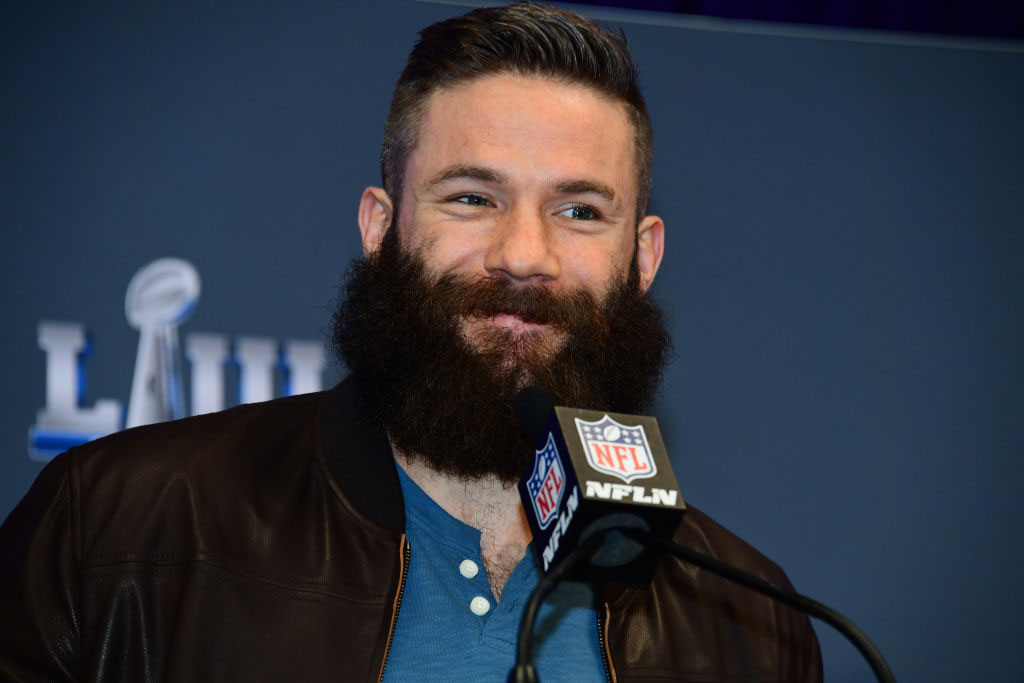
► Julian Edelman is the only Jewish NFL player to win the honor of Super Bowl MVP. Edelman and teammate Nate Ebner won three Super Bowls as teammates on the Patriots. Greg Joseph and Ali Marpet won one Super Bowl as teammates with the Buccaneers.

► The 1950s were the only decade when no Jewish player won an AFL or NFL Championship. The 1960s were the only decade when no Jewish player won an NFL Championship.

► Offensive Tackle Ron Mix, who played with the Los Angeles Chargers, is the only Jewish player to ever win an AFL Championship. That team was led by Jewish Head Coach Sid Gillman, the only Jewish head coach to win an AFL or NFL championship.

► No Jewish NFL head coach has ever won a Super Bowl, but the Buffalo Bills’ Jewish head coach Marv Levy still is the only coach to bring his team to four straight Super Bowl appearances from 1991-1994 — all losses.

Confused yet? Let’s just skip to the list of Jewish football players who have won a Super Bowl (or NFL Championship).

* Denotes a pre-AFL-NFL merger NFL Championship.

# Denotes a pre-AFL-NFL merger AFL Championship.

4 RINGS — JEWISH FOOTBALL PLAYERS WHO WON FOUR SUPER BOWLS OR NFL CHAMPIONSHIPS:

Quarterback Sid Luckman won the NFL Championship in 1940, 1941,1943 and 1946 — all with the Chicago Bears.*

Tight end Randy Grossman won Super Bowl IX in 1975, Super Bowl X in 1976, Super Bowl XIII in 1979 and Super Bowl XIV in 1980 — all with the Pittsburgh Steelers.

3 RINGS — JEWISH FOOTBALL PLAYERS WHO WON THREE SUPER BOWLS OR NFL CHAMPIONSHIPS:

Guard and running back Charles “Buckets” Goldenberg won the NFL Championship with the Green Bay Packers in 1936, 1939 and 1944.*

Offensive tackle Harris Burton won Super Bowl XXIII in 1989, Super Bowl XXIV in 1990 and Super Bowl XXIX in 1995 — all with the San Francisco 49ers.

Wide receiver Julian Edelman won Super Bowl XLIX in 2015, Super Bowl LI in 2017 and Super Bowl LIII in 2018 —all with the New England Patriots. He was named Most Valuable Player of Super Bowl LIII.

Safety/Special Team player Nate Ebner won Super Bowl XLIX in 2015, Super Bowl LI in 2017 and Super Bowl LIII in 2018 — all with the New England Patriots.

2 RINGS  — JEWISH FOOTBALL PLAYERS WHO WON TWO SUPER BOWLS OR NFL CHAMPIONSHIPS:

Tight end John Frank won Super Bowl XIX in 1985 and Super Bowl XXIII in 1989 — both with the San Francisco 49ers.

Outside linebacker Terrell Suggs won Super Bowl XLVI in 2013 with the Baltimore Ravens, and Super Bowl LIV in 2020 with the Kansas City Chiefs.

1 RING  —  JEWISH FOOTBALL PLAYERS WHO WON ONE SUPER BOWL,NFL CHAMPIONSHIP OR AFL CHAMPIONSHIP:

Guard Joseph “Doc” Alexander won the NFL Championship in 1925 with the New York Giants.*

Quarterback Harry Newman won the 1934 NFL Championship with the New York Giants.*

Guard Leonard “Butch” Levy won the NFL Championship in 1945 with the Cleveland Rams.*

Halfback Marshall Goldberg won the 1947 NFL Championship with the Chicago Cardinals.*

Offensive tackle Ron Mix won the American Football League championship in 1963 with the San Diego Chargers.#

Head coach Sid Gillman won the American Football League championship in 1963 with the San Diego Chargers.#

Guard Ed Newman won Super Bowl VIII in 1974 with the Miami Dolphins.

Defensive End Lyle Alzado won Super Bowl XVIII in 1984 with the Los Angeles Raiders.

Punter Josh Miller won Super Bowl XXXIX with the New England Patriots in 2005.

Tackle/Guard Alan Veingrad won Super Bowl XXVII with the Dallas Cowboys in 1993.

Offensive Tackle Mitchell Schwartz won Super Bowl LIV in 2020 with the Kansas City Chiefs.

Placekicker Greg Joseph won Super Bowl LV in 2021 with the Tampa Bay Buccaneers.

Guard Ali Marpet won Super Bowl LV in 2021 with the Tampa Bay Buccaneers.

The next two Super Bowls will be in California — hosted at Levi’s Stadium in Santa Clara in 2026, and SoFi Stadium in Inglewood in 2027.

How Many Jewish Football Players Have Won A Super Bowl? Read More »

Quit Hewning Around – A poem for Parsha Yitro

When you make Me an altar of stones, you must not build it with hewn stones, for if you lift your sword over a stone intended for the altar to cut it, you will profane it. ~ Exodus 20:22

Like God, I prefer a natural look to things.
I keep telling our gardener to let the leaves
grow where they may and it would be fine

if the grass had the chance to ascend a few inches
into the sky before applying the guillotines of his trade.
He’s obsessive with his mower.

Nature is always trying to reach the sun, and we hope
it never gets there because that would be the end of it.
The scientists keep telling us the end of it

is coming soon if we keep hewning everything
the way we’ve been doing. But it may not matter
because one look at the news and we can see

science and scientists will soon be illegal.
They’re sending the scientists to the border
along with the tax collectors to make sure

none of that Canadian energy gets in without
paying the fee. We keep chopping up the Earth.
We keep changing oxygen into something

less desirable. We keep vigilant against
the rainforests lest they keep us alive.
We keep extincting the animals because

their numbers make us uncomfortable.
Look at the beavers. Not a hewn stick
on any of their homes. Beautiful.

We could learn everything from the beavers.


Rick Lupert, a poet, songleader and graphic designer, is the author of 28 books including “God Wrestler: A Poem for Every Torah Portion.” Visit him at www.JewishPoetry.net

Quit Hewning Around – A poem for Parsha Yitro Read More »

Rabbis of LA | Rabbi Sharon Brous’ Path From ‘Functionally Illiterate Jew’ to Ikar’s Spiritual Leader

Ikar, the unique and progressive synagogue in Los Angeles, will celebrate its 21st birthday this year. But Rabbi Sharon Brous, one of Ikar’s founders and its rabbi, has been interrogating the roots and intellectual basis of Judaism for more than three decades. 

Raised in the New Jersey suburbs, Brous grew up in a Jewish-identified but not a Jewish-religious home “We were part of the Reform synagogue,” she said, “but my parents really were Reconstructionsts. My grandmother’s uncle was Mordechai Kaplan [the founder of the Reconstructionist movement]. Rabbi Kaplan married my parents. They always had this little rebellious edge in the Reform environment. They knew they didn’t fit exactly right.”

While she was growing up, her parents left the Reform synagogue and started a little breakoff Reconstructionist community, “one that exists to this day.” This gave her a strong sense of Jewish community and identity growing up. But she explained, it left her without “a very strong context of what the broader Jewish community looked like. And no idea about traditional Jewish practice or learning or ritual or engaging.”

Active in the Reform community, she attended Columbia University because “a quarter of the students were Jewish.” She was in for a surprise. 

While her parents took her to synagogue growing up, it was “a kind of cloudy environment. We had a Jewish life. We were frum on Passover. We took everything out of the house. Every Friday night we ate dinner in the dining room instead of the kitchen. We always had challah. And we went to synagogue, not just on High Holy Days.” She immediately discovered that her understanding of the Jewish community was “very narrow.” The young woman who eventually chose the rabbinate was struck by “how much I didn’t know.” She lacked even the basic knowledge. “It’s embarrassing and painful to realize that something you think is yours  — you have a very thin relationship [with] in reality.  

“I realized the Judaism I was raised in gave me a very small slice of the broader Jewish picture,” she said. It was especially painful because “it was so central to my identity.” But her initial interactions turned her off. “I really was repelled by the Jewish community, which seemed aggressively judgmental – and impenetrable.”

She refused to be discouraged. She started showing up in Jewish environments in college, “going to Shabbat services at Hillel, which was not called Hillel at the time. And going to Shabbat dinners and placing myself in Jewish environments where I recognized quickly there was a whole Jewish language I was completely ill-equipped to engage.”

Brous interpreted each delay as a learning experience. She engaged with life in New York City, studying African-American history and culture and Eastern religion. She viewed herself as a citizen of the world.

That sense of self was shattered by the 1992 attack on the Israeli Embassy in Buenos Aires. “I felt my heart ripped out of my chest,” she said.  “I was so stunned by my own reaction … Why did I feel this particular pain. It felt like it was my family, even though I never had been to Israel. I was very uncomfortable with that awareness.” Jews were attacked a world away in Argentina, and Brous decided she had to investigate.

“My dear friend David, who, years later, would become my husband, had grown up in the Ramah system, going to Ramah camps. His mother was a Jewish educator in Philly. I reached out to her. I asked her to help me find a synagogue where I could learn.

“She handwrote a list of every synagogue in New York City. Thankfully I was in a city with a lot of synagogues. Part of my story is David and I would go every Friday night for almost a year to a different synagogue in New York City. 

“I really got a good understanding of the broader Jewish community. In the Orthodox synagogues and most of the Conservative synagogues, nobody ever said what page we were on.” She walked in as “a Jew searching for a way to connect with my own tradition.” Everybody was engaged, she said, but no one helped her to figure out how to engage.

“I desperately wanted it. I went into Reform synagogues and felt, like, I already know all of this. I’m left functionally illiterate. So it doesn’t help. I really struggled. One Friday night we went to the next one on the list, on the Upper West Side, B’nai Jeshurun. Remember, David was a knowledgeable Jew. This was different from the others. From the moment I walked in, I felt I was embraced in a kind of community that I desperately had been searching for.”

The service was in Hebrew, but she felt “as if I understood every word. It was because the music was so moving, so emotional. And then the preaching was so profound. I felt as if I had been invited into a kind of Jewish practice that was spiritually deep, traditionally rooted and deeply invested in the world we were living in now — and how to make it more just and more loving.”

Rabbi Brous talks about this moment as if it occurred an hour ago. It was, she said, “transformative … I remember the night well. I was bawling. Every week after these failed Friday night experiences, I’d leave crying. We’d go out to dinner, and this is part of our falling-in-love montage because David would say, ‘It’s okay, we’ll find a better place for you next week.’”

Rabbis of LA | Rabbi Sharon Brous’ Path From ‘Functionally Illiterate Jew’ to Ikar’s Spiritual Leader Read More »

My Roots, Midrash and Tu B’Shvat

Although regarding boksers I don’t give two hoots,
about the carob trees on which they grow my mind’s not shut,
appreciating what helps them to grow like me, their roots,
my roots not just midrashic explanations of me, but peshat,
a process which midrashic explanations hardly moots,
both tastier than boksers I don’t eat on Tu B’Shvat,
enjoying both midrashic explanations and peshat as fruits
that aren’t dependent on a kashrut label such as glatt.

I’ll add to this an explanation why the tithing laws
whose fiscal years begin on Tu B’Shvat apply
only to fruit that grows in Israel because
law-hanging fruit digestion depends on divine wi-fi.

All commandments, according to Ramban, Nahmanides,
must be performed in Israel, as if beyond
its borders they are comparable to words of ditties
that we don’t fully comprehend however much of them we’re fond.


In “Why Jews Used to Eat Dried Carob on Tu b’Shvat: Bokser smells like Limburger cheese. It’s also an embodiment of Jewish vitality and endurance,” mosaicmagazine.com, 2/4/15, Meir Soloveichik writes:

In the Talmud, the holiday of Tu b’Shvat commemorates nothing more than one in a series of halakhic deadlines related to the obligation to offer tithed portions of the year’s crops to the Levites in the Temple. For fruits in particular, the end of one fiscal year and the beginning of the next was marked by Tu b’Shvat, the fifteenth day of the Hebrew month of Shvat. Because these laws of tithing applied only to produce grown in the Holy Land, celebrating Tu b’Shvat became throughout the centuries a way of connecting to the land itself. For Ashkenazi Jews, that meant eating one fruit: carob, whose name derives from the Hebrew haruv and whose Yiddish name, bokser, is short for the German bokshornbaum, the tree with ram’s-horn-shaped fruit…..

The last verse provides a midrashic explanation for the fact that the tithing laws whose fiscal year begins on Tu B’Shvat only apply to fruit that grow in Israel. These fruit generate what the rabbis call מצוות תלויות בארץ, whose literal meaning is “commandments hanging from the land,” the word תלויות midrashically implying that commandments which only apply to the land of Israel, hang on this land as decoratively as low-hanging fruit on branches of trees, inspiring my wordplay “law-hanging.”


Gershon Hepner is a poet who has written over 25,000 poems on subjects ranging from music to literature, politics to Torah. He grew up in England and moved to Los Angeles in 1976. Using his varied interests and experiences, he has authored dozens of papers in medical and academic journals, and authored “Legal Friction: Law, Narrative, and Identity Politics in Biblical Israel.” He can be reached at gershonhepner@gmail.com.

My Roots, Midrash and Tu B’Shvat Read More »

A Bisl Torah~The Sworn Truth

How often do we hear someone utter to themselves or casually remark, “I swear it’s true” – without taking the time to verify the veracity of those statements?

In the Ten Commandments, we are introduced to the third commandment, “You shall not take the Lord’s name in vain.” One might assume this only means to not use God’s many names in an informal manner or when offering an angry remark.

But the commandment insinuates more. Biblical commentator Ibn Ezra teaches, “When a person mentions God’s name, he is saying, ‘As God is True, so what I will say is True.’ Thus if he does not keep his word, he is, as it were, denying God.’” By extension, when someone implies they are sharing what they deem the truth, the person is bringing God as a witness to their words, a holy testifying. Likewise, if someone spreads lies and falsehoods, that same person is desecrating God’s name in the process.

We are told that the Torah is the blueprint in how God creates the world; not just the initial unfolding of day by day, but the ongoing process in how human beings interact and grow with each other.

God exists within each of our steps, actions, and words. When we choose our words carefully, with love, sensitivity, kindness, and research, God’s presence shines upon us. When we use our words to hurt and spread lies, God’s presence is stripped from this world.

May our words lift and exalt God’s holy name.

Shabbat Shalom


Rabbi Nicole Guzik is senior rabbi at Sinai Temple. She can be reached at her Facebook page at Rabbi Nicole Guzik or on Instagram @rabbiguzik. For more writings, visit Rabbi Guzik’s blog section from Sinai Temple’s website.

A Bisl Torah~The Sworn Truth Read More »

A Moment in Time: “When the Temperature Goes Up”

Dear all,

Both Maya and Eli have been fighting the flu over the past week. It’s a nasty bug this year with fevers that go down, but then rise up again 15 hours later.

Thankfully, they are on the mend.

Each time their temperature went up, we responded with a combination of cool towels, soothing music, Tylenol/ Motrin and chocolate milk. (Please don’t judge! They just needed something sweet!)

Sigh – as I think about the many issues in our country and our world, with the political temperature seeming to rise to unprecedented levels, I think that we need to consider the same approach:

Rather than respond to heat with heat, rather than allowing ourselves to get caught in the vortex – we need a cooling off period.

We need to refresh our minds.

We need to soothe our hearts.

We need to lower the fever.

And we need sweetness.

It’s not about escaping reality or avoiding important issues. It’s about taking a moment in time to rid ourselves of the viruses that are infecting our spirits.

It’s about grounding ourselves with the values we honor.

So when the temperature goes up, let’s bring it down – then move forward.

With love and shalom,

Rabbi Zach Shapiro

A Moment in Time: “When the Temperature Goes Up” Read More »

When the Fire Takes Everything: Mourning the Loss of a Home

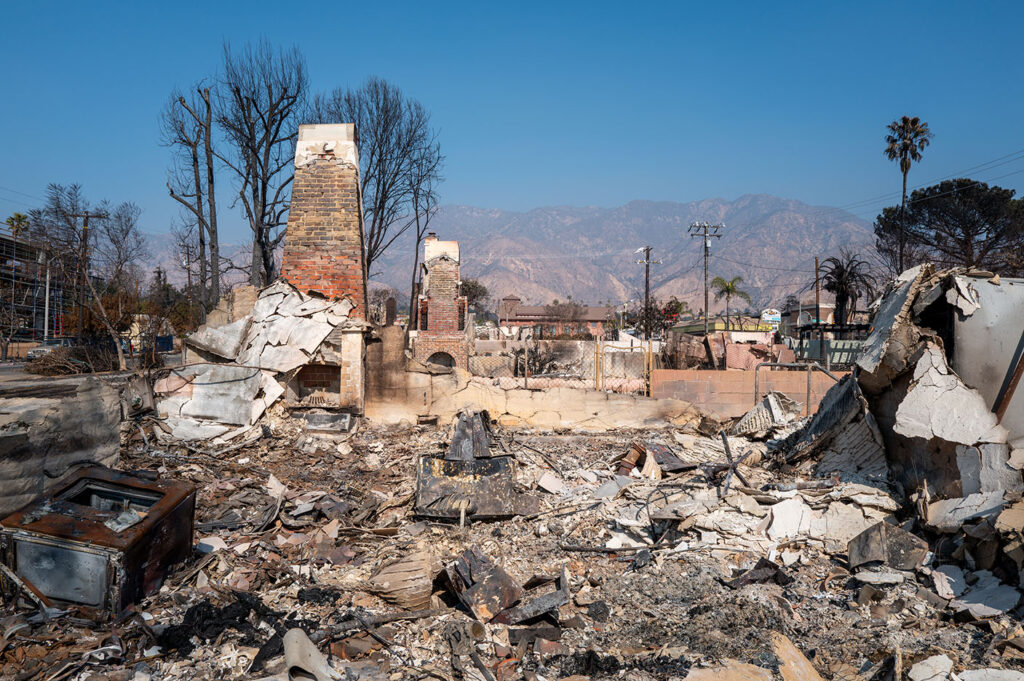
In the stillness after the flames die down, in the silence where walls once held laughter and doorways framed years of coming and going, a unique kind of grief exists. For those who lose a home — especially as suddenly and violently as happens in wildfires — that loss feels both intangible and all-consuming. It is experienced as a disorienting rupture in time and space. 

Jewish tradition has long understood this kind of loss, informed by our experience as a people who wandered, fled, and rebuilt time and again. From the destruction of the First and Second Temples to the forced exiles that scattered our ancestors across the world, we learned what it means to grieve both lost loved ones and lost spaces that once sheltered our lives.

A Trauma of Displacement

Psychologists teach that losing a home to wildfire is a profound psychological rupture, a sudden loss of grounding. Dr. Pauline Boss, an expert on ambiguous loss, explains that some losses — like a loved one’s death — have clear rituals for mourning, while others — like losing a home — leave us in limbo, struggling with unresolved grief. “With ambiguous loss, there is no closure; the challenge is to learn how to live with the ambiguity,” she writes. We grieve both the house itself and the memories and stability it represented, making it harder to find emotional resolution. 

Dr. Betsy Stone, who guides Jewish leaders through catastrophes, contends that losing a home is like losing history: gone are Grandma’s china, kids’ photos, artwork, and expired passports full of stamps. 

Losing a home is also losing comfort: I once knew where I sat, where I kept extra paper towels. Now with routine ripped from me, wherever I land, I must learn a new house and develop new daily rituals. 

Losing a home is also losing a neighborhood: Where do I go for milk? For medications? Where will I take my regular walk? Like in all mourning, we have lost the anchors of our reality. 

Jewish Language for Profound Pain

Jewish tradition offers us a language for profound pain. When we mourn a loved one, we sit shiva to mark the severance of life; we recite Kaddish to affirm that even in loss, holiness (and the Holy One) remain. When we lose the physical spaces where we built our lives — where mezuzot once sanctified our doorways and the glow of Shabbat candles once warmed our tables, Judaism encourages similar mourning rituals.

So after the loss of a home, we mourn: 

Crying constantly, as we struggle through the incongruity of mourning a place. 

Cataloguing what was lost — family heirlooms, childhood growth charts etched into door frames, the scent of familiar spaces — simultaneously dismissing them as mere “things” while also mourning them as sacred. 

Contend with finding a place to live, a temporary sukat shalom (shelter of peace) to hold our broken hearts and in which to create new memories for the future. 

Moving From Loss to Renewal

Then we mirror the actions of our ancestors after the destruction of the Temple. They carried holiness into their new homes, turning each house into a mikdash me’at, a miniature sanctuary, with Shabbat rituals transforming dining tables into altars and meals into sacred gatherings. 

So we hang mezuzot in our new spaces, sanctifying them as places with potential for holiness, healing, and renewal. 

We gather again with people whose presence remind us of relationships that remain. 

We collect new objects that objectively are mere things but when received with love and lifted up with love remind us that we are anchored to a community that cares. 

All of these also reminds us of a Holy Presence that wanders with us. 

Then we make Shabbat in our new temporary homes, imbuing gifted ritual objects with instant holiness. 

The path forward is neither quick nor easy. Healing comes step by step — grieving, honoring, leaning on others, and rebuilding.

Yet even in the absence of what once was, even as the embers cool, we hold on to a truth that has sustained our people for generations: that home is not just a place. Home is memory, it is connection, it is belonging. And like after the loss of a loved one, we too will rise up from the ashes and we will build again.


A Prayer for Those Who Lost Their Homes in the Fires

Eloheinu v’Elohei Doroteinu—Our God and God of all generations,

We turn to You, shaken by loss, our hearts heavy with grief.

The flames have taken much—

The walls that sheltered our family,

The keepsakes that told our stories,

The irreplaceable treasures of our children’s laughter and growth.

And yet, we stand amidst the ashes,

Holding gratitude for what remains.

For the miracle of life,

For the pets that survived,

For the arms that still hold one another, tightly, unyieldingly.

Source of our Strength,

Bless us with resilience to rebuild,

With courage to move forward,

And with faith in the power that renews creation daily.

As the earth regenerates from destruction,

So, too, may we find the strength to rebuild our lives.

Teach us to create anew—

To build homes that will once again hold our laughter,

To fill them with precious keepsakes recreated,

Sacred symbols to pass on L’dor Vador, from generation to generation.

May these new treasures embody the love, values, and resilience that define       our family,

And may the memories we craft today become blessings for the future.

And may Your light guide us,

Illuminating the path from devastation to renewal,

From despair to peace,

From loss to wholeness.

Baruch Atah, Adonai,

HaMechadesh Kol Yom Ma’aseh Beresheet—

Blessed are You, who renews creation daily.


Rabbi Paul Kipnes is leader of Congregation Or Ami in Calabasas, California, and author of “The Secret Life of the Mourner” (lulu.com).

When the Fire Takes Everything: Mourning the Loss of a Home Read More »

‘Not That Jewish’ Performed at The Braid; Beit T’Shuvah Raises Nearly $3 Million

A special performance of “Not That Jewish,” comedian Monica Piper’s popular one-woman show, was held at The Braid, a Jewish performance and art space, on Feb. 8.

“Not That Jewish,” written and performed by Piper, directed by Eve Brandstein and produced by Ronda Spinak, traces Piper’s life, from a childhood in the Bronx doing “Annie Get Your Gun” routines with her father, to adulthood in Los Angeles as a comedian and television writer.

Along the way, she experiences two divorces, the death of her parents and a breast cancer diagnosis. At age 41, she decides to adopt a son. She raises him as a single mother.

Tying the autobiographical show together is Piper’s continued questioning of her relationship with Judaism. When Piper is young, she’s told she’s “Not that Jewish,” since she doesn’t go to synagogue on the High Holy Days, prompting self-examination and the questioning of relatives whose answers over plates of chopped liver are peppered with Yiddish — and what’s more Jewish than that?

Later in her life, her son, whose biological mother isn’t Jewish, wrestles with similar questions about his Jewish identity. 

Ultimately, the 85-minute show is a celebration of family, told with joy and humor. Piper presents the people who most shaped her — her mother, father, relatives and her son — with warmth, nuance and care. 

Seated in the audience in the intimate theater space, one couldn’t help but root for Piper’s character, hoping that her story had a happy ending as she faced what life threw her way, both the mundane and the extraordinary. 

On The Braid website, the show is described as one that’ll leave audiences laughing out loud at some moments while “a little teary-eyed” at others. That certainly proved true. When Piper, in character, reads a letter she received from her son’s biological mother, essentially thanking her for raising such a mensch, a quick glance around the theater showed people wiping away tears.

The recent performance of “Not That Jewish” marked the opening of The Braid’s new venue, located in a small theater in a Santa Monica office park. 

The performance was also an opportunity for those affected by the recent Palisades Fire to take a moment and forget about their stressful circumstances. Those in attendance on Saturday night included people directly affected by the fire. Local community member Ofir Jacob sponsored all the tickets for the evening. 

Before the show began, Jacob said the hope was to give members of the Palisades community a bit of break from everything they’ve been dealing with. Tonight was about enjoying Piper’s show, he said.

Spinak, co-founder and artistic director of The Braid, echoed that sentiment.

The current run of “Not That Jewish,” recently extended, continues at The Braid through March 30. 

If you want to spend an evening laughing, crying and feeling good about being Jewish, don’t miss it.


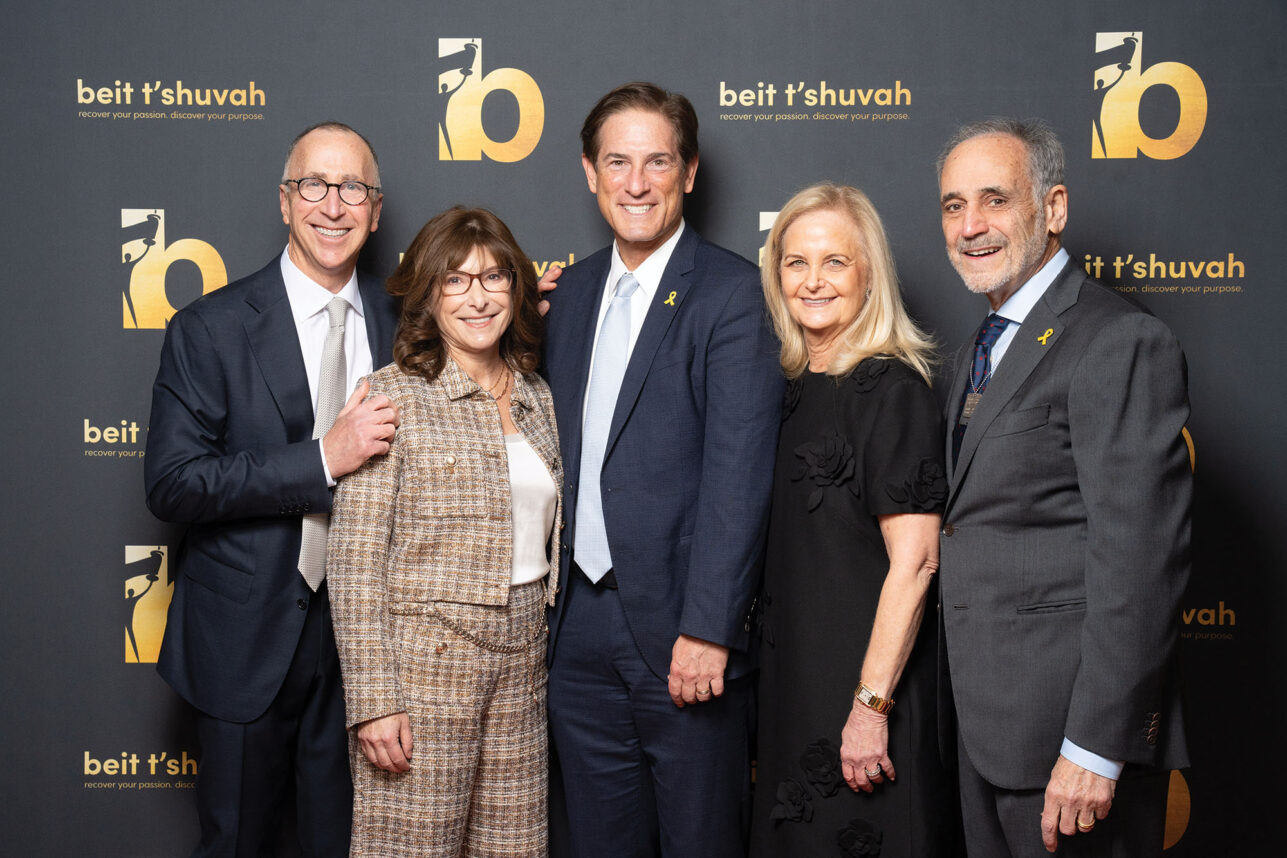
From left: Beit T’Shuvah honoree Keith Elkins; Jackie Elkins; L.A. County District Attorney Nathan Hochman; and Lynn and Les Bider. Courtesy of Beit T’Shuvah

Last month, Beit T’Shuvah held its 33rd annual gala. The glitzy evening raised $2.7 million for addiction recovery scholarships.

The Jan. 26 gathering at the Beverly Hilton drew 830 attendees. 

Speakers included Beit T’Shuvah Board Chair Keith Elkins, who was honored with the T’Shuvah Award, and board member Lynn Bider, who was recognized with the Annette Shapiro Volunteer Award. Elkins shared his heartfelt journey as a grateful father whose son found recovery through Beit T’Shuvah, while Bider reflected on her 24 years of dedicated service to the Beit T’Shuvah community.

Additional participants in the evening were Rabbi Ed Feinstein, emeritus rabbi at Valley Beth Shalom; Beit T’Shuvah Board Chair Emeritus Janice Kamenir-Reznik; U.S. Rep. Brad Sherman (D-Sherman Oaks); and Beit T’Shuvah Executive Director Zac Jones. Jones, for his part, delivered an inspiring message of hope for the future while also sharing his personal story of getting sober through the Beit T’Shuvah program. 

Marrisa Axelrod, a Beit T’Shuvah alumna, and long-time Beit T’Shuvah Board President Annette Shapiro also spoke. Les Bider, Jackie Elkins and Heidi Praw served as the gala co-chairs.

Beit T’Shuvah is a Jewish rehabilitation agency as well as a synagogue. Its mission is to heal broken souls and save the lives of those wrestling with addiction by providing integrated care in a community setting.

‘Not That Jewish’ Performed at The Braid; Beit T’Shuvah Raises Nearly $3 Million Read More »