
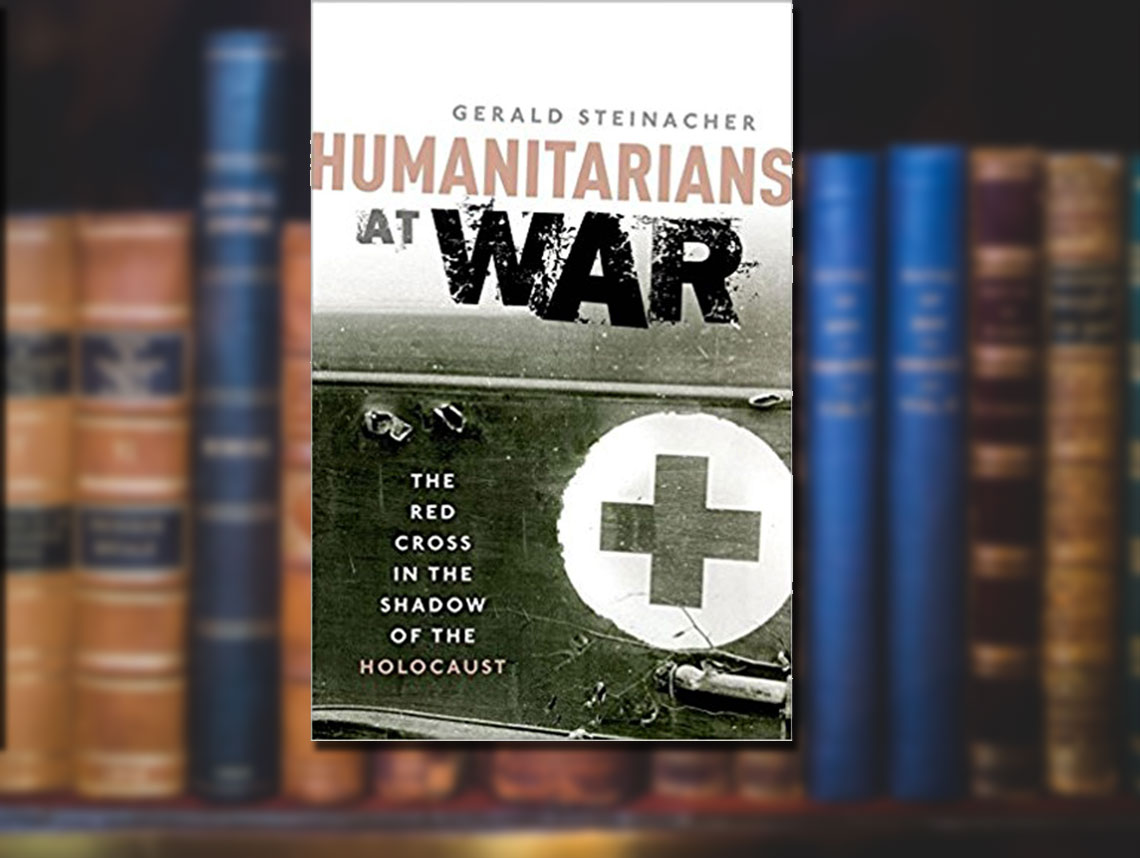
One of the sorry backstories of World War II is found in what the Red Cross did — or, more precisely, failed to do — during the Holocaust.
The pointed question was asked aloud by one survivor in May 1945 — “Where, above all, was the International Red Cross Committee?” — and now it is answered with authority and in compelling detail in “Humanitarians at War: The Red Cross in the Shadow of the Holocaust” by Gerald Steinacher (Oxford University Press).
Steinacher is the Hymen Rosenberg Professor of Judaic Studies at the Lincoln campus of the University of Nebraska. One of his previous books, “Nazis on the Run: How Hitler’s Henchmen Fled Justice,” was honored with a National Jewish Book Award by the Jewish Book Council in 2011.
In his new book, Steinacher reminds us that the International Committee of the Red Cross (ICRC), as the Swiss-based organization was formally titled, deferred to the German Red Cross throughout the 1930s, when Hitler’s concentration camp system was first put into operation. Already “deeply Nazified,” the German Red Cross assured the ICRC that “the living standard in the camps [was] higher than most of the inmates were generally used [to].” Steinacher writes: “The German Red Cross had for all practical purposes … turned into a National Socialist medical service unit supporting Hitler’s Wehrmacht.”
Even after the outbreak of World War II, the ICRC did little or nothing to assist the victims of Nazi terror. Steinacher describes how the ICRC managed to send a few food parcels to Germany in 1943, including 882 packages that reached Dutch and Norwegian inmates, and 31 packages that reached Jewish inmates. But when the ICRC proposed to send food parcels to Auschwitz, the German Red Cross “claimed that the Jews were employed exclusively in labour camps in the East and that food and medication there [were] reportedly abundant,” Steinacher writes. In a message tainted with bitter irony, a representative of the German Red Cross wrote to the ICRC that “shipments of supplies to these camps were in principle not necessary.”
What is surely the most tragic moment in the history of the International Red Cross came when Nazi Germany invited the ICRC and the Danish Red Cross to inspect the concentration camp at Terezín (Theresienstadt). “Weak and sick people were deported to Auschwitz to reduce the numbers in the completely overcrowded camp, houses painted, streets and parks cleaned, and flowers were planted,” Steinacher writes. “The delegates were shown a school, a soccer game, and a children’s theatre performed for them. The deception seemed to have worked, and the Nazis were very pleased with the ICRC’s favourable report of the good treatment of Jews in German camps.”
Not until 1944, when the mass murder of Jews already was being reported in the pages of The New York Times, did the ICRC finally bestir itself to render “tardy assistance” to the Hungarian Jews who were the last major Jewish population to be deported to the death camps. Representatives of the ICRC belatedly showed up in Budapest, where they joined other humanitarians — most notably, the Swedish diplomat Raoul Wallenberg — in an 11th-hour effort to save the precious remnant that remained alive.
“The ICRC in Budapest soon followed the Swedish example and handed out letters of protection to Jews and put Jewish hospitals, clinics, hostels, and soup kitchens under the protection of the organization,” Steinacher reports.
But it took urgent intervention by both Pope Pius XII and U.S. President Franklin Roosevelt to move the ICRC to write a letter of appeal in June 1944 to Hungarian dictator Miklós Horthy. “With this letter, the ICRC officially broke its silence,” Steinacher writes. “But this change of policy came too late for the 400,000 Hungarian Jews who had already been killed by this point.”
And yet, even then, the ICRC remained ambivalent toward Nazi war crimes and the men who committed them. When the ICRC began issuing travel documents to refugees, starting in February 1945 and continuing after the defeat of Nazi Germany in May of that year, the recipients included “thousands of former Nazi collaborators and SS men from all over Europe, including known Holocaust perpetrators such as Adolf Eichmann,” Steinacher explains.
Much of “Humanitarians at War” is devoted to a careful and penetrating analysis of what came next — how these events shaped the identity and destiny of the Red Cross. It examines the resulting competition among Red Cross organizations in Switzerland and Sweden and the complex organizational politics that surrounded the worldwide activities of the Red Cross. More than anything else, it reveals the crisis of conscience within the Red Cross as it confronted its own failings in the postwar era.
But the cutting edge of “Humanitarians at War” is the bill of particulars that Steinacher presents about those failings. “Although the Red Cross achieved much in helping the plight of POW’s, especially in Western Europe, its role in the context of the Holocaust still casts long shadows and ‘has haunted it ever since,’ ” Steinacher writes. “It was only in the 1990s that the ICRC publicly admitted that its silence on the Shoah was a ‘moral defeat.’ ”