When photographer Stephen Wilkes first visited the sprawling abandoned hospital complex on Ellis Island almost two decades ago, he became obsessed with the wards where more than 1 million immigrants languished from 1892 to 1954. The émigrés had been detained — and prevented from entering the United States — for suffering illnesses including trachoma and tuberculosis.
It was “a place where the huddled masses yearning to breathe free remained huddled … yearning, many permanently, just inches short of the Promised Land,” Wilkes writes in his 2006 photography book, “Ellis Island: Ghosts of Freedom.”
More than 30 pictures from that project are on display at the Peter Fetterman Gallery at Bergamot Station in Santa Monica through May 27.
During Wilkes’ initial visit to the decaying hospital in 1998, he discovered “the shoes of immigrants long forgotten; shards of mirror, remnants of beds … [and] a chamber where tuberculosis-infected mattresses were sterilized with scorching heat. … A surreal sculpture of vines, leaves and moss, mingled with shattered plaster, curling paint and rusted iron, meandered through empty corridors and dead rooms.”
Wilkes, 59, who lives in Westport, Conn., was mesmerized not only by the juxtaposition of thriving plants and detritus but also, he said in a recent telephone interview, by “the palpable sense of humanity that was in these ruins. I felt the presence and the energy of our ancestors.”
Wilkes’ own mother passed through the Great Hall at Ellis Island after fleeing Nazi-occupied Vienna in 1939. Traveling alone at the age of 9, she clutched a homemade teddy bear into which her mother had sewn the family’s bonds and jewels. While she bypassed the medical facility, Wilkes said, “The island always had for me this connection to her. So [the project] was quite powerful for me personally.”
In fact, he said, he was so moved after his first journey to the hospital that he couldn’t sleep for two weeks afterward. He returned to the site more than 75 times over the next five years to capture luminous images of every corner and crevice.
In a measles ward, he photographed burnt-yellow light illuminating a single chair that “was such a powerful, almost physical presence in the way it was directly in my face as soon as I opened the door,” Wilkes recalled. “I felt it was like a family member — my mother or my grandmother — waiting for me to come home.”
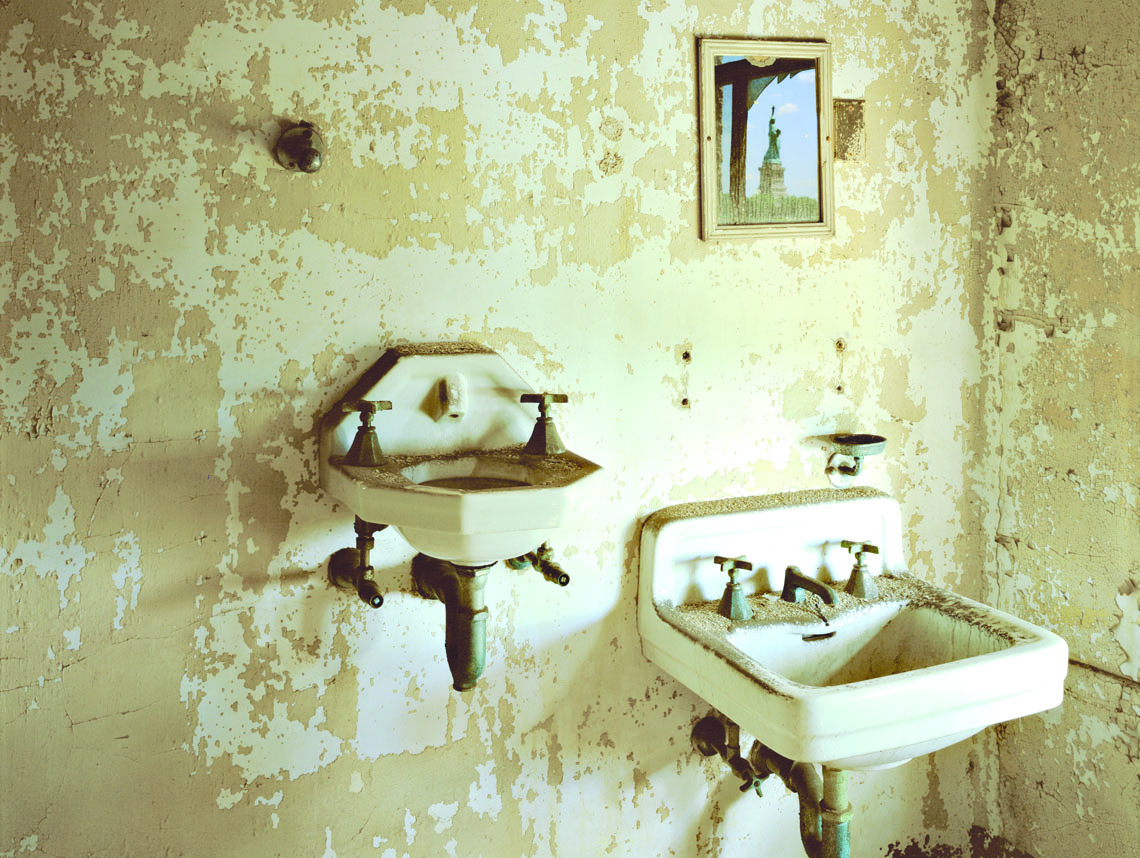
Above two grimy sinks in a tuberculosis wing, Wilkes shot a mirror reflecting the Statue of Liberty from a nearby window. “I got chills because I just had this vision of an Eastern European woman, very much like my grandmother, who saw the statue every morning when she got out of bed to spit or wash her face,” he said. “She would be literally so close and yet so far from freedom.”
In a room covered with peeling green paint in the psychiatric hospital, Wilkes captured an old desk that appears to dominate an adjacent chair — as if a menacing psychiatrist were interrogating a patient. A stack of chairs in another chamber is reminiscent of the huddled masses. And a study of a light switch against a wall of crumbling blue paint reminded Wilkes of a map as well as the sea traversed by the émigré patients.
Wilkes’ photos, as well as a video he produced on the complex, helped convince Congress to spend $6 million toward stabilizing the structure some years ago. “It will never again look like it does in my photographs,” he said.
Approximately 12 million immigrants passed through Ellis Island, one quarter of them Jewish. Wilkes himself grew up in a family of Jewish émigrés, in Great Neck, N.Y. His mother’s immediate relatives had managed to flee the Holocaust, while his father survived Buchenwald before escaping the camp and hiding in a bakery for the duration of the war.
It was the photographer at Wilkes’ Conservative bar mitzvah who first introduced him, in earnest, to the craft; the boy was riveted by the man’s portrait of Stephen and his identical twin brother that had been taken by candlelight. Wilkes went on to apprentice with the photographer for almost a year, then opened his own business, in his mid-teens, photographing weddings and bar mitzvahs.
After attending Syracuse University, Wilkes published photographs in Time magazine, Vanity Fair, The New York Times Magazine and other periodicals. In between those assignments, he embarked upon fine art exhibitions such as his “Day to Night” project, which captures cityscapes from a fixed camera angle over time, and a show on the rapidly changing country of China.
His “Ellis Island: Ghosts of Freedom” was named by Time magazine as one of the five best photography books of the year in 2006.
That project began when one of Wilkes’ former editors from Life magazine asked him to capture images of Ellis Island’s moldering hospital. Wilkes jumped at the chance while braving dangerously rotting floorboards and donning a respirator to prevent poisoning from asbestos and toxic lead paint still clinging to the walls.
Like the legendary Lewis Hine, who photographed immigrants at Ellis Island in the early 20th century, Wilkes used only available light to shoot his pictures. Transparency film enabled him to capture “the subtleties and the nuances, the depth and the richness of lead paint along with the magical, extraordinary highlights and shadow detail that I saw in those rooms,” he said.
“I try to bring viewers in with the beauty, the texture and the light, but what I’m really interested in is having people connect with the history of the people who lived in a particular room,” he added.
At a time when immigrants again are under siege, Wilkes said he hopes his photographs will create increased empathy for new Americans.
“Each one of us has a direct DNA connection to an immigrant, and that’s something these pictures speak to,” he said. “It’s my hope that they inspire others to feel that
connection.
For more information about the exhibition, contact the Peter Fetterman Gallery at (310) 453-6463.