An AIPAC affiliate paid $60,000 during its campaign to thwart the Iran nuclear deal to a group that engages in anti-Muslim extremism.
Citizens for a Nuclear Free Iran, which was launched in the summer of 2015 to rally opposition to the Iran deal, paid the money to the Center for Security Policy, according to a report Wednesday by LobeLog, a Middle East policy news and analysis site.
An American Israel Public Affairs Committee official confirmed the payment to JTA and said it was for an ad. The official did not describe the ad or where it appeared, but Citizens for a Nuclear Free Iran ran ads from July 2015 through September of that year in a failed bid to have Congress nullify the deal.
The Center for Security Policy and its director, Frank Gaffney, have drawn fire for sweeping generalizations about Muslims and Islam, including from Jewish groups. In November, the Reform movement and other liberal Jewish groups urged Israel’s U.S. ambassador, Ron Dermer, not to accept an award from Gaffney’s group because of his statements, which the Reform described as “anti-Muslim bigotry.”
The Anti-Defamation League stopped short of asking Dermer to turn down the award but decried “baseless claims or stereotypes” propagated by the Center for Security Policy.
Gaffney accuses officials in the U.S. government and elsewhere of acting on behalf of radical Muslims, often with scant evidence or because of tenuous associations. He has suggested that former President Barack Obama, a Christian, is a Muslim, and joined in condemnations of a Muslim community in Tennessee seeking to expand its mosque, calling the Muslims there “stealth jihadists.” Attacks on the Muslims in Murfreesboro have included violence and elicited expressions of support for the community from Jewish groups.
Gaffney is close to Steve Bannon, a top strategic adviser to President Donald Trump. In a New York Times report last month on people who have shaped the administration’s views on Islam, Gaffney described what he sees as a decades-long conspiracy by the Muslim Brotherhood to infiltrate all levels of American society, likening those he said were adherents of the Islamist movement to “termites.”
The Center for Security Policy also was adamantly opposed to the Iran deal, and its supporters would have been receptive to appeals to lobby congressmen to oppose the agreement. Additionally, the think tank, which advocates for increased defense spending, and Gaffney, a top Pentagon official under President Ronald Reagan, have longstanding ties to the defense and security establishment. Advertising in its published materials would reach important influencers in those communities.
The AIPAC official noted that the $60,000 was a fraction of the $20 million budgeted to defeat the deal, which Israel’s government, AIPAC and most Republicans opposed.
The deal traded sanctions relief for a rollback in Iran’s nuclear program. The Obama administration said it was the best means of keeping Iran from acquiring nuclear weapons; opponents said it facilitated the acquisition of nuclear weapons because some of its restrictions would lapse in a decade.
I found myself in front of a three way mirror the other day and took this funky panoramic shot with my phone. Contemplating the photo, I am reminded of just how important it is to be mindful of taking taking a second look at things.
Sometimes we are quick to jump to conclusions, often forgetting to give someone the benefit of the doubt. But when we pause and look at something from another angle, insights unfold.
Judaism teaches that each of our biblical ancestors had a unique relationship with God. The relationship is often compared to looking at a diamond: each surface reflects a different light.
What light do we receive?
What light do we emit?
What light do we hold?
And do we make a moment in time to perceive that light from different perspectives – allowing for the benefit of the doubt to transform into a divine connection?
There must be something in the water because a lot of my friends are having babies right now. And because I’m a designer, they usually pick my brain about how to decorate the nursery.
For many expectant parents, having to furnish a nursery can be a daunting task. There’s already so much to do to prepare for the baby, and suddenly they have to play interior decorator, as well.
Worry not, Uncle Jonathan is here with some helpful advice. Think of it as my baby gift — just don’t ask me to help change the diapers.
Decorate for yourself, not the baby
The first thing to remember is that you should decorate the nursery the way you like, not the way you think a baby would like. Yes, I’m sure your baby will be an Einstein out of the womb, but he really does not care how the room looks. As long as the milk train is always at the station, baby is happy. So decorate in a style that reflects your own tastes. If you’re shabby chic, go with that. If you’re a modernist, I’m sure the baby will love the new digs, too.
Try a neutral palette
When people select wall colors for a nursery, they often prefer pastels such as baby blue, blush pink and butter yellow. These colors are fine, but a neutral color palette in the gray or cream family can be just as soothing as a pastel, and they go with practically any other colors you decide to introduce into the room.
Plan for the future
Instead of choosing a specific theme, such as zoo animals or dinosaurs, consider a more timeless design scheme that will be appropriate for years to come. Classic patterns like stripes, chevron or polka dots can add style and whimsy to a nursery without making it look dated. And as the child grows up and develops interests, you can incorporate those themed items via bedding and artwork — items that are easy to replace as time goes on.
Think earthquake safety
Here in Southern California, we have to be prepared for the possibility of earthquakes. Don’t hang pictures where they possibly could fall into the crib. Anchor furniture to prevent it from tipping. And secure items on shelves with museum putty so they don’t fly off during a temblor.
Have everything within reach
When you’re changing diapers, you’ll want all the important things close to the changing table. We’re talking diapers, burping cloths, pacifiers — even the dirty diaper basket. By having plenty of storage nearby, you won’t have to step away from the baby at any time.
Block out the light
To help your baby fall asleep when it’s still light outside, use blackout window shades and curtains to simulate nighttime. But don’t place the crib near the curtains. After babies can stand up in the crib, there’s a risk that they’ll pull on the curtains, which can cause them to fall down, along with the hardware.
Make it easy to clean
Babies are eating, peeing and pooping machines, so the nursery is not going to stay pristine. Hard surfaces such as wood and laminate are easy to clean, but textiles can stain, so make sure area rugs, upholstery and throw pillows are washable.
Look beyond the baby aisle
Check out discount stores like Ross and HomeGoods for great artwork, rugs and accent furniture. Be sure to look in your garage or storage space for furniture you no longer use. With a simple paint job or by changing the knobs, you can give new life to an old furniture piece. And with a baby on the way, we’re all about new life and beginnings.
Jonathan Fong is the author of “Walls That Wow,” “Flowers That Wow” and “Parties That Wow,” and host of “Style With a Smile” on YouTube. Youcan see more of his do-it-yourselfprojects at jonathanfongstyle.com.
Santa Barbara is just 95 miles northwest of Los Angeles, and this month there’s a great reason to make the drive. The Santa Barbara Jewish Film Festival (SBJFF) will take place March 23-27 at the New Vic Theatre, offering a five-day program of feature, documentary and short films representing myriad aspects of Jewish life.
Presented by the Jewish Federation of Greater Santa Barbara, the festival will offer selections from the United States, Israel, Hungary, Germany, the Netherlands, Romania and Italy.
“There’s a lot going on in the Jewish world outside of what we read in the paper and that is reflected in film,” festival co-chair Mashey Bernstein said. “We wanted to bring in films that reflect the wide variety of Jewish experience, not just Israel, not just Holocaust, but things that bring something new to the community, and to our understanding.”
A committee including Bernstein and co-chair Ron Zonen considered about 100 films before choosing the final selections. “It had to be unanimous. We didn’t want just ‘OK,’ ” Bernstein said. “We wanted films that educate and entertain, that bring something new to the table.”
The festival kicks off with the Dutch comedy “Moos” and ends on a similarly humorous note with the German entry “Time to Say Goodbye,” about a 12-year-old boy, his family, his crush (on a female rabbi) and his pre-bar mitzvah bris gone awry.
Other feature films include “The Women’s Balcony,” “AKA Nadia,” and “The Kind Words” from Israel, and Hungarian entry “1945,” in which the arrival of two Jews creates an uproar among townsfolk who were complicit — and profited from — the deportation of the town’s Jewish residents during the war.
The documentary selections range from the inspiring “On the Map,” about Israel’s underdog national basketball team, and “The Settlers,” exploring the hot-button issue of settling the West Bank (with a post-screening director Q-and-A) to “Germans and Jews,” in which second-generation Germans and Jews discuss sensitive questions of guilt, identity and redemption. “Who’s Gonna Love Me Now?” is about a gay Israeli man dealing with an HIV diagnosis and his estranged family, and “There Are Jews Here” focuses on four dwindling American-Jewish communities.
“There Are Jews Here” documentarian Brad Lichtenstein visited more than a dozen towns around the United States before choosing Latrobe, Pa.; Butte, Mont.; Laredo, Texas; and Dothan, Ala., for their geographic diversity “and characters that stand out.”
An elderly congregant of a dying shul, a lay synagogue leader forced to give up her commitment because of health issues, and a young interfaith couple filled the bill, and so did a Los Angeles family that decided to move to Dothan to provide a strong Jewish identity for their daughter. And the $50,000 incentive didn’t hurt.
Yes, Dothan is actively recruiting Jews with cash, and it’s working. “Three or four new families moved in since we stopped filming,” Lichtenstein said. “It’s not just for the money, but for a truly vibrant community.”
The idea — and eventually, funding —for the film came from financier Michael Leven, who is involved with the Jewish Community Legacy Project, which “helps Jewish communities that are nearing the end of their life spans, and helps them figure out how to establish a legacy, preserve their assets and manage this sad process,” Lichtenstein said.
The Milwaukee-based director, who grew up attending Jewish schools in Atlanta, credits his young, non-Jewish producer and co-director Morgan Johnson with providing an objective perspective on the subject. They spent two years filming and another year editing the documentary, which has been in such demand at film festivals that its planned PBS broadcast has been delayed till 2018.
Meanwhile, Lichtenstein (“Ghosts of Attica”) is now working on two projects: a film about race and gun violence and a series about unsolved civil rights-era murders.
He is unable to attend the screening in Santa Barbara but hopes that audiences come away “understanding that there are Jewish communities that are shrinking and it’s really important to make sure their legacies are preserved.”
Among the festival’s short film selections, there’s “A Heartbeat Away,” following an Israeli heart surgeon who performs lifesaving operations on kids in Africa, and “Women in Sink,” in which Israeli-Jewish and Arab women discuss life and politics as they get their hair washed.
Three shorts offer a fresh perspective on the Holocaust. The documentaries “Memory Keepers” and “Our Hebrews” revisit Jewish communities that were wiped out in Romania and Italy, respectively, and the scripted “A Children’s Song” is set in Shanghai, which took in more than 20,000 Jewish refugees from 1933 and 1941.
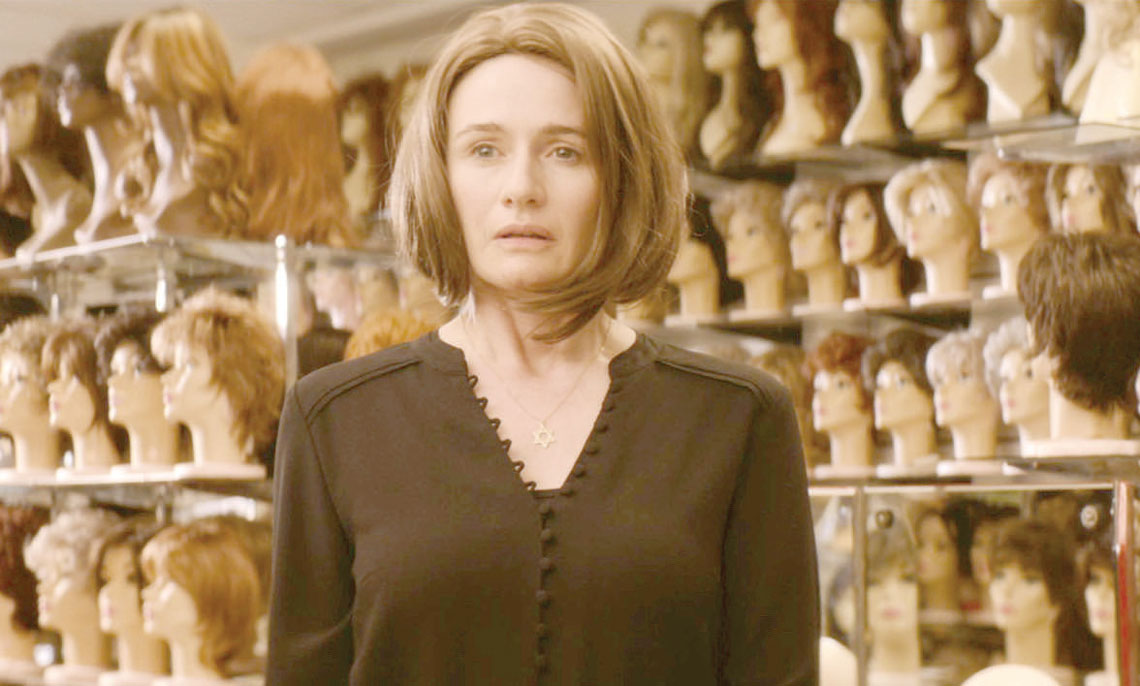
“Wig Shop,” which will screen on opening night, is a slice-of-life story with a surprise ending that’s set in L.A.’s Orthodox community. Producer Jessica Neuman, who grew up in a Russian-Jewish Orthodox family, co-wrote the script with director Kat Coiro, who is not Jewish.
“I’m interested in very close, religious communities even though I don’t come from one. There’s something that always fascinated me,” Coiro said. “This story is so rich and deep and it’s a world we’ve never seen before, and I love that it’s a movie with all women. And while it’s not a true story, it has authenticity because it’s from Jessica’s cultural point of view.”
Through fortuitous connections, actress Emily Mortimer signed on to play the lead and Rachael Taylor was cast in a key supporting role. Neuman’s mother recorded all of Mortimer’s lines to help her nail the Russian accent, Coiro noted.
Coiro, a one-time actress who recently directed episodes of the TV series “Girlfriends’ Guide to Divorce” and “The Mick,” is considering making a feature-length version of “Wig Shop.” She plans to attend the SBJFF screening.
“It’s more than just the films; there’s so much more going on,” Mashey Bernstein said, mentioning a live concert performance after “Who’s Gonna Love Me Now?,” a panel discussion with representatives from small Jewish communities after “There Are Jews Here,” and the opportunity to make new friends over coffee and bagels at the morning screenings.
“There’s a vibrant, exciting Jewish community here,” he said. “Come to one film or come to them all, and you’ll learn something new.”
For more info on the Santa Barbara Jewish Film Festival, visit www.sbjewishfilmfestival.org.
Correction: the article initially misspelled the name of the film’s financier. It is Michael Leven, not Michael Evans.
Three sisters in their 40s spar with one another and discover a long-held secret as they pack up their childhood home after the death of their mother in the new play “April, May & June,” now running at Theatre 40 on the campus of Beverly Hills High School.
Playwright Gary Goldstein described the sisters, whose names make up the title, as a study in contrasts. June (Meredith Thomas), the youngest, is a lesbian who has just broken up with her lover. He characterized her as more free-spirited and brasher than her siblings but said she must learn to better connect with people.
May (Jennifer Taub), the middle sister, is the subject of numerous jokes regarding middle child syndrome.
“She’s kind of the caregiver and the mediator, and wants to take care of everybody and never to be left out,” said Goldstein, who also writes for film and television and is a freelance film critic and feature writer for the Los Angeles Times. “And I think she needs to learn more confidence and to trust herself a little bit more, and I think she does through this experience.
“And then April (Jennifer Lee Laks), who’s the oldest sister, is the one who’s large and in charge and has always been kind of a substitute mother for her sisters in some respects as they were growing up. And she needs to let go and loosen up, and deal with her own life better than she has. So, I think it’s kind of a classic structure for three sisters.”
Goldstein added that, just as the three have very different personalities, they each view their childhood differently.
“April was the most critical of her parents, and particularly of the mother, because she disagreed with the way her mother approached life. She just felt that the mother didn’t have high enough standards, as she called them, and just moved through life without really having goals and having great taste — the things that she, April, the adult April, came to value.
“She tried to do everything to not have the life that the mother lived, as a person and a wife, and found herself, inadvertently, in a bit of the same boat as her mother,” Goldstein said. “When she looks back on it now, there’s this realization.”
On the other hand, the playwright said, May looks back with much more forgiveness and wants for herself what she feels could have been between her parents. “As a result, she somehow knows how to love, how to make it work with her husband, because it was kind of an anti-example that the parents set.”
As for June, Goldstein sees her as falling somewhere between the other two. “She’s very blunt about how the house they lived in was not a great house, and the mother didn’t have great taste in terms of furniture and things like that, and how the father was an alcoholic, among all the things she witnessed,” he said. “And yet, she was not as critical. It was not a matter of being critical of the parents — it was just a matter of being honest about the parents. She saw what she saw, they were what they were, and her takeaway from her childhood was just to go off on her own, create her own life, and be who she was.”
Goldstein has given the sisters a Jewish father and a half-Jewish mother and set the action on Long Island, N.Y. However, he believes the situation could take place anywhere and is universal enough to be about families of any ethnicity. He said he grew up in a mildly observant family, and he writes Jewish characters whenever it makes sense to him to do so.
“I think there’s a unique warmth and connection that Jewish siblings have. I don’t want to be general about it, but I think there’s some very basic emotional things that made sense to me to make them Jewish,” Goldstein said.
He continued, “If I weren’t Jewish, would I have written them Jewish? Probably not. I probably wouldn’t even think about it. If there is anything autobiographical in it, I think some of the emotions and some of the references and things certainly do come from growing up Jewish. It turns the stereotype on its ear because of the kind of person the mother was. She was not what you would think of as the typical Jewish mother.”
In fact, the revelation about the mother that comes at the climax of the play stuns the sisters and brings them closer together as they learn she was not as pedestrian as she seemed. Goldstein hopes the story will inspire audiences to find out as much as they can about their own parents while they still are alive, and also to work on whatever they never reconciled with a parent who is gone.
“When we’re younger, we don’t always think about all the ramifications of the people who’ve always been in our lives,” he said. “But as you get a little older, you really look back and you want to know more about them. There are so many unanswered questions I have about my family members that are no longer alive, but it doesn’t mean that I can’t do the work to try to learn more, even when they’re not here. So, never give up on the memories of people who are gone, because there’s always something to learn about them.”
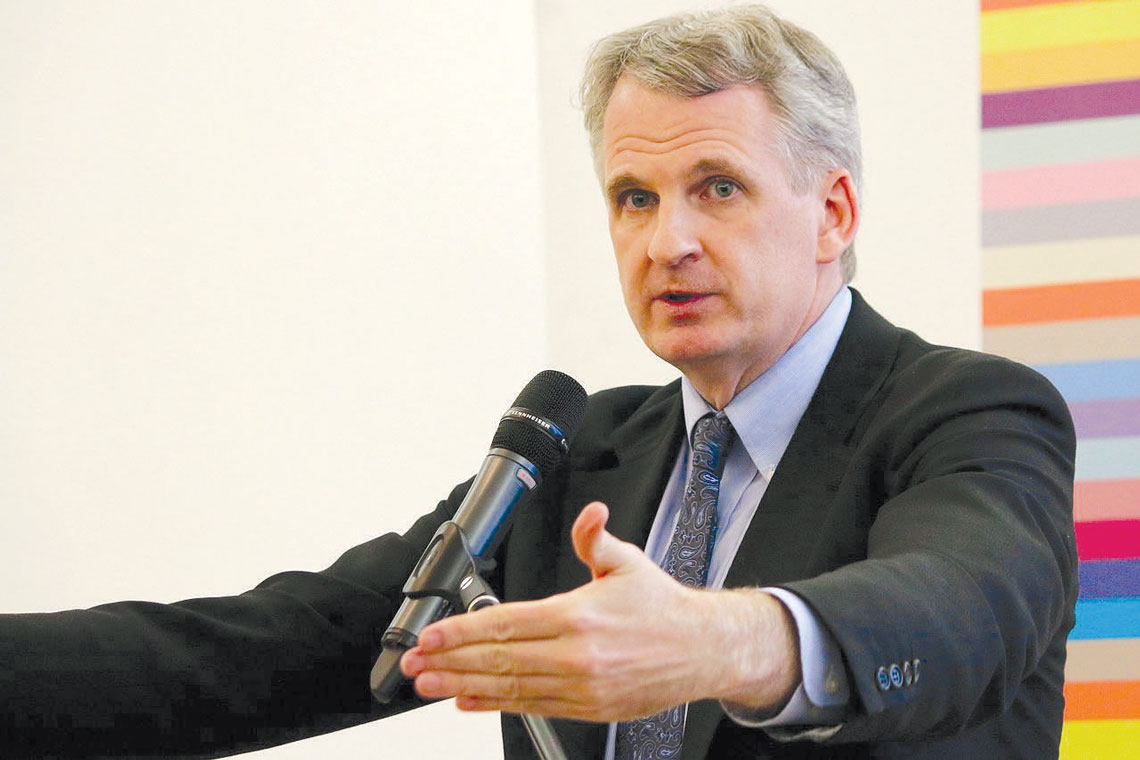
Yale historian Timothy Snyder has spent the better part of his career studying 20th- century authoritarian regimes, from fascist Germany to the communist Soviet Union. Educated at Oxford, Snyder has written extensively about the rise and fall of modern political systems and the catastrophes that ensue when civil society breaks down.
His latest work, “On Tyranny: Twenty Lessons From the Twentieth Century,” is addressed to Americans who are disturbed by the radical new politics introduced into American democracy by the Trump administration. It is both a warning and how-to manual, urging citizens who cherish American democracy to defend democratic institutions and their own independent minds.
Snyder will appear in conversation with Jewish Journal Book Editor Jonathan Kirsch on March 21 at Temple Emanuel of Beverly Hills through Writers Bloc.
DANIELLE BERRIN:At what point did you start to consider the threat of tyranny — a serious charge — a legitimate critique of the current administration?
TIMOTHY SNYDER: I’m trying to adopt the perspective of the Founding Fathers, [who thought] that we need to be very thoughtful about [democratic] institutions, because if you’re not thoughtful about the institutions, the system can fall apart at any time. What I’m trying to do is look back at recent examples of modern tyranny — Nazi Germany, fascism, communist regimes — to see how democratic republics tend to break down. I have to point out, if the book seems relevant now, I wrote the “Twenty Lessons” in November, and had [finished] the book by Christmas. So I couldn’t even judge the present administration. What I was judging were the tendencies of a [president-elect] who seemed to be entirely indifferent to the foundations of our political system.
DB:What did you find most alarming about him?
TS: In Donald Trump’s campaign, there was an absence of support for democracy and an absence of support for human rights. He never talked about those things, whereas other American politicians do. The second thing that concerned me was the Russia connection; I don’t think American politicians should be seeing foreign tyrants as models of leadership. The third thing was the war on truth — not just lying at the margins the way all politicians lie — but the broad-gauge full-on attack on the truth. [Trump] was using language to build up a kind of counter-world, an alternative reality, a myth in which his supporters could live … that’s fascist.
DB:In the book, it’s clear you’re trying to address a wide audience — both left and right. But do you really think the same people reading Breitbart are going to read a work of scholarship?
TS: Look, this book is written from the position of an American citizen who thinks that the American republic is in danger. And the various kinds of moral and intellectual commitments I have don’t line up perfectly with one party or the other. In a lot of ways, I’m sympathetic to conservatism — when it’s actually conservative.
DB: You talk a lot in the book about truth and lies. How do you combat propaganda when truth itself has been politicized?
TS: Without the enlightenment — without the belief that there is truth on earth, and that we can discover that truth — there will not be democracy. There will not be rule of law. If we let truth go, we’re not going to have the system that we have. Journalists are now in a position where you get to be pioneers; you get to be the stars. Because the mainstream is now all this junk. People still say “mainstream media” but the mainstream [has changed]. You guys are now edgy. You guys have a chance to be heroes in 2017.
DB:In order for Hitler to be successful, you write that he needed the complicity of ordinary citizens to carry out his policies. That puts a lot of responsibility on citizens. How much power does the populace actually have to make or break a dictatorship?
TS: Citizens have a huge amount of power and usually what they do is give it away without thinking about it. We [learn] the rules and we adapt. That’s how we survive. But sometimes things change so drastically, we have to check our social impulses and be an individual. We have to stop and say, “This situation is different. I’m not going to automatically adjust.” The smartest analysts of authoritarianism, they all make the point that it depends upon consent. That the little choices you make matter. Just going along is a choice; and when you go along, you’re making regime change happen.
DB:Some people are deeply disturbed by what is happening within our government, but others argue that democracy remains intact — the press is still functioning, we still have rule of law. Even you could write a book “On Tyranny” without fear of repercussions. How close do you think we are to fascism?
TS: There are things that are short of fascism that are absolutely terrible: If America becomes a kleptocratic, authoritarian regime where we have ritualized elections in which everybody knows who will win in advance; where you can’t become prosperous or wealthy without the support of the people in power; where you think about what you’re going to say before you say it — we’re not very far away from that. It won’t take too many pushes to get into a situation where it’s normal for us to think that the president is the richest person in the country and that the next several presidents need to be named Trump. Fascism would be something more. Fascism would be [White House chief strategist Stephen] Bannon succeeding in creating a sense of white nationalism in the U.S. [with] lots of internal violence deliberately directed toward creating a national identity. That’s a higher bar for evil.
DB:Trump has targeted and maligned many minority groups. Why is it important for an authoritarian leader to have scapegoats?
TS: If you want to change the regime, you take a group and say, “This group is not your neighbors, it’s not your fellow citizens; this group is an element of an international plot.” For Hitler, it was Jews, but it can be anybody. The mechanism is the same. So with American Muslims, you’re taking a group that is basically assimilated, basically small, and you’re saying, “Don’t think of them as individuals. Don’t think of them as citizens or as customers. Think of them as part of some larger threat.” That is politically important because it changes domestic politics [to become] about fighting the larger global threat — whether it’s terrorism or the Jewish international conspiracy. And that means that the normal things of domestic politics — like prosperity, group interest or freedom — those things are suddenly less important.
DB:The president hasn’t targeted Jews the way he has Muslims and immigrants, but the political climate has enabled an uptick in anti-Semitic incidents. As a historian of the most anti-Semitic period in history, is the current surge of anti-Semitism here significant?
TS: Those who are saying that anti-Semitism isn’t as bad as it seems is what the Orthodox community in Poland did in the second half of the 1930s; it’s exactly what the German Jews did in 1933. If Jews are going to remember the Holocaust, they have to remember the whole thing — including that normalization burst right after Hitler was elected. That impulse to rationalize — you have to check yourself: What do I think it means as an American Jew that the [headstones in] cemeteries are going down? What do I think it means that there’s all this hate speech? That there are now swastikas in places where there weren’t swastikas before? It sounds crazy and obvious, but this is a time for American Jews to be thinking about the Holocaust — not so much from 1944 in Auschwitz, but from early 1933 and the transition. Because if you only think about the end, you forget about the beginning. And if you only look at the end, nothing is ever as bad as the end — until the end.
Timothy Snyder will be in conversation with Jonathan Kirsch, book editor of The Jewish Journal, 7:30 p.m. on March 21 at Temple Emanuel of Beverly Hills. Tickets are $20.
Mayim Bialik suited up for the Velcro wall at Valley Beth Shalom’s March 12 Purim carnival. Photo courtesy of Mayim Bialik.
Los Angeles Jews celebrated Purim across the city and around the world on March 11 and 12.
On the Westside, Shtibl Minyan and Temple Emanuel of Beverly Hills held “Hamilton”-themed shpiels, “Hamalkah: A Purim Musical” and “Esther: A Purim Musical,” respectively. Temple Isaiah hosted “The Late Late Show Purim,” with Rabbi Joel Nickerson playing talk show host James Grogger and featuring characters from the Purim story as his guests. At Temple Beth Am, senior staff and interns dressed as either Little Orphan Annie or her dog, Sandy, to convey the message that “the sun will come out tomorrow.” Aish Los Angeles held a jungle-themed Purim party for young adults ages 21 to 32 at Morry’s Fireplace.
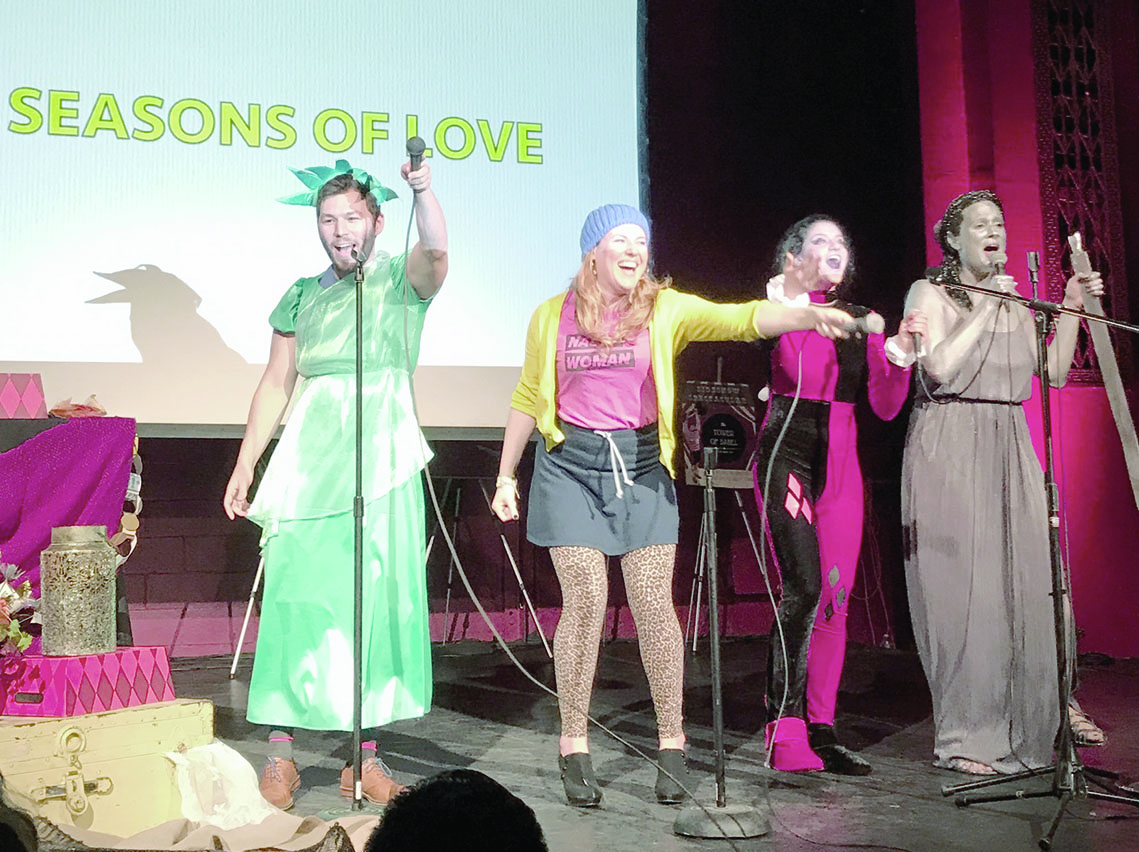
Venturing to Club Fais Do-Do, IKAR held a combination Megillah reading and shpiel, featuring slides with funny images. Between chapters, the shpiel team screened a number of video shorts, including “IKARaoke,” starring “Royal Pains” actor Mark Feuerstein. The spiel ended with a politically themed song parody of “Seasons of Love” (from the musical “Rent”). Costumes, too, skewed political, with Rabbi Sharon Brous dressed as the Statue of Liberty.
Festivities continued Sunday around the region, with carnivals at Temple Judea, Temple Isaiah and Valley Beth Shalom (VBS), among other places. At VBS, actress Mayim Bialik (“The Big Bang Theory”) was one of the carnival-goers who suited up for the Velcro wall.
In Israel, Rabbi Marvin Hier, dean and founder of the Simon Wiesenthal Center in Los Angeles, was spotted dancing after a Megillah reading at the Tel Aviv Hilton with his son, Avi Hier,and Andrew Friedman, president of Congregation Bais Naftoli.
— Esther D. Kustanowitz, Contributing Writer
Soldiers who traveled to Los Angeles as part of Lev Chayal “Trip of a Lifetime” gather around businessman and philanthropist Marvin Markowitz (top row, seventh from left, seated). Photo by Debra Halperin Photography.
Lev Chayal held its second annual “Toast to Our Heroes” party on March 4 at The Mark for Events on Pico Boulevard. The party honored 10 Israel Defense Forces soldiers who were wounded during hostilities with Hamas in Gaza in 2014.
Lev Chayal, which translates to “Heart of a Soldier,” is a group dedicaxted to honoring wounded Israeli soldiers by offering them free leisure trips to Los Angeles. Chaya Israily and Brocha Yemini founded the group in 2016 under the auspices of the Chabad Israel Center.
The black-tie evening coincided with the second trip for soldiers sponsored by Lev Chayal. During their 10-day tour of Los Angeles, dubbed “The Trip of a Lifetime,” the soldiers attended a Lakers game, toured the headquarters of dating app Tinder and visited the Getty Villa museum, among other attractions.
Businessman and philanthropist Marvin Markowitz donated the use of the event space and paid for a significant amount of the event’s expenses.
Some 200 people attended the event, which raised nearly $50,000. Lev Chayal is preparing for the next trip for soldiers in December.
— Eitan Arom, Staff Writer
Alan Dershowitz and Roz Rothstein at “Combating the Boycott Movement Against Israel” conference. Photo courtesy of StandwithUs.
More than 250 people participated in the “Combating the Boycott Movement Against Israel” conference on March 4-6, organized by the group StandWithUs, which focused on countering the Boycott, Divestment and Sanctions (BDS) movement against Israel.
Supported by the Diane Shulman and Roger Richman Israel Education Fund, the conference at the Hyatt Regency Los Angeles International Airport drew students, professionals and activists from the United States, Canada and Israel. Attendees and members of StandWithUs, a nonprofit pro-Israel organization, shared their experiences with the BDS movement and the tactics they have used to challenge it on college campuses and other places.
“Today, you can’t say anything about minorities, about gay people, about Palestinians, about Muslims or about Arabs,” said Harvard University law professor emeritus and defense attorney Alan Dershowitz. “But when you put a shoe on the other foot, you can say analogous things about the nation-state of the Jewish people, about the Jewish lobby, and ultimately about Jews.”
He said college campuses should “demand a single standard” that is fairly applied to both sides.
“Whatever the left says is hate speech against them, we must demand that that be deemed hate speech against us on the other side,” Dershowitz said.
Other guest speakers included Judea Pearl, father of late Wall Street Journal reporter Daniel Pearl; Yaki Lopez, consul for political affairs at the Consulate General of Israel in Los Angeles; and Anne Bayefsky, director of the Touro Institute on Human Rights and the Holocaust.
Hannah Karpin, 17, StandWithUs High School Intern at Palos Verdes Peninsula High School, said the conference enabled her to learn more about the BDS movement.
“I think it should be acknowledged as an anti-Semitic movement,” said Karpin, who is planning to attend college next year. “It was shocking to hear that some recognizable organizations were behind the BDS movement.”
— Olga Grigoryants, Contributing Writer
Elon Gold. Photo by Ryan Torok.
Comedian Elon Gold performed at a Purim comedy concert at the Saban Theatre in Beverly Hills on March 9, during which he talked about why Israel is the nipple of the Middle East breast (Gold said Israel is the most sensitive area and he doesn’t get to visit it as much he would like) and acted as Abraham negotiating with God over how much should be cut off during a circumcision (with God sounding like Marlon Brando and Abraham like Woody Allen).
Gold is Modern Orthodox and his material focused almost exclusively on the Jewish experience. He asked at one point if any gentiles were in the crowd. When nobody raised a hand, he insisted there were a couple of goy but they were hiding. He then asked the non-Jews how it felt for them to be the ones hiding.
Alex Edelman, a stand-up comedian who opened the show, gleaned material from his Jewish upbringing and did an eight-minute bit about the year his family celebrated Christmas, much to the chagrin of his yeshiva teacher.
The several hundred attendees included Pico Shul RabbiYonah Bookstein and his wife, rebbetzin Rachel Bookstein; Jacob Segal, co-chair of the Southern California Israel Chamber of Commerce; David Suissa, president of TRIBE Media Corp., and his daughter, Tova; and Scott Jacobs of JooTube.
On a more serious note, Gold took the opportunity to denounce the anti-Semitism that has been on the rise over the past couple of months, with Jewish community centers being targeted with bomb threats and several Jewish cemeteries vandalized.
“You mess with the Jews, you lose,” Gold said.
From left: FIDF Chairman Ari Ryan and FIDF board members Francesca Ruzin and Michael Spector. Photo courtesy of S&N Photography.
Friends of the Israel Defense Forces (FIDF) held its Young Leadership Western Region Spring Mixer on March 9 at the Nightingale Plaza dance club on La Cienega Boulevard.
Some 650 young donors mingled over cocktails under violet lighting as house music blared, celebrating the work FIDF has done to support Israeli troops. Life-size posters of IDF soldiers in uniform beamed at the guests.
For an extra $18 above the $36 ticket price, attendees were able to send a Purim gift package to an IDF soldier.
The event, chaired by Danielle Moses,Mimi Paley,Francesca Ruzin and Miles Soboroff, raised more than $41,000 for FIDF.
In 2016, FIDF supported, by its own count, 66,000 soldiers, veterans and bereaved family members, including 14,500 through educational programming, 2,800 through assistance to so-called lone soldiers who don’t have immediate family in Israel, and 8,000 soldiers needing financial assistance.
— Eitan Arom, Staff Writer
Michael Janofsky
Michael Janofsky, a former correspondent for The New York Times and more recently managing editor of LA School Report, has joined the Jewish Journal as an assistant editor. Janofsky was a sportswriter, national correspondent and Washington, D.C. reporter over 24 years with the paper. After moving to Los Angeles in 2006, he worked as a speechwriter for the dean of UCLA’s business school and a freelance writer and editor before joining the Journal.
Moving and Shaking highlights events, honors and simchas. Got a tip? Email ryant@jewishjournal.com.
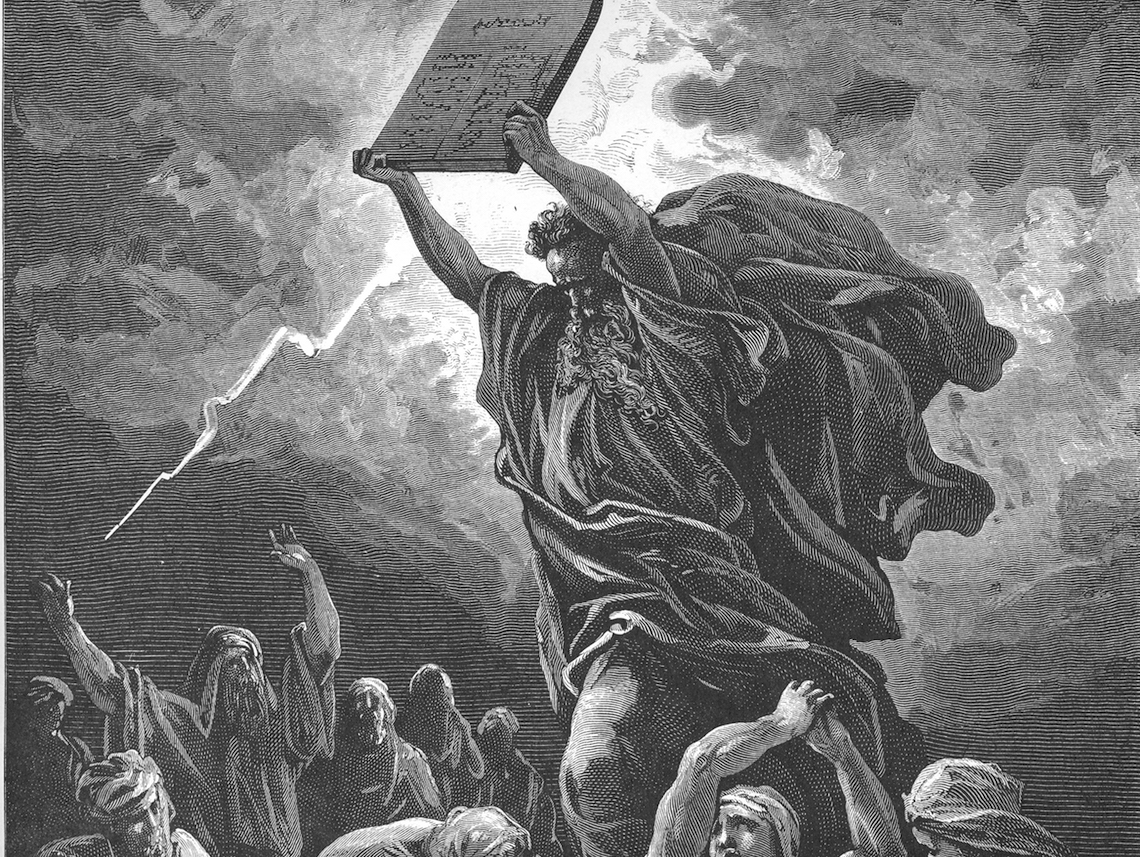
“[Moses] hurled the tablets from his hands and shattered them … ” — Exodus 32:19
The shattering of the Ten Commandments in this week’s parsha after Moses finds the Israelites with the golden calf is the shattering of trust. Think of a moment when your trust was broken. Do you remember the pain of betrayal, when the covenant carved into stone that you thought was solid and eternal was all at once demolished?
Of course you do. No one forgets.
I believe that trust is a delicate compound of truthfulness and tenderness. And today, we are sorely lacking in both elements.
Truth is delicate. It is a fabric easily stretched and torn. And it is becoming increasingly difficult to identify the true fabric of truth amid so many well-crafted synthetics. We are surrounded by what Stephen Colbert calls “truthiness,” which he defines as something that a person making an argument claims to know intuitively “from the gut” or because it “feels right” without regard to evidence, logic, intellectual examination or facts.
Photos are filtered. Bodies are nipped and tucked. Resumes are enhanced. Diplomas are doctored. Reality shows are staged. Facts are altered. We live in an era when more than speaking truth to power, we ache for power to speak truth.
And yet, the truth, too, can be brutal. In Paul Simon’s song “Tenderness,” he sings: “You say you care for me, but there’s no tenderness beneath your honesty/ You don’t have to lie to me, just give me some tenderness beneath your honesty.”
The rabbis say that in order to preserve shalom bayit, peace in the home, every now and then a small fib is OK. In fact, Talmud gives examples of when it is preferable to lie. What does one say to a bride? Even if she is lame and blind, one is to say how graceful and beautiful she is. I would argue that shalom bayit is not about dishonesty. It’s about delivering truthfulness on a cushion of tenderness. You might think the bride is unattractive, but her partner doesn’t, and when we learn to perceive through loving eyes, we are elevated.
Truthfulness plus tenderness equals trust.
In the Talmud, Rava, who lived around the year 300, said: At the hour you enter heaven for judgment, they will ask you, “Nasata v’natata b’emunah?” (“Did you deal honestly with people in your business?”)
There are systems in this world, many, where dealing honestly with one another is not a high priority. Where girls are offered jobs overseas and then are lost in the sex trade. Where bribes corrupt organizations and obstruct every avenue toward justice. Where everyone and everything is for sale, and no one is safe.
And yet, we are a network, a symbiotic relational push-and-pull, give-and-take system. We are all in the same boat, and if I drill a hole under my seat, it affects you. We are connected. Everything depends on trust.
Every time we drop off our kids at school, we trust that they are in caring hands. Every time the light turns yellow, we trust that cars are going to slow to a stop. Every time we make a deposit, we trust our money is safe.
Too much trust can be dangerous — we would be foolish to trust everyone. But trustworthiness is not dangerous. To be on time, respect boundaries, act with sincerity, deliver honesty with tenderness, create safe environments, keep confidentiality — these are what make you trustworthy, sought after, admired and adored.
So while Rava did not say to trust everyone, and he didn’t promise that everyone else will have honest weights and measures, he said you need to be trusted. You have to have honest weights and measures. Success depends on how much you’ve cultivated other people’s trust in you.
On our dollar bill it reads: “In God we trust.” The touchpoint of our entire network of exchange reminds us that we are bound to a trusteeship with God, that our life is our true asset, our breath is our capital, our soul is our fortune.
God leases everything to us. The Torah is the Deed, which we seal with our good deeds, and our good deeds inspire others and accumulate interest. For some God-knows-why reason, God sees trustworthiness in us, and God appoints us the trustees of this supreme gift.
This despite the fact that the shattered shards of trust are scattered all around us. And as we all well know, it takes a lot of time, patience and stamina to put trust back together. Even after new covenants are at last established, we still each carry those broken bits with us.
Moses says in our Torah portion, “Pardon our iniquity and our sin, and take us for Your own!” (Exodus 34:9). The Israelites built the golden calf because they did not have enough trust in God, and afterward, they had to work hard to regain God’s trust. May truthfulness and tenderness inform our relationships with one another and with God.
When photographer Stephen Wilkes first visited the sprawling abandoned hospital complex on Ellis Island almost two decades ago, he became obsessed with the wards where more than 1 million immigrants languished from 1892 to 1954. The émigrés had been detained — and prevented from entering the United States — for suffering illnesses including trachoma and tuberculosis.
It was “a place where the huddled masses yearning to breathe free remained huddled … yearning, many permanently, just inches short of the Promised Land,” Wilkes writes in his 2006 photography book, “Ellis Island: Ghosts of Freedom.”
More than 30 pictures from that project are on display at the Peter Fetterman Gallery at Bergamot Station in Santa Monica through May 27.
During Wilkes’ initial visit to the decaying hospital in 1998, he discovered “the shoes of immigrants long forgotten; shards of mirror, remnants of beds … [and] a chamber where tuberculosis-infected mattresses were sterilized with scorching heat. … A surreal sculpture of vines, leaves and moss, mingled with shattered plaster, curling paint and rusted iron, meandered through empty corridors and dead rooms.”
Wilkes, 59, who lives in Westport, Conn., was mesmerized not only by the juxtaposition of thriving plants and detritus but also, he said in a recent telephone interview, by “the palpable sense of humanity that was in these ruins. I felt the presence and the energy of our ancestors.”
Wilkes’ own mother passed through the Great Hall at Ellis Island after fleeing Nazi-occupied Vienna in 1939. Traveling alone at the age of 9, she clutched a homemade teddy bear into which her mother had sewn the family’s bonds and jewels. While she bypassed the medical facility, Wilkes said, “The island always had for me this connection to her. So [the project] was quite powerful for me personally.”
In fact, he said, he was so moved after his first journey to the hospital that he couldn’t sleep for two weeks afterward. He returned to the site more than 75 times over the next five years to capture luminous images of every corner and crevice.
In a measles ward, he photographed burnt-yellow light illuminating a single chair that “was such a powerful, almost physical presence in the way it was directly in my face as soon as I opened the door,” Wilkes recalled. “I felt it was like a family member — my mother or my grandmother — waiting for me to come home.”
Above two grimy sinks in a tuberculosis wing, Wilkes shot a mirror reflecting the Statue of Liberty from a nearby window. “I got chills because I just had this vision of an Eastern European woman, very much like my grandmother, who saw the statue every morning when she got out of bed to spit or wash her face,” he said. “She would be literally so close and yet so far from freedom.”
In a room covered with peeling green paint in the psychiatric hospital, Wilkes captured an old desk that appears to dominate an adjacent chair — as if a menacing psychiatrist were interrogating a patient. A stack of chairs in another chamber is reminiscent of the huddled masses. And a study of a light switch against a wall of crumbling blue paint reminded Wilkes of a map as well as the sea traversed by the émigré patients.
Wilkes’ photos, as well as a video he produced on the complex, helped convince Congress to spend $6 million toward stabilizing the structure some years ago. “It will never again look like it does in my photographs,” he said.
Approximately 12 million immigrants passed through Ellis Island, one quarter of them Jewish. Wilkes himself grew up in a family of Jewish émigrés, in Great Neck, N.Y. His mother’s immediate relatives had managed to flee the Holocaust, while his father survived Buchenwald before escaping the camp and hiding in a bakery for the duration of the war.
It was the photographer at Wilkes’ Conservative bar mitzvah who first introduced him, in earnest, to the craft; the boy was riveted by the man’s portrait of Stephen and his identical twin brother that had been taken by candlelight. Wilkes went on to apprentice with the photographer for almost a year, then opened his own business, in his mid-teens, photographing weddings and bar mitzvahs.
After attending Syracuse University, Wilkes published photographs in Time magazine, Vanity Fair, The New York Times Magazine and other periodicals. In between those assignments, he embarked upon fine art exhibitions such as his “Day to Night” project, which captures cityscapes from a fixed camera angle over time, and a show on the rapidly changing country of China.
His “Ellis Island: Ghosts of Freedom” was named by Time magazine as one of the five best photography books of the year in 2006.
That project began when one of Wilkes’ former editors from Life magazine asked him to capture images of Ellis Island’s moldering hospital. Wilkes jumped at the chance while braving dangerously rotting floorboards and donning a respirator to prevent poisoning from asbestos and toxic lead paint still clinging to the walls.
Like the legendary Lewis Hine, who photographed immigrants at Ellis Island in the early 20th century, Wilkes used only available light to shoot his pictures. Transparency film enabled him to capture “the subtleties and the nuances, the depth and the richness of lead paint along with the magical, extraordinary highlights and shadow detail that I saw in those rooms,” he said.
“I try to bring viewers in with the beauty, the texture and the light, but what I’m really interested in is having people connect with the history of the people who lived in a particular room,” he added.
At a time when immigrants again are under siege, Wilkes said he hopes his photographs will create increased empathy for new Americans.
“Each one of us has a direct DNA connection to an immigrant, and that’s something these pictures speak to,” he said. “It’s my hope that they inspire others to feel that
connection.
For more information about the exhibition, contact the Peter Fetterman Gallery at (310) 453-6463.
The question of whether and how rabbis should speak out on controversial issues of the day has been with us for many centuries. If the subject has become especially contentious in America of late, it is probably because American Jews in 2017 find ourselves in a situation utterly without precedent.
Technology and globalization have spurred change more rapid and far-reaching than at any time in human history. American society and culture are in flux. The health of the planet itself is threatened as never before. Anti-Semitism seems resurgent. And the relevant political divide in America today is arguably not only that between Democrat and Republican or liberal and conservative but between supporters and opponents of a president who has disavowed major elements of long-term bipartisan policy and major elements of the Jewish and Christian ethical traditions.
What should rabbis do in this situation? What should they say, on the pulpit or off? What alliances and marches should they join or lead? I believe that the lack of consensus on virtually every major issue we face makes it more imperative than ever that rabbis speak out loud and clear on moral and religious issues of the day. They must articulate the moral voice of Judaism, carefully yet boldly, with love for God and Israel and always from deep inside the teaching and practice of Torah.
The rabbi’s role must include far more than announcing page numbers or directing ritual performances (as important as the latter task is). It takes all the knowledge and wisdom a rabbi commands, all the learning and people skills he or she brings to the task, an abundance of cognitive and emotional intelligence, to pronounce and preserve the difference between tamei and tahor, pure and impure — ever the vocation of Aaron and the priests who follow after him. The rabbis must do this while fulfilling Aaron’s priestly function as “pursuer of peace.”
Our rabbis have to build and grow holy communities, keep the peace in those communities, and make sure they are places that bring out the best in all their members. Divisions are rife in many congregations, schools and agencies. Civil discourse is harder and harder to achieve. That discord should not prevent rabbis from speaking out. Rabbis are most effective, in this matter as all others, when they bless the people of Israel with their words and their presence, teach via texts as well as personal example, invite God into Jewish lives, and help make us worthy of having God reside amongst us.
We also want our rabbis to be prophets of a sort, which means helping their communities to hear clearly what God wants of them, and helping our words reach God. Paraphrasing Abraham Joshua Heschel, we might say that the rabbi in his or her prophetic role helps the rest of us to keep God always in mind, and stops us from focusing only on our own needs and desires.
Heschel made that declaration about Israel’s prophets in his 1963 address on “Religion and Race,” and when he marched in Selma, Ala., he affirmed, as Martin Luther King Jr. did in his “Letter From Birmingham Jail,” that rabbis must call out injustice, call for compassion, and call lies, lies. They cannot teach the opening chapters of Genesis without reminding us that human beings are assigned to work and tend the garden of Earth; that all human beings are children of Adam and Eve created in God’s image; that this status carries with it a demand to protect human dignity always and everywhere.
Rabbis cannot teach the Exodus narrative without stressing over and over, as the Torah does, that we are obligated to take care of the stranger, free those enslaved, and not bow down to false gods. The Judge of all the Earth must be assisted in doing justice. YHWH must be helped in the work of redemption associated with God’s very name.
This does not mean, I hasten to add, that the rabbi should tell people how to vote. The problem with rabbis giving such advice goes far beyond IRS regulations concerning the status of religious nonprofits. The complexity of the human situation on the one hand, and the nature of classical Jewish texts on the other, both militate against simple translation of biblical or rabbinic imperatives into endorsements of particular candidates or policies.
Love for the stranger is compatible with a variety of government directives. Widows and orphans must be clothed and fed — that demand is nonnegotiable — but multiple valid approaches to distributive justice have been articulated in Republican and Democratic platforms. Love of the Jewish people, love for the Land of Israel, and love of the stranger can be used to justify a whole range of positions on West Bank settlements. And — complicating matters still further — fulfillment of one mitzvah might clash with fulfillment of another. Sometimes the imperative to Jewish action is clear and unequivocal. Most of the time, however, hard choices must be made and difficult priorities determined.
That is why a rabbi has to be extremely careful in the translation of timeless mitzvah to the partisan politics in the headlines on a given Shabbat. It would be a mistake for rabbis to get into the business of political campaigning for particular candidates or parties. A rabbi’s job is to teach Torah and to help Jews live Torah, not to be a political operative. Spiritual/moral leaders cannot fulfill that calling effectively if they routinely sound off on contemporary controversy rather than helping Jews listen week in and week out to the voice of Torah. The latter task requires listening to and respecting the diverse voices inside each community — just as the community, to be served by the rabbi who leads them, must be willing to listen to their rabbis, even and especially when challenged by disagreement.
Bottom line: Rabbis and their communities need to trust each other’s dedication and integrity.
Some 45 years ago, as a student reporter with incredible chutzpah, I asked Heschel how he had the chutzpah to call the Vietnam War evil — not just wrong, but evil — and to write on the first page of his book “God in Search of Man” that religion had declined because it had become “irrelevant, dull, oppressive, insipid.” Heschel said to me, in these words or words close to them, “I am the heir to a great religious tradition, and as such it is not only my right but my duty to speak in its name as best I can, knowing that others will speak differently.”
It takes enormous courage to do that — and enormous humility to do it well.You’ve got to know your Torah, and know your Jews, and love them both, and love God. We are living in a historic moment that may well test our patience and our courage. It may elicit every ounce of every skill we command, break our hearts over and over, and strain our capacity for hope. I pray that our rabbis, with the blessing of the communities they serve, will have the wisdom to exercise the right, and perform the duty, of speaking in the name of Torah — and will do so with the wisdom and skill needed right now throughout the tabernacles of the Children of Israel.
Arnold M. Eisen is chancellor of The Jewish Theological Seminary (JTS). He delivered these words at a recent JTS convocation honoring members of the Rabbinical Assembly for distinguished service.