Congratulations to Dennis Prager. His splenetic “No Wave” column exceeded his usual repugnant level of see-through propaganda (“There Is No Wave of Trump-Induced Crime in America,” March 10). This inexplicable Nazi/white power apologia reached all the way to outright sick-making (especially appearing in a Jewish publication).
Bonus points for tacking on, at the thrilling conclusion of this slop, blithe lecture-y dismissals of the effects of climate change, AIDS, rape and racism among police, too (efficient!). Love how you brought a little Kellyanne into our Jewish world — fun!
Grrrr.
Steve Heller via email
Columnists Stir Strong Feelings Among Readers
Dennis Prager and David Suissa appeared to be an oasis of credible journalism and well-thought-out commentary in the March 10 edition. It wasn’t a Purim joke; it was rational, credible journalism. In particular, Dennis Prager clearly showed that there is no wave of Trump-induced crime in America. David Suissa exposed the so-called Women’s March as a political movement with a bias toward the liberal left (“Why I’m Protesting the Protests of March 8,” March 10). The Women’s March completely ignored the real persecution of women, such as in some countries that persecute women under Muslim law.
Rob Eshman should, by now, get the message that his bias toward the liberal left has created a disconnect with the Los Angeles area Jewish community. He should take a lesson from and try to emulate Dennis Prager and David Suissa.
Marshall Lerner, Beverly Hills
Thank you, David Suissa. Your take on recognizing Trump as a bullshitter (“Is Trump Worse Than a Liar?” Feb. 24) and on handling acts of Jew-hatred in America from a position of strength (“Fight Jew-Haters but Don’t Promote Them,” March 3), I found right on the mark.
And I especially want to thank Gina Nahai for her firsthand illuminating account of life under the shah (“The Nature of Rubbish,” March 3). I gained tremendous understanding and compassion for what her family and other Persians went through. We Americans need to understand and appreciate how people cope with and survive totalitarian regimes, including “fake news.”
Sharon Alexander, Torrance
GOP Caught in Health Care Trap
Michelle Wolf wrote that the proposed Republican health plan will drastically cut Medicaid benefits from the most needy and vulnerable Americans (many of whom voted for Trump) (“The Cruelest Cuts of All,” March 10).
That is only part of the story. Many, but not all Republicans would like to repeal Obamacare altogether and do away with all government assistance to the medically needy. They got elected on the promise to abolish Obamacare.
However, when it comes to reality, there is a conundrum: Many Republicans campaigned on the shortcomings of Obamacare that, indeed, over promised. They not only promised repeal, but a substitution program which would retain all the popular provisions of Obamacare and add more benefits but cost less.
Now they are caught in the trap of over promise. The actual proposed plan (Trumpcare) would indeed cost less, but would drastically cut benefits, leaving about half of the approximately 20 million newly insured without insurance and most of the rest paying more for less. There is no magic. You usually don’t get more for less. If there is a lesson to be learned from what happened to the Democrats, the Republicans have not learned it.
Or maybe they just painted themselves into a corner. Consider turning over a new leaf: Medicare for everyone.
Michael Telerant, Los Angeles
Watch Your Language, School Board Candidate
Thank you very much for your coverage of the Los Angeles Unified School District Board candidates, including Nicholas Melvoin (“Melvoin: ‘New Blood, New Ideas’ and Charter Schools,” March 3). If I were Harvard, I’d ask Mr. Melvoin to return his English diploma: “Me and Steve could be brothers.” This from someone who is seeking a seat on the Board of Education? Why would anyone support a candidate who cannot construct a simple declarative sentence correctly?
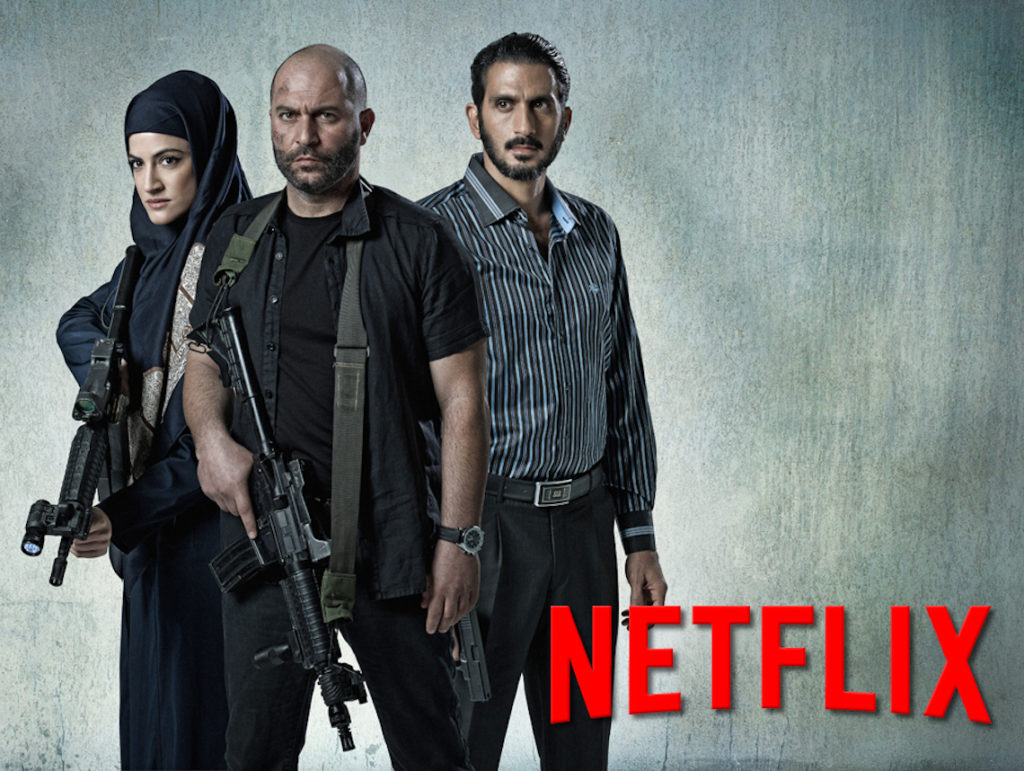
From HBO’s In Treatment to Showtime’s Homeland, Israel has become a prominent exporter of quality content for the American television industry. As an emerging studio, Netflix wasn’t about to miss out. They set their eyes on Fauda.
Fauda is one of the most successful and critically acclaimed Israeli TV shows in recent years. It tells the story of Doron, a member of a covert anti-terror unit in the Israeli military, whose world is split in two, between his undercover identity and his life back home.
Three months ago, Netflix acquired Fauda for global distribution. Avi Issacharoff, Fauda’s co-creator and an analyst of Middle Eastern affairs for Walla News and The Times of Israel, joins 2NJB to tall about the show and its worldwide success.
Editor’s note: This article appears in the March 16, 2017 print issue of The Jewish Journal.
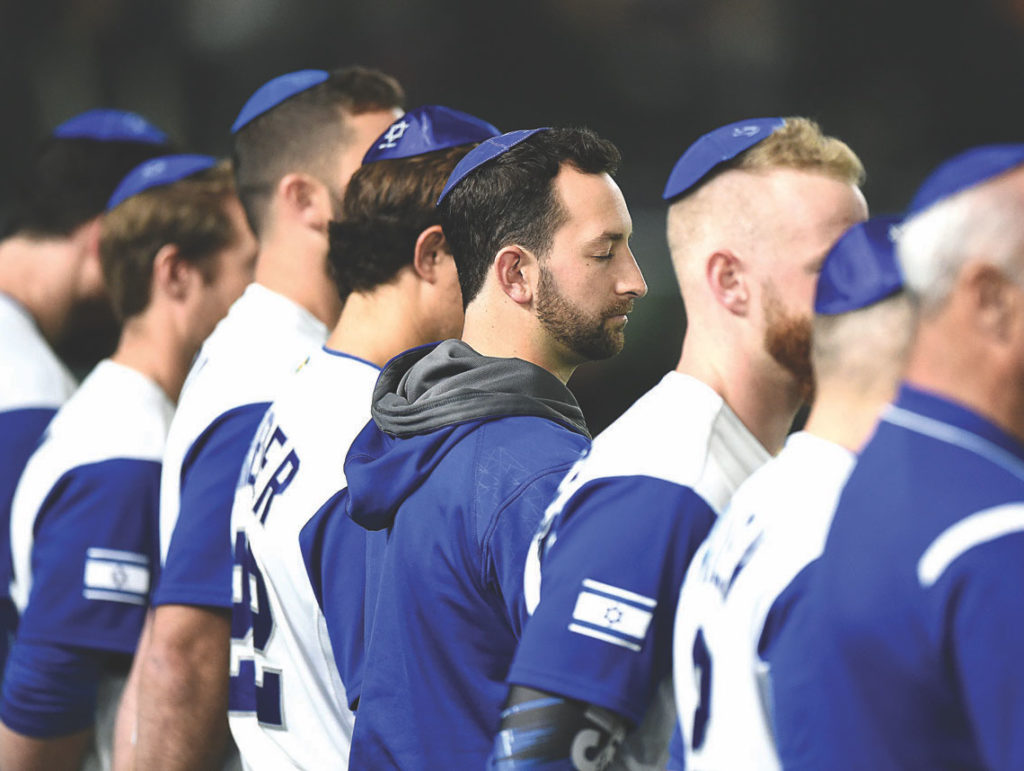
If Hollywood executives are looking for the next “Hoosiers” or “Mighty Ducks,” they might want to pay attention to Team Israel at this year’s World Baseball Classic.
The team ranked 41st in the world by the World Baseball Confederation jumped out to a 4-0 record in the 16-team tournament, which takes place every four years, beating several powerhouses known for producing Major League talent in the process. That includes unlikely wins against the world’s third-, fourth- and fifth-ranked teams in South Korea, Chinese Taipei and Cuba, respectively.
Even after subsequently dropping a second-round game to the Netherlands in Japan, Israel had a real shot to advance to the championship round to be held March 20-22 in Los Angeles at Dodger Stadium. Standing in the way: Japan, the top-ranked team in the world. The teams were scheduled to play March 15, after the Journal went to press. (Israel could advance with a loss, but it would be difficult.)
A trip to Los Angeles for the final round would mean a homecoming for Ike Davis, an American-Jewish infielder currently playing for Team Israel, who signed a minor-league contract with the Dodgers in January.
Outlets like The New York Times and The Washington Post as well as sports titan ESPN have been among those covering Team Israel’s unlikely rise.
“It’s essentially the Mighty Ducks, Hickory High [of “Hoosiers”] and the Jamaican bobsled team all rolled into one,” wrote ESPN senior writer Eddie Matz in a story. “In other words, it’s straight out of Central Casting for the role of ‘underdog team that stands absolutely no chance of winning but somehow goes on to win it all.’ ”
Nate Fish, who has been involved with the Israel Association of Baseball (IAB) for 10 years as its director, and the national team coach from 2013 until 2016, is now the team’s first-base coach. He told the Journal — via email from Tokyo, the site of Israel’s second-round games — that the success experienced by the team this year (the first time it has qualified for the tournament) has been overwhelming.
“It’s been a wild ride. This is by far the biggest thing we have accomplished,” he wrote. “We are trying to control our emotions during the games, but after games individually and as a group it can get emotional when [we] realize we just beat the number four ranked team in the world. Then we see the reaction from friends and family and online and it takes it to a whole other level when we see how many people are supporting us.”
While winning helps garner support, other factors in Israel’s Cinderella story have contributed too. The team has shirts that read “Jew Crew” and a mascot they call “Mensch on a Bench” — a life-size Chassidic doll wearing a black hat and a blue Star of David robe — that makes appearances in the dugout and in post-game press conferences.
“He’s a mascot, he’s a friend. He’s a teammate. He’s a borderline deity to our team,” Israel’s first-baseman Cody Decker said at a news conference after the team’s win over South Korea on March 6. “He brings a lot to the table.”
Despite long-shot odds, Fish said, his team has believed all along it can beat anybody. Still, he admitted in his March 14 email, that taking on Japan represented its tallest task yet.
“We do not view ourselves as underdogs,” he wrote. “In our coaches meeting we map out the games and usually say, ‘Okay, we can beat this team.’ But the further we go in the tournament the more that will change. At a certain point we will truly be underdogs. When we play Japan tomorrow is a good example.”
Israel’s team is made up of mostly American-born Jewish minor leaguers and men who have bounced around the majors. Thirty-eight-year-old pitcher Jason Marquis may be the best-known member of Israel’s pitching staff; he’s currently a free agent who has played for nine major league teams throughout his professional career. The team’s starting shortstop, Ty Kelly, is in the New York Mets’ farm system, but is also focused on a career as a screenwriter.
According to Fish, members of the team have their differences beyond coming from varying baseball backgrounds. However, the joint task of representing the Jewish state on a global stage is bringing them together and adding a layer of significance to the competition that transcends the diamond.
“We all have various levels of connection to Judaism and Israel, but when Hatikva plays before each game, the guys really feel connected and proud of what we are doing,” he wrote. “We know we are representing an entire nation and a group of people from around the world and we take that very seriously.”
Something about Russian President Vladimir Putin vexes the Left. More than any other world leader, many liberals identify Mr. Putin as irredeemable. So bad is he, they argue, that President Trump lacks moral standing for expressing a willingness to work with the Russian leader.
The Left senses a commonality between Putin and Trump. They sense a connection of significance, much more than the diplomatic chit chat of General Kelly and Russian officials. To the left, something deeper is going on, something sinister.
As a conservative who tries to understand the liberal thought process, I have sought an explanation that allows one to see Putin as incorrigible, yet celebrates rapprochement with murderers who have killed myriads of their citizens, namely the Mullahs of Iran.
Mr. Putin has a bad reputation; my goal is not to defend him. Journalists who have written against him have been killed; opposition party officials have been harassed; he regularly battles neighbors who don’t adore his Russia-centric vision. His foreign policy is amoral, as well. In Syria, Putin’s support of Bashar al Assad, a dictator who murdered hundreds of thousands of civilians, was seemingly fashioned with the goal of making himself a player on the world stage; the destruction of a country as the means to his ignoble end.
Yet, at the same time, Russia itself is largely a free country. Its citizens are free to travel. They are not brutalized and imprisoned for holding contrary opinions. Individual freedom is strong. Both Judaism and Christianity are flourishing. Putin takes religion seriously and is wildly popular. Putin has won elections by wide margins and continues to win them, overwhelmingly.
Since 1979, the Iranian regime has killed and imprisoned large swaths of its population it deems a threat to the Islamic power structure. Since 1985, it has supported Hezbollah, which has killed many thousands more. Iran is the world’s greatest financier of terror. Iran’s leaders regularly call for the destruction of Israel and America. When, in 2009, a “Green” democracy movement started, Iran’s leaders crushed it with brutal force. Hundreds were killed and jailed.
Is Putin uniquely bad? Why was President Obama’s dance with Iran considered brave, yet President Trump’s accommodation with Russia defined as evil?
Jewish tradition says that there are two forms of human experience, the masculine and the feminine. Everything humanity does flows from one of these two forces. Perfection is reached when these two forces merge; the coming together of masculine and feminine creates life, and allows mankind to touch eternity.
Nonetheless, in the world at large, masculine and feminine forces are distinct. Power and control are masculine expressions. Sensitivity and understanding are feminine values. A nation’s borders and rules are its masculinity. Its welcoming and generosity to the outsider are its feminine character.
The conservative mind seeks a masculine structure first and feminine magnanimity second. First there must be language, borders and a unique culture, and then we can allow in anyone who wants to become part of the fabric of this nation.
To the Liberal mind, expressions of masculinity are negative. Anything that sets borders and limitation, anything that values discipline over desire, is wrong. Every want is good and should be validated. When there is no absolute good and evil, there is only what feels good and what feels bad. Discipline feels bad, desire feels good, and that has become the foundation of Leftist values.
When I grew up in Orthodox Jewish Brooklyn, masculine role models were not strongmen. They were thoughtful scholars who earned the trust of the community via decades of selfless communal service.
But such is not the way of the world. To most of humanity, masculinity is strength. If there is a masculine figure in world leadership, it is not the men and women sitting on comfortable chairs in Brussels. It is in the persona of Vladimir Putin, a man who fights for his national pride. It is in the bare chested strongman who hunts lions, swims rivers, and dives to the bottom of the ocean. It is a man whose persona exudes strength, whose persona never shows weakness.
This masculine personality is antithetical to the Left. In my opinion, it is not the wrongdoing Putin committed that bothers them. It is the masculinity he has revived.
Iran’s Mullahs are not masculine figures. While they are ideological murderers for sure, but they aren’t overtly masculine. Thus, they are given reprieve. Thus, they should be given accommodation and should be understood.
President Trump is not a conservative. Had the Left-leaning media embraced him from the start, he could well have nominated Merrik Garland instead of Neil Gorsuch. He has never done anything like Putin does. But he won the election by raising America’s masculinity, its national pride. Mexico doesn’t want to pay for the wall? It just got 20 feet taller. Slander me, I’ll sue you. Reject my executive order, I’ll revise it but keep it essentially the same. He doesn’t back down. He is strong. And the Left hates strength.
Trump is not Putin. But his masculinity echoes Putin’s masculinity. Thus, there must be a connection. Thus, there must be a secret alliance. It must be, and so it is.
The Judeo-Christian ethic is masculine. God holds people accountable. God says we must discipline ourselves, limit our desires, to have a full relationship with Him. The pathway to heaven is through choosing good and rejecting evil. It is not by crying victim, blaming others and shirking personal responsibility. There are rules to follow, there are rules to morality.
To me, this is the reason the Left is weak on Iran yet strong on Putin. And why it cannot forgive President Trump.
The author of two books, Rabbi Yaakov Rosenblatt serves as Director of the American Alliance of Jews and Christians (AAJC)
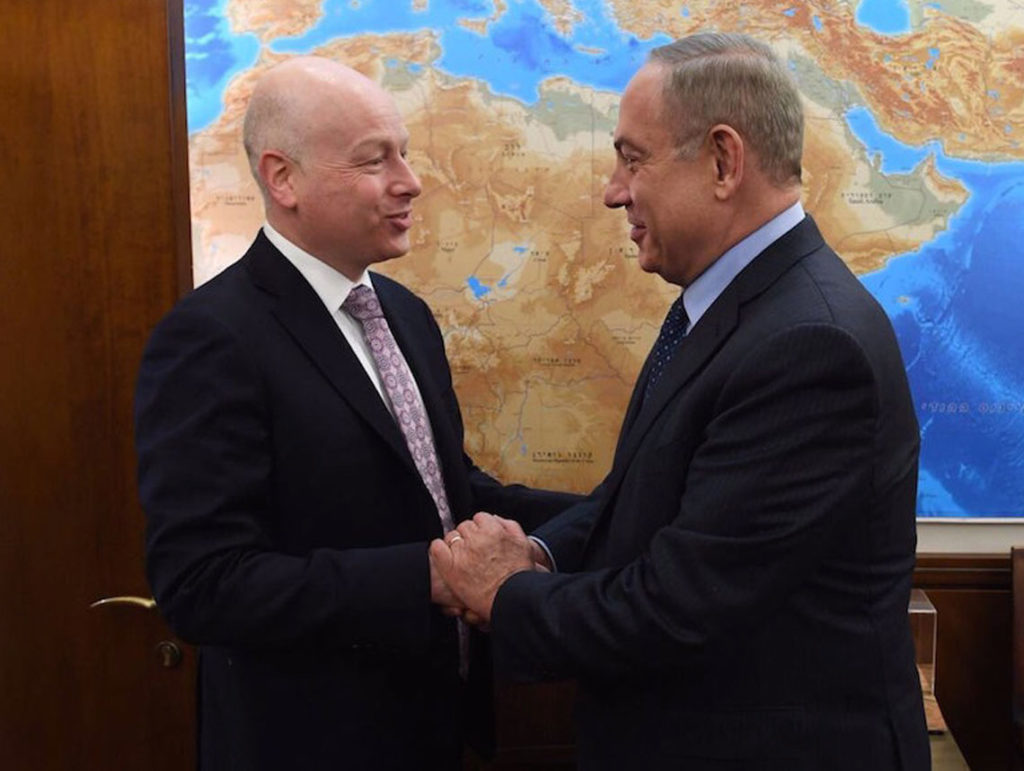
Jason Greenblatt, President Donald Trump’s adviser on international relations, is touring Israel and the Palestinian areas to gauge attitudes to peacemaking and there will likely not be any developments from the trip, a Trump administration spokesman said.
“He’s really there to listen to both sides and how they perceive getting to a peace process,” Mark Toner, the State Department spokesman, said Monday in the daily briefing for reporters. “I don’t expect any big developments out of this trip.”
Trump has expressed an eagerness to bring about a peace deal while retreating from 15 years of U.S. policy backing a two-state outcome to the peace process.
On Friday, Trump spoke on the phone with Mahmoud Abbas, the Palestinian Authority president, and the White House readout of the call sounded bullish on the prospects for peace.
“The President emphasized his personal belief that peace is possible and that the time has come to make a deal,” the readout said. “The President noted that such a deal would not only give Israelis and Palestinians the peace and security they deserve, but that it would reverberate positively throughout the region and the world.”
Trump on the call invited Abbas to the White House. The U.S. leader met last month with Israeli Prime Minister Benjamin Netanyahu.
During that visit, Netanyahu appeared to be taken aback by a request from Trump to stop settlement expansion for now. Settlement building was a key point of tension between Netanyahu and Trump’s predecessor, Barack Obama, and both Netanyahu and Trump have said relations would be smoother now.
Toner said settlements would be discussed during the trip, but also cautioned against any expecting any pronouncements.
“Settlements will obviously be a topic of discussion, but I wouldn’t predict there would be any resolution of that issue,” he said. “As we said earlier just a few weeks ago, with respect to settlements, we see them as a challenge that needs to be addressed at some point.”
Greenblatt, a longtime lawyer to Trump, solicited followers this week on Twitter to track his trip.
“Honored to be meeting with Israelis and Palestinians this week as I travel to the region,” he said. “Follow me for updates on the trip.”
Greenblatt, who is an Orthodox Jew, tweeted Monday from a stop in Frankfurt, Germany, that he was saying shacharit, the morning prayer, and called on followers to “pray for peace.”
Netanyahu later posted a photo of their meeting, welcoming Greenblatt.
Greenblatt is also due to meet with Abbas in Ramallah.
My mother-in-law, Sarah, survived Auschwitz, but at age 76, cancer of the pancreas did her in. Being a physician, I was involved, along with my husband, Fred, in her medical care during the final months. One afternoon, Fred and I attended an oncology appointment with Sarah.
“Mrs. Davidowitz, tell me, when you were in the camps, were there any toxins in the air where you worked?” Dr. Levin asked.
He threw out the question, seemingly comfortable discussing the concentration camps. The office, cluttered with books, charts and diplomas, smelled of cleaning solution. My mother-in-law, barely 5 feet tall, sat in an oversized chair across the desk from Dr. Levin.
“Oh no, the munitions factory where I worked was clean, very clean,” Sarah said. She peered at the doctor, hoping he would like her response.
“Did you smell chemicals in the air?” asked the doctor.
“No chemicals,” she said.
“Do you remember names of any materials they used in the factory?” he gently prodded.
“Names, I don’t know.But there was a guard there, one of the bosses. He let me sleep when I was sick and no one was watching. He was good to me,” she said.
“Uh-huh,” Dr. Levin said.
I was surprised that Sarah spoke kindly toward her captors at that moment. She never said much about the camps, but once in awhile something seeped out. When my husband was 11, he was profoundly disappointed when she refused to allow him to join the Boy Scouts. It was only in later years that Sarah told him the uniforms reminded her of the Hitler Youth organization.
This discussion then, was a surprise. I thought that bitterness would emerge, but Sarah chose to emphasize an act of kindness. Dr. Levin surely saw many reactions to impending death. Maybe this was one of them.
Sarah and I didn’t always see eye-to-eye. When I first met her, I was 33 years old, a professional woman, a physician.Her son Fred, born in a displaced persons camp in Bamberg, Germany, was the first child of an extended family dismantled by the Holocaust. He was the phoenix that rose from the ashes.
One Friday night back then after Shabbat dinner, we sat around Sarah and Irving’s table with Fred’s three children from his first marriage. Fred was divorced. He and I were seriously dating. I thought, as a successful Jewish doctor, I was a good catch for their son. Sarah and I cleared plates and set out teacups and pastries for coffee and dessert. Sweet smelling cookies enticed the children to sit a bit longer.
“So Sherry, how much do you work?” asked Sarah, eyeing me as she spoke.
“About 40 hours a week. It’s taken time to build up a psychiatric practice. Now it’s going well,” I said.
“Uh-huh. Do you cook?” she asked.
“Yeah, some,” I said.
“How’s your brisket recipe?” she asked.
“I don’t have one. I don’t like brisket. Too fatty,” I said.
“Oh, I see. Freddie, he loves brisket,” Sarah said.
I hadn’t planned on defending my cooking. Maybe I didn’t make a brisket but if anyone needed help with medical problems, then I was your girl. Sarah shifted her gaze to her grandchildren, who squirmed in their seats waiting for dessert.
“Here you go, bubbelehs. Rainbow cookies,” said Sarah to the children. She handed them a box of multicolored cookies, a traditional favorite among the grandchildren.
Now, nine years later, Sarah sat helplessly in her chair facing Dr. Levin and a terminal cancer diagnosis. I still believed she thought of me as a driven professional woman, capable of husband neglect. Fred and I had married and were raising our three young daughters. We shared the raising of Fred’s older children with his ex-wife.
The next time I saw her, Sarah was home under the care of hospice. It was December, the month of her death. She appeared weak, motionless under the covers. Irving slept in another room away from the IVs and the caretaker. Our oldest daughter, Andrea, having just turned 7, joined me for an overnight with Sarah, along with birds of paradise we picked from our garden.
“Bubbe, we brought flowers,” Andrea said. She placed them in Sarah’s shrunken hands.
“Beautiful,” Sarah said. “Thank you, a paradise for me. Andrea, bubbeleh, go to the kitchen. Zayde has rainbow cookies.”
Andrea hurried off, looking for Irving and the cookies. Then Sarah turned to me. She took my hand.
“Thank you for coming with Andrea,” she said.
“I’m happy to be here,” I said.
I didn’t know what else to say. We both knew that her end loomed ahead.
“Ah, me too. So Sherry, do me a favor,” she said. “See that Irving takes care of his health.”
“I will,” I said.
Then she looked me straight in the eye.
“And, I want you should have my brisket recipe. Freddie loves brisket,” Sarah said.
“Thank you, Sarah,” I said, wiping away tears.
Sherry Mendelson Davidowitz is a psychiatrist and writer who has written
for Jewish Women’s Theatre and currently iswriting a memoir.
The Jewish Federation of Greater Los Angeles plans to create an innovative Jewish space just steps from the beach in Venice after winning approval Feb. 8 from the California Coastal Commission.
The commission’s approval was the final hurdle toward redeveloping an underused senior facility on the Venice boardwalk, transforming it into what Federation expects to be a one-of-a-kind space for intergenerational encounters.
Federation President and CEO Jay Sanderson said the organization plans to break ground before the end of the year on a project that will transform the aging Israel Levin Center into a modern, three-story complex that will include a kosher kitchen, rooftop deck and Moishe House youth living space.
“This is going to be an architectural masterpiece on the boardwalk unlike anything that’s there,” he said.
Sanderson told the Journal that the project reimagines the center as a place not only for senior programming, such as the regular Shabbat dinners held there, but also to bring young Jews into the orbit of their parents’ and grandparents’ generations. The renovation seeks to capitalize on the increasing number of young Jews working in Venice’s burgeoning tech scene, he said.
Sanderson called the planned space, “a brand new model of Jewish engagement for Jews of all ages. Think of it as a Jewish community center for the 21st century.”
The task of developing that model falls to NuRoots, a grass-roots engagement program within Federation that seeks to create innovative spiritual and communal experiences for young Jews. As part of her role as assistant director of the NuRoots Community Fellowship, Jenn Green has shared coffee with hundreds of Venice-area young adults “on the outskirts of Jewish life.”
“A lot of them are telling me they feel untethered or they’re feeling lonely, they’re new to L.A., they’re working really long hours,” she told the Journal. “A lot of them want to do something meaningful and want to give back.”
Meanwhile, just blocks away from where these coffee dates are taking place, the seniors who frequent the Israel Levin Center are bursting with life advice to share and an eagerness to engage with the next Jewish generation.
“I would hear all the time from the seniors, ‘There’s no way young people want to come and hang out with us,’ ” Green said. “And that is absolutely not the case at all.”
Jason Leivenberg, vice president of NuRoots, said the organization is looking into unique gathering spaces in Los Angeles like the co-working space WeWork and the exclusive Soho House social club to learn how young people come together. He emphasized that NuRoots is just one of the stakeholders that would put on programming at the renovated Venice location.
Federation is looking to raise between $7 million and $8 million for the renovation and programmatic endowments, and already has raised about half of that, Sanderson said. He estimated the renovations will be completed before the end of 2018.
Though the building will be closed during renovations, Federation plans to offer an alternate site in the area for seniors to access services.
The planned renovation would add more than 1,000 square feet and more than double the height of the current single-story building.
A community room would occupy the bulk of the first floor, while the second floor would contain administrative offices and a sun deck, with a 1,300-square-foot residential space on the top floor.
The top-floor apartment will be administered by Moishe House, a Jewish co-living organization that offers reduced rents to young Jews, who host engagement programs in exchange. The two to three residents will host some programs, while the rest will be put on by Federation staff, Jewish Family Service of Los Angeles and members of the Venice Jewish community, according to Federation.
“[The building is] a brand new model of jewish engagement for Jews of all ages. Think of it as a Jewish community center for the 21st Century.”
— Jay Sanderson, Jewish Federation of Greater Los Angeles President and CEO
Sanderson said the space would be unique because it would be modular, with movable walls and furniture able to accommodate diverse needs.
“Most Jewish buildings and institutions, whether they’re [Jewish community centers] or synagogues, they’re built for specific purposes, but they’re not open model,” he said. “This is being designed as an open model.”
The center was built in 1927 as a cafe and then served as a dance hall and later an apartment house. It was deeded to a predecessor organization to Federation in 1964.
But by the time Federation filed for permits to renovate in 2015, a planning firm it hired wrote that “Jewish institutions in the area are minimally attended and the facilities available for Jewish community gatherings are out of date.”
Federation estimates some 45 to 50 seniors visit the center each week.
Sanderson said he’s drawing on a previous experience renovating a residential drug rehab facility on the boardwalk five blocks south of the senior center, now called Phoenix House.
He imagines the Venice redevelopment as a starting point rather than the finish line.
“Our dream is to create places like this throughout the city,” he said.
After suffering a loss in the first round of a statewide playoff tournament on the night of March 8, Milken Community High School’s basketball coach Mike Whiting said his biggest disappointment was not the defeat but that the game would mark his last with the current squad.
“I’m just sad I won’t have the pleasure of coaching those young men again,” he said after the Wildcats were defeated by the Torrance West High School Warriors, 70-57, in the California Interscholastic Federation State Boys Basketball Championships — Division 4 tournament. “It’s a very special group of people, and they accomplished something nobody ever has at Milken.”
The game at West High School in Torrance ended Milken’s unprecedented season, which included winning a sectional championship on March 1 against Shalhevet High School and going further than any Milken sports team had gone before.
On March 8, it looked as if Milken’s journey might continue as the team played a strong first half, led by captain Aaron Harouni knocking down three three-pointers.
In the second quarter, Milken enjoyed its largest lead of the night, 26-23, behind Amitai Afenjar, the team’s 6-foot-4 junior forward, whose 18 points led the Wildcats last week against Shalhevet. He had six points in the second quarter against West.
But West closed the quarter with three unanswered buckets and led 29-26 at halftime.
Still, hopes were high.
“All I heard is how good these guys are,” Rabbi Menachem Weiss, director of the Israel Center, told the Journal, referring to the West High players at halftime. “Meanwhile we’re only one shot away.”
Afenjar and Kian Zar made consecutive baskets to open the third quarter, but that was the team’s high point for the rest of the game. West went on a run, outscored Milken by six in the quarter and ran a full-court defensive press that forced turnovers and gave the Wildcats trouble getting the ball inside to Afenjar.
Trailing in the fourth quarter, Milken fought on as guard Idan Yohanan sank a three-pointer that brought Milken within nine, at 59-50. But West maintained its edge the rest of the way, challenging Milken with a steady stream of field goals and forcing Milken to intentionally foul to stop the clock. The West players converted most of their free throws.
Milken students, alumni, parents and faculty endured heavy rush-hour traffic to Torrance to cheer on the team.
Many Milken fans, including Sam Schiff, a junior who wore a Kanye West T-shirt, arrived still in high spirits from Milken’s two-point victory over Shalhevet the previous week. Watching Milken junior Doron Matian, Schiff described him as “the legend, the half-court hitter,” a reference to Matian’s Hail Mary three-point shot to close the first half against Shalhevet.
Barbara Iverson, upper school athletic director at Milken, said the bond among the team’s 13 players elevated them above the competition this year.
“In all my years at Milken, I’ve never seen a group of boys so tight,” she said before the game. “The chemistry the team has is unbelievable, like no other team I’ve ever seen.”
Polly Kim, a science research teacher at Milken and former teacher at Wise School, a feeder school for Milken, said watching the boys play this season was nostalgic.
“It’s great to see them all grown up, and play basketball,” she said.
Yohanan’s three-pointer in the fourth quarter would be his last basket as a member of a team that, according to his mother, Einat, ought to be proud of its success.
“His dream was to bring a championship to Milken,” she said, watching from the stands.
Like Coach Whiting, Harouni, a junior, is sorry he won’t be playing next year with Yohanan, one of the team’s eight graduating seniors.
“Aaron was saying he is sorry it’s over,” Eddie Harouni, the team captain’s father, said in a phone interview. “He’s not sorry they lost, but he’s sorry it’s over as far as playing with the seniors, the team.”
Young Judaea, a peer-led Zionist youth movement that saw the closure of
its West Coast summer camp in 2009, is starting to see a resurgence in
Los Angeles.
A case in point was the election of El Camino Real Charter High School junior Maccabee Raileanu to Young Judaea’s national teen board on Feb. 18, during the organization’s national midwinter convention in Atlanta. Raileanu’s peers elected him mazkir (president) of the Young Judaea teen board. He will serve for one year.
“I was interested in the role because, ever since getting seriously involved in the movement about three years ago, I have wanted to be the most involved that I possibly could,” Raileanu, 17, said in an email.
Young Judaea National Teen Board President Maccabee Raileanu. Photo courtesy of Michael Raileanu.
Raileanu attended the organization’s national Camp Tel Yehudah in upstate New York from 2014 to 2016 after being awarded a fellowship that subsidized his attendance at the camp and provided training in how to return to his community to build local programming for his peers.
“I have so much love, passion and ideas for Young Judaea,” he said, “and I felt my experience of being the L.A. mazkir has trained me well to move up to the next level and lead the entire movement.”
Founded in 1909, Young Judaea operates year-round programs, an Israel-based gap-year experience for incoming college freshmen, Camp Tel Yehudah, regional camps and other activities.
Los Angeles events are regularly drawing 15 to 20 people, compared with just three people as recently as 2015, Sharon Schoenfeld, Young Judaea’s director of U.S. programs, said in a phone interview.
The organization is spreading the word about renewed local presence by increasing its relationship with The Jewish Federation of Greater Los Angeles.
“I keep in touch with the L.A. Federation and if they’re doing something with teens, I ask them to let us know, so we can be part of it,” Schoenfeld said. “If something’s happening in the community, it’s important our kids know what that is and be involved. … We are trying to be very thoughtful about how we’re building it and what we’re doing. It’s still in its infancy right now.”
Schoenfeld said she hopes people understand that, whatever their views about Israel, the camp is pluralistic and nonpartisan.
Zionism is “a hard word nowadays, but as a pluralistic Zionist youth movement, we don’t necessarily tell people what it means to be a Zionist, we don’t tell kids how to be a Zionist,” she said. “We try to open minds to all sorts of ways of celebrating Israel, learning it and being part of it … going there and being active for it. We don’t tell them this is the way you have to be.”
Young Judaea is currently accepting applications for the latest cohort of its fellowship. The deadline is April 1. For additional information about how to apply, email yjevents@youngjudaea.org.
When Stephen Miller began to crop up in headlines last spring as a member of then-candidate Donald Trump’s inner circle, those who knew him as the scion of a Jewish household in Santa Monica were intrigued — but for the most part unsurprised.
As far back as Hebrew school, his classmates pegged him as a young contrarian. Some now suggest that his journey as an impassioned evangelist for the right, which eventually landed him a West Wing office, began as a rebellion against Santa Monica’s bleeding heart, multiculturalist and heavily Jewish left.
News reports identify Miller, 31, as a principal author of Trump’s draconian immigration measures, including the executive order the president signed in late January targeting immigrants from Muslim-majority countries. These politics are generally reviled in the liberal circles of his Jewish upbringing — such as at Beth Shir Shalom, where he went to Hebrew school, and which describes itself online as a “Progressive Reform Synagogue,” and at The Santa Monica Synagogue, a Reform temple where he was confirmed in 10th grade.
At The Santa Monica Synagogue, members skew liberal, especially when it comes to immigration, said Rabbi Jeffrey Marx, the temple’s longtime rabbi. The confirmation course itself — taught by Marx once a week on Tuesday evenings — sought to instill empathy and respect for the other, the rabbi said.
“We certainly did our best here to teach him the ethical standards of Judaism,” Marx said. “He certainly didn’t grow up not having that knowledge base.”
Miller, who now holds the title of senior policy adviser to the president, first gained nationwide attention as the hype man who would pump up audiences beforeTrump’s appearances at campaign events. His national profile peaked during a Feb. 12 round of the Sunday talk shows, where he struck an authoritarian note that rankled many liberal West Coasters.
“The powers of the president to protect our country are very substantial and will not be questioned,” he told John Dickerson of “Face the Nation” on CBS, discussing the president’s first abortive attempt at a travel ban.
Long before that, though, Miller was the middle child in a Jewish real estate family with immigrant roots, and far more interested in “Star Trek” than politics.
His mother, Miriam, who came to Los Angeles as a social worker, grew up in the well-to-do Glosser family of New Deal Democrats in Johnstown, Pa. Her grandparents were Eastern European immigrants. Stephen’s father, Michael, is a Stanford-trained lawyer who pivoted into real estate management. Peers described the elder Miller as a Jewish community leader, who served in board posts for a number of philanthropic organizations, including on the national board of Hebrew Union College-Jewish Institute of Religion (HUC-JIR) and the board of directors of The Jewish Federation of Greater Los Angeles. Together the couple owns and operates a real estate investment company that controls 2,500 residential units from Pico Rivera to Valley Village.
The Millers also have given generously over the years: From 2013 to 2014, the family donated $25,000 to the American Committee for the Weizmann Institute of Science, a research university south of Tel Aviv, tax documents show. Other recipients of their largesse include the Republican Jewish Coalition and Stanford Law School.
Repeated requests for interviews with Stephen Miller and his parents went unanswered.
Over the years, the family appears to have moved from temple to temple, spending time at The Santa Monica Synagogue, also known has Sha’arei Am, Beth Shir Shalom and Kehillat Ma’arav, a Conservative shul near the 10 Freeway. Each congregation is notable for the liberal politics of its members — but Michael Miller was different.
Steven Windmueller, professor emeritus at HUC-JIR, has known Miller since both men were involved with the now-defunct L.A. Jewish Community Relations Council (JCRC), where Windmueller was director and Michael Miller co-chaired the Western Region, which included Santa Monica and much of the Westside. Windmueller said Miller was “rather conservative in his political outlook” and not particularly shy about it.
But even those who differ from him politically described Michael Miller as a mensch. “He was a great guy to work with,” said Michael Hirschfeld, who took over the directorship of the JCRC after Windmueller left in 1995. “He was committed, he was loyal, he was respectful — he was an all-around good guy.”
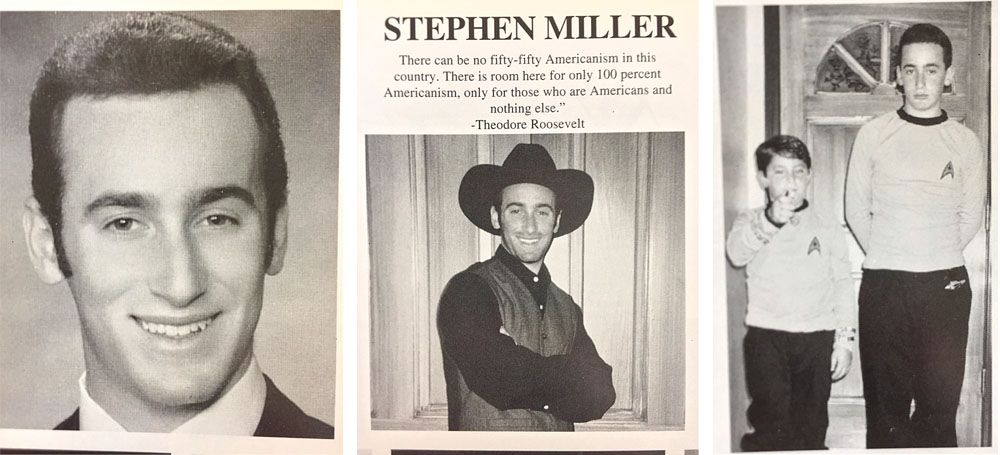
Images of Stephen Miller from the 2003 Santa Monica High School yearbook; far right, Stephen with his younger brother Jacob in “Star Trek” garb. Photos by Eitan Arom.
Early on, young Stephen Miller veered away from the progressive ethos of the temples where he grew up.
Even in Hebrew school at Beth Shir Shalom, Miller was something of a budding provocateur, according to a classmate who asked not to be named so he could speak freely. Though he wasn’t the full-blown contrarian he would become in high school, Miller seemed to enjoy getting a rise out of people, the classmate recalled.
“He was not very concerned with being well liked,” he said.
Another Hebrew school classmate, Sophie Goldstein, said classes encouraged debate — an area where Miller thrived — over Torah tractates and other aspects of the religion.
Once, Goldstein said, the class of about seven or eight kids was discussing how to deal fairly with the sole remaining slice of a pizza pie, when Miller decided to end the debate.
“We’re all talking and talking about it. In the middle of this discussion, Stephen slaps his open hand down on the middle of the slice of pizza,” she recalled. “And of course nobody would touch this pizza slice after he put his greasy 13-year-old paw on it.”
But at that time, politics were on the far backburner for Miller, according to those who knew him. Jason Islas, now a Santa Monica-based journalist, bonded with Miller as a preteen over their shared Trekkie inclinations. Islas said throughout their time together at Lincoln Middle School, world events were far less important for Miller than, for instance, his obsession with Capt. Kirk.
Then, in the early 1990s, the real estate market soured and the Millers downsized from a house on a tree-lined street in the well-to-do neighborhood north of Montana Avenue to a somewhat smaller one in a less affluent area of Santa Monica, off a busy stretch of Pico Boulevard.
The move came just before Stephen entered high school. Islas recalls Miller breaking off the friendship around that time — because, as he says Miller told him, Islas is Latino.
Soon, Miller developed a reputation as a rabble-rouser at Santa Monica High School. He rallied against what he saw as rampant anti-Americanism, decried Spanish-language bulletins, lobbied hard for daily recitations of the Pledge of Allegiance and fought to bring conservative speakers to the overwhelmingly liberal school. A video from the time shows him getting booed offstage during a student government campaign speech, wearing a self-assured grin, for suggesting students shouldn’t have to clean up after themselves since janitors are paid to do so.
Since then, Miller has often defined his ideology in opposition to what he has called the “racial left.” In his high school yearbook, he quotes President Theodore Roosevelt: “There can be no fifty-fifty Americanism in this country.”
“He thought of himself as an anti-establishment figure in an area where the establishment was very progressive on economic and ethnic and racial diversity,” Islas said of Miller’s upbringing.
“We certainly did our best here to teach him the ethical standards of Judaism. He certainly didn’t grow up not having that knowledge base.” — Rabbi Jeffrey Marx, The Santa Monica Synagogue
Islas speculated that Miller’s ideology had its roots in a “teenage rebellion” against his liberal surroundings.
“This is a particular strand of conservatism that can only be created in a place where the predominant paradigm is wealthy, liberal identity politics,” he said.
Miller has said as much in interviews with the media.
“When we think of nonconformity, we tend to imagine kids in the ’60s rebelling against ‘the system,’ ” he told the Los Angeles Times in January. “This was my system. My establishment was a dogmatic educational system that often uniformly expressed a single point of view.”
Among Miller’s battles with the administration at Santa Monica High School was his fight to bring conservative author David Horowitz, founder of the Sherman Oaks-based David Horowitz Freedom Center, to speak on campus.
Administrators at first denied Miller’s request, but later gave in. After his speech, Horowitz stayed in touch with the young man, who came to see him as a mentor. Horowitz credited the teen with a great deal of chutzpah for standing up to hostile teachers and administrators.
“I even thought at the time, ‘This is a very bright young man, but how’s he going to get recommendations for college out of these people?’ ” Horowitz told the Journal in a phone interview.
The two men share more than their conservative ideas and distaste for liberal identity politics. Both strayed far from the political norms in their hometowns.
Horowitz, 78, grew up in a communist family in a hardscrabble neighborhood of Queens, where the Jewish community held President Franklin Roosevelt to be as sacred as any sage rabbi. He said his background growing up among leftists shaped his particular brand of politics, and he suspects the same is true for Miller.
Whereas conservatives tend to approach politics pragmatically, liberals bring a certain missionary zeal, he said. When the liberal political style is applied to conservative ideas, you get somebody like Miller.
“You learn a certain style of politics when you’re on the left, and if you take it over into the right, it comes out as hardball,” Horowitz said.
He also speculated that Miller’s experience dealing with the ire of his classmates inoculated him early on to the hectoring of political opponents who might name him a racist or a xenophobe. And indeed, by the beginning of his senior year at Duke University, Miller would recall with nonchalance being labeled a racist, writing in the school paper that “my skin, in addition to being somewhat pasty, is also very thick.”
“Once you break with the left, they want to kill you,” Horowitz said. “So you learn to survive.”
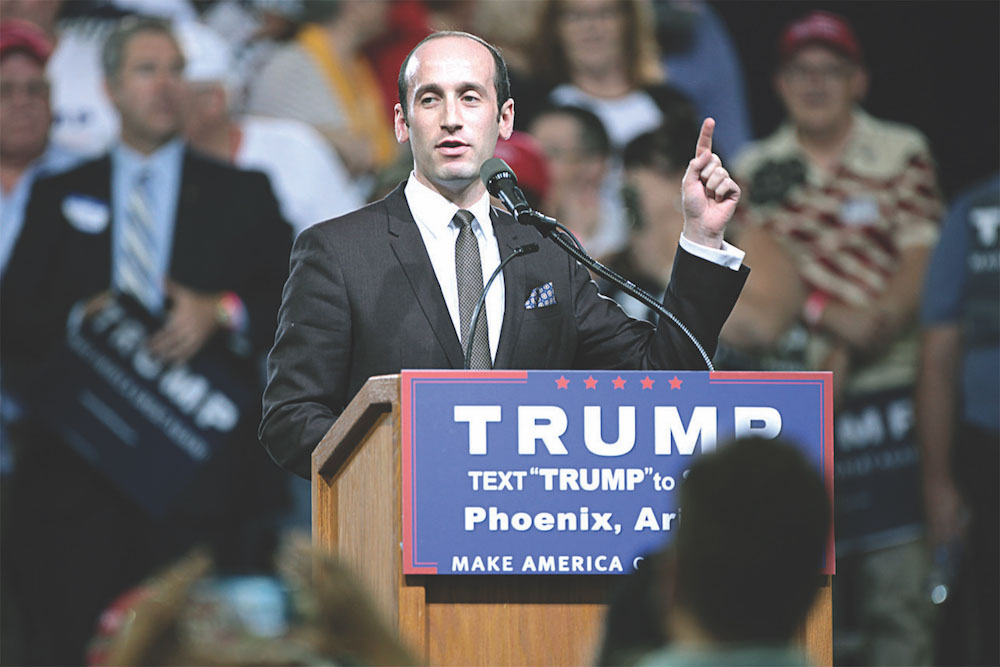
By the time Miller arrived in Johnstown, Pa., for a campaign event just 18 days before the presidential election and mounted the stage to the sound of a thrumming bass and fast-paced rock-’n’-roll drumbeat, his act was smooth, well practiced. He beamed at the audience, wearing a gray suit, skinny tie and pocket square.
Photo by of Gage Skidmore via WikiCommons.
From Duke, Miller had landed jobs with various Republican politicians, such as Michele Bachmann of Minnesota and David Brat of Virginia. He’d worked with Sen. Jeff Sessions of Alabama, now the attorney general, to defeat the bipartisan Gang of Eight immigration reform bill in 2014.
In Johnstown, looking the part of the Washington operative he had by then become, he would nonetheless rail against the government elite, singling out Trump as the last beacon of hope for working-class Americans.
But this campaign stop was somewhat different from the dozens that preceded it. Miller’s mother grew up here during a better time, before Bethlehem Steel, the town’s major employer, went under.
The Glossers first arrived in Johnstown at the turn of the 20th century after fleeing Cossacks and conscription in Antopol, Belarus. As the family established itself, more relatives moved in, until they were a sizable contingent of the town’s population. The Glosser Brothers tailoring shop became Glosser Brothers Department Store on Main Street, and the family thrived. Stephen’s grandfather, Isadore “Izzy” Glosser, was an executive in the family business, serving also as president of Beth Sholom Congregation, the town’s only synagogue. As a kid, young Stephen would travel to the town of some 20,000 each summer to visit his grandparents.
“Johnstown, to me, represents, if you look at the history of this amazing place, what is possible for America when our government, as it once did, puts the American people first,” he told the enthusiastic crowd.
What he failed to mention was that the entire Johnstown wing of his family were Roosevelt stalwarts, New Deal Democrats almost to a man, according to Larry Glosser, a cousin of Miriam Miller.
“I found it strange when I heard that he was Miriam’s son,” Glosser said in an interview with the Journal.
Other than one of his younger brothers, Glosser doesn’t know of anybody in his family who shares Miller’s conservative leanings.
“How would you like it if a family member became the face of white nativism in this country?” Glosser said. “I’m glad he doesn’t have my last name.”
Glosser said he eventually grew apart from Miriam, and doesn’t have any distinct memory of meeting Stephen at all. Discovering his cousin’s name in the news has led to some puzzlement among the extended Glosser clan, in private conversations and on Facebook.
“With all familial affection I wish Stephen career success and personal happiness, however I cannot endorse his political preferences,” Miller’s uncle, David Glosser, wrote in a public post that criticized Trump’s rhetoric.
And while others who knew him in his Santa Monica days found Miller’s new role strange, it also seemed somehow fitting. The Hebrew school classmate who preferred to remain anonymous said he first recalls hearing about Miller’s ascendancy on Facebook.
“I was like, ‘Whoa, Stephen is, like, writing Trump’s speeches,’ ” he said. “That’s crazy — but totally unsurprising.”