fbpx
[additional-authors]
February 21, 2018
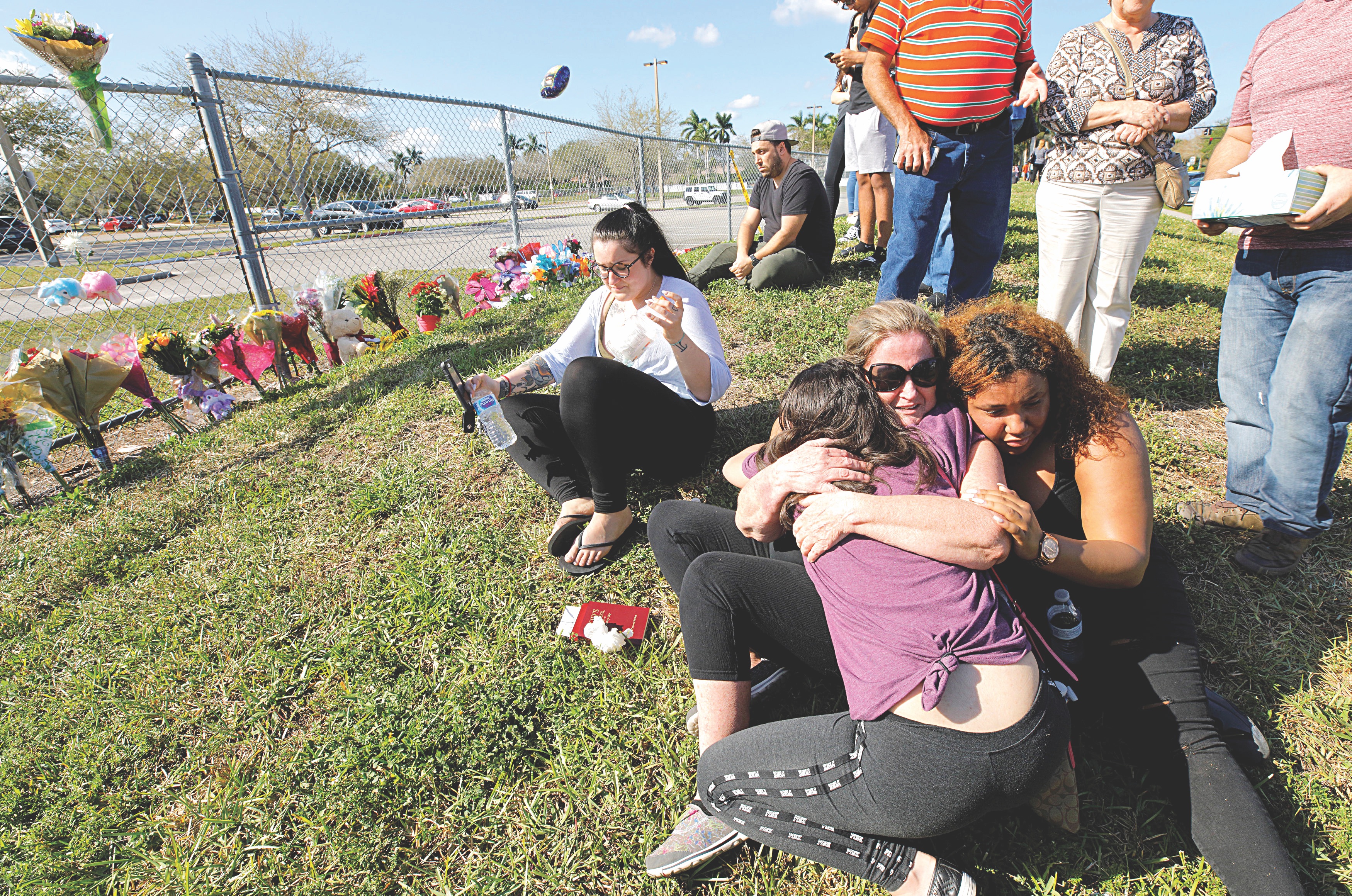
Community members console one another at Marjory Stoneman Douglas High School four days after the shooting, in Parkland, Florida, U.S. February 18, 2018. REUTERS/Jonathan Drake

Rabbi Jeffrey K. Salkin, author and leader of Temple Solel in Hollywood, Fla., 30 minutes from Parkland

In Pirkei Avot, we learn: “One should not comfort someone whose dead lies before them.”

A knowing silence has fallen over the Jewish community of Broward County, Fla., where I live and work. The gates and the walls of our gated communities could not keep out the Angel of Death.

Why does this keep happening? Because of a pervasive gun culture that is actually “gunolatry.” Because of our avoidance of mental health issues in the larger community. And, yes, because of the outsized influence of the NRA on far too many politicians.

We have to go deeper, and journey into our national psyche. Perhaps this is where American exceptionalism comes to die — that, despite the fact that immigrants clamor to enter our country; despite the fact that this is the chosen land and the chosen life for so many — there is an emptiness at the center of the American soul.

Guns? Most Israeli households have guns. Mental illness? Every country has mental illness.

American culture is many great things, but it is a violent culture. It is in our television, our movies, our video games and our literature. It is part of the malignant machismo that afflicts too many of our young men. Notice the paucity of female shooters.

Healing begins in the home, and in the way we raise our sons. Healing begins in schools, and in the way we tell the American story. Healing begins in churches, synagogues and mosques as religious teachers try to create a curriculum of the heart.

This is the essence of prophetic religion. It must speak truth to power and truth to culture.

Did you enjoy this article?
You'll love our roundtable.

Editor's Picks

Latest Articles

Lessons in Gratitude

The deepest expression of gratitude isn’t simply saying thank you for what we’ve received. It’s allowing what we’ve received to shape who we are, who we become, and how we treat others throughout our lives.

A Thanksgiving to Remember

The first holiday my family celebrated in Los Angeles was Thanksgiving. Although it was many decades ago, I can picture that day like it was yesterday and my heart bursts with gratitude for how meaningful and special that day was.

The Thanksgiving Parade and a Jewish Pennsylvanian

The Gimbel family had benefitted greatly from America, and for that they were grateful. A Jewish family, thankful for the freedom to pursue the American Dream, gifted the country, among its many contributions, its quintessential Thanksgiving public celebration.

From a Global People to a People of Israel

Today, 46% of world Jewry lives in Israel. In 2070, according to the forecast, 62% will live there. The U.S. share of world Jewry will drop from 39% to 26%, which numerically means 1.2 million fewer people.

Giving Thanks

Below are some of the things for which I am grateful.

The Magic Words

At every turn Judaism is a religion that is held up by gratitude. Our identity is linked with this most remarkable value, to be grateful.

An Attitude of Gratitude

I raise my glass of Martinelli’s and wish you all a happy, healthy, grateful Thanksgiving.

More news and opinions than at a Shabbat dinner, right in your inbox.