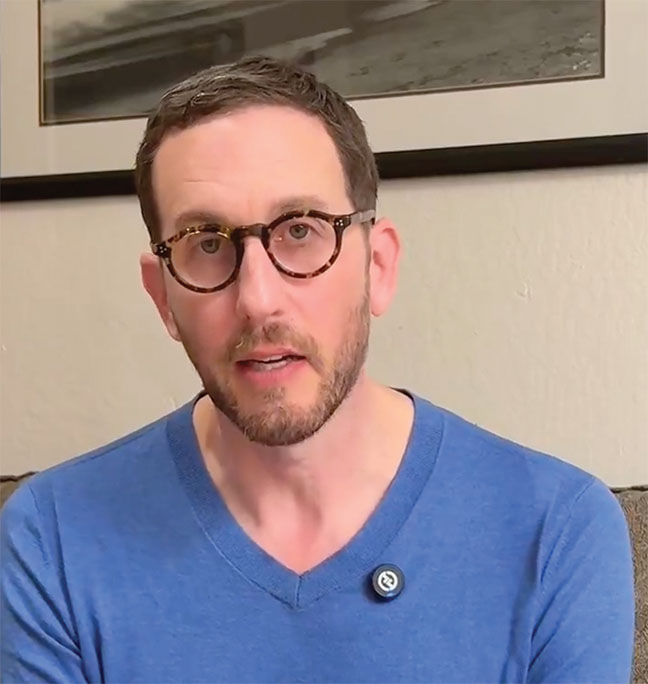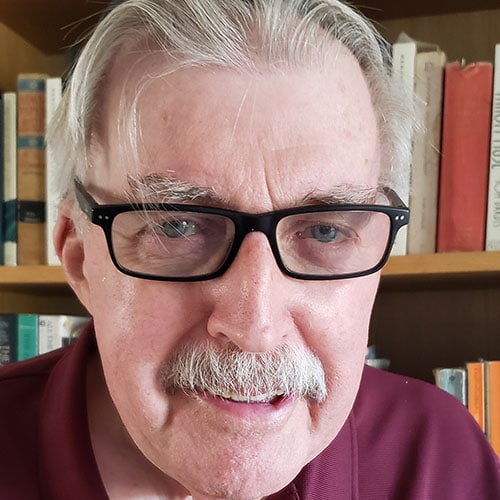
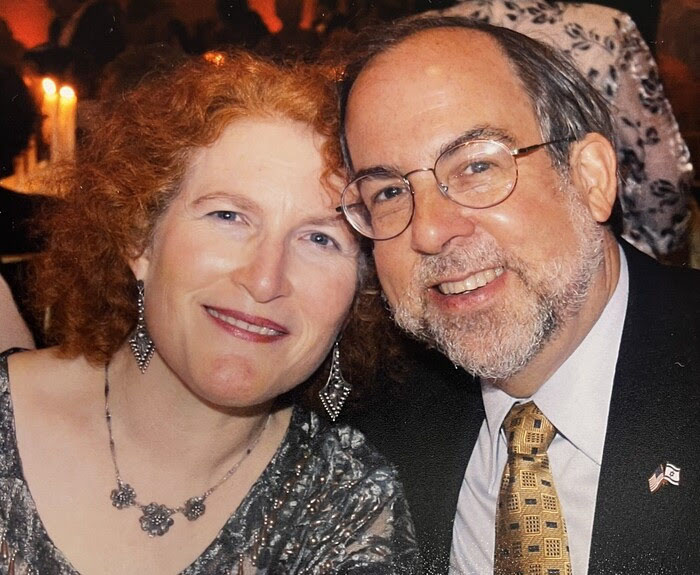
Dec. 19 was the 11th yahrzeit of the beloved Rabbi Harold Schulweis, and in the days leading up to the anniversary, Rabbi Ed Feinstein, who currently leads the Valley Beth Shalom community, reflected on the man who had an outsized influence on his thinking.
It was a Shabbat night in 1970 when Feinstein first encountered Rabbi Schulweis. The young Feinstein had worked that entire summer at Camp Ramah, earning a grand total of 75 dollars. The 16-year-old Feinstein decided to blow it all on one date. “I was crazy in love with one girl, and I invited her out to the Malibu Sea Lion restaurant. We had a table by the ocean. Then we were going to the Hollywood Bowl for a Gershwin concert. I put my arm around this girl, and I said ‘What would you like to do now?’ She said ‘It’s Selichot. Let’s go to shul.’”
This was not what he had in mind. But she told him “There’s this new rabbi in the Valley who’s supposed to be very good. He came with a good deal of notice.” So they drove out to the Valley. Feinstein was a member of United Synagogue Youth and had been to the temple often. “This was a sleepy suburban synagogue,” he said. There wasn’t much going on here.” But that night, there were 1,500 people in shul that night. “It was packed. It was like a High Holy Day. Packed to the back.” And when Rabbi Schulweis walked in in, the place was “just electric. I still remember the first sermon he gave here. … His oratory, his ideas, and the way that he presented Judaism, all of that was so powerful. I like to joke I fell in love twice that night.” His date that night was 14-year-old Nina, now Rabbi Nina, his wife of 47 years, and the second woman to be ordained by the Conservative movement.
Reflecting on that first sermon, Feinstein said “it was the way he spoke. His oratory was beyond what he said. His power, his conviction. This tradition had a moral truth, and that moral truth was urgent, important, and it needed to shape our lives. This is the kind of teacher he was.”
Shulweis’ impact on Feinstein was so strong that when Feinstein went off to college, he and his father engineered a secret deal. The elder Feinstein “used to sneak a tape recorder into shul, and he would send me the tapes of Rabbi Schulweis’s sermons.”
After college, the Jewish Theological Seminary and a short time in the Dallas community, Rabbi Feinstein returned home to lead Camp Ramah. One afternoon on the VBS campus, Rabbi Schulweis invited him into his office. “He said ‘What are you going to be when you grow up?’ I said ‘I’m a camp director.’ He said ‘No you’re not. You can’t do that forever.’ So he invited me to come work with him. I came here in ’93 as the second rabbi, and succeeded him in 2004, and I was with him through his passing in 2014.”
The year 2025 would have been Schulweis’ 100th birthday. “This was an extraordinary soul,” Rabbi Feinstein said. “A deeply courageous rabbi who did not feel himself down by the inhibitions that held back other rabbis. He really knew there was a moral truth that needed to be conveyed.”
What are Rabbi Feinstein’s strongest recollections from their earliest meetings? “Remember I am talking about the ‘60s and ‘70s. I had long hair and strange ideas. And here was a rabbi who said, ‘The moral truth you are looking for is found in the Jewish tradition. You don’t have to leave Judaism to be able to understand what’s happening to society, to understand the revolution that needs to happen in the world. We were all revolutionaries, us young kids. But here was a guy who said that revolution can be expressed in a Jewish language because that Jewish language is ancient. It gave us permission to dream, it gave us permission to imagine what the Jewish community could look like. Rabbi Schulweis gave us permission to imagine what the world community could look like.
“Other rabbis were principally concerned with preserving the Judaism that was, the Judaism of yesterday. Rabbi Schulweis was committed to a Judaism of tomorrow. He wasn’t going to talk about why we don’t do what we should have been doing before. He was going to talk about what we can do tomorrow. He was forward thinking, courageous in that way. That made him very unique.”
Rabbi Feinstein said his mentor made magic as soon as he landed from Oakland, his only previous post: “There were 1,500 people in shul the first night that Nina and I were here, and there were 1,500 people here every Friday night for the next 10 years or so.”
Rabbi Feinstein glowed as he reflected on how Valley Beth Shalom was packed on Friday nights. The service throbbed with music and was full of Rabbi Schulweis’ teaching. Later he introduced Israeli dancing. “We had a guy with an accordion,” Rabbi Feinstein said. “If you were a Jewish teenager like me and you wanted to meet girls, this is where you came on a Friday night. It was a happening in the life of the LA Jewish community.”
He added, “I wouldn’t have been a rabbi without Rabbi Schulweis. I had so many doubts, so many questions, so many challenges. He said ‘Your questions are what qualify you to be a rabbi.’ He said it’s more important to be a keeper of questions than to be someone who has found the answers. He said questions matter more.”
Fast Takes with Rabbi Feinstein
Jewish Journal: What is your favorite Shabbat moment?
Rabbi Feinstein: First, it was growing up in my parents’ home and the big discussions we had over four-course desserts. When my own kids were small, telling jokes, singing songs, telling stories. Now I get to sit with my grandson and my granddaughter on my lap. That’s the best there is.
JJ: Did you ever consider a nonrabbinic career?
RF: Sure. I looked at law school, at academics. I thought of becoming a professor of Jewish studies, maybe becoming a high school teacher.
JJ: Your favorite memory?
RF: Summers at Camp Ramah because they gave me a sense of my capacity to shape for others, to shape a community.