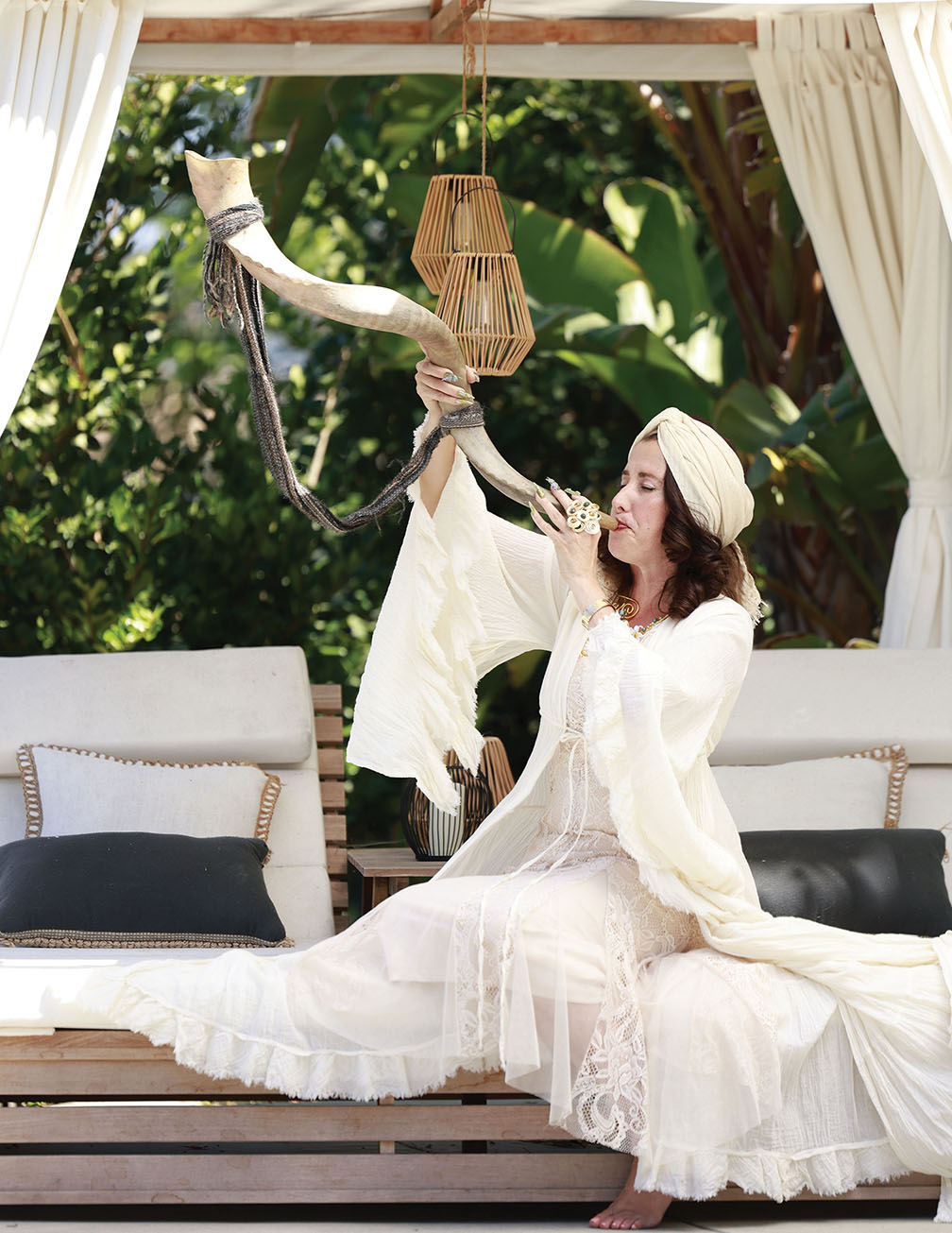
During a recent trip to Berlin, Nili Salem once again found herself in a familiar situation: airport security officers looking puzzled when she arrived at the airport with her more than three-foot-long shofar.
Because the enormous horn was simply too large to fit through the standard security scanner, Salem asked that it be inspected separately.
They looked at it suspiciously. The Orthodox woman knew exactly what they must have been thinking: Was she trying to smuggle something? Drugs? Snakes? Who knows?
One security officer approached her.
“What is it?” he asked in his German accent.
“It’s a ritual prayer horn,” Salem explained.
She added that she works as a spiritual leader, but the airport security personnel didn’t look convinced.
“If it’s really an instrument, then play it,” he said.
“Okay,” Salem replied. “But I’m warning you — it’s quite loud.”
“Oh, we want to hear it,” he insisted.
And so, in the middle of the airport, Salem closed her eyes, slipped into the meditative state, and blew a long, powerful blast that echoed through the terminal, its deep, haunting sound turning heads and stopping passersby in their tracks.
“After a few seconds, I opened my eyes and saw a ring of blond-haired, blue-eyed Germans around me with their jaws dropped,” she recalled.
It was the first time most of them had ever heard a shofar — or even seen one. They let her pass.
There was, of course, a simpler way of dealing with the situation: She could have shown security her Instagram account, filled with dozens of videos of her blowing the shofar all around the world. But then again, she would have missed the look on their faces, and she wouldn’t have this cool story to tell.
“I enjoy the balagan,” she admitted, using the Hebrew word for chaos and general mayhem.
Salem has traveled around the world with her shofar slung across her back, carrying the instrument like a Star Wars warrior carrying his weapon. Last year she published her book, “Awesome Blast: 40 Days of Shofar Intentions, Soul-Healing and Spiritual Return,” which guides readers on a spiritual journey from Elul through Yom Kippur. Through poetic reflections, Torah wisdom and personal stories, Salem explores the shofar as a tool for mindfulness, healing, surrender and inner transformation.
Her love story with the shofar started in second grade at Sinai Temple. “Our principal brought those little shofars from Israel. They were $20 each, and that’s exactly how much I had. I had this burning desire to have one, so I bought it,” Salem said. “And then, it turned out that I was really good at blowing it. It was almost like a natural connection with God.”
Years later, when she was in her early 20s, she was hired to work at Sinai as a cantor and blew the shofar on the High Holy Days. In 2008, she made Aliyah and settled in Nachlaot, a Jerusalem neighborhood near the Mahane Yehuda market. Every day during Elul, Salem heard shofars being blown throughout the neighborhood. She absolutely loved it.
The following year, when her mother began battling cancer, Salem returned to Los Angeles to take care of her. When Elul came around, she said “We have this expression, ‘Where there’s no man, be the man.’ So, I realized, where there’s no shofar blower, I’ll be the shofar blower. Every time you hear the shofar, it’s another reminder that you have this beautiful, auspicious time and this opportunity.”
Salem decided to film herself blowing the shofar every day during Elul. But she quickly realized that simply filming herself blowing the shofar every day might get boring, so she thought of a way to make it more interesting. “I needed to make 24 videos, so I just started going all around Los Angeles and found cool and fun places to film,” said Salem. “I blew the shofar on the Santa Monica Pier, at the Hollywood Sign, the Venice Canals, the Petersen Museum and the Hollywood Walk of Fame.”
That was only the beginning. From there, Salem started traveling across the United States and around the world with her shofar. She took videos of herself with it in some of the most recognizable and historic locations, among them Yosemite National Park, the tomb of Joshua Bin Nun and Caleb ben Yefuneh, the Dead Sea and outside Rome’s Colosseum.
Airports have become a recurring source of adventure, and while things usually go smoothly, there was one incident she’ll never forget. It happened in Peru, where Salem had traveled to lead a Jewish spiritual retreat. However, airport officials confiscated the shofar.
Salem was heartbroken and launched an online plea for help. What followed was an unexpected outpouring of support, as hundreds of people reached out with contacts and connections. After nearly a month of lawyers, a Chabad rabbi and others working behind the scenes, the shofar was finally recovered and eventually made its way back to her.
The experience taught Salem another lesson: Don’t assume every airport encounter will go smoothly. Before her most recent trip to Guatemala, she contacted the government and customs authorities in advance. She even had a local person write a letter on her behalf and went through a formal legal process to obtain permission to bring the shofar into the country.
There is one place, however, where she won’t blow the shofar again — Mea Shearim, Jerusalem’s ultra-Orthodox neighborhood. Salem noticed that her presence, and the ritual there, made people uncomfortable. There was no confrontation, but people lowered their heads and avoided engaging with her. “I realized that it’s not polite to go into someone’s neighborhood and do a custom that isn’t acceptable there,” she said.
Salem believes that the shofar is meant to bring Jews together from the four corners of the earth. It resonates with her own work with Jewish communities around the world, including communities she has visited in Ethiopia, Rwanda, Zimbabwe, India and China.
For Salem, blowing the shofar is also about encouraging women to step into their own power and participate in this larger Jewish calling. She believes women have a special role in bringing about the Geula, or redemption, and sees the shofar as one way to help bring that vision to life.
Speaking on Zoom from Hawaii, where she had traveled the previous week, she told The Journal that she was asked to blow the shofar as she was going through TSA. She gladly did.
“And you know what’s cute? Afterwards at the airport, Jews would pass me by and say, ‘Shalom.’”
When she was heading back to Los Angeles, the flight attendants asked her to stay on board after all the passengers had left, and she blew the shofar for them, right there on the plane. It was exhilarating.
Often, after she blows the shofar, people approach her to tell her that its ancient sound made them feel as if something had opened inside them — as though, for a brief moment, the gates of heaven had opened. “They tell me how it shook them to the bones or how it stirred up something deep inside them,” she said.
“I can’t explain the power behind it. It’s just really magnificent.”