How does one pick up the pieces after a close family member has been murdered in a terror attack or fallen in battle?
The OneFamily organization, which began more than 25 years ago, during the days of the terrible Second Intifada, provides therapeutic and financial relief for family members whose souls have been shattered. Some programs specialize in helping those with who have lost parents, children, grandchildren or siblings, the thinking being that different relationships need healing sessions and programs targeted specifically at them.
Three years ago, in addition to the ongoing programs and camps, OneFamily began a program called Bonim Chalom – “Building a Dream.” It is a seven-month journey that supports bereaved siblings as they find their way back to lives filled with purpose and fulfillment.
Throughout the program, participants meet for personal sessions and in small groups, learn to listen to themselves again, rediscover dreams that were pushed aside, and translate them into practical steps in their personal, family, and professional lives.
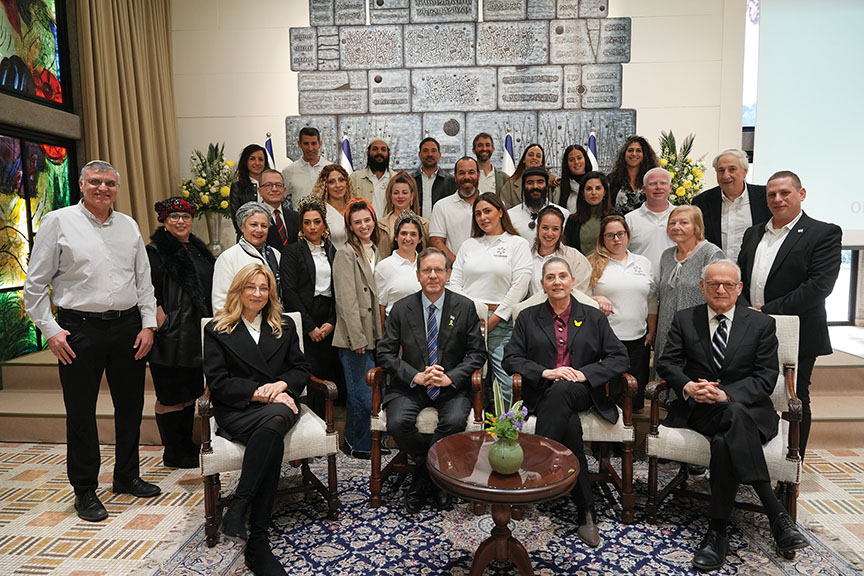
This year’s cohort had 45 siblings. Fifteen of them were able to come together for a deeply emotional event in the residence and with the participation of Israel’s President Isaac Herzog and his wife, the first lady Michal Herzog.
Israel is a small country. The first person I encountered when I entered the President’s House was David Hatuel, a board member of OneFamily. His family’s story is one of the most tragic in the annals of terror attacks. In May, 2004, his wife, Tali, a social worker, eight months pregnant, and four daughters, were in the car on the Kissufim highway leading out of Gush Katif, on their way to speak with Likud voters, to ask them to vote against the threatened expulsion in Ariel Sharon’s referendum. Sharon had promised that the results would determine whether or not the uprooting of Gush Katif would take place. (The Likud members voted against it, but he reneged on his promise.) Terrorists murdered Tali and her daughters at close gunpoint.
I shared with David that in 2012 a granddaughter of ours, Shirel, was one of the winners in the Bible contest that he founded in his family’s memory, in the elementary school where a few of his daughters had studied, in Atzmona (now in Shomria, post-expulsion). It was an emotional moment for both of us. Shirel’s great-aunt and uncle, Rachel and Dov Kol, were also murdered by terrorists, in July 2005, on that same highway.
Like I said, a small country.
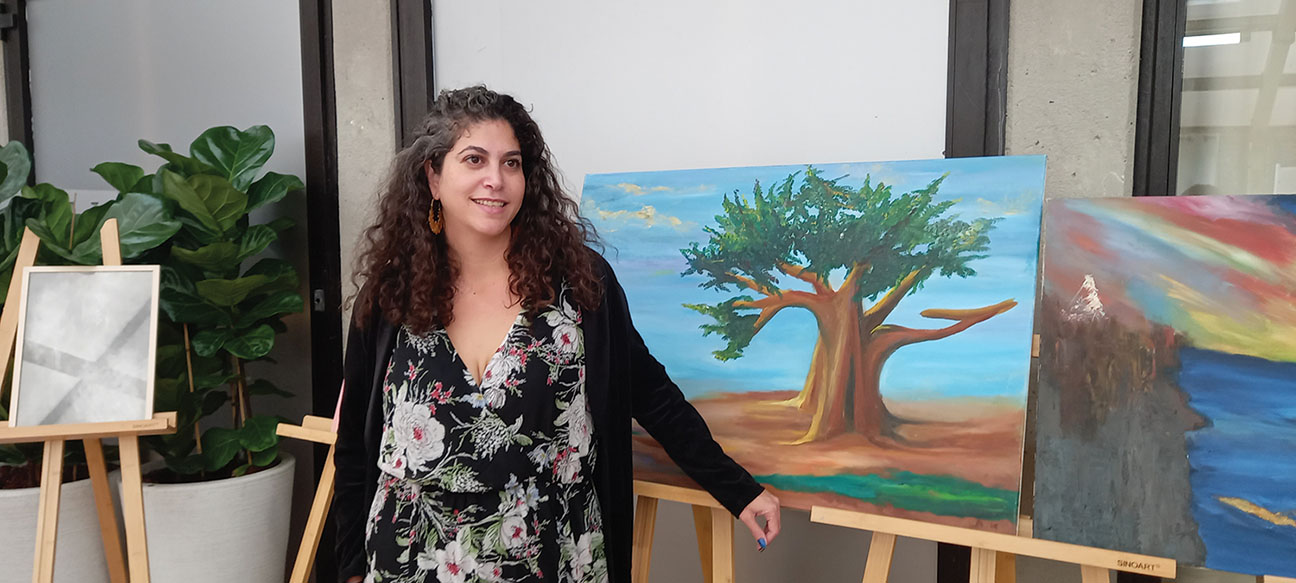
On display in the President’s residence was an exhibit of breathtaking paintings by Tamar Aluf, one of the OneFamily cohort members. They were exhibited in the Jerusalem Theater from Jan. 4 through Feb. 3.
I spoke with Tamar about her story and her process.
Tamar lives in Alon Hagalil, a community village in the Jezreel Valley. She told me that she has been a part of OneFamily since her father, Boaz Aluf, a programmer at Bank Hapoalim, was murdered in a terror attack in 2002. It happened on the #32 bus line, at the French Hill junction, on his way to work. “It was a routine morning,” she says. “I was 16 years old.”
She had been painting since she was 12. She started again the day she got up from shiva.
Does she feel a difference in her artwork before and after?
“Painting is a place where I express myself – my silence, my inner world. It helps me understand things, and process insights that often come quietly, through my hands.” I asked her to explain some of her paintings.
She pointed out one she calls “Cracks in the Foundations” and says about it, “It’s the feeling that things change; everything changes. You have to rebuild, to rearrange your life again after something like that happens.”
I asked her about one of her paintings of a tree. She said, “I had originally painted a tree in black, the day I got up from shiva for my father.” At the President’s House, among the many paintings were two that she painted in reaction to that first tree (not on display) is one called “Tree of Renewal.” The second one she calls “Mosaic of Life.”
In addition to painting, Tamar is an employment coordinator who operates under the auspices of a nonprofit called ‘Shekulo tov’ (“All for the good”) under the Ministry of Health. Her grandparents, Jerry and Sylvia Gibraltar, were born in Manhattan and Brooklyn and made aliya in 1948.
Hearing their stories
After President Herzog lit the Hanukkah candles, he sat down at the head of the room, with Michal Herzog, and with Chantal and Marc Belzberg, the co-founders of OneFamily. The president went around the room and asked each cohort member to introduce themselves. He addressed a personal comment or question to each one, clearly familiar with all their stories. The stories spanned time from more than two decades ago to the last two years.
After everyone introduced themselves, there was a panel of three who spoke about how Bonim Chalom had helped move their personal dreams forward, sensitively moderated by Ofer Hadad, an Israeli journalist.
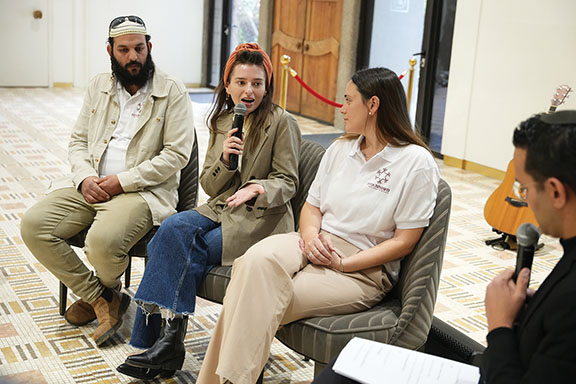
Panelist Moshe Eliyahu, 30, from Aish Kodesh, is married and a father of four. He comes from the world of construction and woodworking. During the war, he lost his brother and brother-in-law, and completed around 530 days of reserve duty in a Homefront Command battalion.
Today he volunteers at Ohel Yehudi on the Kinneret, where he exercises his ability to listen to searching and hurting teens, and to connect with them. Thanks to the Bonei Chalom program, he began a degree in social work and started working as a counselor at the Zula Shel Hetzroni (“Hetzroni’s Zula”), a gathering space for at-risk youth in Jerusalem.
He said on the panel, “My brother used to say a sentence that deserves to be a sticker: ‘Every fracture has a purpose.’ It helps us understand that from every break, when we are shattered, that’s the time to rise. There is a future to the fracture … There is meaning in it. Time doesn’t heal — but time teaches.
“I recommend embracing life, and from what we’ve been through, to rise and rebuild. It’s possible — to dream dreams and to fulfill ourselves.
“I think that to go through a process that leads to this kind of work, you really need to go on a personal journey — of building a dream, of truly arriving at yourself, understanding who you are and how to honor your emotions.
“From there, you can bring yourself to understand the pain of others. And in the end, an encounter that brings you closer to another person also gives you an answer to your own pain.”
Ofek Sitron Shafir spent years studying communications, working intensively in social media management, and learning styling and sewing.
In the period after Oct. 7, 2023, alongside the upheaval of losing her brother Dor, she began offering personal styling consultations. She came to understand that she was not interested in simply learning a profession, but in creating a space that allows for personal expression, beauty and connection.
She recently gave a lecture that wove together styling, Dor’s story and bereavement. It was an evening, she says, in which she finally felt at home on stage, and it anchored within her a clear sense that she has something to give and a uniquely powerful way to give it.
“The word ‘ovdan’ means something we lost, I had a brother, and we lost him, but we also lost a sense of: what do we do now?” she said on the panel.
“There is a feeling like everyone is speaking hevel havalim [From Kohelet 1:2, meaning ‘utter futility’] and I’m in the midst of my own hevel havalim … I work in styling and clothes and the feeling was, what does it matter now?…But davka from that place, I understand how much strength there is in clothing, that I get up in the morning and get dressed and function in the world and fulfill myself…I can also give meaning to others.
“Dor lived intensely, and the sentence that always accompanied him was ‘Live the moment’ — the understanding that every moment here won’t return, and that we must fulfill ourselves.
“I truly believe there is enormous meaning in these meetings — in togetherness. Because dealing with all of this alone is very hard. Within the Bonei Chalom program, there are groups, and each group has its own uniqueness and its own stage in the dream process.
“I remember the first introductory conversation I had with Dan (a OneFamily counselor). I said: ‘I have a dream — something I love to do…’ and he said, ‘If there’s a place where it’s allowed — it’s here… You’re allowed to want to fulfill this dream.’ I remember that I even started crying during that conversation.
“That’s the strength I got from this program. It’s a place to say our dreams out loud and to stand behind them.”
Stav Sela grew up in Kibbutz Neve Ur in the Beit Shean Valley, the youngest of three siblings. Her older brother was murdered on October 7, and life changed forever. She served as an armored corps instructor, an officer, and a company commander in the armored instructors’ course. She traveled the world, studies communication and political science, has an MBA, worked on a political campaign and later in a startup.
After the war, she said, “I had to think about what to do now. It’s a process. I felt I wanted to go inside myself, and think…Since Oct. 7 I experienced a significant lack of trust…I was an officer, I served many years, and I believed in the army, and suddenly…
“All my life I knew I wanted to be involved in public service, social activism, even a bit of politics, also because I lost faith in the system of public service…That’s connected to my dream, because public service really was my dream.
“After October 7, I felt I needed to stop everything. The personal process with Dan, and the group process, made me stop and rethink…Basically, I’m now in a process of learning to love myself.
“You start by creating order: understanding again what I love, what I’m good at, what gives me strength, what I’ve done until now, how I feel while doing it. You really start to put things in order.
“I think the uniqueness of this program is that there are both personal meetings — where you really sit and think deeply with yourself — and group meetings that strengthen you, where you gain perspective. My dream exists in a certain direction, but it’s still being built.
“I didn’t choose this. I would give up everything not to be a bereaved sibling, not to be in this position. But if this is the situation, I really want to say thank you to OneFamily. People who are gold. This program gives tools, and it brings you face to face with yourself, and with people who are precious to you.”
Today, between reserve duty, studies, and trips to India and Sri Lanka with OneFamily, she is using the program as a space to refine her dreams, listen to her intuition, and begin shaping, with courage, the next chapter of her life.
Chantal Belzberg also addressed the group. “In the past two years,” she said, “we have done the work…on a scale, with a depth and complexity, we had never known before— all from within a clear understanding: that the families and wounded need us now, and not only now, but also in a year, in five years, and in 10.”
She reported that OneFamily is supported by more than 70 professional staff members.
Eighty National Service volunteers “who provide the closest possible accompaniment to war widows and children who have lost both parents, and approximately 500 volunteers, who work day after day, night after night, in families’ homes … in groups, workshops and events.
“This Hanukkah alone, more than 1,500 people have already participated in holiday events, community gatherings and moments of hope and growth. Because even within the darkness, we choose to light a candle.”
Their work also crosses borders. “At this very moment, a delegation of OneFamily therapists is in Sydney, Australia, strengthening communities, learning and sharing knowledge …
“This gathering today, and the Building a Dream project, are a profound expression of our belief that even after loss, it is permitted to dream. That self-fulfillment, meaning, and hope are not luxuries, but an essential part of life itself — growth emerging from trauma.”
To conclude the event, President Isaac Herzog addressed the group, first saying to the Belzbergs, “You are a remarkable partnership that brings goodness to the people of Israel, and I want to thank you … building dreams in the face of darkness.
“Viktor Frankl wrote in ‘Man’s Search for Meaning’ that within the deepest hell — a hell where no one wanted to be — you give people meaning. And meaning is absolutely essential for a person to be able to cope with such a tragic situation…We see the fruits of your work years later…”
He quoted from a poem by Tuvia Ruebner, a noted Israeli poet:
After all that has happened,
if you are still able to hear the blackbird,
the skylark’s chirping in the morning,
the songbird and the sunbird,
do not be surprised if you feel joy
at the sight of clouds drifting in the wind,
…or at seeing colors still bright
after sunset.
A human being is capable of bearing almost anything —
and who can know when and where joy will overcome him.
[An excerpt, translated from the Hebrew]
“So I truly wish all the bereaved families — dear and beloved — that joy will overcome them, that they will know comfort and healing.”
Michal Herzog added, “I thank you for reaching out a hand beyond the sea, to also strengthen the Jewish communities that are wounded abroad, and for continuing to dream dreams, because in spite of the loss and the pain, we continue to dream and to be optimistic so thank you.”
Speaking of crossing borders, as I was doing the final edit on this article, I was plugged in to the 2 p.m. Israel radio slot that plays English language golden oldies. The Seekers 1965 hit “A World of Our Own” came up: “We’ll build a world of our own that no one else can share, all our sorrows we’ll leave far behind us there. And I know you will find there’ll be peace of mind, when we live in a world of our own.” It brought tears to my eyes, thinking of the participants of Bonim Chalom who are building worlds of their own, that others can share, that will hopefully help them leave some of their sorrows behind, and bring them peace of mind.
Toby Klein Greenwald is an award-winning journalist and theater director, and the editor of WholeFamily.com. Her current theater project is “Heroines! Songs & Soliloquies for the Soul,” about the heroines of Oct. 7.