The Torah portion Jews read last Shabbat, Yitro, contains one of two iterations of the Ten Commandments. Last Saturday, as I read this section, and specifically the 10th commandment, something occurred to me that I had never thought of the countless times I have read this text.According to the Etz Hayim translation, this commandment reads: “You shall not covet your neighbor’s house; you shall not covet your neighbor’s wife, or his male or female slave, or his ox or his ass, or anything that is your neighbor’s.”
Upon reading this language, my initial thought, as always, centered on the male-oriented text which by this point in my life, I simply take as a given for our sacred scripture. Next, as in the past, I briefly contemplated the items the Torah enumerates as potential sources of jealousy, reflecting on how the categories of spouses and homes still are so very relevant.
But then, a new insight popped into my head.I was struck by the reality that this commandment, even though couched in some outdated language and applications, embodies a timeless truth with particular relevance to the 21st century: envy is a completely unproductive, and even self-destructive, emotion.
The commentary to this passage in the Chumash I use offers a couple insights. One observation notes that proscribing feelings is inconsistent with the Torah’s general pattern reflecting an emphasis on behavior. Another view suggests that although controlling our emotions may be difficult, we can never excuse bad behavior by claiming that our emotions prompted poor choices.
The beauty of Jewish tradition generally, and the wisdom of the Torah in particular, is that its evergreen approach to life enables people living in all times and places to learn and benefit from its insights. As for this commandment specifically, I read it as a personal challenge to replace envy with more productive choices.The Torah does not enumerate on the nature of these choices, leaving the commentary to others as is so often the case.
I believe the two most productive choices in this context are learning to be content with your lot in life, and engaging in proactive measures that facilitate achieving what you feel is missing.For most people, I suspect this is not a uniform “either-or” choice across the board.We all have aspects of our lives in which we are, or have the potential to be, content, and other areas where we will always wish and hope for more. But I see the Torah’s message here as very clear: envy is a poison that not only consumes people, but also prevents them from making more positive choices that could improve their overall well-being.
Years ago, I had a close friend who struggled with alcoholism, and she eventually lost her battle. During that time, I became familiar with the Alcoholics Anonymous Serenity Prayer, which contains a message embodying my interpretation of the 10th commandment. “God grant me the serenity to accept the things I cannot change, courage to change the things I can, and wisdom to know the difference.”
With respect to matters that are in our power to change, we should direct our efforts toward taking affirmative steps that can help us achieve more of our life goals rather than focusing on what others have that we lack. As for those things we cannot change, we need to focus on acceptance.All too often, though, people turn to envy in both instances. Underlying the Torah’s message in the 10th commandment is the idea that envy is unproductive as well as harmful to ourselves, and potentially to others.
The Torah’s wisdom here can go a long way toward making a positive difference in our lives.Unfortunately, although social media has many benefits, one of its greatest downsides is that it often encourages envy. Today, it is so easy for people to flout their possessions and achievements in an unprecedented highly visible manner. This reality makes it so much more difficult for all of us to focus on the Torah’s timeless message embodied in the 10th commandment:human beings have been endowed with the affirmative ability to control both our thoughts and actions.
Roberta Rosenthal Kwall is a law professor, author, and Jewish educator with a focus on American Judaism. Her latest book is “Polarized: Why American Jews are Divided and What to do About It” (October, 2026, Bloomsbury Press).
My truck-driver father and secretarymother, both hardworking people, seemed like failures to me because they were not doctors or lawyers like many of my grammar school classmates’ parents.
I was so wrong. It’s painful to think that your parents are losers. I hope to God they never knew my thoughts.I lived in a world of compare and despair. That world never ends well. I was never satisfied and always felt uneasy. Rabbi Abraham Twerski wrote 30 books about low self-esteem. I had a good case of it.
When it comes to money, I’ve never been rich nor poor. I have somehow always ridden in the middle of the pack — lucky to open the right door at the right time, do what was necessary to keep it open and have the sechel to keep expenses low.
When coins were part of our lives, I had a giant five-gallon water bottle I tossed loose change into. I went to Europe and Hawaii on what I amassed in a few years. That felt good because I saved it up myself.
Even now that I can afford DoorDash, I never order. I knew, young, that buying cars I could not afford, or other big-ticket items, never raised my sense of self. It had the reverse; it caused worry.
At 17, I moved to Manhattan from Forest Hills, Queens, and started my career as a comedian, where no matter what your parents did for a living or how many millions they had or who you knew, there was no leg up to becoming a comic. You lived and died on your God-given talent, the sweat of your brow, and millions of mistakes. Everyone was on equal footing.This was a feeling that was new to me. I loved it.
Jerry Seinfeld and I both lived in studio apartments, and our rents were under $150 a month. But you still had to get the $150. To make rent, I was a short-order cook.Jerry mowed lawns and was a waiter. Once I started paying the rent from my comedy earnings, a sense of satisfaction gripped me for the first time.
Pirkei Avot: Who is rich? He who is happy with his lot, “When you eat of the labor of your hands, you are praiseworthy, and all is well with you.”
If you’re happy with your lot and don’t compare yourself to others, you might be in possession of one of the rarest of all gifts, A Satisfied Mind. A few of my friends have become big stars and mega-rich. I’ve been asked whether it bothers me not to have achieved that level of success, to not have a TV show and the star on Hollywood Boulevard.I’d be lying if I said I would not like to have 400 million dollars in the bank and that success. But I am not consumed with the thought. I don’t feel less-than since I don’t have it.
What I am consumed with is helping God, being a better husband, father, grandfather, friend, performer and writer. Even when I come up short, there is the sense I’m trying. When most of these things are clicking, I hit gold and a satisfied mind. When I stopped trying to be Neil Simon or George Carlin and just looked at what is inside of me, I struck gold again. God doesn’t make junk.
I somehow understand that comparing my marriage or my kids to your marriage or your kids is a dead end. I am lucky because I have a marriage that works the way it does and I have children and spouses who get along and love each other and grandkids who bring me joy and naches. I have a career I love, a paycheck and a chance to keep growing.
I grew up with a mind that was always on the attack. It pains me when I see others that possess like what I had.
I need to tell you writing this was very hard for me. It took close to a week. But I didn’t give up. The reward for not giving up is a satisfied mind.Now go listen to the song “A Satisfied Mind” by Mahalia Jackson. She sings it better than I could ever say it.
Mark Schiff is a comedian, actor and writer and hosts, along with Danny Lobell, the “We Think It’s Funny” podcast. His new book is “Why Not? Lessons on Comedy, Courage and Chutzpah.”
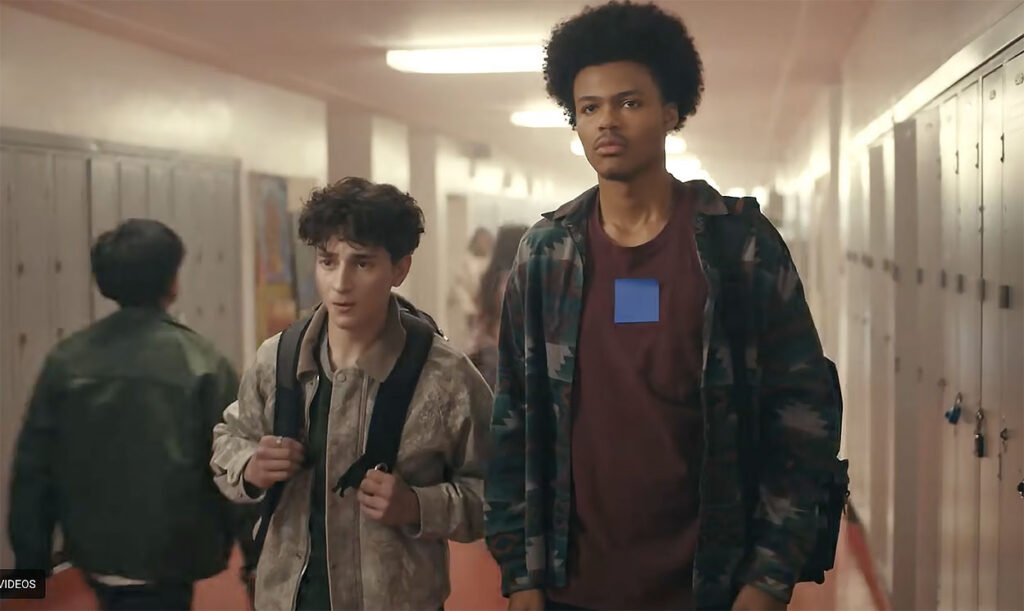
The most important 30 seconds of the Super Bowl were not anything that either team did on the field during the game itself. It was not the rousing list of 23 Western Hemisphere countries recited by halftime performer Bad Bunny when framing his pointed proclamation of “God Bless America.” Rather, the most significant half-minute of the weekend was the splendidly touching and stirringly meaningful video drama aired by Robert Kraft’s Blue Square Alliance Against Hate.
Their short-form film (calling it an advertisement would diminish both its art and its impact) offered an inspiring lesson about how to most effectively confront antisemitism. The Alliance website, which provides a link to the video, explains that their goal “is to inspire Americans to stand up to Jewish hate and all hate,” making it clear that those two brands of ugly animosity cannot and must not be separated.
This is the third consecutive year in which they have aired an anti-hate message during professional football’s most visible event and it is by far the most poignant and most effective. While the previous spots talked about fighting all types of hatred in every form, the essence of this film focused specifically on prejudice against Jews. The two teenage protagonists represent the importance of underrepresented communities supporting each other, delivering a message of universality and unity for Jews – but more importantly for non-Jews.
The organization sensibly leaves it to others to lead the fight against the most virulent antisemites and to support American Jews. But while the strategy employed by Kraft and his allies is less frontal, it is potentially longer-lasting. Their emphasis is not on culture or heritage or history. That is where our synagogues and our day schools and our community organizations are so important. The aggressive pushback against antisemitism is the province of the Anti-Defamation League and other similarly fearless organizations. The Alliance’s core message is simply one of friendship and teamwork, how good people who stand together against hate can drive it back into the shadows where it belongs.
New York Times columnist Bret Stephens recently instigated a debate when he suggested that our community prioritize the strengthening of Jewish life above the fight against our antagonists. But this is not an either/or question: we must do both. We must build our future while defending ourselves at the same time. The Blue Square Alliance reminds us that just as important as these two tasks is the need for solidarity. Jews comprise barely 2% of the U.S. population, which means there aren’t nearly enough of us to accomplish these tasks on our own. Our options are to either immediately and dramatically increase our procreation rate (a strategy that the Haredi can tell us has significant limitations), or to become much better at making friends.
We know that friendships come much easier to us when we’re young. We also know that lifelong habits and attitudes develop during our formative years. And the Alliance’s film tells us that “two in three Jewish teens have experienced antisemitism.” So starting our partnership-building exercise with adolescents can have a profound and lasting impact. These are the members of our community most likely to experience antisemitism. While we older Jews can retreat to our neighborhoods, our offices and our restaurants, these young people are on the front lines. To get the education they deserve, they must be willing to traverse high school and college campuses and be prepared to look this hatred in the eyes.
The primary target of the Blue Square message is a younger non-Jewish audience, one that is less likely to be engaged or informed on these issues, and therefore more reachable with a more low-key, personal and non-political message. Those who misunderstand its goal and its priority audience may bristle, but the young people who watch this video will be much more likely allies and partners when we need them.
Kraft is the owner of the New England Patriots, who lost the game decisively. But for the third Super Bowl in a row, he and the Blue Square Alliance were the night’s champions.
Dan Schnur is the U.S. Politics Editor for the Jewish Journal. He teaches courses in politics, communications, and leadership at UC Berkeley, USC and Pepperdine. He hosts the monthly webinar “The Dan Schnur Political Report” for the Los Angeles World Affairs Council & Town Hall. Follow Dan’s work at www.danschnurpolitics.com.
The last three State of World Jewry addresses have concluded the same way: Jews need to build Jewish identity to fight antisemitism.
Are we listening?
The Jewish community is at an inflection point. The current strategies are broken. A fundamental rebalancing is required. A revolution is needed.
Decades of organizing Jewish life primarily around reaction, defense and crisis management haven’t stopped the world from hating us.
It has actually weakened our self-confidence and resilience.
Jewish continuity has never depended on popularity or approval from others. It has always depended on education, identity and resilience.
Communities that define themselves by what they oppose lose sight of what they truly stand for.
Defense, advocacy and security are essential, of course. But they cannot serve as the organizing principle of Jewish life.
The most durable and effective response to antisemitism isn’t better messaging.It’s investing more in Jewish life itself.
We teach young Jews to defend themselves and Israel before we teach them to love Jewish civilization.
Because our priorities are inverted. Too many resources flow toward monitoring hate groups.
It’s time for a change.
Jews need to know who they are, where they come from and why it matters. Jewish education, schools, camps and high-impact, deep-engagement formative experiences that shape identity and belonging need far greater investment.
A generation raised on defense will always feel under siege. A generation raised on identity will feel confident and capable.
Rooted like the Kotel.
We cannot retreat from the world with optics and brand recognition. We cannot survive in our current emergency mode. We must invest in our growth.
Antisemitism thrives on insecurity and fragmentation. A grounded, inwardly invested Jewish community doesn’t need to beg for legitimacy.
When Jewish identity is shaped by multiple fears, threats and a sense of victimization, it produces anxiety, exhaustion and disengagement — not strength.
Resilient communities invest relentlessly in continuity. Education, culture, faith, language and community-building neutralizes the haters.
Bravo to Bret Stephens. In his remarks at the 46th annual conference in New York on Feb. 1, Stephens said the hundreds of millions of dollars that fund the ADL, the AJC and the UJA would be better spent on Jewish day schools that promote and strengthen cultural identity.
Leading Jewish organizations have long acted with sincerity, moral clarity and real impact. The challenge today is not intent but alignment. Some missions were built for an earlier moment, and the current landscape demands a recalibration of where our energy and advocacy can be most effective.
Clearly, the current strategies and millions of dollars aimed at combating antisemitism aren’t working. Consider the rising popularity of Tucker Carlson. Or a study that shows one in five millennials in New York state believe that Jews were responsible for the Holocaust.
The path forward is clear: invest less in perpetual reaction. The emphasis on Holocaust education and remembrance just isn’t enough.
Dan Senor, whose podcast shapes much of today’s Jewish conversation, said this clearly at last year’s State of World Jewry address. The message landed. The shift did not. We don’t seem to be listening.
A dear friend, Sarah Hurwitz, who served as a speechwriter for President Barack Obama and Michelle Obama, put it plainly: “You don’t fight a tsunami with buckets. Only an ark will do.”
How do we take advantage of these scary times? By embracing our Jewishness. As an Australian by birth, seeing Bondi Beach in this story felt personal, just as the Jew hunt in Amsterdam and the Tree of Life massacre felt communal. The response cannot be fear or withdrawal. It must be a renewed embrace of Jewish identity and purpose.
Oct. 7, 2023 can be its own badge of honor.
Communities endure not by fighting louder but by building deeper. Can our legacy organizations pivot? Or is the future in the hands of a new calibration of educators and philanthropists?
We must reclaim our mission.
We must fortify our Jewish foundation by building more day schools and summer camps that celebrate our heritage and nurture our communal connectiveness.
Let’s spend our resources on programs that cultivate pride, meaning and a lived understanding of what Israel and Jewish civilization represent to our ancestry and our future.
Stephens quoted the composer Philip Glass, who famously said: “If there’s no room at the table, build your own.”Jewish history has never waited for permission. It has advanced through creativity, scholarship, moral courage and the lived vitality of our civilization.
This is truly our moment. A defining moment to move from listening to action. Rabbi Lord Jonathan Sacks reminded us that Shema Yisrael does not mean passive hearing. It means attentive listening that leads to responsibility and action.
We have listened long enough. Now we must act. We need to double down. We need to ramp up. And we must find the courage to change, not defensively, but confidently, by building Jewish life strong enough to carry us forward.
Rabbi Daniel Kraus serves as Vice President of Strategic Partnerships at the Birthright Israel Foundation and Director of Community Education at Congregation Kehilath Jeshurun in New York. An ordained rabbi with an MBA from Yeshiva University, he was named to The Jewish Week’s 36 Under 36 for his leadership in Jewish engagement.
The frigid wind off the Hudson River had teeth. Winter in New York chills one’s social life. No one lingers, and small talk becomes a luxury.
But stepping inside the 150th Westminster Kennel Club dog show at the Javits Center, the temperature warmed up in more ways than one.
There were gorgeous, friendly dogs everywhere, alert, curious and generous with their unflinching affection for humankind. And with them, breeders, groomers and trainers who were excited to tell about their dogs.
Marvel at the site of a beautifully bred pup and watch their handler’s eyes light up. Pause to admire a stunning coat or regal posture and a story is sure to follow. The dogs themselves love it too, tails wagging, receptive to attention from all who are willing to bestow it. Inside, the cold instantly thawed, replaced by a deeply satisfying feeling of belonging.
I went looking for theology and religious upbringing, not in the form of doctrine, but in stories. What they shared wasn’t so much driven by scripture. They spoke about ethics learned at home and responsibility learned by doing, with kindness as a sort of moral baseline. Still, in three conversations, two with Jews and one with a Christian, belief and identity did show up, not as a sermon, but more as a frame.
The clearest voice belonged to Ellen Burleson, a dog trainer from Cotati in Sonoma County, in town with River, a corgi she described as “a nice young dog” at the start of his career. She spoke quickly, with the confidence of someone who has lived inside the structures of the sport long enough to explain them plainly. A championship, she said, is “very involved” — 25 points, earned through a series of eliminations. Dogs are judged against a written standard, not against each other, and the standard can be exhaustive: “It’s 30 pages,” she said, explaining the corgi’s head shape in terms of geometry. The standard for a corgi is a face shaped like an equilateral triangle measured from ear tip to ear tip to nose.
She also said what matters most is what no standard guarantees. “This is a subjective sport,” she said. “The ring is like a giant slot machine. Sometimes you come up lemons, and sometimes you come up diamonds.” It was the kind of line that only lands if you’ve spent years trying to find a rational distinction between effort and luck.
When the conversation shifted away from technique and toward values like stewardship, kindness, discipline, Burleson was practical. Asked whether her upbringing shaped her ethics, she didn’t acknowledge a direct connection between Judaism and dog training.
“I think being Jewish is … kind of an odd thing in the sport as it is,” she said. “Where I live, there’s not a lot of Jews … and I’m painfully aware of antisemitism where I live, you know, now more so in this climate of politics.” And then she did something telling: she refused to make the ring into a battleground for that anxiety. “Dogs are dogs. We don’t talk religion. We talk dogs,” she said. “My dog. Your dog. It doesn’t matter, he could be purple. A good dog is a good dog.”
A dog doesn’t care who you are, Burleson said. “Dogs don’t care what your religion is,” she said. “They don’t care if you’re fat. They don’t care if you’re thin. They care if you’re unhappy. And they care if you’re happy. This dog will protect me with his life … How many people do you know would do that? But your dog will.”
What she offered was a faith-adjacent ethic without the language of faith: devotion modeled by the animal, returned by the human through consistency and care. Her Judaism entered the conversation not as theology but as social reality. What it feels like to be “painfully aware” of prejudice, and how her response was to find peace in her dog’s refusal to judge, and in her own commitment to care for him.
If Burleson’s Jewishness functioned as context, Eric Steel, who also identified as Jewish, spoke about belief as something seemingly even more than religion.
Eric Steel (Photo by Eric Schwartzman)
Steel lives in Amagansett “all the way out on the end of Long Island,” and he has lived with saluki dogs for more than half a century. His earliest memories were of walking his dogs before school, wearing “a jacket and tie,” being pulled into the dirt, going home to change. The longer he spoke, the more he described dog training less as behavior modification than as a kind of attentiveness. The “biggest thing,” he said, was learning to “trust your … animal, empathetic self … the part of you that just feels the way a dog would feel like.” That understanding didn’t come from a parent or a program. “No,” he said, when asked if he learned it from his mother. He learned it “from the dogs,” he said.
When the questions turned to culture and religion, Steel didn’t attach himself to a doctrine. Salukis, he said, are “really ancient …the oldest breed of domesticated dogs.” The word “tradition” came up, but to him it meant lineage rather than ritual. “Thousands of years ago, somebody cared about them enough to make sure that they survived,” he said. “I guess I like to think that I’m part of that tradition … that’s why I’m a breeder. I mean, I expect … my dogs will be in the pedigrees of dogs hundreds of years from now.”
That kind of statement can sound grand until you hear what it’s anchored to: the repetitive, unglamorous acts that actually keep a breed alive. The feeding, exercising, training, protecting, choosing pairings and endless patience. Steel’s ambition wasn’t just to win the show, at least not in the way spectators imagine. It was to participate in an intergenerational chain of caretaking that outlasts a human life.
The most explicitly theological voice came from Ashley Waters, a handler from Indiana who spoke of work with dogs in a vocabulary of purpose. When asked what she learned growing up, she described obedience and agility training as a practice of attention: getting dogs “really focused and engaged” and making training fun.
Ashely Waters (Photo by Eric Schwartzman)
Then, when asked about morality and religion, she didn’t hesitate. “Every time we’re working with dogs … is an opportunity God gives us,” she said, “to not only work with the dogs, but to have fun with the owners and the people around.” She sees training as a sort of offering: “We try to do our work unto the Lord,” she said. “For some of the more difficult dogs,” she said, “we pray through it and have patience.”
Waters doesn’t claim her dog shares her religion. When asked whether her dog had the same religion she did, she said no. “I think of them as a creation that God made,” she said, “and … they have an important part in life … to make people happy.” In her account, the dog is not a moral agent in a human sense. Her dog is a responsibility that she protects with faith and belief.
Taken together, the three conversations formed a pattern I hadn’t expected when I walked in from the cold. The link between religion and dog training wasn’t a set of distinctive rituals or a consistent theological position. It was the way faith, identity and ethics repeatedly came up when they tried to explain why they love their dogs so much.
For Waters, Christianity shapes how she practices patience and tolerance. For Burleson, Judaism appears as a social marker that her dog’s radical impartiality erases. And for Steel, the language of belief dissolved into lineage and responsibility for a breed’s continuity throughout time.
What connects all three is stewardship. The belief that a dog is not an object but a life worth celebrating, and that care is a moral practice whether it’s grounded in God, tradition, or family code.
Tammy Tomlinson with Daniel (Photo by Eric Schwartzman)
That theme was echoed, more quietly, by Tammy Tomlinson, who came from Ligonier, Pennsylvania with Daniel, a golden retriever who won the Sporting Group at Westminster in 2020. She traced her beginnings to “more of a country type thing” where children learn animal care, she said. When asked about values, she said “animals came first” and that ethics matter “in all aspects of your life.” For me, her comment brings to mind Noah’s symbolic stewardship of all creation.
In the end, the story I found at Westminster — through the words people chose, and the things they refused to claim — was a shared understanding that care is not sentimental. It is taught. It is practiced. And sometimes, when you ask someone why they do it, you can hear the shape of a life behind the answer: a religion, a culture, a childhood, a family code, an ancient tradition.
Eric Schwartzman is a journalist, SaaS founder and advisor focused on owned media, information integrity, narrative discovery, and how ideas are amplified and distorted across modern information systems.
How does one pick up the pieces after a close family member has been murdered in a terror attack or fallen in battle?
The OneFamily organization, which began more than 25 years ago, during the days of the terrible Second Intifada, provides therapeutic and financial relief for family members whose souls have been shattered. Some programs specialize in helping those with who have lost parents, children, grandchildren or siblings, the thinking being that different relationships need healing sessions and programs targeted specifically at them.
Three years ago, in addition to the ongoing programs and camps, OneFamily began a program called Bonim Chalom – “Building a Dream.” It is a seven-month journey that supports bereaved siblings as they find their way back to lives filled with purpose and fulfillment.
Throughout the program, participants meet for personal sessions and in small groups, learn to listen to themselves again, rediscover dreams that were pushed aside, and translate them into practical steps in their personal, family, and professional lives.
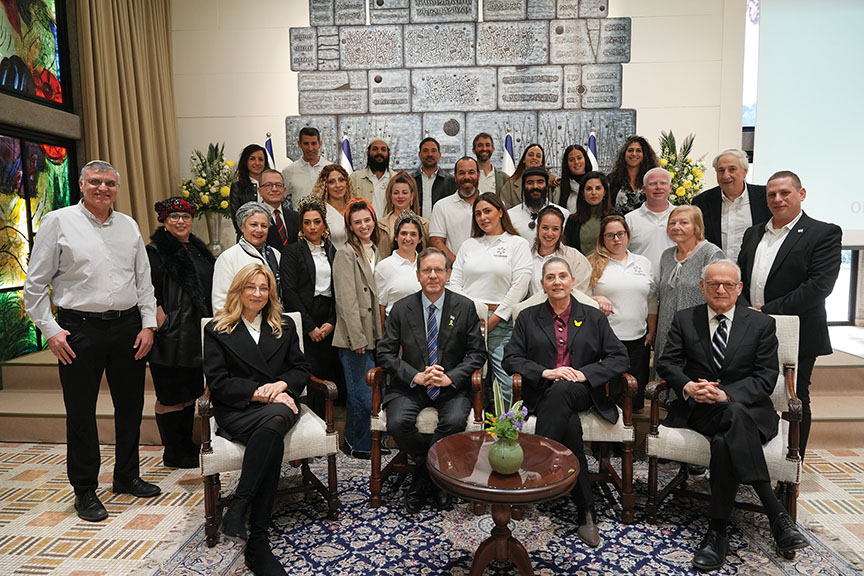
This year’s cohort had 45 siblings. Fifteen of them were able to come together for a deeply emotional event in the residence and with the participation of Israel’s President Isaac Herzog and his wife, the first lady Michal Herzog.
Israel is a small country. The first person I encountered when I entered the President’s House was David Hatuel, a board member of OneFamily. His family’s story is one of the most tragic in the annals of terror attacks. In May, 2004, his wife, Tali, a social worker, eight months pregnant, and four daughters, were in the car on the Kissufim highway leading out of Gush Katif, on their way to speak with Likud voters, to ask them to vote against the threatened expulsion in Ariel Sharon’s referendum. Sharon had promised that the results would determine whether or not the uprooting of Gush Katif would take place. (The Likud members voted against it, but he reneged on his promise.) Terrorists murdered Tali and her daughters at close gunpoint.
I shared with David that in 2012 a granddaughter of ours, Shirel, was one of the winners in the Bible contest that he founded in his family’s memory, in the elementary school where a few of his daughters had studied, in Atzmona (now in Shomria, post-expulsion). It was an emotional moment for both of us. Shirel’s great-aunt and uncle, Rachel and Dov Kol, were also murdered by terrorists, in July 2005, on that same highway.
Like I said, a small country.
On display in the President’s residence was an exhibit of breathtaking paintings by Tamar Aluf, one of the OneFamily cohort members. They were exhibited in the Jerusalem Theater from Jan. 4 through Feb. 3.
I spoke with Tamar about her story and her process.
Tamar lives in Alon Hagalil, a community village in the Jezreel Valley. She told me that she has been a part of OneFamily since her father, Boaz Aluf, a programmer at Bank Hapoalim, was murdered in a terror attack in 2002. It happened on the #32 bus line, at the French Hill junction, on his way to work. “It was a routine morning,” she says. “I was 16 years old.”
She had been painting since she was 12. She started again the day she got up from shiva.
Does she feel a difference in her artwork before and after?
“Painting is a place where I express myself – my silence, my inner world. It helps me understand things, and process insights that often come quietly, through my hands.” I asked her to explain some of her paintings.
She pointed out one she calls “Cracks in the Foundations” and says about it, “It’s the feeling that things change; everything changes. You have to rebuild, to rearrange your life again after something like that happens.”
I asked her about one of her paintings of a tree. She said, “I had originally painted a tree in black, the day I got up from shiva for my father.” At the President’s House, among the many paintings were two that she painted in reaction to that first tree (not on display) is one called “Tree of Renewal.” The second one she calls “Mosaic of Life.”
In addition to painting, Tamar is an employment coordinator who operates under the auspices of a nonprofit called ‘Shekulo tov’ (“All for the good”) under the Ministry of Health. Her grandparents, Jerry and Sylvia Gibraltar, were born in Manhattan and Brooklyn and made aliya in 1948.
Hearing their stories
After President Herzog lit the Hanukkah candles, he sat down at the head of the room, with Michal Herzog, and with Chantal and Marc Belzberg, the co-founders of OneFamily. The president went around the room and asked each cohort member to introduce themselves. He addressed a personal comment or question to each one, clearly familiar with all their stories. The stories spanned time from more than two decades ago to the last two years.
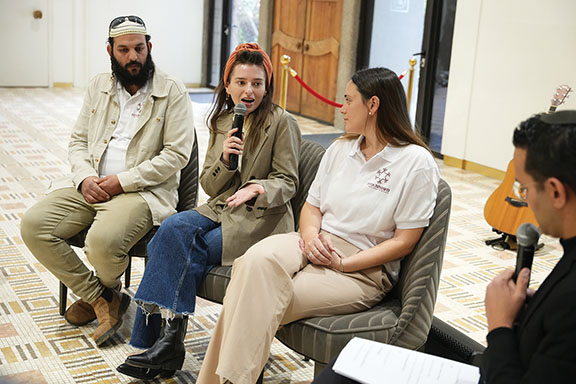
After everyone introduced themselves, there was a panel of three who spoke about how Bonim Chalom had helped move their personal dreams forward, sensitively moderated by Ofer Hadad, an Israeli journalist.
Panelists Moshe Eliyahu, Ofek Sitron Shafir and Stav Sela Photo by Meir Pavlovski
Panelist Moshe Eliyahu, 30, from Aish Kodesh, is married and a father of four. He comes from the world of construction and woodworking. During the war, he lost his brother and brother-in-law, and completed around 530 days of reserve duty in a Homefront Command battalion.
Today he volunteers at Ohel Yehudi on the Kinneret, where he exercises his ability to listen to searching and hurting teens, and to connect with them. Thanks to the Bonei Chalom program, he began a degree in social work and started working as a counselor at the Zula Shel Hetzroni (“Hetzroni’s Zula”), a gathering space for at-risk youth in Jerusalem.
He said on the panel, “My brother used to say a sentence that deserves to be a sticker: ‘Every fracture has a purpose.’ It helps us understand that from every break, when we are shattered, that’s the time to rise. There is a future to the fracture … There is meaning in it. Time doesn’t heal — but time teaches.
“I recommend embracing life, and from what we’ve been through, to rise and rebuild. It’s possible — to dream dreams and to fulfill ourselves.
“I think that to go through a process that leads to this kind of work, you really need to go on a personal journey — of building a dream, of truly arriving at yourself, understanding who you are and how to honor your emotions.
“From there, you can bring yourself to understand the pain of others. And in the end, an encounter that brings you closer to another person also gives you an answer to your own pain.”
Ofek Sitron Shafir spent years studying communications, working intensively in social media management, and learning styling and sewing.
In the period after Oct. 7, 2023, alongside the upheaval of losing her brother Dor, she began offering personal styling consultations. She came to understand that she was not interested in simply learning a profession, but in creating a space that allows for personal expression, beauty and connection.
She recently gave a lecture that wove together styling, Dor’s story and bereavement. It was an evening, she says, in which she finally felt at home on stage, and it anchored within her a clear sense that she has something to give and a uniquely powerful way to give it.
“The word ‘ovdan’ means something we lost, I had a brother, and we lost him, but we also lost a sense of: what do we do now?” she said on the panel.
“There is a feeling like everyone is speaking hevel havalim [From Kohelet 1:2, meaning ‘utter futility’] and I’m in the midst of my own hevel havalim … I work in styling and clothes and the feeling was, what does it matter now?…But davka from that place, I understand how much strength there is in clothing, that I get up in the morning and get dressed and function in the world and fulfill myself…I can also give meaning to others.
“Dor lived intensely, and the sentence that always accompanied him was ‘Live the moment’ — the understanding that every moment here won’t return, and that we must fulfill ourselves.
“I truly believe there is enormous meaning in these meetings — in togetherness. Because dealing with all of this alone is very hard. Within the Bonei Chalom program, there are groups, and each group has its own uniqueness and its own stage in the dream process.
“I remember the first introductory conversation I had with Dan (a OneFamily counselor). I said: ‘I have a dream — something I love to do…’ and he said, ‘If there’s a place where it’s allowed — it’s here… You’re allowed to want to fulfill this dream.’ I remember that I even started crying during that conversation.
“That’s the strength I got from this program. It’s a place to say our dreams out loud and to stand behind them.”
Stav Selagrew up in Kibbutz Neve Ur in the Beit Shean Valley, the youngest of three siblings. Her older brother was murdered on October 7, and life changed forever. She served as an armored corps instructor, an officer, and a company commander in the armored instructors’ course. She traveled the world, studies communication and political science, has an MBA, worked on a political campaign and later in a startup.
After the war, she said, “I had to think about what to do now. It’s a process. I felt I wanted to go inside myself, and think…Since Oct. 7 I experienced a significant lack of trust…I was an officer, I served many years, and I believed in the army, and suddenly…
“All my life I knew I wanted to be involved in public service, social activism, even a bit of politics, also because I lost faith in the system of public service…That’s connected to my dream, because public service really was my dream.
“After October 7, I felt I needed to stop everything. The personal process with Dan, and the group process, made me stop and rethink…Basically, I’m now in a process of learning to love myself.
“You start by creating order: understanding again what I love, what I’m good at, what gives me strength, what I’ve done until now, how I feel while doing it. You really start to put things in order.
“I think the uniqueness of this program is that there are both personal meetings — where you really sit and think deeply with yourself — and group meetings that strengthen you, where you gain perspective. My dream exists in a certain direction, but it’s still being built.
“I didn’t choose this. I would give up everything not to be a bereaved sibling, not to be in this position. But if this is the situation, I really want to say thank you to OneFamily. People who are gold. This program gives tools, and it brings you face to face with yourself, and with people who are precious to you.”
Today, between reserve duty, studies, and trips to India and Sri Lanka with OneFamily, she is using the program as a space to refine her dreams, listen to her intuition, and begin shaping, with courage, the next chapter of her life.
Chantal Belzberg also addressed the group. “In the past two years,” she said, “we have done the work…on a scale, with a depth and complexity, we had never known before— all from within a clear understanding: that the families and wounded need us now, and not only now, but also in a year, in five years, and in 10.”
She reported that OneFamily is supported by more than 70 professional staff members.
Eighty National Service volunteers “who provide the closest possible accompaniment to war widows and children who have lost both parents, and approximately 500 volunteers, who work day after day, night after night, in families’ homes … in groups, workshops and events.
“This Hanukkah alone, more than 1,500 people have already participated in holiday events, community gatherings and moments of hope and growth. Because even within the darkness, we choose to light a candle.”
Their work also crosses borders. “At this very moment, a delegation of OneFamily therapists is in Sydney, Australia, strengthening communities, learning and sharing knowledge …
“This gathering today, and the Building a Dream project, are a profound expression of our belief that even after loss, it is permitted to dream. That self-fulfillment, meaning, and hope are not luxuries, but an essential part of life itself — growth emerging from trauma.”
To conclude the event, President Isaac Herzog addressed the group, first saying to the Belzbergs, “You are a remarkable partnership that brings goodness to the people of Israel, and I want to thank you … building dreams in the face of darkness.
Photo by by Meir Pavlovski
“Viktor Frankl wrote in ‘Man’s Search for Meaning’ that within the deepest hell — a hell where no one wanted to be — you give people meaning. And meaning is absolutely essential for a person to be able to cope with such a tragic situation…We see the fruits of your work years later…”
He quoted from a poem by Tuvia Ruebner, a noted Israeli poet:
After all that has happened,
if you are still able to hear the blackbird,
the skylark’s chirping in the morning,
the songbird and the sunbird,
do not be surprised if you feel joy
at the sight of clouds drifting in the wind,
…or at seeing colors still bright
after sunset.
A human being is capable of bearing almost anything —
and who can know when and where joy will overcome him.
[An excerpt, translated from the Hebrew]
“So I truly wish all the bereaved families — dear and beloved — that joy will overcome them, that they will know comfort and healing.”
Michal Herzog added, “I thank you for reaching out a hand beyond the sea, to also strengthen the Jewish communities that are wounded abroad, and for continuing to dream dreams, because in spite of the loss and the pain, we continue to dream and to be optimistic so thank you.”
Speaking of crossing borders, as I was doing the final edit on this article, I was plugged in to the 2 p.m. Israel radio slot that plays English language golden oldies. The Seekers 1965 hit “A World of Our Own” came up: “We’ll build a world of our own that no one else can share, all our sorrows we’ll leave far behind us there. And I know you will find there’ll be peace of mind, when we live in a world of our own.” It brought tears to my eyes, thinking of the participants of Bonim Chalomwho are building worlds of their own, that others can share, that will hopefully help them leave some of their sorrows behind, and bring them peace of mind.
Toby Klein Greenwald is an award-winning journalist and theater director, and the editor of WholeFamily.com. Her current theater project is “Heroines! Songs & Soliloquies for the Soul,” about the heroines of Oct. 7.
The opening night of the 37th Film Festival in Los Angeles took place on Wednesday, Feb. 4 at the Saban Theaterein Beverly Hills.
Meir Fenigstein, the founder and executive director of the festival, chose to give the Visionary Award this year to producer Lawrence Bender (“Pulp Fiction,” “Inglorious Basterds”), who produced the four-part series “Red Alert” on Paramount +, about the events of Oct. 7, 2023.
However, Sharon Stone, who was supposed to present him with the award, was notably absent. Fenigstein said the actress notified him that she would not be able to attend, as she was flying to Australia for a movie — just five days before the event. Canceling so close to the ceremony, especially when it involves honoring someone as widely respected in the industry as Bender, raised some speculations. Several outlets were quick to report that, according to Fenigstein, the actress might have been threatened or advised not to attend, but in a conversation with The Journal, he denied it. He added that Stone had previously attended the festival as an honoree, along with actress Natalie Portman.
For the last-minute replacement, Bender called his friend, comedian Tiffany Haddish, who was happy to present the award and flew in from San Francisco on short notice. Haddish, who is Jewish on her father’s side, had visited Israel in February 2024 to celebrate her bat mitzvah at age 40.
Bender praised Fenigstein for 37 years of running the festival and said, “My dad and mom would have been so proud to see me getting an award with the word Israel on it.” The famed producer, a longtime supporter of Israel, also reflected on the anti-Israel sentiment in parts of the entertainment industry: “Who would have believed years ago that there’d come a day when Hollywood would be signing a boycott letter against Israel? Nothing prepared me for what happened on Oct. 8. I had no idea how life-changing this experience would be.”
Also honored was award-winning filmmaker Eran Riklis, whose adaptation of “Reading Lolita in Tehran” had its Los Angeles premiere at the festival. He was presented with the Cinematic Achievement Award by Ram Bergman, producer of “Solo: A Star Wars Story” (2018).
The evening was a celebration of Israeli cinema, though the sheer number of speeches and their length made the program feel a bit long. Among those addressing the crowd was Israel Bachar, Consul General of Israel to the Pacific Southwest. Bachar emphasized the importance of the festival: “In the diplomatic arena, facts are reported. But facts are never enough. They don’t move hearts. Facts inform, stories transform. Israeli creators understand this. Their work is raw, honest and unafraid.”
Bachar added that, “the organized and funded pressure against artists who support Israel is deterring some of them. We must continue to show the presence of Israeli creativity and art — which are excellent and appreciated — without fear. That is why the festival has been held for 37 consecutive years.”
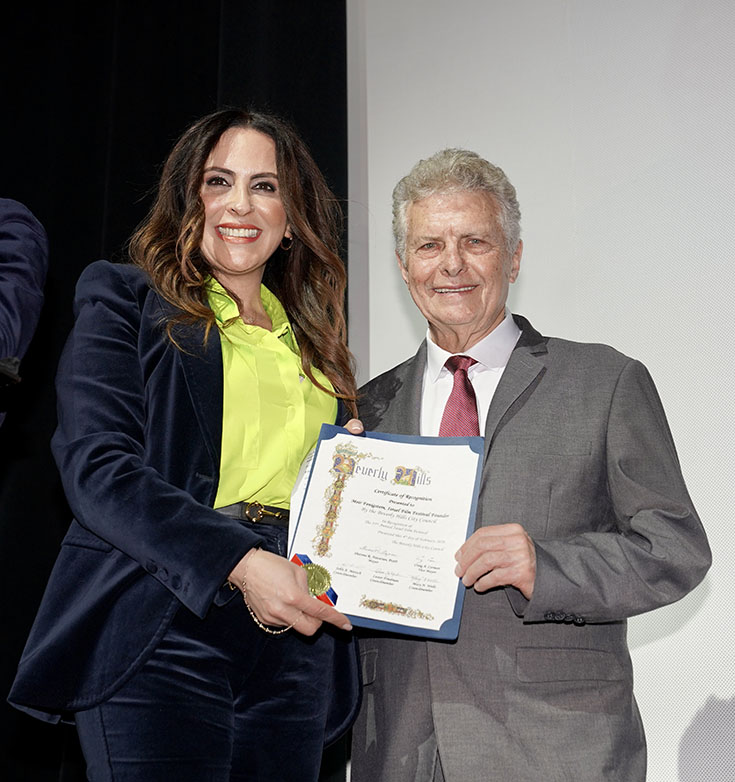
Meir Fenigstein with Sharona Nazarian, Mayor, Beverly Hills, California. Photo credit: Orly Halevy.
Sharona Nazarian, Mayor of Beverly Hills, presented Fenigstein and the IFF with a Letter of Recognition from the Beverly Hills City Council.
“Nearly every day, we are seeing antisemitic attacks across the world, but not in Beverly Hills,” said Nazarian. “History reminds us that hate does not fade on its own, it must be confronted.”
Nineteen visiting Israeli filmmakers and talent took to the stage in recognition of their films, which will be screened throughout the festival.
Comedian Elon Gold returned as the gala’s master of ceremonies. As photographers kept snapping away, he quipped, “Why do you need so many photos? Are you sending these to the L.A. Times? Just take one, send it to [The Jewish Journal editor David] Suissa and call it a day.”
Photo credit: Orly Halevy
The evening concluded with the Los Angeles premiere of “A Letter to David,” directed by Tom Shoval and winner of this year’s Israeli Academy Ophir Award for Best Documentary. Sponsored by American Friends of NATAL and Los Angeles-based AFN board member Dr. Dity Brunn, the documentary tells the harrowing story of the Cunio brothers, who were kidnapped by Hamas.
In 2013, David and Ariel Cunio starred in the Israeli-German production “Youth,” portraying teenage brothers who share a deep bond and face mounting pressures when their family falls into severe financial trouble. In the film, they make the desperate decision to kidnap a wealthy girl in hopes of securing ransom money to help their family.
A decade later, life took a chillingly ironic turn: David and his younger brother Ariel were kidnapped and held by Hamas for 738 days, experiencing firsthand the fear and helplessness of captivity until their eventual release.
Humanitarian advocate Alana Zeitchik, representing the Cunio family, spoke about navigating the collective trauma of the past year in Israel and how shared purpose and art can help communities heal.
The film will have three screenings during the festival, which runs until February 19, each followed by a Q&A with Shoval.
The ISRAEL FILM FESTIVAL will screen films at the Regal North Hollywood and the Fine Arts Theatre (Beverly Hills). Visit israelfilmfestival.comfor a full schedule of festival screenings, filmmaker Q&As and to purchase tickets.
There is, and should be, enduring outrage over Jeffrey Epstein.
A man with extraordinary access used that access to abuse underage girls while circulating among presidents, prime ministers, princes, financiers, and intellectuals. Institutions meant to protect the vulnerable proved permeable. People who might have intervened found reasons not to. Power performed its oldest service: it protected the predator.
The disgust is real. It should be.
But outrage is not self-justifying. It demands something from the people who carry it. Above all, it asks whether it is a rule or a ritual.
Rules travel. Rituals stay home.
And when the spectacle thins — when the documentaries end and the podcasts move on — the Epstein affair leaves a question behind like a fingerprint on glass:
Are we moved to protect girls, or by the ease of condemning the correct villain?
Because if we mean what we say, the moral language summoned in Epstein’s name should echo in places far less comfortable to discuss.
Epstein required darkness. Secrecy was infrastructure. So was the decision not to know. The shadows were part of the design.
Elsewhere, similar harm moves not through shadows but through paperwork. It passes desks. It gathers stamps. It is explained, justified, normalized.
In Iran, a girl may legally be married at thirteen, and younger with judicial approval. The system does not hide this; it records it.
In Egypt, despite prohibitions, female genital mutilation remains the experience of most girls. The practice did not retreat. It adapted. It is often carried out by medical professionals, before many girls reach their teens.
In Yemen, thin legal barriers have long allowed girls to be married off while still children, and poor records help obscure how many.
In Pakistan, minority families continue to allege daughters taken, converted, married, and then sealed behind rulings that can turn terror into legality.
This is not conspiracy talk.
It is the daily work of lawyers, activists, and parents.
And yet — beside Epstein — the volume falls almost to silence.
We are told not to compare.
But refusing comparison is how inconsistency survives.
If influence magnified Epstein’s crimes, why would state sanction not magnify others? If abuse of a minor is intolerable, why would miles make it milder?
The pattern is familiar. Those who can detect injustice in a careless phrase grow restrained when the injustice is structural.
Not because they misunderstand.
Because they understand the price.
What makes the quiet harder to defend is that the call for clarity comes most urgently from inside these societies.
From the women of Iran who flooded the streets after the killing of Mahsa Amini.
From Egyptian reformers who have risked livelihoods and safety to call mutilation what it is.
From Pakistani families who enter courtrooms fearing the paperwork more than the abductors.
They understand the danger perfectly. What they cannot understand is the restraint abroad.
Epstein is easy. The villain is famous, the righteous outrage preloaded. One can thunder without consequence.
But if he is only a spectacle, he will evaporate like one.
If he is a standard, then standards require repetition. They require application where applause is uncertain and backlash guaranteed.
They ask whether we intend to keep our promises — to all victims.
Selective outrage leaves injuries of its own.
It abandons reformers.
It reassures regimes.
It tells millions of girls that universality comes with conditions.
It builds a hierarchy of empathy — precisely what the language of human rights was meant to undo.
The Epstein story will keep producing revelations. It will fuel films, threads, and endless reuse. It will tempt people to make suffering serve other narratives.
That temptation will win more often than it should.
But beneath it lies something sterner.
If we mean what we say about protecting children, then we must mean it everywhere.
If we do not, the boundary we have located is not geographic. It is moral.
Micha Danzig served in the Israeli Army and is a former police officer with the NYPD. He is currently an attorney and is very active with numerous Jewish and pro-Israel organizations, including Stand With Us and the FIDF, and is a national board member of Herut North America.
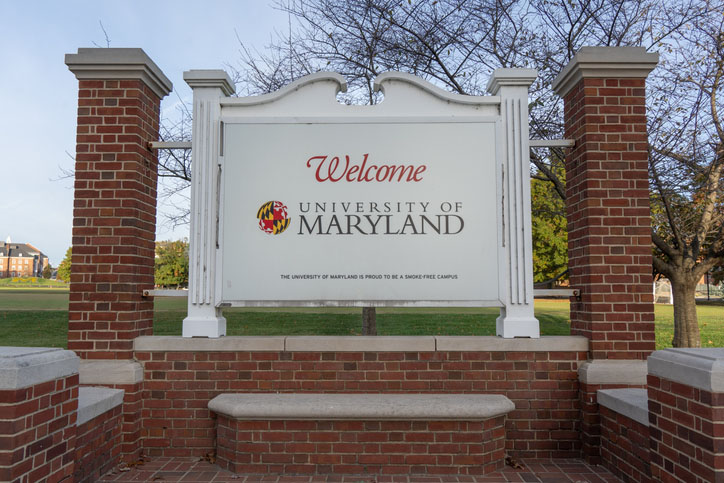
Students for Justice in Palestine has presented its fourth anti-Israel resolution of the 2025-2026 academic year to the Student Government Association at the University of Maryland, College Park. It is slated for a vote on February 11.
SJP is urging UMD and the University System of Maryland Foundation to divest from and commit to not investing in arms-producing companies. Specifically mentioning Israel, it says, “USMFs investments may include companies such as Lockheed Martin, Northrop Grumman, BAE Systems, Elbit Systems, Caterpillar Inc, and RTX Corp, all companies that, in some form or another, supply weapons, surveillance technology, or infrastructure used in Israel’s oppression of Palestinians and have been linked to human-rights violations in other regions.”
The previous three resolutions passed on September 17, on November 5, and on October 2 – which was the night of Yom Kippur, when Jewish students could not attend. The September 17 resolution demanded UMD to recognize Israel’s offensive as a genocide in Gaza, and the others dealt with a boycott, divestment, and sanctions (BDS) approach to Israel and called for the university to ban former Israeli soldiers from coming to campus to speak.
Following last spring’s student government elections, an overwhelming majority of voting members now align with SJP and have demonstrated that support by backing all three of SJP’s previous resolutions this academic year. The vote totals for each resolution were: 25 yes, 1 no, 1 abstain (September 17), 28 yes, 0 no, 1 abstain (October 2), and 25 yes, 0 no, 1 abstain (November 5).
In an Instagram post, Students Supporting Israel at UMD College Park wrote, “While we had hoped the conclusion of the war in Israel would yield some collective acknowledgements of Israel’s propensity towards peace, this bill is reinforcing an unfortunate sentiment of perpetual demonization of the only Jewish state… SGA has become an echo chamber whose sole objective is to make the University of Maryland an uncomfortable place for Zionists.”
Uriel Appel, a senior and president of SSI at UMD College Park, said, “When it came time to confront Jew-hatred on our campus, they [the student government] not only stood by but actively perpetuated it. They held votes and hearings over boycotts against the world’s only Jewish state on two separate Jewish holidays and subjected Israel to disproportionate scrutiny unmatched by any other country. At the same time, they have turned a blind eye to crimes in Iran, Syria, and anti-Christian massacres in Africa. SGA at the University of Maryland has made one thing clear: its Jewish constituents are not represented.”
“SGA at the University of Maryland has made one thing clear: its Jewish constituents are not represented.” – Uriel Appel
Meirav Solomon, a senior at UMD, echoed a similar sentiment.
“It’s disappointing to see SGA once again focus on Jewish students instead of addressing broader issues that could improve the university,” she said. “Being put through this situation repeatedly is frustrating and unnecessary.”
The latest resolution is similar to the February 4 resolution that was passed by the Association of Students of the University of Nebraska. It stated, “As a university institution, it is antithetical and contradictory for us to continue investments in bombs that have destroyed every university in Gaza and the livelihood of Palestinian students, professors, and administrators.”
Another resolution, put forth at the University of Michigan in the fall, looked like the ones from UMD, College Park and the University of Nebraska–Lincoln as well. It had the same title as the Nebraska resolution, “Divest for Humanity Act,” and the Michigan group collaborated on an Instagram post with UNL’s SJP, celebrating the passage of their February 4 resolution.
The post read, “Divest for Humanity just went national… our colleagues in Nebraska just earned a huge victory in the fight to divest our $$$ from genocide.”
According to SSI’s Instagram, the UMD, College Park chapter of SJP on their FAQ sheet, “refuses to condemn Hamas, does not believe Israel has a right to defend itself, and does not believe Israel has a right to exist. Because the sponsor does not believe Israel has the right to defend itself, we remain unsurprised that this bill is calling for the divestment of some of the biggest companies that help Israel defend itself.”
The post continued, “the University of Maryland should be a place where difficult global conversations are met with intellectual honesty and respect for the lived identities of all students. We urge SGA to recommit itself to those principles, not by singling out one people or one state, but by fostering a campus culture where Jewish and Zionist students can participate safely and without fear of exclusion.”
If you’re going to spend $15 million for a Super Bowl ad to defend Jews against antisemitism, you ought to think extra hard about how you depict those Jews.
That nebbish Jewish boy in the much-discussed commercial looks weak, down and confused— not exactly a winning image.
Still, the creators of the ad felt they were making an important point—since they informed viewers that “2 out of 3 Jewish teens have experienced antisemitism,” it follows that these Jews need allies. Showing a tall Black kid helping a Jewish kid accused of being a “dirty Jew” was a bullseye for that strategy. It tells the non-Jewish world to do their share and “stand up to Jew-hate.”
But like so many Jewish efforts today that aim to fight antisemitism, it overlooks the unintended consequence that it makes Jews look weak.
Yes, but who’s got time to worry about image when the barbarians are at the gate?
I do.
Because the weaker we look, the more vulnerable we are, the more the haters smell blood, the more we corrode Jewish pride, the more we are disrespected.
Want me to continue?
Everyone knows it’s bad to look weak. But name one Jewish organization that cares about how Jews look, that cares about the public face of Jews. I don’t know of any. In fact, I’m pretty sure I’ve never seen “strengthening the public face of Jews” in any mission statement.
And I think I know why.
It feels nebulous. It’s not concrete.
The commercial with the kid is concrete. You show a non-Jew helping a Jew. For the creators, there’s no need to worry about something abstract like “how the kid comes across” because it’s enough to communicate something direct and on message.
Similarly, Jewish organizations rarely ask: How will this initiative influence the way Jews look? Will it make us look weak or strong? Cool or nebbish? Scared or confident?
There are countless efforts that make Jews look weak that organizations don’t question. Like, for example, informing the world that “antisemitism is now at an all-time high!” or that “Jews are under assault more than ever.”
We don’t question this stuff because it’s true, it’s concrete, it feels real, it feels urgent. We feel we must expose the hate, condemn it, raise hell — even if it makes Jews look weak, and even if the problem keeps getting worse no matter how much hell we raise.
Fear sells.
“How Jews look” doesn’t.
Here’s a thought: maybe it’s time we transfer some of our fear to “how Jews look,” because the price of looking weak is a lot higher than we think.
In recent years, especially since Oct. 7, we have allowed the rise of Jew-hatred to trap us into looking weak. We think we look strong when we’re out there “fighting” and making all this noise against the haters, when we ring the alarm after each incident, when all we seem to talk about is protection and security.
That’s not strength; it’s weakness. It makes us look fragile. It’s an admission that the haters are running the show.
You want a delightful example of strength?
It’s Jerry Seinfeld telling a Palestinian heckler: “I think you need to go back and tell whoever is running your organization: you just gave money to a Jew.”
The key point is this: Even if we reallyare victims, it doesn’t help us to come across as victims. The minute we do that, we look like losers, we make things worse, and the haters win.
This is not the kind of strategizing that gets kicked around in Jewish boardrooms. It’s too uncomfortable. Imagine a new initiative from a major organization titled, “How Jews can regain their mojo.” It’s like a foreign language.
But it’s a language we must learn if we’re serious about nurturing Jewish pride.
Like I wrote in my piece about the Bret Stephens speech, I’m all for the targeted fight against antisemitism that “enforces laws, rules, policies and regulations that protect the rights of Jews… from sophisticated monitoring and reporting of online Jew-hatred to lawsuits against discrimination to correcting lies and libels against Israel” and that basically says: “You mess with Jews and cross red lines, you’ll pay a price.”
Of course we must boost our security, but that’s different than turning it into a public megilla that advertises nothing but fear and weakness. How we choose what to show is as important as how we choose what to do.
In short, I’m all for fighting with mojo.
Which means, among other things: Let’s stop complaining. Let’s stop telling America how much we’re hated. Let’s stop showing Jews who look weak rather than proud. And let’s strengthen our Jewish identity and fight antisemitism like winners who love America.
Whether in commercials or in real life, there is a huge difference between looking strong and proud and looking weak, needy and confused.