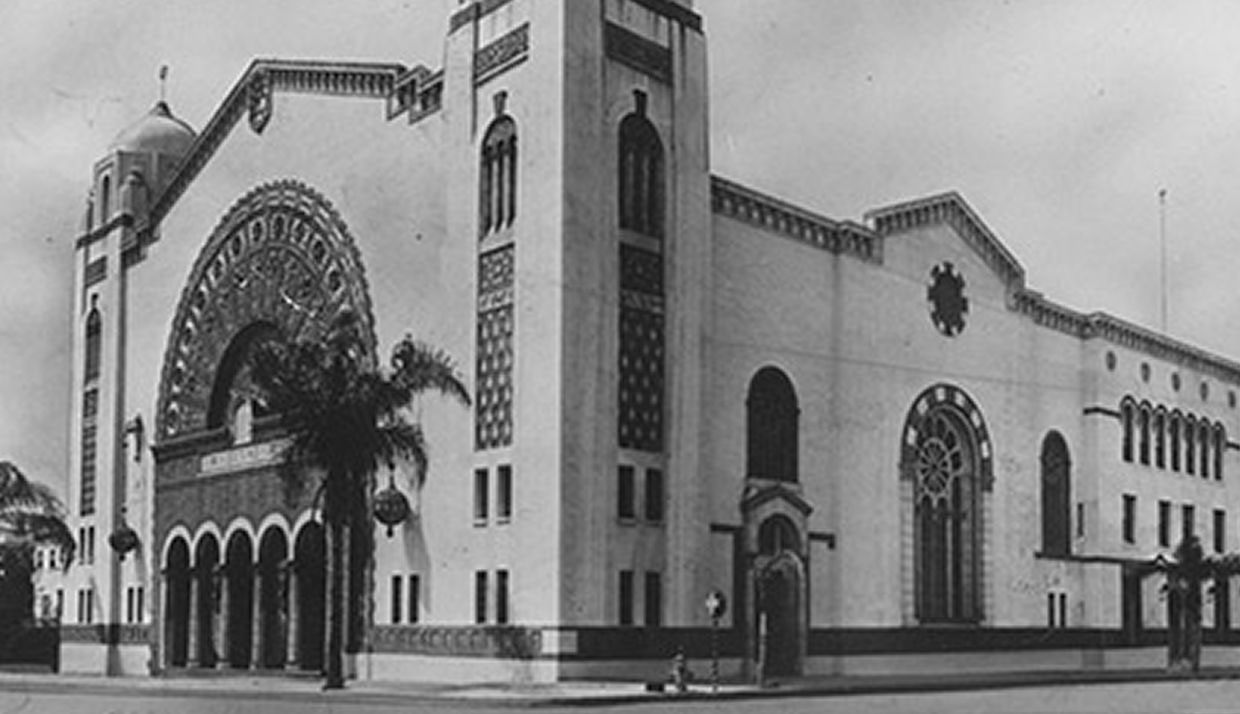
I’ve driven by Sinai Temple in Westwood hundreds of times, and attended countless events, but never once have I asked myself: What came before this?
I’ve always known the temple has been around for a while, but I had no idea how it started or how it evolved.
We’re a people of stories and memory. We tell our stories all the time—stories from the Bible, from the old country, from the Holocaust, from the miracle of Israel, from the centuries of our Diaspora– but rarely do we tell stories of our own communities. The study of Jewish history seems to stop at the borders of our cities.
Maybe that’s because while we are immersed in our communities, we tend to focus on the pressing issues of the day. Why think about the past when we have so much to worry about in the present?
Those thoughts were on my mind the other night as I attended a concert celebrating the 120th anniversary of Sinai Temple.
What struck me was not just the rich history of the temple, but the way the event was able to capture such a long history in one night.
It helped that music was the motif of the evening; specifically, Sinai’s long cantorial history from its beginning in 1906.
“Every symphony begins with a single note,” master of ceremony Cantor Marcus Feldman said in his opening. “For Sinai Temple, that note was struck in 1906, not by a famous Hazzan, but by the community itself.
“In those earliest days at 12th and Valencia, services were often led by ‘lovers of prayer’—laymen whose devotion filled the room. We recall our first Cantor Marcel Katz, who led our worship from 1905-1909.
“We didn’t have a professional choir, but we had members of the community serve as a choir to augment the cantor. Cantor Katz was followed by Cantor Moses Alter, and Cantor Jacob Weinstock. These men were the pioneers who carried the torch of tradition in a city that was still finding its own identity.”
In those days, Feldman said, the community numbered perhaps 6,000 Jews. “Yet, a handful of families gathered in the B’nai B’rith lodge downtown to do something bold: they established the first Conservative congregation in Southern California.”
How did Feldman continue with this long history lesson without boring the audience with stuff that has little bearing on the congregation’s current issues?
By supplementing the music with images and stories.
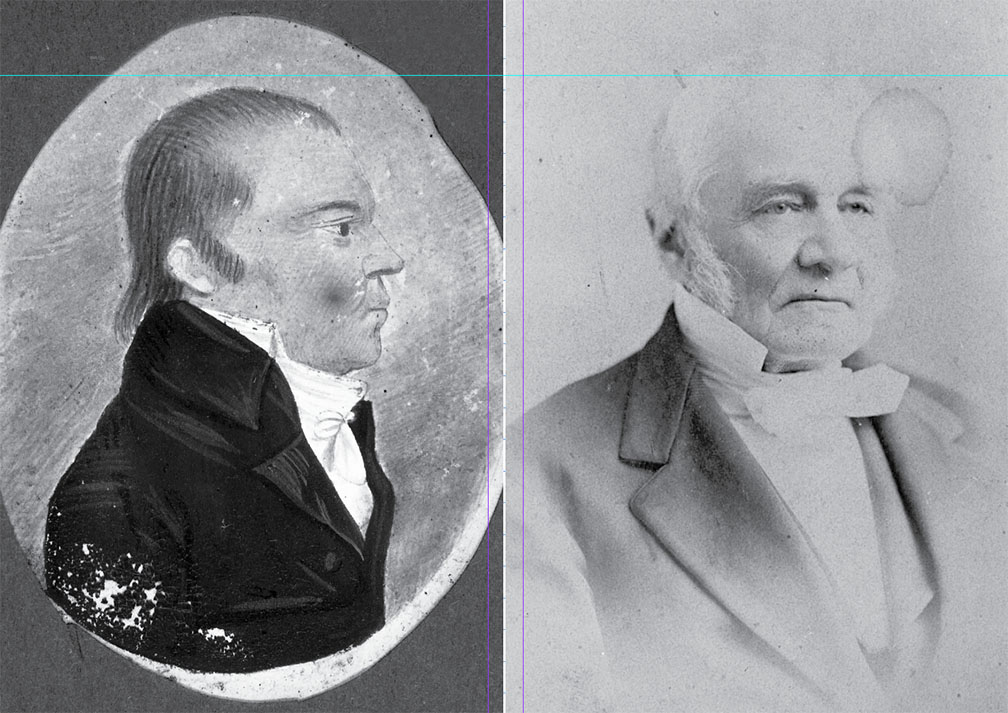
While the history was told, images would pop up of cantors and other prominent members who shaped that history. And while you saw the images, Feldman would tell stories and introduce a cantorial performance that captured the era, sung by both men and women, with a back-up choir and musicians.
As the evening unfolded, the entertainment value made you forget this was an evening about history. Everything felt alive and in the present. A great voice, after all, is a great voice. A great cantor is a great cantor.
Some, like Leib Glantz, were forces of nature.
“In 1941, the winds of war were blowing across the world, but here in Los Angeles, a different kind of storm arrived. His name was Leib Glantz,” Feldman said. “Glantz was not merely a cantor; he was an international force. A Talmudic scholar and a founder of the Histadrut in America, he held a distinction no other cantor in history could claim: he was elected as a delegate to six World Zionist Congresses.”
As the story goes, when the search committee asked Glantz to audition for the position, he replied, “I do not audition. I am Leib Glantz!”
“And he was right,” Feldman said. “He brought the ‘Golden Age’ of European Hazzanut directly to Los Angeles. His music was not just beautiful; it was intellectual, fiery, and deeply modal. He wrestled with the text, creating a soundscape that was as intricate as it was spiritual.”
As a great cantor himself, Feldman was the ideal MC for the evening. You could feel the reverence he had for his long list of predecessors, and he sang many of the tributes himself. He recounted the Sinai story through key milestones, starting with The Early Years: Voices in a New Land (1906 to 1918).
He spoke about the temple’s big move to Westwood, which happened when it broke ground in 1956, after many years as the “Temple Center” in the Wilshire District.
But as important as the buildings are, they are still the hardware, and they’d be nothing without the software. The concert celebrated the human software of timeless music, the value of community, the contributions of members and cherished memories.
It would take a few more thousand words to give you a rundown of the whole evening, and include such historical highlights as Craig Taubman’s and Rabbi Emeritus David Wolpe’s popular Friday Night Live, and current leaders like Rabbi Erez Sherman, Rabbi Nicole Guzik, musical director Benjamin Fingerhut, Cantor Emeritus Joseph Gole and so many others. But luckily a film is available (see below) for those who want the full experience (and catch all the names I’m missing!).
To give you a little taste, here are titles of some of the other milestones:
–The Roots: The Silverman Era & the Temple Era (1918—1940).
–The Golden Age of Hazzanut (Glantz and Urstein).
–The Dynasty of Directors: Helfman, Sendry & Jospe.
–The Israel Connection, from 1948 to Today.
–The Finkelstein Era: A New Sound.
–A Tapestry of Cultures: The Persian Influence.
“We have traveled through 120 years,” Cantor Feldman said near the end. “We have heard the echoes of lay leaders in a small hall on Valencia Street, the Hazzanut of Silverman and Glantz, the warmth of Urstein and Gole, and the innovations of Finkelstein and Taubman.
“But what is the sound of Sinai today? It is a sound that honors tradition while embracing new melodies.”
As a Moroccan Jew, those melodies are far from what I’m used to. With the organ music and the angelic singing, they’re radically different from the Sephardic chazzanut I was raised with, which has Arabian, Andelusian and Berber influences.
But while I love my Sephardic melodies, I wasn’t thinking about them at the concert. What I was thinking was: “These are my people, and I love that they have their own melodies. Given all the different places where we come from, how could they not?”
I can’t help thinking of the many other stories and melodies that exist in our community that we know nothing about, just like I knew nothing about the Sinai story. Which congregation would like to step up and share with us their own “symphony”?
Not that we need more initiatives these days with all the emergencies on our plate, I’d still love to see something like a Local History Project, sponsored perhaps by the Federation, that would encourage the gathering and dissemination of our community’s many origin stories.
Do we need it as much as we need to fight antisemitism? No, we don’t.
But if we’re a people of stories, and stories help bond our community, it feels right to include those very stories that are closest to us.
Sinai Temple has given us a model.