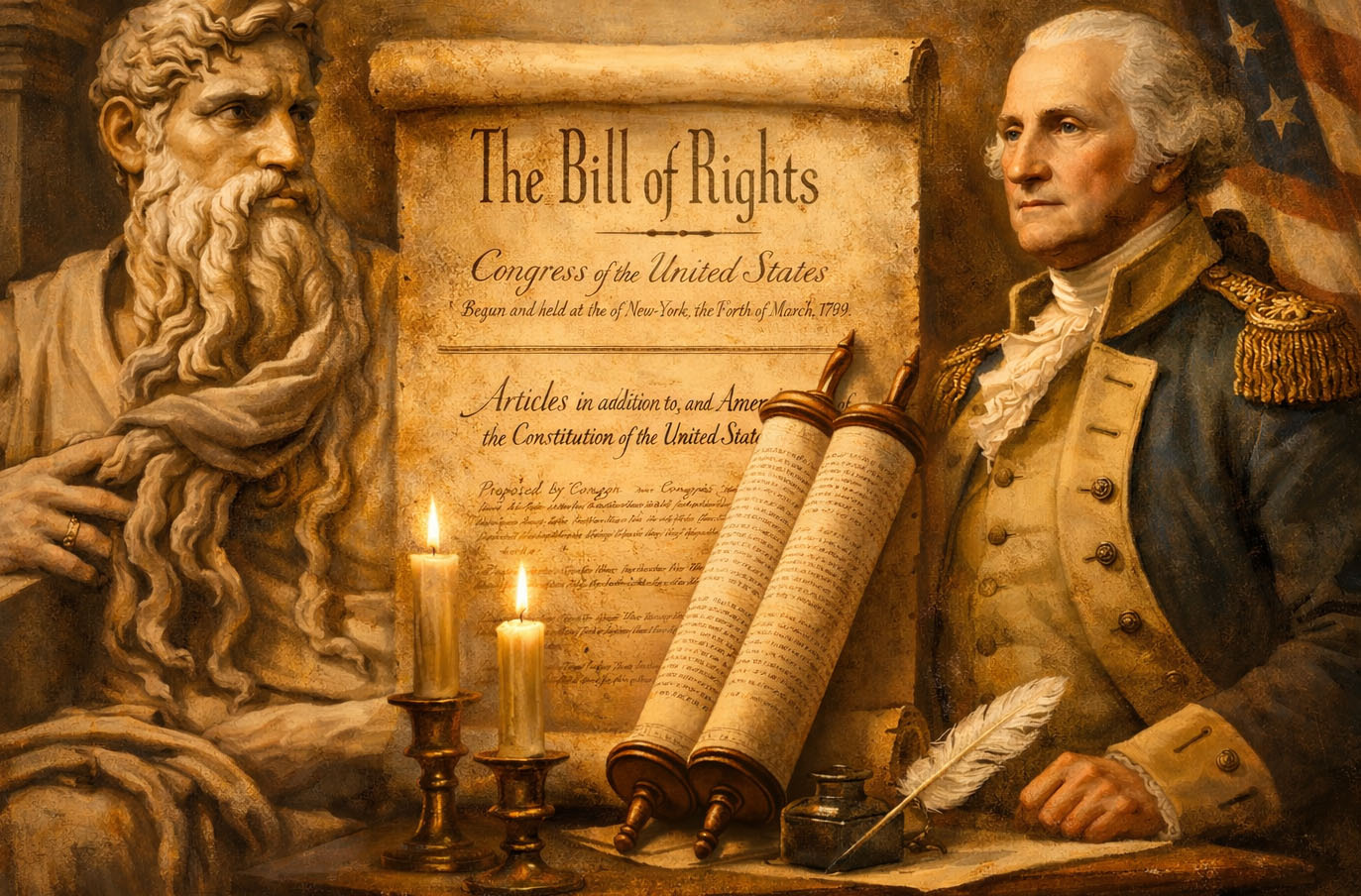
George W. Bush, a US president whose intellectual ability
is not the greatest quality by which he seems to have been apparently endowed,
identifies President George Washington’s humungous humility
as the quality that made him the greatest member of the US presidential crowd,
thereby linking him to Israel’s greatest leader, Moses, whose outstanding
humility is mentioned in a narrative in the Bible which tells that he was attacked
by both his siblings in a democratic criticism, both demanding
an approbation equal to his, demonstrating that humility was a quality which, like our present president, they both lacked.
In fairness to Miriam and Aaron, it should be noted that both Washington and Moses allowed
their names to be immortalized, the name of the former given to
the United States’s capital, Washington DC, and of the latter to the Torah that’s endowed
to Moses, called Torat Moshe, Moses’ Torah, by every Jew.
In “From One President to Another, a Love Letter With an Edge,” NYT, 2/16/26, Jennifer Schuessler writes:
For American politicians, there is nothing more uncontroversial than a Presidents’ Day tribute to George Washington, the upright Virginian who may (or may not) have chopped down that cherry tree but otherwise stands as the embodiment of leadership and virtue.
But in an essay published on Monday, a more recent George W. is putting a little 2026 edge on the subject.
“Few qualities have inspired me more than Washington’s humility,” former President George W. Bush writes in the essay, which was released as part of a new nonpartisan history project.
“Our first president could have remained all-powerful, but twice he chose not to,” Mr. Bush writes, referring to Washington’s decision to relinquish leadership of the Army after the American Revolution, and then to step down from the presidency after two terms.
By “relinquishing power rather than holding onto it,” Mr. Bush continues, “he ensured America wouldn’t become a monarchy, or worse.”
Gershon Hepner is a poet who has written over 25,000 poems on subjects ranging from music to literature, politics to Torah. He grew up in England and moved to Los Angeles in 1976. Using his varied interests and experiences, he has authored dozens of papers in medical and academic journals, and authored “Legal Friction: Law, Narrative, and Identity Politics in Biblical Israel.” He can be reached at gershonhepner@gmail.com.